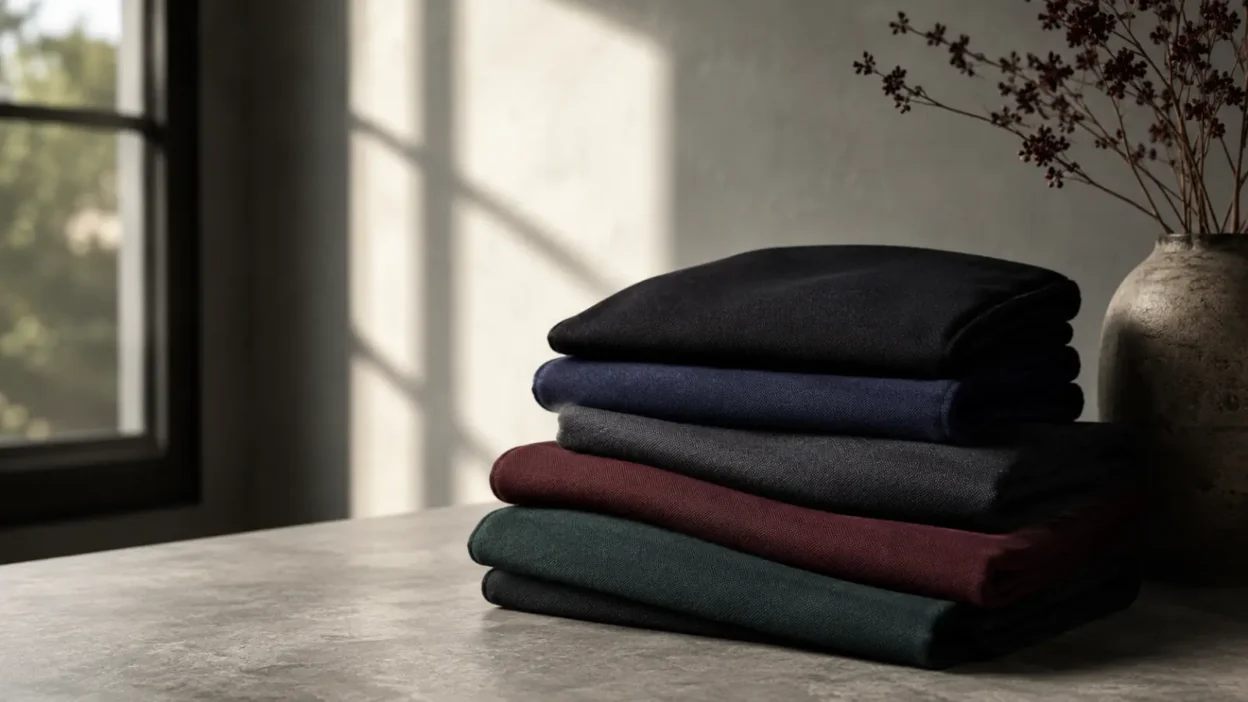
Dark colors are not one symbol with one fixed meaning. They are a family of shades that includes black, charcoal, navy, deep brown, burgundy, forest green, dark purple, and other low-light colors.
The meaning of dark colors usually comes from contrast. They feel heavier than pale colors. They absorb attention rather than reflecting it. They can look formal, quiet, protective, elegant, secretive, sad, or strong.
In the United States, people meet these meanings everywhere: black funeral clothing, navy business suits, dark luxury packaging, moody interiors, gothic fashion, sports uniforms, tattoos, formalwear, and digital design.
That range matters. A black dress at a funeral does not mean the same thing as a black dress at a gala. A dark green wall does not mean the same thing as a dark green military uniform. The symbolism changes with setting, culture, and use.
Quick Answer
In modern U.S. symbolism, the meaning of dark colors is most often tied to seriousness, mystery, elegance, power, grief, privacy, and emotional depth. These meanings developed from visible experiences of night, shadow, earth, formal clothing, mourning customs, and later uses in fashion, branding, art, and design.
TL;DR
- Dark colors often feel serious, quiet, or formal.
- Black is strongly linked with mourning in U.S. culture.
- Navy suggests trust, discipline, and professionalism.
- Burgundy and dark purple can suggest luxury or intensity.
- Meanings change by shade, culture, and setting.
- “Dark equals bad” is an oversimplification.
What Dark Colors Usually Symbolize Today
Dark colors most often symbolize seriousness, mystery, elegance, strength, grief, privacy, and depth.
That does not mean every dark color has the same message. It means they share a visual quality: they sit closer to shadow than brightness. Because of that, people often read them as more controlled, quiet, and weighty than light colors.
In modern U.S. culture, dark colors often appear when people want to show restraint. A black suit, charcoal coat, navy dress, or deep brown leather chair usually feels more formal than a neon shirt or pastel sofa. The dark color tells the eye to slow down.
Dark colors can also suggest maturity. They are common in courtrooms, offices, formal dinners, memorial services, luxury products, and serious films. They often create distance. They can make a person, room, or object feel less casual.
But they are not only negative. A dark color can mean confidence, elegance, protection, privacy, tradition, or calm. A dark room can feel restful. A black tuxedo can feel refined. A navy blazer can feel trustworthy. A deep green bedroom can feel grounded.
The key is context. Dark colors rarely speak alone. They take meaning from where they appear, who uses them, and what other symbols surround them.
What Counts as a Dark Color?
A dark color is usually a shade with low brightness. It may still have a clear hue, but it carries less light than a pale or vivid version of that hue.
Common dark colors include:
- black
- charcoal gray
- dark gray
- navy blue
- midnight blue
- forest green
- dark olive
- burgundy
- maroon
- dark purple
- espresso brown
- chocolate brown
- oxblood red
Some dark colors are near-neutral, like black, charcoal, and dark brown. Others are deep versions of bright colors, like burgundy, navy, or plum.
This difference matters. Black often carries the strongest links to mourning, formality, and finality in U.S. culture. Navy is usually more institutional and professional. Burgundy can feel romantic, old-fashioned, or luxurious. Dark green can suggest nature, wealth, the military, or stability.
A useful way to understand dark colors is to ask three questions:
What color family is it in?
Where is it being used?
What mood or message does the setting already suggest?
A dark red velvet curtain in a theater feels dramatic. A dark red warning sign feels urgent. A dark red wine label feels rich or traditional. Same color family, different meaning.
Why Dark Colors Feel Heavy, Quiet, or Serious
Dark colors often feel heavy because they remind people of things with less light: night, closed rooms, shadow, deep water, soil, stone, smoke, and winter.
These associations are not random, but they are not simple rules either. Human beings often connect color with objects and experiences. A color can feel pleasant when it reminds us of something safe or beautiful. It can feel unpleasant when it reminds us of danger, decay, fear, or loss.
Dark colors are also less visually loud than bright colors. They do not jump forward in the same way as yellow, bright red, or hot pink. That makes them useful when people want calm, seriousness, or control.
This is one reason dark colors show up in formal clothing. A dark suit does not compete for attention. It supports the role, event, or ceremony. In a business setting, that can suggest discipline. At a funeral, it can suggest respect. At a black-tie event, it can suggest elegance.
Dark colors can also feel protective. Black clothing, dark sunglasses, dark car windows, and dark hoodies can create a sense of privacy. They reduce visual exposure. Sometimes that reads as confidence. Sometimes it reads as distance.
The emotional meaning is real, but it is not automatic. A person may find dark colors comforting, stylish, spiritual, gloomy, safe, dramatic, or oppressive depending on memory, culture, personality, and setting.
A Quick Guide to Common Dark Color Meanings
Dark colors work best when understood shade by shade. The table below gives a practical comparison without treating any meaning as universal.
| Dark color | Common symbolic meanings | Modern U.S. examples |
|---|---|---|
| Black | Mourning, formality, elegance, power, secrecy | Funeral clothing, tuxedos, luxury logos, gothic style |
| Navy blue | Trust, discipline, professionalism, restraint | Business suits, uniforms, school colors, corporate design |
| Charcoal gray | Seriousness, neutrality, maturity, control | Office wear, technology branding, modern interiors |
| Dark brown | Earthiness, stability, age, comfort, simplicity | Leather goods, wood furniture, coffee packaging |
| Burgundy or maroon | Depth, passion, tradition, richness, intensity | Formal dresses, university colors, wine labels, fall decor |
| Dark green | Nature, wealth, endurance, privacy, tradition | Forest imagery, military tones, banking, heritage design |
These meanings often overlap. A dark green suit can feel formal like black, natural like green, and traditional like deep earth tones. A burgundy wall can feel warm rather than gloomy because red gives it emotional heat.
This is why dark color symbolism should not be reduced to “sadness” or “evil.” Dark colors can carry sadness, but they can also carry dignity, luxury, focus, loyalty, and warmth.
How Mourning Shaped the Meaning of Dark Colors in the West
For many U.S. readers, the strongest dark-color association is mourning.
Black clothing at funerals is familiar in much of the United States because American mourning customs were shaped by European and especially British traditions. In the 19th century, mourning dress became highly formalized. Black clothing showed that a person was grieving and that the public should treat them with seriousness.
This custom was especially visible during the Victorian period. Queen Victoria’s long public mourning after Prince Albert’s death influenced fashion and social expectations. Over time, black mourning dress became a strong visual language for grief, respect, and restraint.
The meaning was not only emotional. It was social. Wearing black could tell others, “I am in mourning.” It could also tell others, “This is not a time for display.”
That history still shapes U.S. funeral etiquette, though the rules are much looser today. Many Americans wear black, charcoal, navy, or other dark neutrals to funerals because these colors feel quiet and respectful. They avoid drawing attention away from the person who died and the family who is grieving.
Still, black mourning is not universal. Some cultures use white, red, yellow, or other colors in mourning or memorial traditions. Some U.S. families now request bright colors for a celebration of life. Others choose a loved one’s favorite color.
So the careful statement is this: in mainstream U.S. and Western funeral settings, dark colors often symbolize grief, respect, and solemnity. That meaning is historically strong, but it is not a global rule.
Power, Authority, and Formality in Dark Colors
Dark colors also symbolize power and authority because they are linked with formal roles.
Judges wear black robes. Many police uniforms use dark tones. Business suits are often black, charcoal, or navy. Formal eveningwear often centers on black. These patterns train people to connect dark colors with seriousness, rules, hierarchy, and public responsibility.
Black can feel final. It leaves little visual softness. That is why it can suggest control, strength, or command. In fashion, a black outfit can look severe, elegant, rebellious, or refined depending on cut and setting.
Navy works differently. It often feels less dramatic than black. In the United States, navy is common in business, government, schools, and uniforms. It suggests discipline and trust more than mystery. A navy suit can look serious without feeling harsh.
Charcoal gray sits between black and lighter gray. It often suggests maturity, neutrality, and restraint. In offices and technology design, charcoal can feel modern and practical. It gives weight without the emotional charge of black.
Luxury brands also use dark colors because they create contrast and control. Black packaging with gold type, deep green boxes, dark glass bottles, or burgundy labels can make a product feel expensive. The darkness creates a sense of reserve. It says less, so the viewer reads more into it.
This does not mean dark colors are naturally powerful. Their authority comes from repeated use in clothing, institutions, ceremonies, and design.
Mystery, Privacy, and the Pull of the Unknown
Dark colors often symbolize mystery because they are tied to what cannot be fully seen.
Night hides detail. Shadow softens edges. Dark rooms make people listen more than look. These physical experiences helped build the symbolic link between darkness and secrecy, privacy, fear, magic, danger, and the unknown.
This is common in stories. Villains, detectives, witches, mourners, secret societies, spies, and gothic heroes are often dressed in dark colors. A dark hallway in a movie prepares the viewer for suspense. A black book cover may hint at crime, horror, or hidden knowledge.
But mystery is not always frightening. It can also be attractive. A dark velvet dress, black nail polish, deep purple bedroom, or midnight-blue website can feel intimate, artistic, or self-contained. The symbolism is less “evil” and more “not fully revealed.”
Privacy is part of this. Dark colors can create a boundary. They may help a person feel less exposed. That is why dark clothing can appeal to people who want to look composed, guarded, stylish, or independent.
This meaning is especially visible in subcultures. Gothic, punk, metal, emo, and alternative styles have all used dark clothing in different ways. Sometimes the meaning is grief or anger. Sometimes it is beauty, resistance, irony, theatricality, or belonging.
Dark Colors in Religion, Folklore, and Spiritual Interpretation
Dark colors appear in religious and spiritual settings, but their meanings vary widely.
In some Christian contexts, black clothing can suggest mourning, humility, renunciation, or clerical seriousness. In some monastic or religious dress traditions, dark garments may signal simplicity rather than gloom. In other settings, black may be associated with sin, death, or spiritual danger, especially in older moral language.
In folklore, dark colors often appear around night, spirits, witches, curses, storms, underworld journeys, and hidden forces. These are story patterns, not proof that dark colors have one fixed supernatural meaning.
Modern spiritual writing often gives dark colors meanings such as protection, grounding, shadow work, mystery, transformation, or inner strength. Some people find those interpretations meaningful. They can be useful as personal reflection. But they should be described as belief-based or interpretive, not as established history for all cultures.
Dark brown and deep green are often treated as grounding colors because they resemble earth, bark, roots, and forests. Dark purple may be read as mystical or royal because purple has long been linked with rarity, status, and ceremonial use in many settings. Black may be read as protective because it feels enclosing or absorbing.
These meanings can be thoughtful when handled with care. Problems begin when modern interpretations are presented as ancient universal facts. Many “spiritual meaning” claims online mix personal symbolism, new age language, folklore fragments, and design psychology. That does not make them worthless, but it does make caution necessary.
A respectful approach is simple: name the tradition when there is one, avoid claiming ownership of another culture’s sacred meanings, and admit when a meaning is modern or personal.
Dark Colors in Modern U.S. Fashion, Decor, Branding, and Digital Life
In the United States today, dark colors are everywhere because they are practical and flexible.
In fashion, dark colors often signal formality, confidence, elegance, rebellion, or simplicity. Black jeans, black dresses, navy suits, dark boots, and charcoal coats are popular because they are easy to combine and less visually risky than bright colors.
In home decor, dark colors create mood. A dark green bedroom can feel calm and enclosed. A charcoal kitchen can feel modern. A deep brown leather sofa can feel warm and traditional. A black accent wall can feel dramatic, but too much darkness in a small room may feel heavy unless balanced with light, texture, or contrast.
In branding, dark colors often appear when a company wants to seem premium, serious, secure, or established. Black can suggest luxury. Navy can suggest trust. Deep green can suggest money, nature, or heritage. Burgundy can suggest richness or tradition.
In digital life, dark mode has changed how many people experience dark colors. On screens, dark backgrounds can feel sleek, comfortable, private, or technical. For some users, dark mode also reduces glare in low-light settings. This has helped make dark palettes feel less old-fashioned and more modern.
Common modern uses include:
- black formalwear for weddings, galas, and funerals
- navy and charcoal in professional clothing
- dark green and brown in nature-based branding
- black and deep gray in technology design
- burgundy, plum, and oxblood in fall fashion
- dark palettes in gaming, film, and streaming platforms
Dark colors are useful because they adapt. They can look classic, edgy, warm, severe, luxurious, or quiet depending on material and setting.
Tattoos, Personal Style, and Identity Meanings
Dark colors are central to tattoo symbolism because black ink is durable, visible, and traditional in many tattoo styles.
A black tattoo can symbolize grief, strength, memory, protection, seriousness, rebellion, or simplicity. But the color alone rarely carries the full meaning. The design matters more. A black rose, black snake, black cross, black heart, black band, or black bird can each suggest something different.
Blackwork tattoos often use large areas of black ink. Some people choose them for bold visual style. Others use them to cover older tattoos, mark personal change, or create a sense of armor. Still, it would be wrong to assume that every dark tattoo means trauma or mourning.
Dark colors in personal style work the same way. Someone may wear black because it feels elegant. Someone else may wear it because it feels safe. Another person may choose dark colors because they are part of a music scene, fashion identity, religious practice, work dress code, or simple preference.
Dark clothing can also help people control how they are seen. It may reduce attention, create a strong silhouette, or give a sense of emotional distance. For some, that feels empowering. For others, it feels too severe.
The meaning is strongest when the person gives it meaning. Outside observers should be careful. A dark outfit or tattoo is not a reliable map of someone’s mood, beliefs, or personality.
Misuse, Oversimplification, and the Problem With “Dark Equals Bad”
One of the biggest problems in dark color symbolism is the lazy idea that dark means bad and light means good.
That pattern appears in fairy tales, horror films, religious language, old moral metaphors, advertising, and everyday speech. It can be easy to use because night and shadow are linked with fear and uncertainty. But when repeated without care, it can support harmful ideas.
In the United States, language around darkness and blackness has a long and painful overlap with race, skin tone, and colorism. Phrases that treat black or dark as automatically dirty, evil, criminal, or inferior can carry more weight than the speaker intends.
This does not mean people must stop discussing dark color symbolism. It means the discussion should be precise. Black clothing at a funeral is a cultural mourning code. A dark scene in a film can create suspense. A black luxury label can signal elegance. None of those require saying dark colors are morally bad.
It also helps to separate color symbolism from people. A symbolic reading of black fabric, dark rooms, or shadow in art should never be turned into a judgment about darker skin, racial identity, or human worth.
Oversimplification also weakens interpretation. Dark colors are not only sad. They are not only mysterious. They are not only powerful. They can be solemn, warm, protective, elegant, natural, spiritual, oppressive, romantic, or rebellious.
The best reading asks what the color is doing in that specific place.
FAQs
What do dark colors symbolize?
Dark colors often symbolize seriousness, mystery, elegance, grief, privacy, strength, or emotional depth. The exact meaning depends on the shade and the setting.
Are dark colors negative?
Dark colors can be negative in some contexts, especially when linked with grief, fear, danger, or sadness. They can also be positive when they suggest elegance, protection, maturity, calm, or authority.
What does wearing dark colors mean?
Wearing dark colors may suggest formality, confidence, privacy, restraint, style, mourning, or practicality. It should not be read as a simple sign of someone’s mood or personality.
What do dark colors mean spiritually?
In modern spiritual interpretation, dark colors are often linked with protection, grounding, mystery, shadow work, or transformation. These meanings are usually belief-based or personal unless tied to a specific religious tradition.
Why are dark colors used at funerals?
In mainstream U.S. funeral custom, black and other dark colors are used because they suggest grief, respect, restraint, and solemnity. This comes largely from Western mourning traditions, though funeral colors vary across cultures and families.
What do dark colors mean in tattoos?
Dark colors in tattoos can suggest strength, memory, grief, protection, seriousness, or bold personal style. The image, placement, and wearer’s intention matter more than the color alone.
Do dark colors mean the same thing in every culture?
No. Dark colors do not have one universal meaning. Mourning, spiritual meaning, status, and emotional associations can change across cultures, religions, historical periods, and personal experiences.
Conclusion
Dark colors carry meaning because they sit close to shadow, formality, depth, and restraint. In U.S. culture, they often suggest seriousness, elegance, privacy, mourning, authority, or mystery.