Animal symbolism has existed for thousands of years, but the modern idea of “animal guides” is especially popular in American wellness, spiritual, and self-reflection culture. People often connect certain animals with personality traits, emotional lessons, or periods of change in life.
Today, animal guides meaning usually refers to the belief or interpretation that certain animals represent qualities people identify with. A wolf may symbolize independence or loyalty. An owl may represent wisdom or intuition. These meanings often come from folklore, visible animal behavior, storytelling traditions, and modern spiritual interpretation.
At the same time, the topic can become confusing because many online explanations mix together Indigenous traditions, modern New Age spirituality, psychology, and internet trends. Some meanings are deeply rooted in living cultural traditions. Others are recent reinterpretations shaped by social media, tattoos, and self-help culture in the United States.
Understanding where these meanings come from helps separate established history from modern symbolism.
Quick Answer
Animal guides meaning usually refers to symbolic animals people associate with personal traits, emotional insight, or spiritual reflection. In modern U.S. culture, animal guides are commonly linked to self-discovery, mindfulness, tattoos, and symbolic identity, although many popular meanings are modern interpretations rather than ancient universal traditions.
TL;DR
- Animal guides symbolize traits people identify with.
- Most meanings come from folklore and observation.
- Modern U.S. use blends spirituality and self-reflection.
- Not all traditions share the same animal meanings.
- “Spirit animal” language can be culturally sensitive.
- Tattoos often use animal symbolism for identity.
What People Mean by “Animal Guides” Today
In modern American culture, an animal guide is usually understood as a symbolic animal connected to a person’s emotions, personality, challenges, or goals. Some people treat animal guides as spiritual companions. Others see them more as metaphors for self-understanding.
The idea appears in several overlapping spaces:
- Wellness and meditation communities
- Symbolism and dream interpretation
- Tattoo culture
- Personality quizzes and online identity trends
- Alternative spirituality
- Nature-centered mindfulness practices
For many Americans, animal guides are less about organized religion and more about personal meaning. Someone drawn to hawks may associate them with focus and perspective. Someone connected to turtles may value patience and emotional stability.
This flexibility helps explain why the idea became mainstream online. Animal symbolism feels personal, visual, and emotionally accessible.
Still, there is no single agreed-upon system. Different traditions interpret animals differently, and modern internet meanings often simplify much older cultural beliefs.
Why Humans Give Animals Symbolic Meanings
Humans have long used animals to explain human behavior, emotions, and social values. Animals are highly visible in daily life, and many have traits people easily notice and remember.
Large predators often became symbols of strength or danger. Birds gained associations with freedom because they fly. Nocturnal animals became linked with mystery because humans rarely saw them clearly at night.
These symbolic connections developed naturally through storytelling and observation.
For example:
- Foxes became associated with cleverness because they are difficult to catch.
- Lions symbolized authority partly because of their physical dominance.
- Owls became linked to wisdom because of their alert eyes and nighttime awareness.
- Wolves developed dual meanings of loyalty and fear because they hunt in packs yet were historically feared by rural communities.
Over time, stories reinforced these associations. Folklore, myths, religious teachings, and proverbs helped turn animal traits into symbolic language.
Modern psychology also shaped newer interpretations. In the 20th century, animal symbolism became connected to archetypes, dreams, and self-discovery. This helped animal-guide language move beyond folklore into therapy culture, spirituality, and personal branding.
Historical Roots Behind Animal Guide Beliefs
Many cultures historically attached spiritual or symbolic meaning to animals, but these traditions were not all the same.
Some Indigenous cultures in North America viewed animals as spiritually important relatives, teachers, protectors, or clan symbols. However, beliefs varied greatly between nations and regions. Modern internet lists that claim every animal has one fixed “Native American meaning” oversimplify living traditions.
Ancient cultures elsewhere also used animal symbolism in different ways:
- Ancient Egyptians linked animals with divine qualities.
- Greek mythology used animals as symbols of gods and human behavior.
- Celtic folklore associated animals with landscapes and seasonal cycles.
- East Asian traditions often connected animals with luck, balance, or moral lessons.
The modern phrase “animal guide” is heavily shaped by late 20th-century spirituality rather than one continuous ancient system. During the 1960s through the 1990s, American New Age movements blended psychology, meditation, Indigenous-inspired language, folklore, and alternative spirituality into more individualized practices.
That modern blend is what most people recognize today.
Animal Guides in Modern American Culture
In the United States, animal symbolism now appears far beyond spiritual spaces. It is common in fashion, sports, branding, social media, and entertainment.
People use animal symbolism to express identity traits such as:
- Independence
- Resilience
- Wisdom
- Protection
- Adaptability
- Courage
Sports teams rely heavily on animal imagery because animals quickly communicate emotion and strength. Eagles suggest power and patriotism. Bulls suggest aggression and force. Panthers suggest speed and stealth.
Animal symbolism also appears in:
- Home decor
- Jewelry
- Clothing design
- Wellness journals
- Meditation apps
- Social media aesthetics
- Tattoo art
In modern self-help culture, animal guides are often treated as reflective tools rather than literal supernatural beings. Someone may connect with a wolf during a period of isolation or with a butterfly during personal change.
This symbolic flexibility helps explain the lasting popularity of the concept.
Common Animal Guides and Their Popular Meanings
Many modern animal-guide meanings are based on visible traits, folklore traditions, and emotional associations rather than scientific animal behavior alone.
| Animal | Common Modern Meaning | Why That Meaning Developed |
|---|---|---|
| Wolf | Loyalty, instinct, independence | Pack behavior and wilderness imagery |
| Owl | Wisdom, intuition, mystery | Night vision and ancient folklore |
| Bear | Strength, protection, grounding | Physical power and hibernation cycles |
| Fox | Cleverness, adaptability | Elusive behavior in folklore |
| Eagle | Freedom, vision, authority | Flight and national symbolism |
| Butterfly | Transformation, growth | Metamorphosis symbolism |
These meanings are not universal. In some cultures, the same animal may carry very different associations.
Owls are a good example. In many modern American contexts, owls symbolize wisdom. In some folklore traditions elsewhere, they are connected to death, warnings, or the supernatural.
That variation matters because symbolism is shaped by culture, not only by the animal itself.
Why Certain Animals Represent Certain Traits
Animal symbolism often reflects what humans notice most strongly about an animal, even when those observations are incomplete.
People tend to turn visible traits into emotional metaphors.
A bear appears physically powerful, so it becomes a symbol of strength. A butterfly changes form dramatically, so it becomes linked with transformation. A snake sheds its skin, which many cultures interpreted as renewal or rebirth.
Storytelling strengthens these meanings over time. Once an animal becomes linked to a trait in myths, proverbs, or religion, future generations often repeat the association.
Modern media reinforces these patterns further. Movies, mascots, logos, and social media all repeat familiar symbolic roles:
- Sharks as relentless
- Ravens as mysterious
- Deer as gentle
- Tigers as fierce
- Doves as peaceful
These symbolic roles can become so common that people forget they are cultural interpretations rather than objective truths about the animals themselves.
Real animals are more complex than their symbolic versions.
Animal Guide Symbolism in Tattoos and Personal Identity
Animal tattoos are one of the clearest examples of modern symbolic identity in the United States.
People often choose animals not because they believe the animal literally guides them, but because the symbolism reflects how they see themselves or how they want to be seen.
Common examples include:
- Wolves for loyalty or independence
- Owls for intelligence or introspection
- Lions for courage
- Snakes for renewal
- Ravens for mystery or survival
- Butterflies for recovery and change
Tattoo symbolism is highly personal. Two people may choose the same animal for completely different reasons.
Animal imagery also appears in online usernames, sports branding, motorcycle culture, military symbolism, and outdoor lifestyles. In many cases, the animal becomes a shorthand identity marker.
This modern usage is often more psychological and aesthetic than religious.
Spiritual Belief Versus Symbolic Self-Reflection
People approach animal guides in very different ways.
Some believe animal guides are spiritually meaningful presences encountered through meditation, dreams, prayer, or life experiences. Others view them more symbolically, similar to personality archetypes or reflective tools.
These approaches are not identical.
| Perspective | Typical Interpretation |
|---|---|
| Spiritual belief | Animal guide seen as spiritually significant |
| Psychological reflection | Animal used as symbolic self-understanding |
| Artistic identity | Animal chosen for emotional or aesthetic meaning |
| Folklore interest | Animal symbolism explored historically |
In the United States, many people move between these categories without strict boundaries. Someone may enjoy animal symbolism emotionally without treating it as literal spiritual truth.
That flexibility is part of why animal-guide culture continues to grow online.
The Debate Around “Spirit Animal” Language
The phrase “spirit animal” has become controversial in recent years, especially in discussions about cultural appropriation.
Some Indigenous communities have criticized casual use of the term because certain animal-related spiritual practices come from specific sacred traditions. Problems often arise when social media reduces those traditions into jokes, personality quizzes, or fashion aesthetics.
For example, saying “coffee is my spirit animal” became common internet slang during the 2010s. Critics argued that this trivialized cultural and spiritual concepts tied to real communities.
At the same time, not all animal symbolism is culturally restricted. Humans across many societies have long used animals symbolically.
The key issue is context and respect.
Using animal symbolism thoughtfully is different from claiming authority over traditions someone does not belong to or understand. Many Americans now prefer broader phrases like:
- animal guide
- symbolic animal
- animal archetype
- personal animal symbolism
These alternatives avoid flattening many Indigenous traditions into one generalized idea.
How Animal Guide Meanings Continue to Change
Animal symbolism keeps evolving because culture keeps evolving.
Social media platforms now shape meanings almost as much as folklore once did. Certain animals trend online because they match emotional moods or internet aesthetics.
For example:
- Crows and ravens often appear in dark-academia aesthetics.
- Frogs became tied to internet humor and emotional comfort culture.
- Mushrooms, moths, snakes, and deer appear frequently in nature-focused wellness branding.
- Wolves remain popular in masculinity, survivalist, and lone-wolf identity narratives.
Environmental awareness has also influenced symbolism. Animals increasingly represent ecological concern, conservation, and connection to nature.
At the same time, modern audiences are becoming more aware of cultural oversimplification. More readers now question “one-size-fits-all” symbolism lists and want historical context instead of vague spiritual claims.
That shift may lead to more careful and culturally informed discussions in the future.
FAQs
What does an animal guide symbolize?
An animal guide usually symbolizes traits, emotions, or life themes that people identify with personally. In modern American culture, these meanings are often connected to self-reflection, spirituality, or emotional identity rather than formal religion.
Is an animal guide the same as a spirit animal?
Not exactly. Many people use the terms interchangeably, but “spirit animal” has cultural sensitivity concerns because it can overlap with sacred Indigenous traditions. “Animal guide” is often used as a broader and more neutral phrase.
Are animal guide meanings historically accurate?
Some symbolic meanings have deep historical roots, but many modern interpretations are newer combinations of folklore, psychology, and internet spirituality. Not every popular meaning comes from ancient tradition.
Why are wolves and owls so common in animal symbolism?
Both animals developed strong symbolic identities through folklore and storytelling. Wolves became linked with loyalty and wilderness, while owls became associated with wisdom and mystery because of their nighttime behavior and striking appearance.
What do animal tattoos usually represent?
Animal tattoos often represent identity, emotional resilience, personal values, or life experiences. The meaning is usually personal, even when the animal already carries common cultural symbolism.
Can animal guide meanings change over time?
Yes. Symbolic meanings shift as cultures change. Modern media, environmental awareness, internet culture, and social trends all influence how animals are interpreted today.
Conclusion
Animal symbolism remains popular because animals give people a visual and emotional way to describe human experiences. Strength, fear, wisdom, survival, loyalty, and change are easier to picture when attached to familiar animal images.
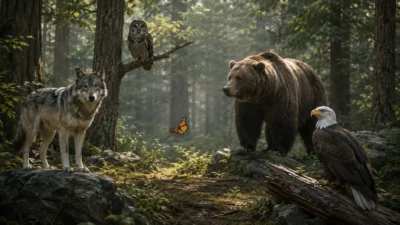
A calm natural landscape featuring several symbolic animals including a wolf, owl, bear, and fox appearing subtly along a forest path at dawn, realistic editorial style, balanced lighting, grounded and reflective mood