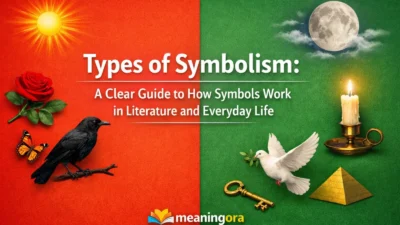
When people search for examples of symbolism, they usually want more than a simple classroom definition. They want to understand how a rose can suggest love, why a flag can represent national identity, or how an ordinary object in a novel can point to a much larger idea.
In simple terms, symbolism is the use of an object, image, color, action, or place to suggest a deeper meaning beyond its literal one. This technique appears in literature, art, religion, history, politics, film, and everyday life.
A symbol can communicate an idea quickly. A wedding ring may suggest commitment. A memorial flower may express remembrance. A green light may suggest permission in everyday life or hope in a story. However, symbols do not always have one fixed meaning. Their interpretation often depends on culture, context, history, and the way they are used.
Quick Answer
Examples of symbolism include objects, colors, animals, images, and actions that represent ideas beyond their literal meanings. Common examples include a red rose for love, a dove for peace, a flag for national identity, and a wedding ring for commitment. In literature, symbols such as the green light in The Great Gatsby or the raven in Poe’s poetry gain meaning from the story surrounding them.
TL;DR
- Symbolism gives a concrete thing a deeper or associated meaning.
- A symbol can represent an idea, emotion, value, memory, or identity.
- Meaning depends heavily on context and culture.
- Common examples include roses, doves, flags, rings, and rainbows.
- Literature often uses repeated objects and images as symbols.
- Historical and religious symbols can have complex meanings.
- Not every repeated detail in a story is automatically symbolic.
- Good interpretation considers the work, culture, period, and context.
What Does Symbolism Mean?
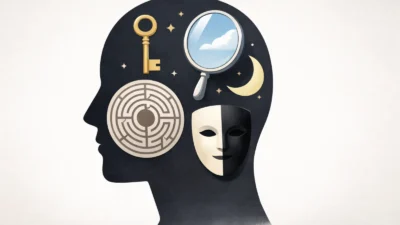
A symbol is something concrete that points toward another idea or meaning. The symbol might be an object, color, animal, action, place, sound, or image.
For example, a wedding ring is a physical object. Yet it can also represent love, commitment, marriage, or an ongoing relationship. The literal object remains a ring, but its cultural meaning adds another layer.
Symbolism is the use of symbols to communicate these additional meanings.
Writers often use symbolism because it allows them to express complicated ideas without explaining everything directly. Instead of repeatedly telling readers that a character feels trapped, a writer might place that character behind a locked door or inside a confined space.
However, readers should avoid assuming that every detail has a hidden meaning. An object can simply be part of the setting or plot. Strong symbolic interpretation should be supported by the context of the work.
12 Clear Examples of Symbolism
Here are some familiar examples that show how symbolism can work in different settings:
| Symbol | Common Meaning | Typical Context |
|---|---|---|
| Red rose | Love or romance | Gifts, poetry, weddings |
| Dove | Peace | Art, memorials, religious imagery |
| Rainbow | Hope or renewal | Art, celebrations, cultural imagery |
| Traffic light | Stop, caution, or permission to proceed | Everyday life |
| Wedding ring | Commitment or marriage | Weddings and relationships |
| U.S. flag | National identity and shared civic meaning | Public events, schools, holidays |
| Liberty Bell | Freedom and American history | U.S. history and civic culture |
| Green light | Hope, desire, or permission | Stories, films, everyday language |
| Raven | Death, grief, or mystery | Literature and folklore |
| Albatross | Burden, guilt, or consequence | Literature |
| Mockingjay | Resistance and rebellion | The Hunger Games |
| One Ring | Power and corruption | The Lord of the Rings |
These examples demonstrate an important point: symbols do not all come from the same source.
Some develop through everyday conventions. Others come from history, religion, folklore, or specific works of literature. A symbol’s meaning becomes recognizable through repeated use and shared understanding.
Why Context Changes Symbolic Meaning
One of the biggest mistakes people make with symbolism is assuming that every symbol has one universal definition.
The same image can mean different things in different settings. A rose might suggest romance in a wedding scene but grief in a memorial. A flag can represent national pride for one person while evoking political conflict or historical debate for another.
Context matters because symbols are shaped by culture and experience.
Consider these examples:
| Symbol | Common Reading | Where It May Appear | Important Context |
| Rose | Love or affection | Gifts, poems, weddings | Can also suggest grief, secrecy, or political ideas |
| Dove | Peace | Art, memorials, religious settings | May also have specific religious meanings |
| Flag | Nation or identity | Schools, holidays, public events | Meaning can vary with history and politics |
| Green light | Permission or hope | Traffic, novels, films | Literal in traffic; potentially symbolic in fiction |
| Bicycle | Freedom or independence | History, art, social movements | Meaning depends on historical context |
This is why symbolic interpretation should begin with a question: What does this symbol mean here?
Instead of memorizing a list of fixed meanings, readers should consider how the symbol functions in its particular setting.
Examples of Symbolism in Everyday American Life
Symbolism is not limited to novels and poems. American culture contains many familiar symbols that people encounter every day.
The U.S. flag, for example, can represent national identity, civic belonging, history, and shared ideals. The bald eagle is another well-known American symbol associated with the nation and its history.
The Statue of Liberty can symbolize freedom, opportunity, and the country’s ideals. The Liberty Bell is closely associated with American history and the idea of liberty.
These objects have literal identities, but their cultural significance goes beyond what they physically are.
A diploma offers another simple example. Literally, it is a document. Symbolically, it can represent education, achievement, effort, and professional accomplishment.
A wedding ring works in much the same way. It is a piece of jewelry, but its meaning can include commitment, marriage, loyalty, and a lasting relationship.
Even traffic signals demonstrate how humans use symbols. A red light means drivers should stop, while a green light means they may proceed when it is safe. These meanings depend on a shared system of signs and rules.
Examples of Symbolism in Literature
Literature is one of the most common places where people encounter symbolism.
A literary symbol may be an object, animal, color, setting, action, or image that connects to a larger theme. Writers often strengthen a symbol by repeating it or placing it at important moments in the story.
The Green Light in The Great Gatsby
F. Scott Fitzgerald’s The Great Gatsby provides one of the most widely discussed examples.
The green light across the water becomes connected with Gatsby’s longing for Daisy. It can also suggest hope, desire, and a future that always seems just out of reach.
The important point is that the green light does not automatically mean “love” or “hope” in every story. Its meaning comes from Fitzgerald’s specific use of the image and its relationship to Gatsby’s character.
The Raven in Poe’s Poetry
The raven is another famous literary symbol.
In Edgar Allan Poe’s “The Raven,” the bird becomes closely associated with grief, loss, mystery, and the speaker’s emotional suffering. Its symbolic force develops through the poem rather than coming simply from the fact that ravens are black birds.
The Albatross in The Rime of the Ancient Mariner
Samuel Taylor Coleridge’s albatross becomes associated with guilt, burden, and consequences.
The bird first appears as part of the mariner’s journey. After the mariner kills it, the consequences of that action become central to the poem.
This is a good example of how an object or creature can acquire symbolic meaning through a character’s actions and the consequences that follow.
The Mockingjay in The Hunger Games
In Suzanne Collins’s The Hunger Games, the mockingjay develops into a symbol of resistance against oppression.
Its meaning is not simply “rebellion” because of the bird itself. Instead, the meaning develops through the characters, events, and political conflict within the series.
The One Ring in The Lord of the Rings
J.R.R. Tolkien’s One Ring represents more than a powerful piece of jewelry.
Its influence connects it with power, temptation, control, and corruption. The ring becomes especially meaningful because of the choices characters make when faced with its power.
These examples show why literary symbolism should be interpreted through the entire work rather than through a simple dictionary of symbols.
Symbolism in Film and Visual Storytelling
Film can communicate symbolism even faster than written literature because viewers can immediately see colors, objects, locations, and visual patterns.
A filmmaker might repeatedly show a particular color whenever a character experiences fear. A door might appear whenever a character faces an important decision. A broken mirror might suggest a damaged identity or divided sense of self.
However, visual details should not automatically be treated as symbols.
A red object in a movie does not necessarily symbolize danger. A bird does not automatically symbolize freedom. The meaning becomes stronger when the image is repeated, emphasized, connected to a character, or linked to the film’s larger themes.
This makes pattern and context especially important when interpreting visual symbolism.
Religious symbolism requires particular care because symbols can carry deep meanings for living communities.
Across many traditions, symbols appear in art, architecture, rituals, clothing, objects, and stories. They can communicate beliefs about faith, sacrifice, creation, death, renewal, salvation, and spiritual identity. A symbol may communicate beliefs about faith, sacrifice, creation, death, renewal, salvation, or spiritual identity.
For example, the cross has profound significance in Christianity. The crescent and star have been used in association with Islam and Muslim cultures, although their historical and religious meanings are more complicated than a simple one-word definition suggests.
The important lesson is to avoid treating religious symbols as decorative icons with universally identical meanings.
A symbol’s significance can vary among traditions, denominations, historical periods, and communities.
Folklore and Superstition
Folklore also contains many symbolic associations.
Animals, numbers, colors, weather events, dreams, and everyday objects can acquire meanings through stories and traditions. For example, some cultures associate certain animals with good fortune, while others connect the same animals with danger or bad luck.
These beliefs should be distinguished from scientific claims.
A superstition can be culturally meaningful without being scientifically established. In the same way, a folklore tradition can reveal what a community historically believed without proving that the belief is objectively true.
That distinction helps explain symbolism without presenting traditional beliefs as facts.
How Symbols Change Over Time
Symbols are not frozen in history. Their meanings can change as societies reuse them.
A symbol may begin with one purpose, acquire a new association, and eventually become connected with several ideas at once.
American history provides many examples of this process. The Liberty Bell, for instance, became associated with abolitionist activism in the nineteenth century and later developed a broader place in American public memory as a symbol of liberty.
The history of the women’s suffrage movement also shows how objects and colors can become symbolic through organized public use. White clothing became strongly associated with suffrage imagery, while other visual elements developed meanings within the movement.
These examples demonstrate an important principle: symbols gain meaning through use, repetition, memory, and cultural association.
A symbol that seems obvious today may have had a very different meaning in an earlier period.
Modern Symbolism in Tattoos, Fashion, and Online Culture
Symbolism remains common in modern personal expression.
People choose tattoos, jewelry, clothing, flowers, emojis, and artwork to communicate ideas about identity, love, grief, faith, independence, memory, or personal change.
A tattoo of a bird might represent freedom to one person. For another, it might commemorate a loved one or represent a specific cultural tradition.
The same principle applies to emojis and online images. A heart can express affection, while a broken heart can suggest sadness or emotional loss. Yet even these familiar meanings can change depending on the conversation.
Modern internet culture can also simplify older symbols. An image may become popular as a design without people knowing its historical, religious, or political background.
Before using an unfamiliar symbol, it can therefore be helpful to ask:
- What does this symbol commonly mean today?
- Where did the symbol come from?
- Does it have religious, cultural, or political associations?
- Could different communities interpret it differently?
- Am I using it for its historical meaning or simply its visual appearance?
Common Mistakes People Make With Symbolism
1. Assuming Every Symbol Has One Meaning
This is probably the most common mistake.
A rose often represents love, but that does not mean every rose in every story symbolizes romance. The surrounding scene matters.
2. Treating Cultural Meanings as Universal
A symbol that has one common interpretation in the United States may have another meaning elsewhere.
Symbolic meaning develops through cultural traditions, historical experiences, and shared conventions.
3. Finding Symbols in Every Detail
Not every object is symbolic.
A chair may simply be a chair. A character may walk through a red door because the plot requires it. Readers should look for meaningful patterns before claiming that an ordinary detail represents something deeper.
4. Ignoring the Work’s Historical Period
A symbol can change meaning over time.
Understanding when and where a work was created can make its symbolism much easier to interpret.
5. Confusing Personal Interpretation With Established Meaning
Readers can have personal reactions to symbols. However, a personal interpretation is not automatically the same as a historically established or author-supported meaning.
A stronger interpretation explains why the symbol has that meaning in the specific work.
How to Identify Symbolism in a Story
You do not need to memorize hundreds of symbolic meanings. Instead, use a simple process.
Look for Repetition
Does the same object, color, animal, or image appear several times?
Repeated details are often worth examining more closely.
Notice Emphasis
Does the writer spend unusual time describing an object? Does a camera repeatedly focus on it in a film?
Extra attention can be a clue.
Connect the Symbol to a Theme
Ask whether the object relates to a major idea in the story.
For example, if a character repeatedly encounters locked doors while struggling with freedom, the doors may have symbolic importance.
Examine the Character’s Relationship With It
A symbol often becomes meaningful because of how a character interacts with it.
An object connected to a character’s memories, fears, hopes, or choices may carry additional meaning.
Consider the Historical and Cultural Context
Ask what the symbol meant when and where the work was created.
This can prevent modern assumptions from being projected onto an older text.
Test Your Interpretation
Finally, ask whether your interpretation explains several details in the work.
If one symbolic reading fits the character, plot, repeated imagery, and theme, it is more convincing than a reading based on one isolated detail.
FAQs
Symbolism vs. Metaphor: Are They the Same?
No. Symbolism and metaphor are related, but they are not the same literary device.
A metaphor makes a comparison by describing one thing in terms of another. For example, saying “time is a thief” compares time to a thief.
A symbol, on the other hand, is an object, image, action, or other concrete element that points toward a larger meaning.
The two can overlap. A writer may use a metaphorical description that also becomes symbolic through repetition and context.
Are Symbols Universal?
Not usually.
Some symbols have meanings that are widely recognized within particular cultures. However, few symbols have exactly the same meaning everywhere.
A color, animal, gesture, or object can carry different associations across countries, religions, historical periods, and communities.
For that reason, it is safer to describe a symbol as having a common meaning in a particular context rather than claiming that it has one universal meaning.
What Are Common American Symbols?
Common American symbols include the U.S. flag, bald eagle, Statue of Liberty, Liberty Bell, Uncle Sam, and national anthem.
These symbols are connected with American history, national identity, civic traditions, and shared cultural memory.
Their meanings are not necessarily identical for every American, however. Historical events and political debates can influence how people understand national symbols.
What Does Symbolism Mean in Tattoos?
In tattoos, symbolism means using an image to represent an idea, memory, belief, relationship, experience, or personal identity.
For example, someone might choose a flower to remember a loved one or a mountain to represent strength and personal growth.
Tattoo symbolism is especially personal. A design may have a traditional meaning, but the person wearing it may give it an entirely different significance.
Therefore, tattoo symbols should not be treated as having one fixed definition.
Can Something Be Symbolic Without the Creator Intending It?
Yes, but there is an important distinction.
Readers and viewers can interpret an image symbolically even when there is no clear evidence that the creator deliberately intended that meaning. Cultural associations can also influence interpretation.
However, the strongest literary interpretations usually have evidence within the work itself.
If an image appears repeatedly, connects to the main theme, and receives unusual emphasis, there is stronger reason to discuss it as a symbol.
What Is a Simple Example of Symbolism?
A red rose representing love is one of the simplest examples.
The rose is literally a flower, but in many cultural and literary contexts, it can also suggest romantic love, affection, or passion.
Its meaning still depends on context. A red rose at a romantic dinner may suggest love, while a red rose placed at a funeral could carry a very different emotional meaning.
Conclusion
The best way to understand examples of symbolism is to think about layered meaning rather than secret codes.
A symbol is a concrete thing that points beyond itself. It can be a rose, flag, ring, raven, bell, color, animal, place, or action. In literature, symbolism can deepen characters and themes. In everyday life, it can communicate identity, emotion, tradition, and shared values.
At the same time, symbols do not have one permanent meaning. Culture, history, genre, personal experience, and context all influence interpretation.
So when you encounter a possible symbol, do not ask only, “What does this symbol mean?” Ask a better question: “What does this symbol mean here?”
That small change leads to more accurate and thoughtful interpretations of literature, art, history, and everyday life.