Symbolism in culture is the way people give visible things shared meaning. A flag can stand for a nation. A ring can suggest commitment. A color, gesture, animal, or emoji can say far more than its literal form.
People care about symbols because they help make culture readable. They turn memory, belief, identity, and emotion into something people can recognize quickly. That is true in religion, politics, family life, fashion, sports, and online life.
In the United States, symbolism matters because public life is full of it. Americans argue over flags, mascots, hand gestures, logos, monuments, and holiday imagery not just because of what they are, but because of what they are understood to mean.
The most useful way to think about symbolism is simple: symbols are not born with fixed meaning. Communities give them meaning, repeat that meaning, debate it, and sometimes change it.
Quick Answer
In modern U.S. usage, symbolism in culture usually refers to the way objects, colors, gestures, images, and rituals carry shared social meaning beyond their literal use. Those meanings come from history, belief, repetition, and public memory, so they can deepen over time, split across communities, or change when politics, religion, media, or technology change.
TL;DR
- Symbols turn ideas into recognizable forms.
- Meanings come from shared use, not nature.
- Context matters more than appearance alone.
- U.S. meanings often come from history.
- Digital culture creates symbols very quickly.
- Sacred and harmful symbols need careful handling.
What symbolism in culture actually means
A symbol is something people use to stand for something else. Sometimes that “something else” is an idea, like freedom. Sometimes it is a group, a memory, a warning, or a belief.
That sounds basic, but it matters. A symbol is not just decoration. It helps people organize meaning. The object itself may be ordinary, but the shared understanding around it is not.
Take a candle. It can be a useful object that gives light. But in many settings it also signals remembrance, mourning, prayer, or quiet reflection. The same object can work on both levels at once.
This is why symbols matter in culture rather than only in art or literature. They help people know how to feel, act, gather, celebrate, mourn, or identify themselves.
Why human groups rely on symbols at all
Culture is too large to carry around as a list of rules. Symbols make it portable.
A nation does not fit inside a piece of cloth, yet a flag can call up loyalty, grief, protest, pride, or anger. A wedding ring does not create a relationship, but it can publicly mark one. A school mascot is not the school itself, yet it can become a shortcut for belonging.
Symbols also help groups pass ideas across time. A child does not need a full history lecture to learn that some family objects are “special,” some colors belong to a holiday, or some songs belong to a ceremony. Culture often travels through repeated symbolic use long before anyone explains it in formal words.
That is one reason rituals matter so much. Repetition teaches meaning. The more often a community connects an object, image, or act to a shared value, the more durable the symbol becomes.
How symbols get their meanings
Symbols usually gain meaning through a mix of function, story, repetition, and power.
Sometimes function comes first. A doorway can come to symbolize welcome or transition because it marks an actual threshold. A crown can symbolize authority because it is linked to rulers. A road sign becomes symbolic because people learn what action it calls for.
Sometimes story comes first. A symbol may gain force because a community ties it to an origin story, a sacred event, a struggle, or a victory. Once a symbol enters public memory, it can carry that story even when the original event is far in the past.
Power matters too. Schools, governments, religions, movements, and brands all reinforce meaning. When institutions repeat a symbol in ceremonies, buildings, holidays, uniforms, or advertising, that meaning becomes easier to recognize and harder to ignore.
So symbolic meaning is not random. It is built. But it is built socially, not naturally.
Why the same symbol can mean different things in different cultures
One of the biggest mistakes people make is assuming that a symbol has one “real” meaning everywhere. In practice, meaning depends on the community using it.
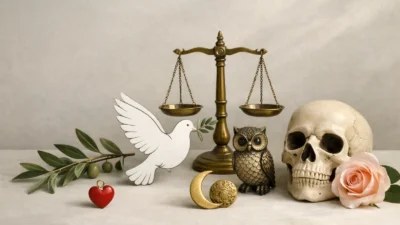
A dove may suggest peace in one setting, religious imagery in another, and simply a bird in another. White clothing may read as bridal in one place, mourning in another, or plain summer style in another. A hand gesture that feels friendly in one region may feel rude somewhere else.
Here is a simple way to think about it:
| Symbol area | How meaning forms | Possible U.S. reading |
| National symbols | History, state use, public memory | Patriotism, protest, unity, division |
| Religious symbols | Sacred teaching, ritual, devotion | Faith marker, reverence, or oversimplified decor |
| Colors | Tradition, emotion, social codes | Holiday, politics, warning, mood |
| Animals | Folklore, visible traits, myth | Mascot, freedom, wisdom, toughness |
| Digital symbols | Platform norms, age group use | Humor, irony, affection, sarcasm |
This is why cultural interpretation needs humility. Similar appearance does not guarantee similar meaning.
How symbolism in culture changes over time
Symbols do not stay still. They change when the world around them changes.
A symbol can shift because people migrate and bring it into a new setting. It can shift because a religion spreads. It can shift because businesses turn a local image into a marketable design. It can shift because politics hardens its meaning. And now it can shift because social media moves a new usage across millions of people very quickly.
Some changes are gradual. Others are sudden.
A strong example is the American flag. In the United States today, it often stands for patriotism, service, and national belonging. But that meaning was shaped by specific history. The flag became much more emotionally powerful after the War of 1812 and the story of Fort McHenry. Public feeling gave it force; the cloth alone did not.
Other changes are darker. Some symbols with older sacred or auspicious meanings were later taken up by extremist movements. In those cases, a symbol may still have older meanings in some traditions, but public understanding in the United States may be dominated by the later harmful association. That does not erase older history, but it does change how the symbol is received.
How Americans use symbols in public life
In the United States, cultural symbolism shows up most clearly where identity becomes public.
That includes:
- flags and monuments
- sports mascots and school emblems
- holiday colors and imagery
- wedding and mourning customs
- campaign logos and protest signs
- uniforms, badges, and awareness ribbons
Americans often read symbols through a civic lens. A symbol may be asked to show loyalty, dissent, solidarity, grief, or moral position.
That is why the same object can split public opinion. One person may see a statue as heritage. Another may see it as exclusion or harm. One person may wear a symbol to signal faith. Another may see only fashion. One may read a flag display as national pride. Another may read it as political messaging.
U.S. culture is especially shaped by this tension because it is both highly visual and highly plural. Many communities live together, but they do not all inherit the same symbolic meanings.
Symbols in religion, spirituality, and everyday respect
Religious symbols need a different kind of reading from secular ones. Their meaning often comes from worship, teaching, ritual practice, and community life, not just from broad public opinion.
That is why a sacred symbol should not be reduced to a mood, a trend, or a vague “good vibes” image. For people inside a tradition, the symbol may connect to prayer, duty, memory, divine presence, protection, sacrifice, or ethical life.
In the United States, many religious symbols also move in and out of mainstream design. They appear in jewelry, tattoos, home decor, festival products, and social media graphics. That does not automatically make their use disrespectful, but it can strip away meaning if people borrow the image without understanding its religious place.
A careful rule helps here: ask whether the symbol is being used as living tradition, personal devotion, aesthetic styling, or commercial shorthand. Those are not the same thing.
How brands, fashion, tattoos, and decor reuse cultural symbols
Modern life constantly repackages symbols. Some reuse is thoughtful. Some is shallow. Some becomes controversial.
In fashion, symbols can signal identity, taste, rebellion, faith, ancestry, or affiliation. In tattoos, people often choose symbols because they feel more personal or lasting than a sentence. In home decor, symbols are often softened into atmosphere: peace, heritage, romance, protection, luck.
That reuse can do three different things:
- Preserve meaning: a community keeps using a symbol in a way that still matches its roots.
- Broaden meaning: a symbol moves into mainstream life and gains looser associations.
- Distort meaning: a symbol is copied without context, or used in ways that clash with its history.
Brands do this too. A company may borrow an animal, color, shield, halo, or geometric mark because symbols communicate faster than explanation. The risk is that symbolic borrowing can make serious traditions feel like style assets.
This is especially sensitive when the source symbol is sacred, Indigenous, racialized, or tied to real historical harm.
How digital life creates fast-moving symbols
Digital culture did not replace symbolism. It accelerated it.
Emojis, memes, hashtags, reaction images, and platform-specific jokes all work like symbolic shorthand. They condense tone and identity into small forms that travel fast.
The catch is that digital symbols are unstable. Their meaning can shift by age, subculture, platform, and moment. A symbol that seems warm in one group may sound dismissive in another. A meme format can move from joke to insult to nostalgia in a short time.
That is especially visible in emoji use. The same image can express support, irony, flirtation, or contempt depending on who sends it and where. This is not a side issue. It shows the same basic rule that has always shaped symbolism in culture: meaning depends on shared understanding, and shared understanding can change.
Online life also rewards speed over depth. That makes symbolic misunderstanding more common. People see the image first and ask questions later.
Where interpretation goes wrong
Most symbolic confusion comes from one of four mistakes.
First, people assume a symbol has one permanent meaning. It rarely does.
Second, people treat belief as fact. A symbol may be associated with luck, protection, or spiritual force in folklore or faith, but that does not make the claim universal or historically provable.
Third, people erase context. A symbol may look ancient, but the meaning most Americans know today may be modern, political, or shaped by mass media.
Fourth, people ignore harm. Some symbols carry painful histories in the United States. Discussing their older meanings without naming present-day impact is incomplete. But the reverse is also true: reducing every symbol only to its most recent misuse can erase older living traditions.
The swastika is the clearest example of this problem. It has a much older history in several religious and cultural traditions, but in the United States today it is overwhelmingly read through Nazism, antisemitism, and hate. Responsible interpretation has to hold both truths at once: older history exists, and modern public harm is real.
Good symbolic reading is careful, not dramatic. It asks who is using the symbol, where, for what purpose, with what history, and for which audience.
FAQs
What does symbolism in culture mean in simple terms?
It means people give things shared meaning beyond their literal use. A symbol can be an object, image, color, gesture, or ritual that helps a group express values, memory, identity, or belief.
Is symbolism in culture the same as religion?
No. Religion is one major source of symbolic meaning, but symbols also shape politics, family life, sports, brands, holidays, and internet culture. Religious symbols usually need more care because they may still carry sacred meaning for living communities.
Why do symbols mean different things to different people?
Because symbols are learned socially, not built into the object itself. Personal experience matters too, so a public symbol can carry a broad shared meaning while still feeling positive, painful, or complicated to different individuals.
How does symbolism in culture show up in the United States today?
It appears in flags, memorials, mascots, wedding customs, mourning rituals, protest imagery, awareness ribbons, logos, and emojis. In the U.S., symbols often carry extra weight because they are used in debates about identity, patriotism, faith, and public memory.
What does a symbol mean in a tattoo?
A tattoo symbol usually mixes public meaning with personal meaning. That is why the same design can suggest faith, grief, heritage, protection, rebellion, or aesthetics depending on the wearer and the cultural context.
Can a symbol have both positive and negative meanings?
Yes. Many do. A symbol may be sacred in one tradition, commercial in another, and controversial in a third, which is why context is more reliable than any one-line definition.
Conclusion
The clearest way to understand symbols is to stop treating them as fixed codes. They are social tools. People build them, inherit them, argue over them, and change them.
That is why symbolism in culture matters so much. It shapes how people recognize belonging, express belief, tell history, and read the world around them. The meaning is rarely just in the image itself. It lives in the community that gives the image force.
A careful reading of symbols starts with context and ends with humility. That is usually where the most honest interpretation begins.