A good symbolism examples list should do more than name a heart, dove, or owl and give it a one-word definition. Most people want to know something deeper: What does this symbol mean today, and how did that meaning develop?
Symbols are everywhere in American life. They appear in tattoos, jewelry, emojis, school mascots, protest signs, wedding decorations, holiday cards, artwork, and brand designs. A simple image can communicate an idea or emotion without using words.
However, symbols do not have one fixed meaning everywhere. Their meanings can come from religion, mythology, folklore, literature, art, history, popular culture, or everyday use. Some meanings have existed for centuries, while others are relatively modern.
That is why context matters. The same symbol can suggest love in one setting, danger in another, and personal identity somewhere else.
This guide explores 18 common symbols, their most familiar meanings, and the history or cultural ideas behind them.
Quick Answer
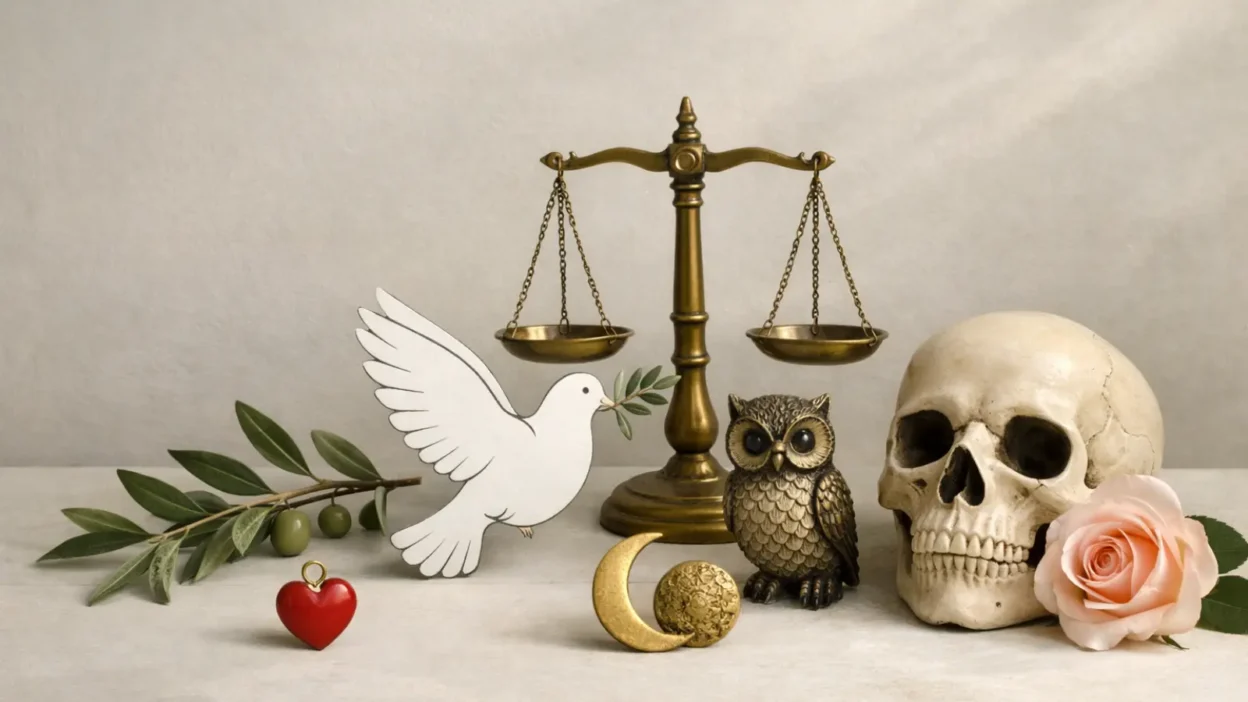
Common symbolism examples include the heart, dove, olive branch, owl, scales, skull, rose, snake, moon, sun, cross, butterfly, anchor, tree, key, mirror, lion, and star.
In modern American culture, these symbols often represent ideas such as love, peace, wisdom, justice, mortality, beauty, transformation, hope, strength, freedom, and mystery.
However, these meanings are not universal rules. A symbol’s meaning can change depending on its cultural background, religious tradition, historical period, and the situation in which it appears.
18 Common Symbols and What They Mean
| Symbol | Common meaning | Other possible meanings |
|---|---|---|
| Heart | Love and affection | Compassion, life, devotion |
| Dove | Peace | Hope, purity, reconciliation |
| Olive branch | Peace | Victory, diplomacy, reconciliation |
| Owl | Wisdom | Mystery, darkness, knowledge |
| Scales | Justice and fairness | Balance, judgment |
| Skull | Mortality | Danger, rebellion, remembrance |
| Rose | Love and beauty | Grief, secrecy, remembrance |
| Snake | Transformation | Danger, temptation, healing |
| Moon | Change and cycles | Mystery, femininity, time |
| Sun | Life and energy | Hope, power, renewal |
| Cross | Christian faith | Sacrifice, salvation, suffering |
| Butterfly | Transformation | Freedom, rebirth, change |
| Anchor | Stability | Hope, security, perseverance |
| Tree | Growth and life | Family, connection, strength |
| Key | Access and opportunity | Secrets, knowledge, freedom |
| Mirror | Self-reflection | Truth, vanity, identity |
| Lion | Strength and courage | Leadership, royalty, pride |
| Star | Hope and guidance | Achievement, faith, destiny |
1. Heart: Love, Affection, and Emotion
The heart is one of the most recognizable symbols of love. In modern American culture, a heart can represent romantic love, affection, care, emotional connection, or support.
The symbolic connection between the heart and emotion is much older than the modern heart shape. Many cultures historically viewed the heart as an important center of emotion, thought, character, or spiritual life.
The familiar heart shape, however, is not a realistic representation of the human organ. Over time, artists and designers simplified the shape into the symbol people recognize today.
Modern culture has expanded its meaning even further. A red heart emoji may communicate love, appreciation, encouragement, or warmth. A broken heart usually represents emotional pain, separation, or grief.
So while the heart commonly symbolizes love, its exact meaning depends on how and where it is used.
2. Dove: Peace and Reconciliation
The dove is widely recognized as a symbol of peace. It appears in religious artwork, memorials, political imagery, wedding designs, and anti-war messages.
One important source of this association is the biblical story of Noah’s Ark. In Genesis, a dove returns carrying an olive leaf, signaling that the floodwaters are receding.
That image helped connect the dove with hope, renewal, and reconciliation. Later artistic and political traditions strengthened its association with peace.
The dove can also have other meanings. In Christian art, for example, a dove may represent the Holy Spirit. In other traditions, birds can symbolize freedom, spirituality, or the soul.
Therefore, calling the dove simply a “peace symbol” is useful for modern readers, but it does not capture the symbol’s full history.
3. Olive Branch: Peace and Diplomacy
The olive branch has long been associated with peace, reconciliation, and the end of conflict.
Its symbolism developed partly from ancient Mediterranean traditions, where the olive tree had important economic, cultural, and religious significance. An olive branch could also be associated with victory and goodwill.
The symbol remains familiar in American civic imagery. The Great Seal of the United States, for example, depicts an eagle holding an olive branch in one talon and arrows in the other.
This combination is often interpreted as representing a preference for peace while recognizing the ability to defend the nation.
Today, an olive branch can therefore suggest peace, diplomacy, compromise, or reconciliation.
4. Owl: Wisdom and Knowledge
The owl is commonly associated with wisdom, intelligence, learning, and observation.
One major reason for this association comes from ancient Greek tradition. The owl was connected with Athena, the goddess associated with wisdom, and became strongly linked with knowledge.
That association continued through Western art and literature. Today, owls frequently appear in school logos, educational materials, libraries, books, and academic designs.
Yet the owl has a darker side in some traditions. Because owls are nocturnal and difficult to see in the dark, they have also been associated with mystery, death, omens, or the supernatural.
In modern American everyday use, wisdom is usually the strongest meaning. Horror, Halloween, and fantasy imagery can bring out the owl’s more mysterious associations.
5. Scales: Justice and Fairness
Scales symbolize justice because their literal purpose is to weigh and compare.
The image suggests that evidence, arguments, or competing claims should be carefully weighed before a judgment is made.
Scales are often shown alongside Lady Justice, a personification of justice commonly depicted with scales, a sword, and sometimes a blindfold.
Each element contributes to the larger idea. The scales suggest balance, while the sword can represent authority or enforcement. The blindfold is commonly associated with impartiality.
The symbol represents an ideal of fairness rather than a guarantee that every legal decision will actually be fair.
6. Skull: Mortality, Danger, and Rebellion
The skull has several important symbolic meanings. Its most fundamental association is with mortality and death.
European artists often used skulls in vanitas artwork to remind viewers that life is temporary. In these works, the skull was not simply a frightening object. It encouraged people to think about mortality and the temporary nature of worldly pleasures.
Later, the skull became a warning symbol. Skull-and-crossbones imagery has been used to indicate poison, toxic substances, and other dangers.
Modern popular culture added even more meanings. A skull can suggest rebellion, toughness, fearlessness, gothic style, or an awareness of mortality.
A skull tattoo, for example, does not automatically mean danger. Depending on the person, it may represent survival, remembrance, personal change, or acceptance of life’s temporary nature.
7. Rose: Love and Beauty
The rose is one of the most familiar symbols of love and beauty.
Its fragrance, appearance, and long association with courtship helped make it a powerful romantic symbol. Giving someone roses can communicate affection, appreciation, or romantic interest.
Color can also influence interpretation. Red roses are strongly associated with romantic love, while other colors may carry different conventional associations.
The rose has also appeared in religious, political, literary, and artistic traditions. In some contexts, it can suggest secrecy, mourning, remembrance, or political identity.
That makes the rose a good example of why symbolic meaning should never be reduced to one definition.
8. Snake: Transformation, Danger, and Healing
Few symbols have meanings as divided as the snake.
A snake can represent danger or temptation because of its venom, unpredictable movement, and presence in religious and mythological stories.
At the same time, snakes can symbolize transformation and renewal. Their ability to shed their skin naturally lends itself to ideas of change and regeneration.
The snake also appears in medical symbolism. The Rod of Asclepius, which features a serpent around a staff, is associated with healing and medicine.
Because of these contrasting traditions, a snake might represent danger in one image and healing in another.
9. Moon: Change, Cycles, and Mystery
The moon is often used to symbolize change, cycles, mystery, time, and the passage of life.
Its changing phases provide an obvious visual connection to cycles and transformation. The moon has also played an important role in calendars, religious observances, stories, and cultural traditions.
In modern American design, moon imagery is often associated with dreams, nighttime, mystery, femininity, or spirituality.
However, some modern interpretations are newer than they appear. Not every meaning attached to moon imagery today has an ancient origin.
10. Sun: Life, Energy, and Hope
The sun commonly represents life, energy, warmth, light, and hope.
This symbolism is easy to understand because sunlight is essential to life and strongly affects human experience. Light can also represent knowledge or clarity, while darkness may suggest uncertainty or the unknown.
Across cultures, the sun has been connected with powerful deities and religious traditions. Modern artwork and design continue to use the sun as a symbol of optimism, renewal, strength, and vitality.
A rising sun can be especially powerful because it suggests a new beginning.
11. Cross: Faith, Sacrifice, and Christianity
The cross is one of the most important symbols in Christianity. It is closely associated with the crucifixion of Jesus and therefore with Christian beliefs about sacrifice, salvation, suffering, and redemption.
Its meaning can vary depending on the specific tradition and design. A simple cross may function as a statement of Christian faith, while a cross in a memorial setting may emphasize grief, hope, or remembrance.
Because the cross is a living religious symbol, its meaning should be understood within its Christian context rather than treated simply as decorative imagery.
12. Butterfly: Transformation and Change
The butterfly is one of the clearest modern symbols of transformation.
Its life cycle provides the foundation for the symbolism. A caterpillar changes dramatically before emerging as a butterfly, making the insect a natural image of growth and personal change.
For this reason, butterflies often appear in tattoos and memorial designs. They can represent a new chapter, personal growth, freedom, or a life transformed by experience.
The butterfly can also symbolize beauty and delicacy. Its meaning is usually positive, although the exact interpretation depends on the person using it.
13. Anchor: Stability and Hope
An anchor is strongly associated with stability because its literal purpose is to hold a vessel in place.
That physical function became a broader metaphor for security, steadiness, and remaining grounded during difficult circumstances.
Anchors can also represent hope, especially in Christian symbolism. They appear frequently in maritime tattoos and designs, where they may reflect a connection to the sea, travel, family, or perseverance.
An anchor therefore works as both a literal maritime image and a metaphor for emotional or personal stability.
14. Tree: Growth, Life, and Connection
Trees are common symbols of growth, strength, life, family, and connection.
Their roots connect them to the ground, while their branches reach outward and upward. That structure makes the tree a natural metaphor for family history, personal development, and connection between generations.
Trees also have important roles in mythology and religion. The Tree of Life, for example, appears in different forms across several cultural and religious traditions.
A tree tattoo may therefore represent family, resilience, personal growth, nature, or a sense of belonging.
15. Key: Opportunity, Knowledge, and Access
A key is a simple object with a powerful symbolic meaning.
Because a key opens a locked door, it naturally represents access, opportunity, discovery, or freedom. A key can also suggest knowledge because understanding something can feel like discovering the key to a problem.
In romantic or personal symbolism, a key may represent trust or access to someone’s heart or private world.
The meaning can change considerably depending on the design. An old key may suggest mystery or history, while a modern key may simply represent access or independence.
16. Mirror: Self-Reflection and Identity
A mirror can symbolize self-knowledge, identity, truth, appearance, or self-reflection.
Its symbolic power comes from what it does literally: it shows us an image of ourselves.
That makes the mirror especially useful in literature and art. A character looking into a mirror may be confronting their identity, appearance, choices, or hidden qualities.
Mirrors can also symbolize vanity. In other contexts, they represent truth because they appear to show things as they are.
The meaning depends heavily on the surrounding story or image.
17. Lion: Strength, Courage, and Leadership
The lion is commonly associated with strength, courage, authority, leadership, and power.
Its reputation as a powerful predator helped create these associations across many cultures. Lions have also appeared in royal heraldry, religious imagery, literature, and national symbols.
In modern American culture, lions frequently appear in sports branding, school mascots, tattoos, and motivational artwork.
A lion may therefore represent physical strength, personal courage, leadership, pride, or determination.
18. Star: Hope, Guidance, and Achievement
Stars can symbolize hope, guidance, achievement, faith, or aspiration.
People have used stars for navigation for thousands of years, which helps explain their association with guidance and direction. A star shining in darkness can also suggest hope during difficult times.
Stars have many specific meanings in different religious and cultural traditions. The five-pointed star, six-pointed star, and other star designs should not automatically be treated as interchangeable.
In modern American culture, stars also appear in awards, entertainment, sports, and branding. A star can therefore represent excellence or achievement as easily as it represents guidance or hope.
Why Symbol Meanings Change Over Time
Symbols are not frozen in the past. Their meanings develop as people reuse them.
A heart became a familiar feature of greeting cards and eventually an emoji. A skull moved from religious artwork into warning signs, music, fashion, and tattoos. The moon became a common element of modern decorative and spiritual aesthetics.
Several forces can change the meaning of a symbol:
- Religion: Sacred traditions can give symbols specific meanings.
- Art and literature: Writers and artists can introduce new interpretations.
- Popular culture: Movies, television, music, and games can reshape familiar imagery.
- Branding: Companies use simple symbols to create quick associations.
- Social media: Emojis and icons can give old symbols new everyday uses.
- Personal expression: Tattoos and artwork allow people to create highly personal meanings.
This is why a modern interpretation should not automatically be presented as the original meaning.
Why Context Matters When Reading Symbols
The same symbol can mean different things in different settings.
Consider the skull. On a warning label, it signals danger. In a museum painting, it may represent mortality. On a tattoo, it could represent survival or remembrance. On clothing, it might simply communicate a particular style.
The image has not changed. The context has.
When interpreting a symbol, ask:
- Where does the symbol appear?
- Who is using it?
- What culture or tradition does it come from?
- Is the meaning historical, religious, modern, or personal?
- Are there other elements nearby that change its meaning?
These questions are more reliable than memorizing a single definition for every symbol.
Common Mistakes People Make About Symbolism
Treating every meaning as universal
A symbol that means one thing in the United States may mean something different elsewhere.
Assuming every symbol has an ancient origin
Some meanings are genuinely old. Others developed through modern art, advertising, fashion, or internet culture.
Ignoring religious context
A symbol from a living religious tradition may have a specific meaning that is very different from its modern decorative use.
Confusing folklore with historical fact
Online symbolism lists often repeat claims without explaining where those claims came from. A popular interpretation is not automatically a documented historical meaning.
Giving a symbol only one definition
Many symbols are deliberately complex. The snake, skull, moon, and owl can all carry contrasting meanings.
FAQs
What are some common examples of symbolism?
Common examples include the heart for love, the dove for peace, scales for justice, the owl for wisdom, the skull for mortality, the rose for love and beauty, and the butterfly for transformation.
Do symbols have the same meaning everywhere?
No. Symbolic meanings can vary across cultures, religions, historical periods, and individual experiences. Some meanings are widely recognized, but few are completely universal.
What does a heart symbolize?
A heart commonly symbolizes love, affection, care, and emotional connection. Depending on the context, it can also represent compassion, devotion, life, or emotional pain.
What does a snake symbolize?
A snake can symbolize danger, temptation, transformation, renewal, wisdom, or healing. Its meaning depends strongly on the cultural and visual context.
What does a skull symbolize?
A skull most fundamentally represents mortality and death. It can also symbolize danger, rebellion, remembrance, fearlessness, or acceptance of mortality.
Why can one symbol have opposite meanings?
Symbols develop through different traditions and experiences. A snake, for example, can represent danger in one tradition and healing in another. Context determines which meaning is most relevant.
Are modern symbol meanings different from historical meanings?
Often, yes. Modern culture can simplify, expand, or completely reshape an older meaning. Social media, branding, fashion, tattoos, and popular entertainment can all contribute to these changes.
Conclusion
Symbols help people communicate complex ideas through simple images. A heart can suggest love. A dove can represent peace. Scales can stand for justice, while a butterfly can suggest transformation.
But symbols rarely have one permanent definition.
Their meanings develop through history, religion, folklore, art, culture, popular media, and personal experience. Some meanings are widely shared, while others are specific to a particular community or situation.
The best way to understand symbolism is therefore to look beyond the image itself. Ask where the symbol comes from, who is using it, and what the surrounding context suggests.
Once you do that, a symbolism examples list becomes more than a collection of definitions. It becomes a useful way to understand how people turn ordinary objects, animals, shapes, and images into meaningful forms of communication.