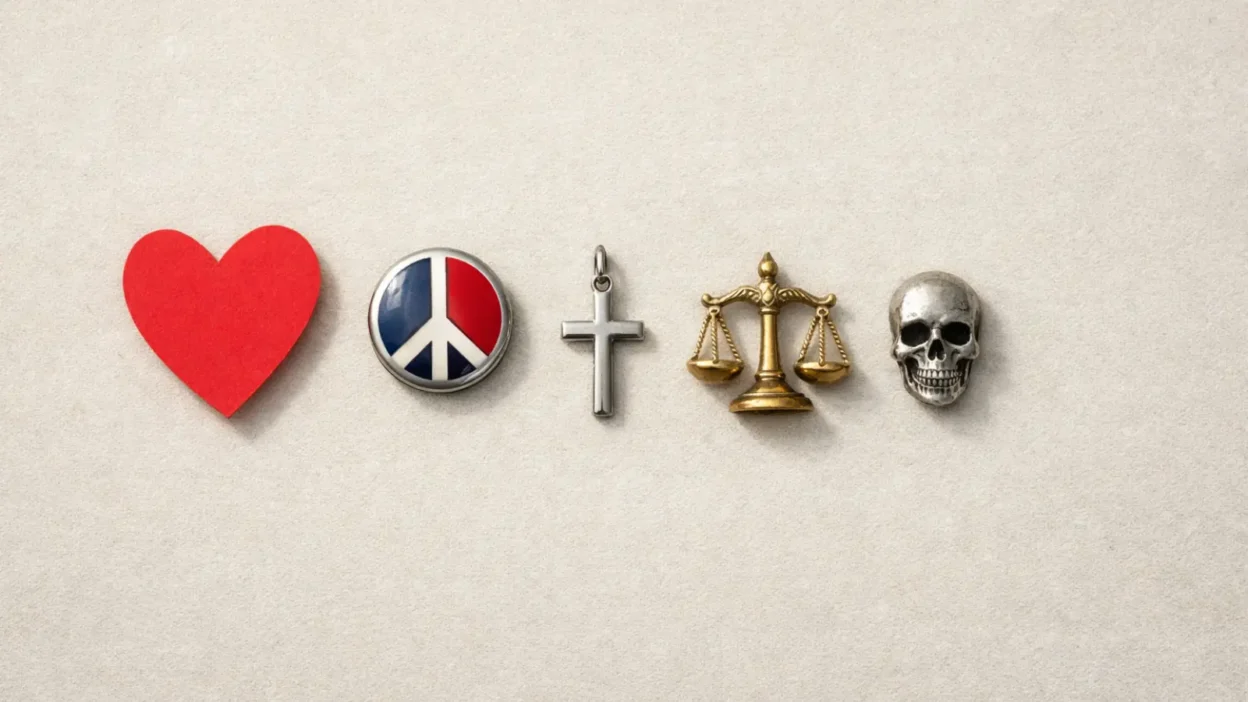
People use symbols every day, even when they do not stop to name them. A heart on a text message, a peace sign on a poster, a cross on a necklace, or scales outside a courthouse can all say something quickly without a full sentence.
That is why common symbols and meanings matter. They help people express love, grief, protest, faith, warning, identity, and belonging. But the catch is that symbols are not fixed formulas. Their meanings come from habit, history, belief, and repeated use, so the same image can feel obvious in one setting and more complicated in another.
In the United States, people often meet symbols in a mixed environment: religion, law, fashion, social media, tattoos, advertising, and pop culture all overlap. That makes it easy to assume a meaning is universal when it may only be common in a specific place or moment.
Quick Answer
In modern U.S. use, common symbols and meanings usually refer to familiar images that stand for bigger ideas, such as the heart for love, the peace sign for peace or protest, the cross for Christian faith, the skull for death or danger, and the scales for justice. Those meanings did not appear out of nowhere; they developed over time through religion, art, law, custom, protest movements, and now digital culture.
TL;DR
- Symbols are shared shortcuts, not universal laws.
- Modern meaning often differs from original use.
- Context changes how a symbol is read.
- U.S. use blends religion, law, style, and media.
- Some meanings are documented; others are later interpretations.
What people mean when they ask about common symbols and meanings
Usually, people asking this question do not want a theory of semiotics. They want to know what familiar signs are understood to mean in ordinary life now. A symbol is best thought of as something visible that points beyond itself. It stands for an idea, feeling, group, value, or story people already know how to recognize.
That is also why there is no single master list of meanings that works in every culture. Some symbols travel widely. Others stay tied to one religion, one region, or one era. Even very common symbols can pick up extra meanings over time. In practice, the “meaning” of a symbol is often a stack: original use, later reinterpretation, and current everyday use all sitting together.
Why some symbols feel obvious even when their history is messy
A symbol starts to feel natural when people see it again and again in the same emotional or social setting. If a sign keeps appearing in love letters, protest marches, churches, courthouses, warning labels, or phone screens, people stop treating it like a puzzle and start reading it almost instantly.
That repetition matters more than visual accuracy. The heart shape does not look much like an anatomical heart, yet it still reads as love. The scales of justice do not literally produce fairness, yet they instantly suggest balance and weighing evidence. Meaning grows from use, not just resemblance.
This is also why meanings change. A symbol can move from sacred use into jewelry, from political protest into fashion, or from religious art into emoji culture. Once that happens, the old meaning may remain, but it no longer stands alone.
The heart: love, affection, and emotional closeness
For most Americans today, the heart symbol means love first. It can suggest romance, but it also covers affection, care, sympathy, friendship, and emotional support. In digital life, the red heart emoji often works as a quick sign of warmth or approval, not only romantic feeling.
Its shape, though, has a less certain history. Historians have proposed several explanations, including links to the silphium plant, medieval anatomical drawings, and older visual traditions. Good sources tend to agree on one point: the exact origin is hard to pin down, so it is better to speak in possibilities than certainties.
What is clearer is how the symbol became dominant. By the late medieval and Renaissance periods, heart imagery was already tied to courtly love, religious art, and later Valentine material. That long association helped turn the heart into the default visual shorthand for intimate feeling in the modern West, including the United States.
Today, Americans use the heart almost everywhere: greeting cards, wedding decor, charity campaigns, reaction buttons, tattoos, and brand messaging. Because it is so common, its meaning often depends on tone. A plain red heart may read as romantic, familial, supportive, or simply kind depending on who sends it and where it appears.
The peace sign: from nuclear disarmament to a general sign of peace
The modern peace sign is one of the few famous symbols with a very clear documented origin. Britannica traces it to 1958, when Gerald Holtom designed it for the British Campaign for Nuclear Disarmament. Its lines came from the semaphore signals for N and D inside a circle.
That origin matters because it corrects a common mistake. The peace sign is not an ancient universal emblem that somehow floated through all civilizations unchanged. It is a modern protest symbol that later broadened in meaning.
In the United States, it became especially visible through anti-war activism in the 1960s and then moved into youth culture, music, fashion, and graphic design. Once that happened, many people started reading it less specifically as “nuclear disarmament” and more generally as peace, anti-war values, or a hopeful countercultural spirit.
That shift is a good example of how symbols evolve. A symbol can keep its historical origin while gaining a broader public meaning. The current U.S. reading of the peace sign is usually friendly and idealistic, but its documented roots are political and activist.
The cross: faith, sacrifice, identity, and the need for respectful context
In modern American life, the cross is first and foremost a Christian symbol. Britannica describes it as the principal symbol of Christianity, tied to the Crucifixion of Jesus Christ and the faith of Christians. That remains the central meaning, especially in worship, prayer, funerals, church spaces, and devotional jewelry.
At the same time, the cross is not a simple one-note image. Different Christian traditions use it differently. A crucifix, which includes the figure of Christ, can carry a different devotional emphasis from a plain cross. Historical usage also shifted: open public display of the cross was not common in early Christianity, and its artistic treatment changed over centuries.
In the United States, many people also encounter the cross outside formal worship. It appears in fashion, tattoos, memorial objects, architecture, and public debate. That does not erase its religious meaning, but it does mean viewers may read the same symbol as faith, heritage, remembrance, or style depending on context.
This is where care matters. Because the cross is part of a living religious tradition, reducing it to a generic “positive symbol” misses what it means to many believers. Decorative reuse is common, but respectful interpretation still starts with its Christian significance rather than treating it as just another visual motif.
The skull: death, danger, rebellion, and remembrance
Most Americans read a skull as a sign of death first. That is why it appears so easily in horror imagery, poison warnings, Halloween design, and dark fashion. The image is immediate because it points to mortality in a way few symbols can.
But that is not the whole story. Museum sources on memento mori objects show that skull imagery also worked as a reminder of life’s brevity and the need for reflection. In that tradition, the skull was not just there to shock. It asked viewers to remember that life is temporary.
That older meaning still echoes in modern use. A skull tattoo, ring, or artwork can suggest toughness or rebellion, but it can also signal memory, grief, survival, or a refusal to ignore death. Context makes the difference. A skull on a hazard label is not doing the same job as a skull on mourning jewelry or a biker patch.
This is one reason broad symbol lists often miss the mark. Saying “skull means death” is not wrong, but it is incomplete. In U.S. culture, the skull moves between warning, style, memorial symbolism, and philosophical reflection.
The scales of justice: fairness, evidence, and legal authority
The scales of justice are among the most recognizable public symbols in the United States because people see them in courthouses, seals, textbooks, and legal imagery. Official Supreme Court material explains the usual reading clearly: scales for impartiality, sword for power, and blindfold for fairness.
The image also has depth. The Supreme Court traces the female figure of Justice back to Themis in Greek tradition and Justicia in Roman tradition. Over time, the figure became associated with scales, later with a sword, and then often with a blindfold. That means the full symbol was assembled in stages rather than arriving all at once.
Why do scales work so well? Because they make law visible. They suggest weighing claims, evidence, and competing arguments. Even people with no legal training understand the metaphor right away. The image turns an abstract ideal into something concrete.
In U.S. public life, the symbol also carries aspiration. It does not prove that outcomes are fair; it expresses what justice is supposed to be. That gap between ideal and reality is part of why the scales remain powerful in civic argument as well as courtroom design.
A quick comparison of common symbols in modern U.S. life
| Symbol | Most common U.S. meaning today | Historical root or key development | Common modern use |
| Heart | Love, care, affection | Medieval and later love imagery; exact shape origin disputed | Texting, Valentine’s Day, tattoos, branding |
| Peace sign | Peace, protest, anti-war values | Designed in 1958 for nuclear disarmament | Posters, shirts, pins, youth culture |
| Cross | Christian faith, sacrifice, devotion | Central Christian symbol tied to the Crucifixion | Jewelry, churches, funerals, tattoos |
| Skull | Death, danger, edgy style | Long memento mori tradition; later warning use | Fashion, Halloween, hazard imagery |
| Scales | Fairness, legal balance | Justice personifications in classical and later legal art | Courthouses, seals, legal logos |
How tattoos, decor, branding, and emojis change meaning
Once symbols leave their older settings, people start using them more personally. That can make meaning richer, but also looser.
- Tattoos: A person may choose a heart for family love, a cross for faith, a skull for survival, or scales for a career in law. Personal meaning often matters more than textbook meaning.
- Decor and fashion: A symbol in home decor or clothing may signal mood, taste, or identity rather than belief.
- Branding: Companies often borrow familiar symbols because they are instantly legible. The downside is that branding can flatten nuance.
- Emoji and messaging: Digital platforms speed up meaning shifts. The red heart, for example, often moves beyond romance into support, approval, or simple warmth.
This modern remixing is not automatically shallow. It is just different. A symbol used in an app reaction bar is doing a different kind of communication than the same symbol used in a church, courtroom, or protest march.
Where people go wrong with symbols
The biggest mistake is treating a common symbol as if it has one eternal meaning everywhere. That is rarely true. Symbols are shaped by culture, religion, politics, design trends, and local habits. A meaning can be common without being universal.
Another mistake is mixing documented history with later internet claims. The peace sign has a documented origin. The heart symbol does not have one fully settled origin story. Those two cases should not be discussed with the same level of certainty.
People also oversimplify sacred symbols by stripping them of living religious meaning. That especially matters with the cross and with symbols from traditions outside one’s own. A symbol can be visually popular and still deserve cultural or religious care.
Finally, there is the problem of flattening mood into meaning. A skull is not always “evil.” A heart is not always romantic. A peace sign is not ancient wisdom. Good interpretation starts with context: who is using the symbol, where, and for what purpose.
FAQs
What do common symbols and meanings usually mean today?
Usually, they refer to familiar images that stand for larger ideas people recognize quickly, such as love, peace, faith, death, warning, or justice. In the United States, those meanings are shaped as much by modern media and daily use as by older history.
Are common symbols universal across all cultures?
No. Some symbols travel widely, but very few mean exactly the same thing everywhere. It is safer to say a meaning is common in a certain culture or period than to call it universal.
What does a heart symbol mean in a tattoo?
In a tattoo, the heart often means love, attachment, grief, memory, or loyalty. The personal context matters a lot, and modern tattoo meaning may be more individual than the older historical meaning of the symbol.
Is the peace sign a religious symbol?
Its modern form is not originally a religious symbol. Reliable historical sources trace it to the 1958 nuclear disarmament movement, even though later rumors and reinterpretations have tried to attach other meanings to it.
Why do skulls sometimes have a positive meaning?
Because skull imagery has not only been used as a warning. In memento mori art and objects, the skull can function as a reminder to value life, remember death, and reflect on what matters.
Is a cross always just a fashion symbol in the U.S.?
No. Even when used in fashion or jewelry, the cross still carries strong Christian meaning for many people. That is why context and respectful use matter more here than with many purely decorative symbols.
Conclusion
The clearest way to understand familiar symbols is to start with how people actually use them now. In the United States, a heart usually signals love or care, a peace sign suggests peace or protest, a cross points to Christian faith, a skull raises mortality or danger, and scales stand for justice.