When people search for symbolism images meaning, they are usually trying to figure out how pictures carry ideas beyond what they literally show. A rose can suggest romance. A skull can suggest death, danger, rebellion, or even fashion. A heart icon on a phone often means affection, not anatomy.
That matters because modern life is full of images that do more than decorate. We see them in art, emojis, logos, tattoos, memorials, political graphics, holiday décor, and social media posts. We read them fast, often without realizing how much background knowledge we are bringing with us.
In the United States, people tend to treat symbolic images as shortcuts for feeling and identity. A white dove may read as peace. A crown may read as status or self-worth. But those meanings are not built into the image itself. They develop through history, custom, religion, advertising, and repeated use.
So the real question is not just “What does this image mean?” It is also “Who is using it, where, and why?”
Quick Answer
In modern U.S. use, symbolism images meaning usually refers to the idea that images can stand for feelings, beliefs, identities, or ideas beyond their literal appearance. Those meanings often come from shared cultural habits, religious traditions, art history, and modern media, which is why the same image can feel obvious in one setting and mean something very different in another.
TL;DR
- Images gain meaning through shared cultural habits.
- Context matters more than image shape alone.
- Literal meaning and symbolic meaning are different.
- U.S. readers meet symbols daily online.
- Sacred meanings and trendy uses are not identical.
- Some symbols changed meaning through harm.
What “symbolism images meaning” usually refers to
This phrase usually does not point to one official list of symbols with one fixed answer. It usually points to a broader question: how do people get meaning from visual images?
Sometimes the image is obvious. A red heart icon usually signals love, care, or approval. Sometimes the meaning is layered. A broken mirror in a film scene may suggest bad luck, a damaged self-image, or a turning point. In art, a candle may mean prayer, mourning, time passing, or spiritual presence, depending on the setting.
That is why readers often feel frustrated by flat symbol lists online. They want a meaning, but what they really need is a way to read an image in context.
How an image becomes a symbol
An image becomes symbolic when a group of people starts linking it to an idea beyond its literal form. That link can grow for different reasons.
Sometimes it comes from function. A crown came to suggest authority because crowns were worn by rulers. A key can suggest access, trust, or knowledge because keys open what is closed.
Sometimes it comes from visible traits. Fire suggests danger or transformation because it destroys and changes what it touches. Wings suggest freedom because birds move through space in a way humans cannot.
Sometimes it comes from ritual and repetition. A white dress at a wedding means something because people repeatedly used it that way, not because white fabric naturally contains a message.
Over time, repetition turns images into visual shorthand. Once that happens, people can read the image quickly, often without stopping to ask where the meaning came from.
Literal meaning versus symbolic meaning
A useful first step is to separate what an image is from what it suggests.
Literal meaning is the plain thing you can point to. A skull is a skull. A ladder is a ladder. A dove is a bird.
Symbolic meaning is the extra layer people attach to it. A skull might suggest mortality. A ladder might suggest ambition, escape, or spiritual ascent. A dove might suggest peace, hope, or the Holy Spirit in a Christian setting.
This matters because symbolic reading can go wrong when people skip the literal level. If you do not first identify what is actually in front of you, it is easy to start projecting meaning that the image does not strongly support.
A good rule is simple: first describe, then interpret.
Where image symbolism comes from
Visual symbolism has deep roots, but not one single origin. People have long used images to teach, mark status, tell stories, and signal shared beliefs.
In religious art, repeated motifs helped viewers identify people and stories. Halos, crosses, lotuses, lambs, and other recurring images worked because communities learned them together. In political life, flags, eagles, seals, and emblems did similar work. In memorial culture, flowers, candles, black clothing, and folded hands developed strong emotional associations through public ritual.
Art history gives this process a name: iconography. That simply means studying the symbols, attributes, and motifs that help viewers identify subject matter. In practice, it means asking what a community would have recognized when the image was made.
That last part is important. A symbol does not float outside of time. It belongs to a setting.
Why the same image can mean different things
The same image can shift meaning across place, era, and audience. That is normal.
A snake is a good example. In one setting it may suggest danger or deceit. In another it may suggest healing, renewal, wisdom, or protection. None of those meanings are automatic. They come from stories, religion, medicine, fear, and local tradition.
Color works the same way. White is often linked in the United States with weddings, cleanliness, or simplicity. In other contexts it can be tied to mourning, ritual purity, or formal dress.
Platform matters too. A skull in a museum painting, a Halloween decoration, a biker patch, and a text message do not land the same way. The image may be similar, but the social cue is different.
That is why there is no honest way to say an image “always” means one thing.
Common image types and what they often suggest today
Below is a simple map of common symbolic images in modern U.S. reading. These are common tendencies, not fixed rules.
| Image type | Common U.S. reading today | What can change the meaning |
|---|---|---|
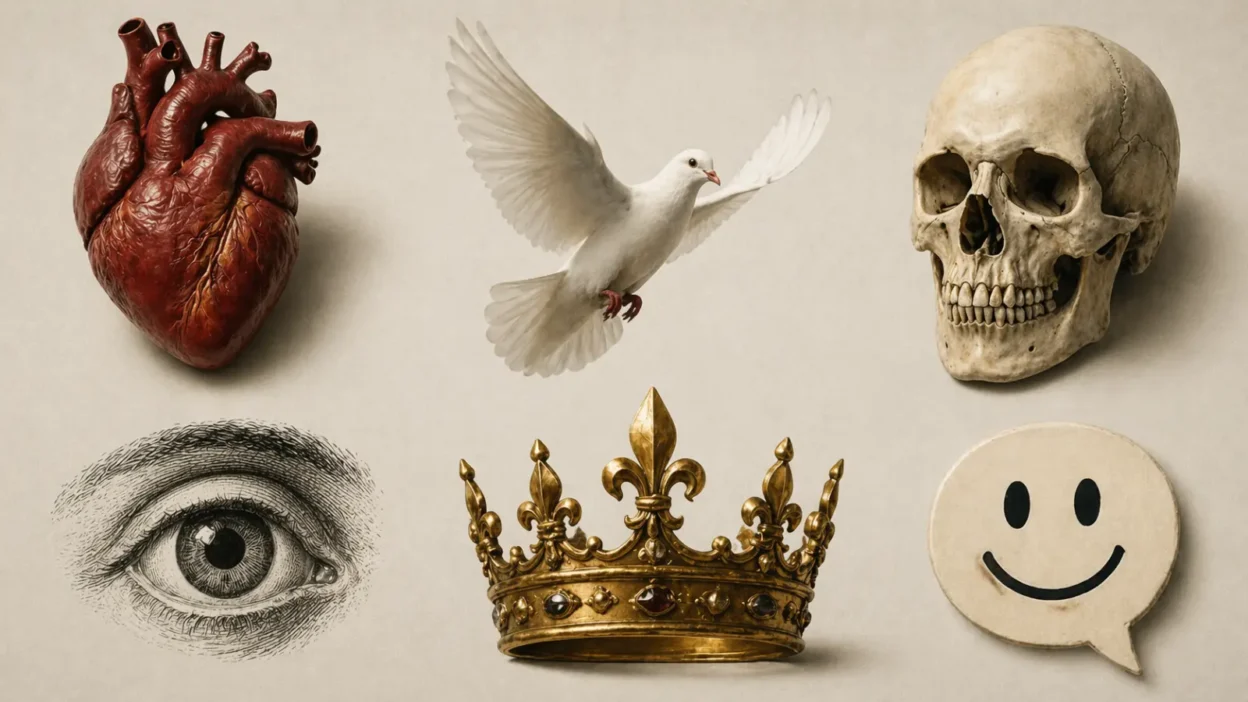
| Heart | Love, care, approval, emotional closeness | Color, irony, platform, relationship context |
| Skull | Death, danger, rebellion, edge, Halloween | Art style, fashion use, memorial setting |
| Dove | Peace, hope, gentleness, spiritual comfort | Religious context, political use, memorial use |
| Crown | Power, status, victory, self-worth | Branding, irony, pop culture, class cues |
| Eye | Awareness, protection, surveillance, intuition | Religious use, conspiracy culture, design style |
These meanings developed because the images are easy to repeat and easy to remember. They also carry emotional speed. People do not need a long explanation to react to a heart, skull, or crown.
Still, context keeps doing the real work. A crown in a church painting, a pageant logo, and a streetwear graphic will not read the same way.
How Americans use symbolic images now
In the United States, symbolic images are part of everyday communication, not just museum culture.
In digital life
Emojis are the clearest example. They work like tiny symbols for tone, mood, reaction, and identity. A crying-laughing face can signal real amusement, exaggeration, or generational style. A folded-hands emoji may read as prayer, gratitude, or simply “thank you.”
In branding
Companies rely on visual shorthand all the time. Leaves suggest freshness or eco-friendliness. Shields suggest protection. Stars suggest quality or aspiration. None of those meanings are neutral. They are built through repeated commercial use.
In tattoos and personal style
Symbolic images often stand in for values people want to carry with them. Wings may suggest freedom. A compass may suggest direction. An eye may suggest awareness or protection. But tattoo meaning is often personal, not public. Two people can choose the same image for very different reasons.
In décor and gifting
Hearts, candles, angels, butterflies, suns, moons, and flowers often show up in homes, greeting cards, and memorial spaces. In these settings, symbolism tends to be emotional first and historical second.
Religious, spiritual, and folklore readings
This is where caution matters most.
Many images do carry sacred meaning within a living religious tradition. But that does not mean every modern use of that image carries the same depth. A lotus in a faith context is not the same as a lotus on spa packaging. A halo in religious painting is not the same as a halo filter in pop culture. A cross worn for devotion is not the same as a cross used as a general fashion motif.
Folklore adds another layer. Some people treat butterflies, feathers, owls, crows, moons, or repeating numbers as signs. Those readings can be deeply meaningful within personal belief or community tradition. But they should be described as belief, custom, or interpretation, not proven fact.
The safest approach is to ask two questions:
- Is this symbol part of a living tradition?
- Is the current use devotional, decorative, commercial, or personal?
That keeps sacred meaning from getting flattened into mood-board language.
When symbolic interpretation goes too far
People naturally look for patterns. That can be helpful, but it can also lead to overreading.
One common mistake is assuming every detail in an image was placed there to hide a coded message. Sometimes a rose is a symbol. Sometimes it is just a rose that fits the composition.
Another mistake is treating one internet meaning as final. Online symbol lists often sound certain because certainty feels useful. But symbolic interpretation is rarely that neat. The same image may carry an old religious meaning, a newer fashion meaning, and a private personal meaning at the same time.
A third mistake is reading across cultures too quickly. An image may look familiar, but its meaning may come from a story or practice you do not know. That is where symbolic interpretation turns from insight into projection.
Symbols that changed meaning or became controversial
Some images do not just evolve. They become contested.
The clearest example is the swastika. It existed for centuries in several cultural and religious traditions before the Nazi Party adopted it in the 20th century. In much of the modern West, especially in the United States, it now overwhelmingly reads as a hate symbol because of Nazism, antisemitism, and the Holocaust. That later history does not erase older sacred uses in Hinduism, Buddhism, Jainism, and other traditions. But it does mean context is morally and historically unavoidable.
This is a larger pattern. Symbols can be rebranded by states, movements, subcultures, or extremist groups. Once that happens, public meaning may shift fast and painfully. A symbol can carry older meanings and present-day harm at the same time.
That is why “original meaning” is not always enough. Current social meaning matters too.
A practical way to read symbols in images responsibly
A simple method works better than memorizing giant symbol lists.
1. Identify the image plainly
What do you actually see?
2. Check the setting
Is it an artwork, logo, meme, tattoo, ritual object, memorial, or product label?
3. Ask who the audience is
A symbol aimed at churchgoers, museum visitors, teenagers, or luxury shoppers will not land the same way.
4. Separate public meaning from personal meaning
Some images have widely shared meanings. Others are private to the creator.
5. Look for history before making big claims
If the image seems sacred, political, or controversial, history matters.
6. Leave room for uncertainty
The most responsible reading is often: “This likely suggests X in this context,” not “This always means X.”
That approach is less dramatic, but it is usually more accurate.
FAQs
What does symbolism in images mean in simple terms?
It means a picture is being used to suggest something beyond what it literally shows. A visual image can point to an emotion, belief, value, memory, or social idea without spelling it out in words.
Are symbolic image meanings universal?
Usually, no. Some associations feel widespread, but most meanings depend on culture, religion, history, and context. What seems obvious in one place can be unclear or even opposite somewhere else.
What do symbolic images mean in tattoos?
Tattoo symbolism often combines public meaning and private intention. A rose, skull, snake, or moon may carry common associations, but the wearer may connect it to grief, faith, family, survival, or identity in a much more personal way.
Are spiritual meanings of images historically proven?
Sometimes they are documented within a tradition, and sometimes they are later interpretation. It is best to describe those meanings as religious teaching, folklore, or belief practice unless there is strong historical evidence for a specific claim.
Why do emojis count as symbolic images?
Because they work as small visual signs that shape tone and meaning. In the U.S., people often use them to soften messages, show emotion, signal irony, or mark group style, which makes them part of modern visual symbolism.
Can one symbol have both positive and negative meanings?
Yes. That happens often. An image can suggest comfort in one setting and threat in another, or carry an old sacred meaning while also being linked to later misuse or political harm.
Conclusion
The clearest way to understand visual symbolism is to stop looking for one permanent meaning and start looking at context. Images become symbols because people keep using them to carry emotion, memory, identity, power, belief, and social cues.