Black is one of the easiest colors to recognize and one of the hardest to reduce to one meaning. In the United States, black color symbolism often points first to mourning, seriousness, power, elegance, and mystery.
People care about black because it shows up at important moments. We wear it to funerals and formal events. We use it in logos, uniforms, protest signs, tattoos, sports jerseys, home decor, and phone screens. It can feel respectful in one setting and rebellious in another.
That range is exactly why black needs careful interpretation. Its meaning depends on context, culture, material, and intention. A black suit, a black ribbon, a black flag, and a black wedding dress do not say the same thing.
Quick Answer
Black color symbolism most commonly represents mourning, seriousness, power, elegance, and mystery in modern U.S. culture. Historically, many of these meanings grew from black’s link with darkness, death, formal dress, religious solemnity, and later fashion and design. It can also suggest rebellion, protection, minimalism, or the unknown, depending on where and how it appears.
TL;DR
- Black often signals mourning, formality, authority, and mystery.
- Context changes its meaning more than the shade alone.
- U.S. meanings come largely from Western mourning and fashion.
- Religious and spiritual meanings vary by tradition.
- Modern black can feel elegant, edgy, protective, or severe.
- Avoid treating black as universally negative or sacred.
What Black Means Most Often Today
In everyday U.S. life, black usually means seriousness first. It can mark grief, respect, discipline, authority, privacy, and control. That is why it appears in funeral clothing, courtrooms, security uniforms, formal wear, luxury packaging, and minimalist interiors.
Black also carries style meanings. These meanings are not ancient laws. They are habits built through dress codes, media images, design choices, and social repetition.
The same color can also feel heavy, cold, threatening, or sad.
That is the central rule: black does not carry one fixed message. It narrows attention. It reduces visual noise. Then the setting tells people how to read it.
Why Darkness Shaped Black Symbolism
Many black meanings begin with a simple human experience: black is linked with low light. Night limits vision. Shadows conceal details. Darkness can make people feel uncertain because they cannot see what is near them.
From that physical experience, black became associated with the unknown. This does not mean every culture viewed black as evil. It means black could easily become a symbol for what is hidden, private, distant, secret, or not yet understood.
That link explains why black works so well in mystery stories, horror design, and dramatic art. It creates space for imagination. A black doorway, black screen, or black cloak suggests that something is being withheld.
But darkness can also be restful. A dark room can mean sleep. A black background can make other colors shine. Black soil can suggest fertility in some historical settings. The same visual quality that hides danger can also hold possibility.
Mourning and Respect in U.S. Culture
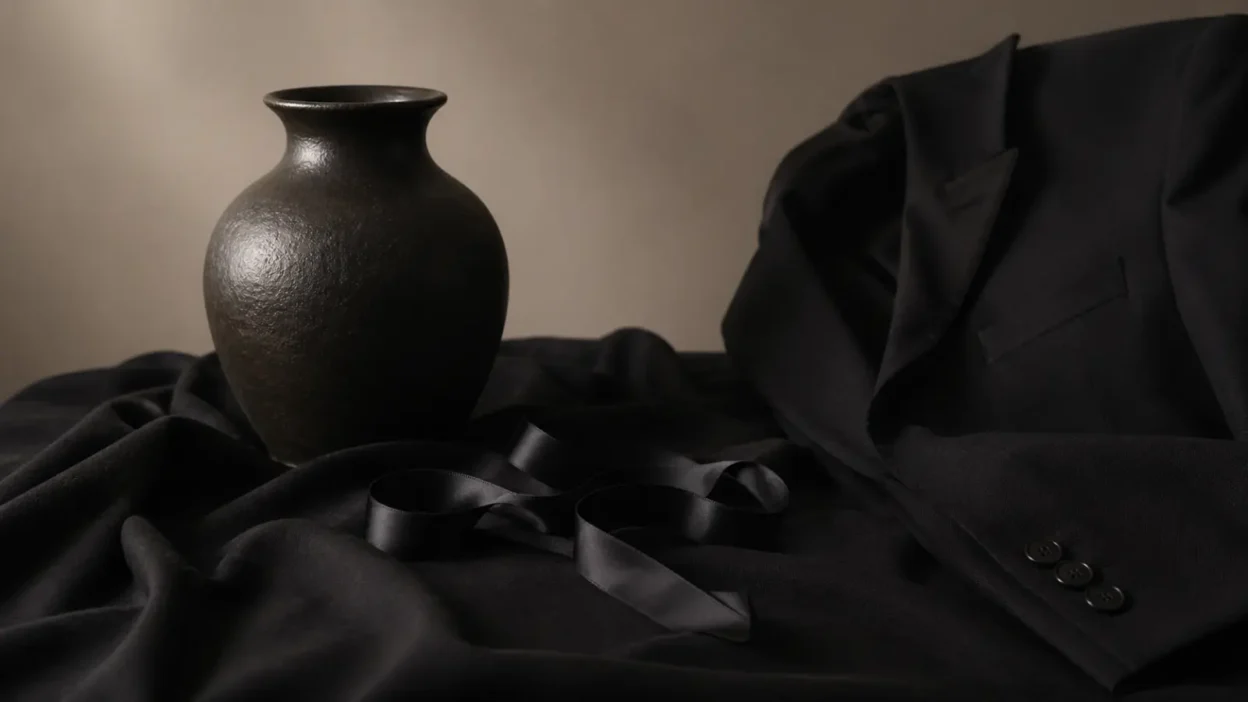
For many Americans, black is still the expected color of mourning. People wear black to funerals because it feels serious, restrained, and respectful. It lets the focus stay on the loss rather than on the wearer.
This habit comes mainly through European and American mourning customs. In the 19th century, mourning dress became especially formal. Widows and close relatives could be expected to wear black for long periods, with rules changing by relationship, class, and stage of grief. Those customs were not simply emotional. They were social signals that made private loss visible in public.
Today, the rules are looser. Many families accept navy, gray, dark green, or simple formal clothing. Some services ask guests to wear bright colors to honor the person who died. Even so, black remains common because it communicates sympathy without needing many words.
Black ribbons, black profile images, and black banners also appear after tragedies. In these uses, black is not decoration. It is a public sign of mourning, solidarity, or remembrance.
Authority, Formality, and Control
Black often appears where people want seriousness and order. Judges’ robes, tuxedos, black suits, dress shoes, academic gowns, and some official uniforms all use black to reduce distraction and project authority.
In U.S. courtrooms, black judicial robes help the judge appear less like a private individual and more like a public officer. The robe does not create fairness by itself, but it supports the idea that the role is larger than personal taste.
Formal black clothing works in a similar way. A tuxedo or black evening dress follows a social code. It says the event matters. It also simplifies choice, which is part of black’s appeal. Black can make people look composed because it hides visual clutter.
This is why black can feel controlled. It absorbs attention rather than scattering it. In the right setting, that feels dignified. In the wrong setting, it can feel distant or intimidating.
Elegance, Fashion, and Minimalism
Black became a major fashion color partly because it is practical. It pairs easily with other colors, hides some wear, and works across seasons. Over time, that practicality turned into a style message.
The little black dress is one of the clearest examples. Black had already been used for formal and semi-formal clothing, but the modern black dress helped shift black from mourning-only associations toward versatility, independence, and urban polish. By the 20th century, black could feel modern rather than only somber.
Minimalist design also depends on black. A black chair, phone, lamp, or website can look clean because the color removes extra visual emotion. It creates contrast and lets shape, texture, and spacing matter more.
Still, elegance is not automatic. Black velvet, black plastic, black leather, black denim, and matte black metal all feel different. Material changes the message. So does fit, setting, lighting, and what black is paired with.
Rebellion, Edge, and Counterculture
Black also has a long modern life as a color of refusal. It appears in punk, goth, metal, biker style, protest clothing, and other subcultures that use dress to reject mainstream softness or cheerfulness.
This rebellious meaning grew partly because black already carried associations with night, danger, and death. Subcultures turned those associations into identity. Wearing black could say, “I do not want to look harmless,” or “I do not belong to the usual rules.”
Black flags and black clothing can also appear in protest settings. In some political traditions, black has been used to reject state authority or mark grief for victims of violence and oppression. These meanings are specific to context. A black hoodie at a concert is not the same symbol as a black flag at a demonstration.
In U.S. pop culture, black is often used for antiheroes, villains, secret agents, rebels, witches, and outsiders. That does not make black bad. It shows how media uses color contrast to make roles easy to read.
Common U.S. Contexts for Black
Black is especially flexible because Americans encounter it in many ordinary places. The meaning changes with the object.
| Context | Common Meaning | Important Caution |
| Funeral clothing | Mourning, respect, restraint | Not every family expects black |
| Black-tie events | Formality, elegance, occasion | It is a dress code, not a moral value |
| Logos and packaging | Luxury, confidence, simplicity | Overuse can feel cold or heavy |
| Tattoos | Strength, memory, mystery, permanence | Meaning depends on the design |
| Home decor | Minimalism, contrast, drama | Too much black may feel severe |
| Protest symbols | Grief, defiance, refusal | Meaning depends on the movement |
This is why black needs context more than many other colors. It is not enough to ask, “What does black mean?” A better question is, “Where is black being used, and what is it doing there?”
Religion, Folklore, and Spiritual Readings
In some Hindu traditions and folk practices, black can be connected with protection, fierce divine power, or the warding off of harmful attention. These beliefs vary by region, family, and practice. They should not be treated as one universal Hindu meaning.
Modern spiritual writing often describes black as protection, grounding, transformation, or the void. Those are interpretations, not proven facts. They may be meaningful to practitioners, but they should be framed as belief, ritual language, or personal symbolism.
Cross-Cultural Meanings Without Flattening Them
Black is often called a universal color of mourning, but that is too broad. Many Western cultures strongly connect black with funerals and grief. Other cultures may use white, red, or other colors in death rituals. Some traditions give black meanings tied to fertility, maturity, water, protection, or sacred power.
Ancient Egypt is a useful example. The dark soil left by the Nile could connect black with fertility and renewal, not only death. That does not mean black “always” meant rebirth in Egypt, and it should not be used to rewrite every later black symbol as positive. It simply shows that black’s meaning depends on local environment and belief.
The same caution applies to Asia, Africa, Indigenous traditions, and diasporic cultures. A color can carry different meanings inside one country, one religion, or one family. Broad summaries are useful only when they leave room for difference.
For a U.S. reader, the safest approach is to treat black as a context-sensitive color. It may signal mourning in one ceremony, elegance in another, and protection in a third.
Black in Branding, Decor, and Digital Life
In branding, black often says “serious,” “premium,” or “direct.” Luxury fashion, technology, beauty, automotive, and entertainment brands use black because it creates contrast and feels visually controlled.
Black also works well on screens. It can make photos, products, and bright colors stand out. Dark mode interfaces use black or near-black to reduce glare for some users and create a calmer viewing experience, though readability still depends on contrast and design.
In home decor, black can ground a room. A black picture frame, table, faucet, or accent wall creates structure. It can make a space feel modern, cozy, dramatic, or refined. But black absorbs light, so too much of it can make a room feel smaller or heavier.
Modern black is often less about sadness and more about clarity. It removes extra color so people notice shape, texture, and contrast.
Tattoos, Fashion Choices, and Personal Identity
Black tattoos are common because black ink is clear, durable, and visually strong. Symbolically, a black tattoo can suggest memory, grief, protection, strength, discipline, mystery, or commitment. The design matters more than the color alone. A black rose, black band, black bird, black heart, and black geometric mark each carry different associations.
In fashion, people often choose black because it feels safe and expressive at the same time. It can help someone blend in or stand out. A black hoodie can feel private. A black suit can feel professional. A black leather jacket can feel tough. A black dress can feel elegant, sensual, or solemn.
Black also appears in weddings, especially in modern or gothic-inspired ceremonies. For some couples, black wedding clothing means drama, individuality, or a break from tradition. For others, it may still feel too connected with mourning. The meaning depends on family expectations and the mood of the event.
As personal identity, black often gives people control over how visible they feel. It can be armor, simplicity, style, grief, or taste.
Misuse, Racial Language, and Oversimplified Symbolism
Black as a color must be handled carefully because English often links “black” with badness: blackmail, blacklist, black mark, black-hearted, and similar phrases. These phrases do not simply describe color. They can reinforce harmful habits of thought when darkness is repeatedly tied to danger, guilt, or inferiority.
That matters in the United States because Black is also a racial and cultural identity. The symbolism of the color black is not the same thing as Black people, Black culture, or Black history. Treating the color as naturally evil can echo colorism and anti-Black bias, even when no insult is intended.
There is also misuse in politics and media. Black clothing or flags can be used to make a group look threatening. Villain costumes often rely on black to simplify moral judgment. This can be effective storytelling, but it can also train people to read darkness as danger without thinking.
A responsible interpretation keeps the meanings separate. Black can symbolize grief, power, elegance, mystery, or threat in a design. It should not be used as a shortcut for judging people.
How Black Changed Over Time
Black’s meaning changed because society changed. In older Western settings, black was strongly tied to death, penitence, religious seriousness, and formal public roles. In the 19th century, mourning customs made black highly visible in daily life.
In the 20th century, fashion changed black’s public image. Film, photography, urban style, evening wear, and modern design helped black become chic. It no longer belonged only to grief. It could be practical, elegant, artistic, or rebellious.
In the 21st century, black is everywhere. It appears in phones, cars, sneakers, packaging, websites, kitchen fixtures, workout clothing, tattoos, and social media images. Its older meanings have not disappeared. They now sit beside newer ones.
That is why black can feel so current. It carries memory and modernity at the same time.
How to Interpret Black in Real Life
To understand black in a specific situation, start with the setting. Is it a funeral, courtroom, wedding, logo, tattoo, protest, sports uniform, church service, or bedroom wall? The setting usually gives the strongest clue.
Then look at material and pairing. Glossy black can feel sleek. Matte black can feel quiet or severe. Black with gold may suggest luxury. Black with red may feel dramatic or dangerous. Black with white may feel formal, stark, or balanced.
Also ask who chose it. A family wearing black at a memorial is different from a brand using black to sell perfume. A teenager wearing black may be exploring identity, not expressing sadness. A spiritual practitioner using black may mean protection, while a designer may mean contrast.
Black is best read as a symbol of intensity. It makes things feel more serious, more private, more formal, or more dramatic. The exact meaning comes from context.
FAQs
What does the color black symbolize most often?
In the United States, black most often symbolizes mourning, seriousness, authority, elegance, and mystery. The meaning changes by setting, so black at a funeral is not the same as black in a logo, tattoo, or evening outfit.
Is black a positive or negative color?
Black can be either positive or negative. It can suggest dignity, strength, sophistication, and protection, but it can also suggest grief, fear, secrecy, or threat. The most accurate reading depends on context.
What does a black tattoo mean?
A black tattoo can mean memory, strength, grief, protection, mystery, permanence, or personal style. The image matters more than the ink color alone, so a black rose, black band, and black bird should be interpreted separately.
What does black mean spiritually?
Some spiritual traditions and modern practices use black to represent protection, grounding, transformation, hidden wisdom, or the unknown. These meanings are belief-based and vary widely, so they should not be presented as universal facts.
Why is black worn at funerals?
Black is worn at many U.S. funerals because it signals grief, respect, restraint, and solemnity. The custom comes through older Western mourning traditions, though many families today accept other dark or meaningful colors.
Why does black feel elegant?
Black often feels elegant because it reduces visual clutter and creates strong contrast. In formal clothing and design, that simplicity can make shape, fit, texture, and occasion stand out.
Is black symbolism the same in every culture?
No. Black has different meanings across cultures and religions. It may represent mourning in one place, protection in another, and fertility, authority, or sacred power somewhere else.
Conclusion
Black is one of the most flexible symbolic colors because it carries both weight and restraint. In the United States, it most clearly points to mourning, seriousness, authority, elegance, mystery, and controlled style.