When people search for types of symbolism, they usually want a simple list. The problem is that the phrase does not have just one accepted answer. Some guides sort symbolism by literary device. Others sort it by subject matter, like colors, animals, or objects. Still others focus on whether a symbol is widely shared or only meaningful inside one story.
That is why so many pages on this topic feel incomplete. They are not always wrong. They are just answering different versions of the same question. A student reading a novel, a writer building a story, and a general U.S. reader thinking about flags, emojis, or famous icons may all mean something slightly different by the word symbolism.
This guide gives the clearest working answer: symbolism is best understood through three practical systems. You can classify it by the writing device being used, by the kind of symbol being used, or by how shared the meaning is. Once you see those systems side by side, the topic becomes much easier to understand.
Quick Answer
In current U.S. search intent, types of symbolism usually means the main ways people classify symbols in literature: by literary device such as metaphor or allegory, by symbol category such as colors, objects, or animals, and by context such as general, cultural, or story-specific meaning. Outside literature, the same logic also helps explain symbolism in art, national identity, advertising, and everyday communication.
TL;DR
• Symbolism means one thing points to another meaning.
• There is no single perfect master list.
• Literary guides classify symbolism in different ways.
• Context matters more than fixed “universal” meaning.
• Americans meet symbolism in books, art, flags, and emojis.
• Strong interpretation needs evidence, not guesswork.
What symbolism means
At its simplest, symbolism is the use of one thing to represent another idea, quality, concern, or layer of meaning. Dictionary and academic definitions agree on that broad point, even when they explain it in different words. In literature, symbolism often appears through an object, action, setting detail, or repeated image that carries more than literal meaning.
But that does not mean a symbol comes with a fixed dictionary answer every time. Oregon State’s literature guide makes an important point: something like the color red can suggest love, danger, blood, politics, or warning depending on context. In other words, symbolism is real, but it is not mechanical. The surrounding story, culture, and situation shape the meaning.
Why “types of symbolism” has more than one answer
This keyword is messy because different teachers, writers, and reference pages classify symbolism for different purposes. A writer-focused page may say the types are metaphor, simile, allegory, archetype, personification, metonymy, and irony. A film or literature page may instead say the types are color symbolism, character symbolism, religious symbolism, nature symbolism, animal symbolism, and object symbolism.
An academic classroom page may do something else entirely and separate symbols into general and specific kinds. That system asks whether a symbol has a widely recognized meaning or whether it only gains meaning inside the text itself. None of these systems is fully wrong. They are just sorting the same subject from different angles.
Type 1: symbolism by literary device
This is the most common writing-guide approach. In that system, symbolism is grouped through related devices such as metaphor, simile, allegory, archetype, personification, metonymy, and sometimes irony or hyperbole. These devices do not all function in exactly the same way, but they can all help a text point beyond its literal surface.
Metaphor and simile make comparisons. Allegory turns a full story or story layer into a larger symbolic structure. Archetype uses recurring figures, places, or situations that feel familiar across many texts. Personification gives human qualities to nonhuman things. Metonymy lets one associated thing stand in for another.
The useful caution here is that some academic literature guides treat these as related to symbolism, not identical to it. A metaphor is a figure of speech. A symbol is often an element that recurs inside the narrative world and gathers meaning there. So when a page calls metaphor a “type of symbolism,” it is using a broad teaching shortcut, not a strict rule accepted everywhere.
Type 2: symbolism by subject category
Another very common system sorts symbolism by what kind of thing becomes symbolic. This is the approach many students notice first because it is concrete and easy to remember. Categories here often include colors, objects, animals, nature, characters, and religious imagery.
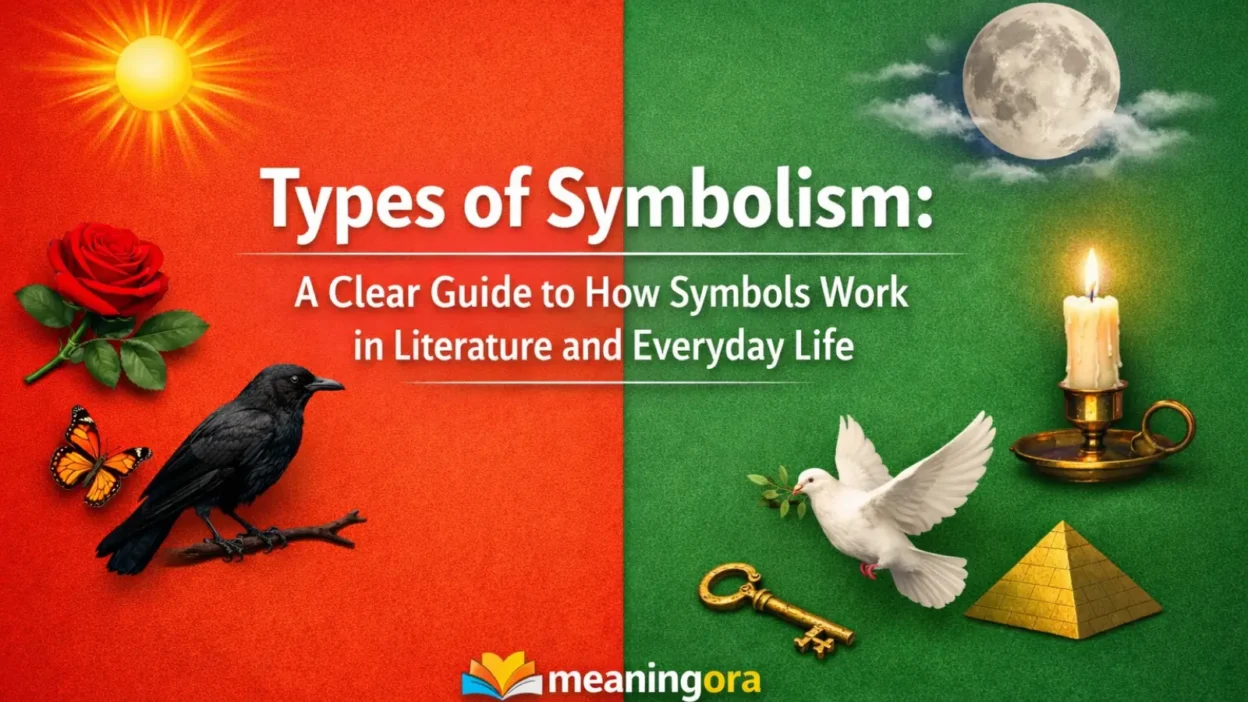
Color symbolism might use red for danger, passion, shame, or sacrifice. Object symbolism might use a ring, letter, key, mask, or light to stand for something larger. Animal symbolism may attach human ideas to lions, doves, snakes, ravens, or deer. Nature symbolism often uses storms, seasons, rivers, forests, or moonlight to reflect pressure, change, memory, or renewal.
Religious symbolism is another major category, but it needs extra care. Some symbols belong to living traditions and should not be stripped into vague aesthetic language. A cross, lotus, crescent, halo, or sacred animal can carry meaning inside a religious tradition, in later art, and in modern commercial reuse, but those layers are not automatically the same thing.
Type 3: symbolism by context and shared meaning
The most useful system for accuracy may be the context-based one. Del Mar College separates symbols into general and specific kinds. A general symbol has a more widely recognized meaning. A specific symbol gains meaning from the particular story, poem, or artwork using it.
For modern readers, it helps to expand that into three levels:
general or conventional symbolism, cultural symbolism, and text-specific symbolism. A heart shape for love may feel broadly familiar. The American flag, bald eagle, and Statue of Liberty carry strong U.S. civic meaning. But a green light, broken watch, or old coat inside a novel may become symbolic only because the text teaches you how to read it.
This is also where many weak articles go wrong. They jump too quickly from “commonly associated with” to “universally means.” Academic sources push back on that move. Symbols can be shared, but they are still shaped by culture, history, repetition, and context.
How symbolism developed over time
The English word symbolism has recorded use going back to the seventeenth century. Merriam-Webster lists a first known use in 1654. That tells us the term is old, but the modern way people discuss it now comes from several later traditions, especially literary study, art interpretation, and modern classroom writing instruction.
There is also a capital-S historical movement called Symbolism. Britannica describes it as a late nineteenth-century literary and artistic movement that began with French poets and later influenced painting, theater, and twentieth-century European and American literature. That movement did not invent symbols, but it helped make symbolic suggestion, mood, and layered imagery a more central part of modern artistic language.
So the history of symbolism has two tracks. One is the long human habit of using meaningful signs and images. The other is the later literary and artistic tradition that made symbolic reading feel especially important to modern readers, students, critics, and writers.
How Americans use symbolism now
In the United States, symbolism is not just a literature-class topic. It shows up in public life, politics, art, school reading, advertising, sports, memorial culture, and digital communication. Smithsonian teaching material on American art points directly to icons such as the Statue of Liberty, the bald eagle, and the American flag as symbols used to communicate ideas about American culture and society.
Shared symbols also help everyday communication more broadly. Sociology resources note that cultures rely on symbols, whether those symbols are words, gestures, objects, or other signs that make shared meaning possible. That helps explain why symbolism works in everything from national rituals to warning labels to movie franchises.
Even digital culture keeps proving the point. Educational material from Arizona State notes that even seemingly universal visual shorthand like emoji can shift meaning across cultural contexts. So modern symbolism in America is both shared and unstable: familiar enough to communicate quickly, but flexible enough to be misunderstood or reinterpreted.
A simple way to compare the main systems
If you want one practical framework, use this table first.
| Way of classifying symbolism | What it focuses on | Typical examples | Best use |
| By literary device | How meaning is built in language or structure | metaphor, allegory, archetype, personification | writing analysis |
| By subject category | What kind of thing becomes symbolic | colors, animals, objects, nature, religious imagery | classroom examples |
| By context level | How shared the meaning is | general, cultural, text-specific symbols | accurate interpretation |
| By modern social use | Where symbols operate in life | flags, logos, mascots, emojis, memorial icons | U.S. culture and media |
This comparison solves most confusion. Instead of asking, “Which list is the real one?” ask, “Which system is this page using?” Once you do that, the topic stops feeling contradictory.
How to identify symbolism without overreading
Good symbolism usually leaves clues. Del Mar notes that symbols are often signaled by emphasis, repetition, or position inside a text. Purdue also notes that symbols tend to recur and carry information about events, characters, and the author’s larger concerns.
That gives readers a practical method. First, notice what keeps returning. Second, ask what ideas gather around that detail. Third, test your interpretation against the whole work. If the meaning only works in one isolated line and collapses everywhere else, it is probably a weak reading.
Oregon State adds another useful warning: sometimes a rose is just a rose, and sometimes a storm is just weather. Strong reading does not mean seeing secret symbolism in every object. It means knowing when the text has earned that deeper interpretation.
Common mistakes people make
The first mistake is treating every symbol as universal. That flattens history and culture. White may suggest innocence in one context and death or emptiness in another. An owl may suggest wisdom in one tradition and something darker in another. Shared meanings exist, but they do not erase cultural difference.
The second mistake is confusing related devices. Metaphor, allegory, archetype, and symbolism overlap, but they are not perfectly interchangeable. Some guides bundle them together for teaching convenience, while academic literary terminology separates them more carefully.
The third mistake is using spiritual, folklore, or religious claims too loosely. A symbol may have a traditional association, but that does not make every modern use sacred, ancient, or proven. For living traditions especially, it is better to name the context than to make dramatic claims about hidden universal truth.
Why symbolism still matters
Symbolism still matters because it helps people compress big ideas into memorable forms. A story can use one image to hold conflict, identity, grief, hope, power, or change without naming it directly every time. Culture works in a similar way. Shared symbols help groups communicate values, belonging, memory, and public meaning.
That is why the best answer to this keyword is not a random list. It is a framework. Once you understand the main systems behind symbolism, you can read more carefully, write more clearly, and avoid shallow claims that sound certain but ignore context.
If you want to understand the basic idea before exploring its different forms, read our detailed guide on symbolism definition for a clear and simple explanation.
FAQs
What are the main types of symbolism?
The clearest answer is that symbolism is commonly classified in three ways: by literary device, by symbol category, and by context. That is more accurate than pretending there is one universal list used by every teacher, writer, and critic.
Is metaphor a type of symbolism?
Many writing guides say yes, but stricter literary resources often treat metaphor as a related device rather than the same thing as a symbol. A metaphor compares, while a symbol usually builds layered meaning through context, recurrence, and interpretation.
What is the difference between general and specific symbolism?
General symbolism uses meanings that many readers may recognize more easily. Specific symbolism gains its meaning from the story, poem, film, or artwork itself, so you have to read the whole context to understand it well.
Are color, animal, and object symbolism real categories?
Yes. Those are common category-based ways of organizing symbolism, especially in literature and film explainers. They are helpful for teaching, but context still matters more than any one fixed meaning chart.
Does symbolism have the same meaning in every culture?
No. Some symbols travel widely, but meanings still shift across cultures, time periods, and local traditions. That is why good interpretation avoids claiming that one symbolic meaning is always universal.
Why do Americans care about symbolism so much in everyday life?
Because symbolism is built into U.S. public culture, not just literature. National icons, memorial imagery, sports branding, protest imagery, and digital shorthand all depend on shared symbolic meaning, even when people disagree about what those symbols should stand for.
Conclusion
The best way to understand types of symbolism is to stop looking for one rigid list. In real use, symbolism is classified in several valid ways. Writers may sort it by device. Teachers may sort it by category. Careful readers may sort it by how shared or text-specific the meaning is.