
Writers talk about symbolism all the time, but the term can get slippery fast. Sometimes it means a single object that carries extra meaning. Sometimes it means a larger pattern of images that slowly shapes how a story feels.
For most readers in the United States, symbolism for writers means using something concrete—a place, color, object, action, or repeated image—to suggest something larger without spelling it out. Done well, it gives a story depth. Done badly, it feels like a classroom assignment in disguise.
That matters because American readers are used to symbolic reading. They meet it in school, in book clubs, in films, in prestige TV, in advertising, and even in emoji-heavy digital life. People may not use the same words for it, but they know when a story detail seems to mean more than it says.
The trick is not to plant a “meaningful object” and hope for the best. Symbolism works when the story teaches the reader how to read that detail.
Quick Answer
In modern U.S. writing, symbolism for writers usually means using a concrete detail to point toward a larger idea, emotion, or tension in the story. Its meaning does not come from a fixed universal code so much as from context, repetition, contrast, and the associations readers bring with them.
TL;DR
- Symbols gain force from story context.
- A symbol is not the same as theme.
- Repetition often makes symbolism visible.
- Overexplaining usually weakens the effect.
- Familiar symbols need fresh context.
- Sacred imagery requires extra care.
Main Article
What symbolism means for writers
For a writer, symbolism is not decoration. It is a way of making meaning travel through the story in physical form.
That physical form can be almost anything. A broken watch. A shut window. A yellow dress someone keeps wearing long after a relationship ends. A neighborhood tree that survives every storm until it does not. The detail stays literal, but it also starts carrying emotional or thematic weight.
That is the key point many beginner guides skip. A symbol is still itself. A key in a story is still a key. What makes it symbolic is the pressure the story puts on it.
This is why symbolism feels natural in strong fiction and fake in weak fiction. In strong fiction, the symbol belongs to the world of the story. In weak fiction, it looks like it was imported to make the story seem deeper.
Why symbols work at all
Symbols work because human beings are pattern-making readers. We notice when a writer keeps returning to something, especially if that thing appears at turning points or shows up under emotional stress.
A detail starts to feel symbolic when the story gives it special treatment. It may be repeated. It may be framed with unusual emphasis. It may change as the character changes. It may appear beside a conflict the reader already cares about.
This is also why symbolism does not need to be mysterious. It is often built from plain old association. Winter can suggest emotional distance because cold, stillness, and scarcity already carry social and sensory weight. A locked door can suggest exclusion because that is what locked doors literally do.
In other words, symbols often grow out of use. Writers do not have to invent meaning from nothing. They work with associations readers already know, then reshape them for the story at hand.
Symbol, motif, theme, and allegory are not the same thing
These terms get mixed up constantly, and that confusion hurts both reading and writing.
A symbol is a detail that points beyond itself. A motif is a repeated element that builds a pattern. A theme is the larger idea the story explores. An allegory is a whole narrative system in which characters, settings, and events consistently stand for another level of meaning.
Here is the cleanest way to separate them:
| Term | What it is | What it does | Example shape |
| Symbol | One charged detail | Suggests extra meaning | A cracked cup suggests strain or memory |
| Motif | Repeated image or element | Builds pattern across the work | Repeated water imagery |
| Theme | Big underlying idea | States what the story wrestles with | Grief changes identity |
| Allegory | Full symbolic structure | Makes the whole narrative double-layered | A political fable |
A symbol can support a motif. A motif can help reveal a theme. But they are not interchangeable.
That distinction matters in revision. If you think your theme is your symbol, you may write too abstractly. If you mistake a repeated image for a full allegory, you may push the story harder than it can bear.
A short history of literary symbolism
Writers have used symbolic language for as long as stories have existed, but “Symbolism” with a capital S also names a specific literary and artistic movement.
In the late nineteenth century, French Symbolist poets pushed back against blunt description and direct statement. They favored suggestion, mood, indirect feeling, and layered imagery. That movement shaped later modern literature and helped make subtle symbolic writing feel artistically serious.
Still, it helps not to confuse the movement with the broader craft tool. You do not have to write like a Symbolist poet to use symbolism. A realist novel, a horror screenplay, a memoir, or a children’s book can all use symbolic detail.
The historical lesson is simpler than it sounds: writers have long used symbols to say more than a plot summary can say. What changed over time was not the existence of symbolism, but the prestige attached to subtlety, ambiguity, and indirect meaning.
Where symbolic meaning comes from
Symbolic meaning usually comes from five places.
First, it can come from physical traits. Fire suggests warmth, danger, destruction, or renewal because those are real qualities of fire.
Second, it can come from social use. Rings suggest commitment because cultures actually use rings in ceremonies of commitment.
Third, it can come from religious or ritual meaning. Light, water, bread, blood, ash, and veils all carry deep weight in many traditions, though not in the same way.
Fourth, it can come from literary memory. A writer using a green light, a white whale, or a forbidden garden is working in a world where earlier literature may echo in the background.
Fifth, it can come from the story itself. This is the most important one. A child’s red scarf can mean almost nothing on page five and become the emotional center of the book by page two hundred, simply because the story taught the reader to care.
That last point keeps writers honest. There is no universal dictionary that can do the work for you. Some associations are common. None are self-executing.
How writers build symbols without forcing them
Strong symbolism usually grows in stages.
Start with the pressure point of the story. What is your character struggling with: shame, freedom, class anxiety, grief, hunger for control, fear of being known? If you do not know that, the symbol will stay ornamental.
Then choose a detail that can live naturally inside the story world. A motel key card in a contemporary novel may do more work than an old-fashioned key if the setting is a chain hotel off the interstate. A symbol feels stronger when it fits the material world of the book.
From there, use a simple process:
- Attach the symbol to a real conflict.
- Repeat it sparingly, not mechanically.
- Let its meaning shift over time.
- Put it near turning points.
- Resist the urge to explain it outright.
Variation matters. If the same rainstorm always means “sadness,” the symbol goes flat. If rain first feels cleansing, later isolating, and later strangely liberating, it starts to act like lived meaning instead of a coded label.
The best symbols also survive literal reading. A house should still matter as a house. A necklace should still matter as a necklace. The symbolic layer should deepen the object, not replace it.
Common symbols writers use—and why many feel tired
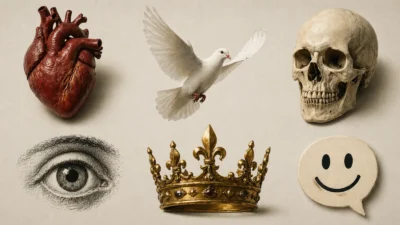
Some symbols show up so often that readers can predict them before the paragraph is over. Mirrors for identity. Storms for turmoil. Birds for freedom. Clocks for mortality. Roses for romance. Ravens for death. Keys for secrets.
These are not unusable. They are just high-risk.
They feel tired when the writer relies on inherited meaning alone. If the story assumes that a mirror automatically means self-knowledge, the symbol arrives prepackaged. The reader sees the shortcut.
They still work when the writer makes them specific. A mirror in a dance studio does different work from a mirror in a prison infirmary. A key on a teenager’s first car means something different from a key to an inherited house. A rose in a grocery-store bouquet does not land like a rose dried inside a family Bible.
A useful test is this: would the detail still feel chosen if the reader had never taken an English class? If yes, you are probably on stronger ground.
Symbolism in U.S. writing culture now
American readers are unusually trained to look for symbolism. School reading habits play a big role. Many people first learn symbolic reading through assigned novels, poems, and class essays. That can be helpful, but it also leaves some readers suspicious that every curtain color must “mean something.”
Modern U.S. culture adds another layer. We live in a world of logos, icons, franchise imagery, political color coding, awareness ribbons, meme templates, and visual branding. Readers are used to compressed meaning. A single image can carry identity, status, irony, or allegiance very quickly.
That changes how symbolism lands on the page. Contemporary readers often catch visual shorthand faster than older audiences did, but they also notice cliché faster. They can smell “writerly significance” from a mile away.
For writers, this cuts both ways. Symbolism can travel quickly because readers are trained for it. But it also needs more care because modern audiences are visually literate, culturally mixed, and often skeptical of symbols that feel borrowed rather than earned.
Sacred, political, and culturally loaded symbols need extra care
Not every symbol is just a useful storytelling prop.
Some images are alive inside real religious practice. Some are tied to mourning, ethnicity, national identity, or historical trauma. Some have been hijacked by hate movements. Some have layered meanings that change depending on who is looking.
That does not mean writers must avoid all charged symbols. It means they should know what they are touching.
If you borrow sacred imagery, ask whether the story understands the tradition or merely wants the aura of depth. If you use a political emblem, ask whether the reader is meant to read it as belief, irony, fear, performance, or background detail. If you use a symbol that has been appropriated by extremists, the history of that misuse may matter even if your character means something else by it.
This is especially important in U.S. publishing culture, where readers often come from mixed traditions and bring different levels of historical memory. A symbol that looks “neutral” to one audience may feel loaded to another. Good writing does not panic about that. It pays attention.
When symbolism goes wrong
Symbolism usually fails in familiar ways.
- It is too obvious. The writer keeps pointing at it until the reader stops participating.
- It has only one note. The symbol never changes as the story changes.
- It does not belong to the world. The object feels imported for significance.
- It conflicts with the story’s emotional logic. The symbol says one thing while the plot says another.
- It depends on a cliché the reader has seen too often.
- It asks for cultural agreement that the story has not earned.
Another common failure is mixed signaling. A writer may load one image with grief, rebirth, purity, secrecy, and rebellion all at once. Multiple meanings are possible, but they still need control. If everything means everything, the symbol dissolves.
And sometimes the problem is not the symbol at all. It is the explanation after the symbol. The fastest way to weaken a charged detail is to translate it too neatly for the reader.
A simple revision test for stronger symbolism
When you revise, do not ask, “What should this symbol mean?” Ask better questions.
- Where does the symbol first appear?
- Why would this character notice it?
- What literal role does it play?
- Does it recur at meaningful moments?
- Does its meaning deepen or shift?
- Is the story overexplaining it?
- Could a reader still follow the story without decoding it?
- Does it rely on cultural assumptions I have not examined?
- Is there a fresher object, image, or setting detail available?
- Does this symbol belong to this specific book, or could it be pasted into any book?
If you can answer those questions clearly, your symbolism is probably doing real work.
If not, the fix is usually not “make it bigger.” It is usually “make it truer to the story.”
FAQs
What does symbolism for writers usually mean?
It usually means using a concrete detail to suggest a larger idea, emotion, or theme. For most writers, the goal is not to hide a code but to add depth through pattern, context, and association.
Is symbolism the same as motif?
No. A symbol is one charged detail, while a motif is a repeated element that builds a pattern across the work. A motif can contain symbols, but the terms are not interchangeable.
Should writers explain their symbols?
Usually not in a direct way. Readers tend to trust symbolism more when the story lets the meaning emerge through repetition, placement, and change rather than a tidy explanation.
Can a symbol have more than one meaning?
Yes, but not unlimited meaning. A symbol can hold several layers at once, especially if those layers fit the story’s context, genre, and emotional logic.
Does symbolism matter in commercial fiction, or only in literary fiction?
It matters in both. Thrillers, romance, horror, fantasy, young adult fiction, and screenwriting all use symbolism, even when they do it fast and quietly.
What are good symbols for tattoos or character design in fiction?
That depends on the character, not a universal list. The strongest tattoo or visual symbol in fiction usually comes from lived history, group identity, memory, belief, or contradiction within the character.
Conclusion
Symbolism works best when it stays close to the life of the story. It is not a layer you spread on top of the draft after the fact. It is a way of letting objects, places, actions, and images carry emotional pressure.