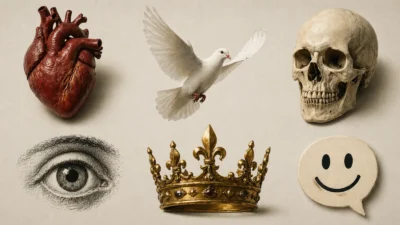
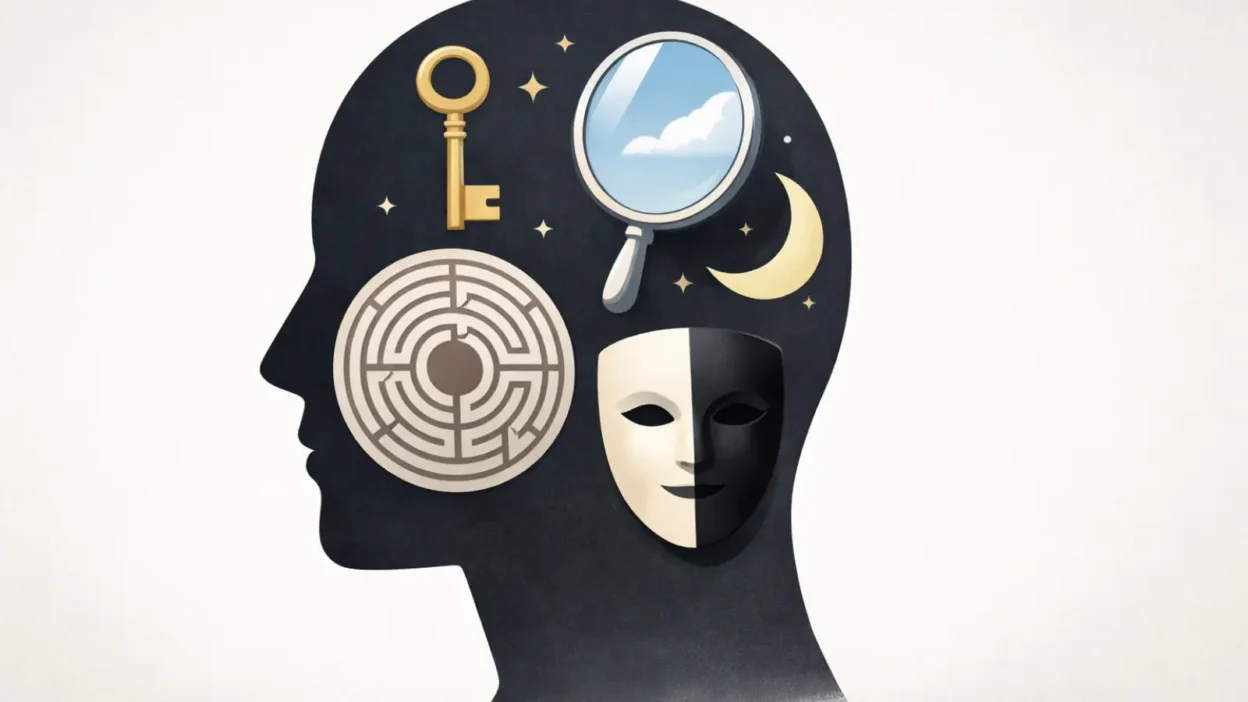
Symbolism in psychology usually refers to the way an image, object, action, or idea stands for something beyond its literal form. In plain terms, a symbol carries extra meaning. It can point to a feeling, memory, conflict, belief, social role, or larger pattern in human experience.
People care about this topic because symbols show up everywhere. They appear in dreams, therapy, religion, art, language, childhood play, branding, and everyday habits. Sometimes they are deeply personal. Sometimes they are shared by a whole culture.
In modern U.S. culture, the subject often gets reduced to dream dictionaries or social media posts that promise one fixed meaning for every image. That is too simple. Psychology treats symbols as meaningful, but it does not always treat them as universal or easy to decode.
The clearest modern view is this: symbols matter because human beings think, feel, remember, and communicate through representations, not just through literal facts.
Quick Answer
Symbolism in psychology most often refers to the way people use images, objects, words, or actions to represent deeper thoughts, feelings, and ideas. In modern use, it usually points to meaning-making in the mind, especially in dreams, therapy, development, and culture, though the exact meaning of a symbol depends heavily on context.
TL;DR
- Symbols stand for more than they literally show.
- Psychology uses symbols in theory, therapy, and development.
- Freud and Jung made symbolic interpretation widely known.
- Meanings are often contextual, not fixed.
- Children develop symbolic thinking early.
- U.S. culture uses psychological symbols constantly.
Main Article
What symbolism in psychology actually refers to
In psychology, a symbol is not just a sign or label. It is something that carries meaning beyond its immediate form.
A stop sign is mostly direct. It tells you what to do. A dream about a locked room is different. The room may not matter as a room. It may stand for privacy, fear, memory, shame, or something else entirely.
That difference matters. When psychologists talk about symbolism, they are often talking about representation. One thing stands in for another. The meaning may be emotional, social, unconscious, or culturally learned.
That is why the topic stretches across several parts of psychology. It belongs to psychoanalysis and Jungian thought, but also to child development, cognition, language, play, and culture.
Why symbols matter to the human mind
Human beings do not think only in literal terms. We think through stories, images, words, metaphors, and substitutes.
A flag can stand for a nation. A wedding ring can stand for commitment. A childhood toy can hold grief, safety, or memory far beyond its physical use. These are ordinary examples of symbolic thinking.
Psychologically, symbols help people handle things that are hard to hold directly. Some experiences are abstract, like identity. Some are painful, like loss. Some are complex, like shame, desire, or conflict. Symbols compress those experiences into a form the mind can work with.
This is one reason symbols feel so charged. They can gather emotion, memory, and social meaning into a single image or object.
Freud and the early psychoanalytic view of symbols
For many readers, symbolism in psychology begins with Freud. That makes sense. Freud helped make symbolic interpretation famous, especially through dream analysis.
In classical psychoanalysis, a dream image could disguise a wish, fear, or conflict that the mind could not face directly. The symbol was not random. It was part of a process of indirect expression. That idea shaped popular culture so strongly that many people still hear “psychological symbol” and think “dream code.”
But Freud’s symbolic method has limits.
First, Freud often linked symbols to repressed wishes in ways many later readers found too narrow. Second, later psychology challenged the idea that dream images can be decoded through one stable key. Third, even within psychoanalytic traditions, interpretation depends on the person, the setting, and the larger emotional pattern.
So Freud matters historically. He helped establish the idea that the mind can speak indirectly. But his approach is not the final word on what symbols mean.
Jung’s view: symbols, archetypes, and the unconscious
If Freud made symbols famous, Jung made them expansive.
Jung argued that symbols do more than hide repressed material. In his view, they can reveal parts of the psyche that are still forming, still emerging, or not yet fully understood. That is one reason Jungian writing often sounds less like code-breaking and more like exploration.
He also linked symbols to archetypes. These are not fixed pictures stored in the brain like files. They are better understood as recurring patterns or themes that show up in myths, religion, dreams, stories, and inner life. The mother, the shadow, the hero, the wise old figure, and the journey are common examples in later Jungian discussion.
This is where caution matters. Jungian ideas remain influential, especially in art, literature, spirituality, and therapy. But many modern readers overstate them. Not every repeated image proves a universal archetype. Not every symbol means the same thing in every culture.
Still, Jung’s lasting contribution is clear. He helped people see symbols not only as disguises, but as ways the mind organizes experience and reaches toward meaning.
Personal symbols versus shared cultural symbols
A central mistake in popular interpretation is assuming that all symbols work the same way.
Some symbols are mostly personal. Others are widely shared. Many are a mix of both.
| Type of symbol | What it depends on | Example | Main caution |
| Personal symbol | Individual memory and emotion | A lake tied to one person’s grief | Outsiders may misread it |
| Cultural symbol | Shared social learning | Wedding ring, national flag | Meaning varies by culture and era |
| Religious symbol | Tradition and belief community | Cross, crescent, lotus | Should not be reduced to aesthetics |
| Theory-based symbolic reading | Clinical or interpretive framework | Shadow figure in a Jungian reading | Not the only valid interpretation |
A snake is a useful example. For one person, it may represent childhood fear. In a religious setting, it may carry moral or spiritual meaning. In a medical logo, it can signal healing. In a dream, it may be read through personal context, not through a universal answer sheet.
That is why strong interpretation begins with context, not with certainty.
How symbolism appears in modern therapy
Symbols still appear in therapy, but modern practice is usually more careful than popular culture suggests.
A client may describe recurring images, dreams, fantasies, or objects that feel emotionally loaded. A therapist may explore what those images connect to. The goal is not always to “solve” the symbol. Often the goal is to understand what it organizes: fear, memory, identity, conflict, or desire.
This can happen in several ways:
- through dream discussion
- through art or image-based work
- through play therapy with children
- through recurring metaphors in speech
- through body-based or emotional imagery
In good therapy, symbols are not usually treated as fortune-telling devices. They are treated as clues. They may point toward something meaningful, but they need the person’s own associations, history, and emotional reality.
That distinction is important. Therapy may work with symbols, but it does not require blind belief in one universal symbolic system.
Symbolic thinking in childhood development
Psychological symbolism is not just about adults and dreams. It is also built into normal development.
Children begin to show symbolic thinking when they can let one thing stand for another. A banana becomes a phone. A block becomes a car. A child pretends to be a doctor, parent, monster, or teacher. That is not meaningless play. It is a major step in mental development.
This matters for several reasons.
First, symbolic thought helps children represent things that are not physically present. Second, it supports language, imagination, memory, and social learning. Third, symbolic play can help children work through fear, frustration, and everyday experience.
In this sense, symbolism in psychology is not fringe material. It is part of how human minds grow.
Symbolism in everyday American life
In the United States, people use symbols psychologically all the time, even when they do not describe it that way.
Think about:
- Identity: tattoos, jewelry, clothing, and personal objects often stand for values, grief, recovery, faith, or belonging.
- Digital life: emojis, profile images, and aesthetic choices act as fast symbolic signals of mood, attitude, or group identity.
- Branding: logos and colors aim to trigger trust, status, safety, youth, rebellion, or simplicity.
- Public rituals: memorials, uniforms, flowers, candles, and silence carry symbolic weight beyond practical use.
- Personal narrative: people often describe life stages through symbols like doors, masks, storms, roots, or crossroads.
This is one reason the topic remains relevant. Even people who never read Freud or Jung still live in a symbolic world.
Why symbols feel emotionally powerful
Symbols often feel powerful because they connect several layers of experience at once.
A symbol may hold memory. It may also hold social meaning. It may carry a story about the self. And it may gather strong feeling without forcing a person to explain everything directly.
That layered quality helps explain why symbols can feel more intense than plain language. A person may struggle to say, “I feel split between who I am and who others expect me to be.” But the image of a mask may express it instantly.
There is nothing magical about that. It is a feature of how memory, emotion, and association work together.
Symbols can also organize experience over time. A person may return to the same image again and again because it gives shape to a recurring inner problem. In that sense, symbols can be psychologically useful even when their meaning is not perfectly clear.
Common oversimplifications and misuse
This topic gets distorted easily. A few habits are especially common.
- Treating every symbol as universal. Some patterns recur widely, but meanings still shift across culture, religion, and personal history.
- Using dream dictionaries as fixed truth. They can be interesting, but they often flatten complex experience into canned answers.
- Confusing Jungian interpretation with settled science. Jung remains influential, but influence is not the same as proof.
- Reducing sacred symbols to mood-board aesthetics. Religious and living cultural symbols should be handled with care.
- Acting as if one object always reveals one hidden message. Context changes everything.
This is especially visible online. Social media rewards certainty, speed, and neat lists. Psychology usually works more slowly than that.
What symbolism in psychology means today
Today, the strongest way to understand symbolism in psychology is to see it as a bridge concept.
It connects mind and culture. It connects private feeling and shared meaning. It connects development, language, therapy, memory, and identity.
Historically, Freud and Jung made symbolic interpretation famous. Modern psychology keeps part of that legacy, but it uses more caution. Symbols can reveal patterns. They can express emotion indirectly. They can structure thought. But they are not always universal, and they are not always easy to read.
That more careful view is also the more useful one. It leaves room for history, theory, and interpretation without pretending every symbol comes with one final answer.
FAQs
Is symbolism in psychology the same as dream interpretation?
No. Dream interpretation is one major branch of the topic, especially in psychoanalytic and Jungian traditions, but symbolism in psychology also includes symbolic thinking, language, play, memory, and cultural meaning. The broader topic is about how the mind uses representation.
What did Freud believe symbols meant?
Freud generally treated symbols as disguised expressions of wishes, fears, or conflicts, especially in dreams. His approach shaped popular culture, but many later psychologists thought his readings were too narrow or too confident.
What did Jung add to the idea of symbols?
Jung treated symbols as more than disguises. He saw them as meaningful expressions of the psyche, often tied to larger patterns, myths, and archetypal themes, though many modern readers overstate how universal those themes really are.
Are psychological symbols universal?
Sometimes there are broad recurring patterns, but no, most symbols should not be treated as universally fixed. Personal history, religion, language, culture, and situation all affect what a symbol means.
What does symbolism in psychology mean for tattoos?
A tattoo can function as a personal symbol of grief, survival, identity, faith, love, or change. Its meaning may matter more to the person wearing it than to any public interpretation guide.
Does modern therapy still use symbols?
Yes, some therapists explore symbols through dreams, art, recurring images, or metaphor. But good therapy usually treats symbols as part of a person’s lived context, not as clues from a universal codebook.
Conclusion
The clearest modern takeaway is simple: symbols matter in psychology because people do not live by literal facts alone. We also live by images, stories, rituals, substitutions, and emotional associations.