People ask for symbolism examples with meanings because symbols show up everywhere. They appear in tattoos, greeting cards, logos, classroom lessons, religious spaces, social media, and everyday design. A simple image can carry much more than its literal form.
The tricky part is that symbols are not fixed in stone. A heart may suggest love, care, or health. An owl may suggest wisdom in one setting and a bad omen in another. The same image can change meaning across time, place, and community.
For a U.S. reader, the most useful approach is not to hunt for one “true” meaning. It is to ask what a symbol most commonly means now, where that meaning came from, and whether that meaning is historical, religious, folkloric, commercial, or purely personal.
Quick Answer
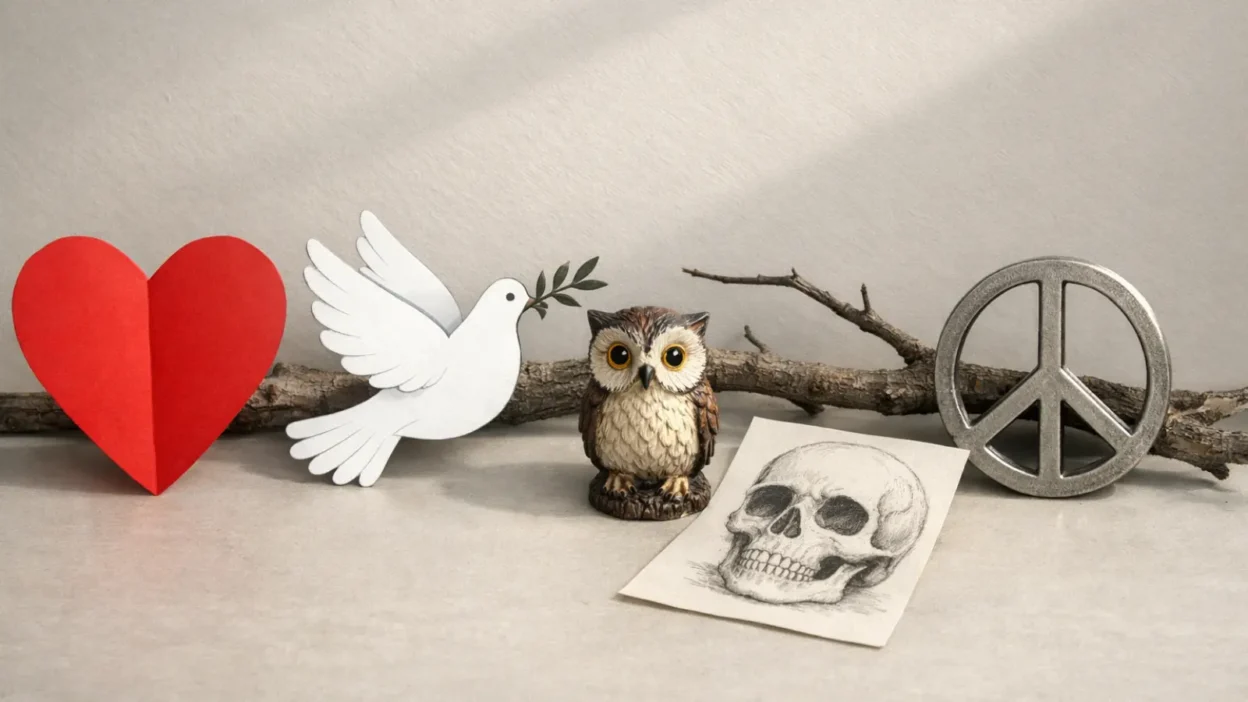
In modern U.S. use, symbolism examples with meanings usually refer to familiar images that stand for larger ideas, like a heart for love, a dove for peace, an owl for wisdom, or a skull for death and danger. Those meanings did not appear out of nowhere: they developed through religion, art, folklore, politics, advertising, and repeated everyday use, and some are much more culture-specific than people assume.
TL;DR
- Symbols work through shared cultural meaning.
- Context matters more than “universal” lists.
- Hearts usually mean love or care.
- Doves often suggest peace and renewal.
- Owls can mean wisdom or warning.
- Sacred symbols need extra care.
What people mean when they ask for symbolism examples with meanings
A symbol is something visible that points beyond itself. It might be an object, animal, shape, color, or sign that people connect with a larger idea. That larger idea might be emotional, spiritual, political, or social.
What makes symbolism useful is repetition. When enough people learn the same association, the image starts working as shorthand. That is why a heart can communicate affection in a text message without any explanation.
Still, symbols are not magic codes with one answer. Meaning depends on setting. A symbol in church, on a T-shirt, in a tattoo studio, or inside an app may not carry the same weight.
Why some symbols become widely recognized
Most common symbols become familiar for a few simple reasons.
First, they are easy to remember. A heart, a dove, or a skull has a strong visual shape. Second, they connect to ideas people already feel strongly about, like love, danger, peace, grief, or hope. Third, institutions repeat them. Religion, schools, public signs, campaigns, brands, and mass media all help stabilize meaning.
That does not make them universal. It only makes them common within certain traditions or shared media environments. In the United States, many symbol meanings feel “obvious” because people meet them early and often through holidays, advertising, emojis, memorial culture, and entertainment.
Heart: love, care, and emotional closeness
Today, the heart is probably the most recognizable symbol of love in the United States. It also suggests affection, care, compassion, emotional closeness, and, in some contexts, physical health. You see it on Valentine’s Day cards, reaction buttons, charity campaigns, and food packaging.
Its history is layered. The modern heart shape does not come from one neat ancient origin story. Historians and popular explainers point instead to a long development involving medieval ideas about the heart as the seat of emotion, courtly love imagery, and Christian devotional images such as the Sacred Heart. That is why the heart became both a romantic and a spiritual sign before it became a digital icon.
In modern American use, the heart has widened even more. It can mean:
- romantic love
- family affection
- kindness
- support for a cause
- “I like this”
- heart health
That breadth is helpful, but it also flattens older meanings. A heart emoji and the Sacred Heart of Jesus are not interchangeable, even though both use heart imagery. One is casual and flexible; the other is devotional and tradition-specific.
Dove: peace, hope, and gentle renewal
The dove usually means peace in modern U.S. culture. It can also suggest innocence, reconciliation, hope, or a fresh start. White doves show up in memorial imagery, weddings, sympathy designs, and peace-themed art for exactly that reason.
That meaning has deep roots. In biblical tradition, the dove and olive branch became tied to the end of destruction and the return of peace after the flood story. In Christian art, the dove also developed associations with the Holy Spirit and divine peace. Later, modern political art helped turn the dove into a secular peace emblem, especially through Pablo Picasso’s 1949 Dove.
This is a good example of symbolism changing without losing its past. The dove did not stop carrying religious meaning when it became a peace symbol. It simply gained a broader public role. In the United States today, many people use it without thinking about theology at all.
Owl: wisdom in some traditions, warning in others
Americans often learn that the owl means wisdom. That idea comes largely from the owl’s link to Athena in ancient Greek tradition and from later Western education and popular culture, where the owl became a mascot for intelligence, libraries, and learning.
But this is where symbol lists often oversimplify. Owls do not mean wisdom everywhere. In some traditions, night birds can carry meanings tied to secrecy, death, fear, or warning. Their nocturnal behavior, unusual calls, and visible eyes make them easy to interpret in very different ways.
For U.S. readers, the safest summary is this: the owl most commonly suggests wisdom today, but that meaning is not universal. It is a culturally specific reading that became dominant in Western schooling and design.
Skull: death, danger, and remembering life is short
The skull has one of the widest meaning ranges of any common symbol. In everyday American life, it often signals death, danger, poison, fear, Halloween, or edgy style.
Historically, though, the skull also had a reflective meaning. In memento mori art, skulls reminded viewers that life is short and status does not last. Museum collections and art-history discussions show skulls paired with candles, flowers, clocks, and hourglasses to push that same point: beauty fades, time runs out, and death comes to everyone.
That older use matters because it explains why the skull can mean more than fear. Depending on context, it can suggest:
- mortality
- humility
- spiritual reflection
- equal fate for rich and poor
- rebellion or anti-establishment style
- literal hazard
A skull on a lab label is a safety warning. A skull in memorial art may be philosophical. A skull tattoo might mean survival, fearlessness, grief, or nothing more than visual style. Context does the real work.
Tree: life, family, endurance, and rootedness
Trees are common symbols because their physical form is easy to interpret. Roots suggest origin. Branches suggest growth. Rings suggest time. Seasonal change makes trees especially useful for talking about death, renewal, memory, and endurance.
In the United States, tree symbolism often shows up in family-tree language, memorial planting, nature-inspired tattoos, home décor, and wellness branding. When people use a tree symbol today, they often mean one of four things: life, family connection, stability, or personal growth.
That does not mean every tree means the same thing. Species, season, and setting can shift the reading. A bare winter tree may suggest grief or loneliness. A flowering tree may suggest hope, spring, or renewal. The broad symbol stays familiar, but the details change the mood.
Cross, peace sign, and dreamcatcher: why sacred and political symbols need extra care
Some symbols carry extra weight because they are still active inside living traditions or social movements.
The cross is the clearest example. In the United States, many people see it as a general symbol of faith, hope, sacrifice, or Christianity. But for practicing Christians, it is not just decorative. It is tied to core religious belief. That makes casual reuse different from devotional use.
The peace sign is another good case. Many Americans treat it as a free-floating sign for peace, but its modern form has a specific political history. The symbol was created for the Campaign for Nuclear Disarmament in 1958 and later spread far beyond that original context. In other words, its meaning broadened, but it did not begin as a vague ancient sign.
The dreamcatcher requires even more care. In U.S. retail culture, it is often sold as a general spiritual or bohemian decoration. But Indigenous writers and community voices have stressed that this use can strip the object of its cultural meaning and turn a living tradition into an aesthetic product.
The larger rule is simple: when a symbol is sacred, political, or identity-based, ask whether you are seeing the original meaning, a later adaptation, or a commercial copy.
A quick comparison of common symbols and what they usually mean now
| Symbol | Most common U.S. meaning today | Important caution |
| Heart | Love, care, affection | Also used for health, branding, and devotion |
| Dove | Peace, hope, renewal | Religious roots still matter |
| Owl | Wisdom, knowledge | Not a universal meaning |
| Skull | Death, danger, rebellion | Can also mean reflection on mortality |
| Tree | Growth, family, rootedness | Species and setting change the tone |
This table is useful as a starting point, not a final verdict. Symbols become misleading when people treat them like permanent dictionary entries instead of living cultural shorthand.
How Americans use symbols today in tattoos, gifts, logos, décor, and online life
Modern U.S. symbolism is practical and personal. People do not only inherit meanings. They also remix them.
In tattoos, symbols often keep their broad public meaning while adding a private story. A heart may stand for a partner, child, or recovery. A tree may stand for ancestry. A skull may stand for loss survived rather than death feared.
In gifts and décor, symbols tend to become softer and more commercial. Hearts, doves, trees, moons, and flowers are used because they feel emotionally legible. They do not require much explanation.
In logos and campaigns, symbols are used for speed. The heart is especially powerful in American branding because it can signal love, civic pride, support, or health in a single shape. That helps explain the durability of icons like “I Love New York” and the American Heart Association’s Heart-Check mark.
Online, symbols become even more flexible. Emoji have made many meanings faster, lighter, and more personal. A red heart can mean romance, friendship, approval, or emotional emphasis depending on who sends it and why. That is modern symbolism in its simplest form: shared enough to work, loose enough to adapt.
FAQs
What are the best-known symbolism examples with meanings?
The best-known examples in modern U.S. culture include the heart for love, the dove for peace, the owl for wisdom, the skull for death or danger, and the tree for life or growth. These are common because they appear often in education, religion, media, design, and everyday communication.
Does a symbol always mean the same thing?
No. Symbols depend on context, culture, and time period. A meaning that feels obvious in the United States may be weaker, different, or even reversed somewhere else.
What does a symbol mean in a tattoo?
A tattoo meaning is usually a mix of public and private meaning. A skull may suggest mortality in art history, but in a tattoo it might mean survival, grief, toughness, or simply a visual style choice.
Are symbol meanings spiritual facts?
Not usually. Some symbol meanings come from living religious traditions, while others come from folklore, superstition, or later interpretation. It is better to describe them as cultural or belief-based meanings unless there is a clear historical record behind them.
Why do some symbols feel universal?
They often feel universal because they are repeated so often in media, design, and schooling. But widespread use is not the same thing as true universality, and many “everyone knows this” claims fall apart under closer cultural comparison.
Is it okay to use sacred symbols as décor?
That depends on the symbol and the context. Some symbols have become widely decorative, but others still carry strong religious or cultural meaning, so casual reuse can feel flattening, disrespectful, or appropriative.
Conclusion
Symbols matter because they help people compress big ideas into simple forms. A heart, dove, owl, skull, or tree can communicate emotion, memory, identity, or belief in a way that feels immediate.