Poetry often says more than it states outright. A poem may mention a road, a bird, a season, or a house, but the reader quickly senses that the image is doing extra work.
That is the heart of symbolism in poetry. A symbol is usually something concrete that points beyond itself toward an emotion, idea, value, conflict, or state of mind.
People care about symbolism because poems are short. They cannot explain everything directly, so poets often compress meaning into images readers can feel and remember. In modern U.S. culture, that matters not only in classrooms but also in spoken-word performance, song-adjacent poetry, and personal writing, where a single image can carry grief, identity, love, fear, or hope.
Quick Answer
In modern U.S. reading, symbolism in poetry usually means using a concrete image, object, action, or setting to suggest a deeper idea or emotion without naming it directly. Historically, poets have used symbols for centuries, but modern readers also connect symbolism with close reading, layered meaning, and the idea that a poem can support more than one evidence-based interpretation.
TL;DR
- Symbols connect images to larger ideas.
- Meaning depends on context, not dictionaries.
- Not every object in a poem is symbolic.
- Symbolism is older than the Symbolist movement.
- U.S. readers meet it most in school and modern poetry.
- Good interpretation needs textual evidence.
What symbolism in poetry actually means
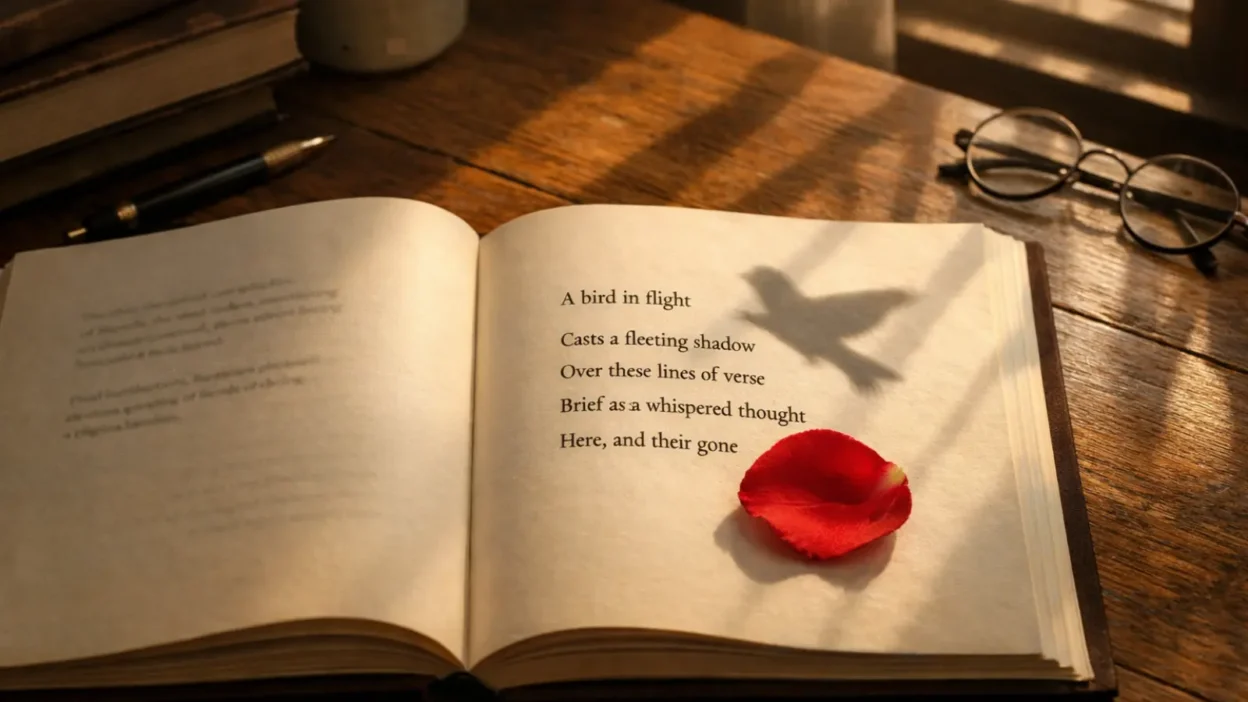
A symbol in poetry is usually something you can picture: a rose, a river, a locked door, a winter field, a bird in flight. On the page, it remains itself. But it also points to something less literal, such as desire, separation, freedom, memory, or mortality.
That double function matters. A rose is still a flower. A road is still a road. Symbolism begins when the poem makes that image carry an added layer of meaning.
This is why symbolism is close to metaphor, but not identical to it. A metaphor compares one thing to another. A symbol tends to build meaning through presence, repetition, association, and context. In practice, poems often use both at once.
Why poets rely on symbols in the first place
Poets use symbols because poems work under pressure. Space is limited. Every word matters. A symbol lets a poet compress thought and feeling into something a reader can hold in the mind.
Symbols also slow the reader down in a useful way. Instead of delivering a flat statement like “the speaker feels trapped,” a poem can describe a sealed room, a narrow hallway, or a bird beating against glass. The reader experiences the feeling rather than receiving a summary.
That indirectness is part of poetry’s appeal. It gives room for mood, uncertainty, and discovery. It also explains why readers often remember a poem’s images long after they forget its argument.
Where poetic symbolism came from
Poetic symbolism did not begin in one place or one century. Writers have long used objects and images to stand for larger ideas, especially in religious writing, myth, allegory, and lyric poetry.
Still, it is better to be specific than vague. Rather than claiming that symbols have meant the same thing “throughout history,” it is more accurate to say that many traditions developed recurring symbolic habits. Flowers could suggest love or transience. Light could suggest knowledge, revelation, or divine presence. Night could suggest danger, intimacy, rest, or mystery. Those associations grew from ritual, story, natural observation, and repeated literary use.
Over time, repeated usage makes some symbols feel familiar. But familiar does not mean fixed. A white flower in one poem may suggest innocence. In another, it may suggest mourning, emptiness, or emotional distance. That is why historical background helps, but the poem itself still comes first.
The Symbolist movement changed how readers talk about symbols
There is an important distinction here. Symbolism with a capital S refers to a late-19th-century literary and artistic movement associated especially with French poets such as Stéphane Mallarmé, Paul Verlaine, and Arthur Rimbaud.
These writers pushed against plain description and realism. They favored suggestion, dream logic, musical language, and images that hint rather than explain. Their work helped shape the modern idea that poetry can move through association instead of direct statement.
That movement did not invent symbolic writing. Poets were doing that long before. But it did help formalize a style of reading in which image, mood, and indirect meaning became central. That influence still lingers in the way many readers talk about poems today.
How symbols gather meaning inside a poem
A symbol does not arrive with a label attached. It gathers force from the poem around it.
Readers usually get the clearest clue from a few places:
- Repetition: if an image returns, it probably matters.
- Placement: titles, first lines, and endings often sharpen symbolism.
- Tone: the same moon can feel tender, cold, eerie, or comforting.
- Speaker perspective: a child, mourner, lover, exile, or veteran may load the same object differently.
- Cultural context: an eagle, cross, veil, or flag may carry specific inherited meanings.
- Contrast: when a poem places two images against each other, symbolic pressure increases.
This is why good interpretation is evidence-based. If a reader says a river symbolizes time, the poem should support that reading through motion, age, memory, loss, or some related pattern. Otherwise the claim may just be free association.
Common symbol families in poetry and what they often suggest
Some symbol families show up so often that readers benefit from knowing the pattern. But these are starting points, not fixed translations.
| Symbol family | Often suggests | Key caution |
| Seasons | change, aging, renewal, endings | Spring is not always hopeful; winter is not always despair |
| Birds | freedom, soul, warning, song, escape | Species and tone change meaning |
| Roads and paths | choice, direction, life course | Sometimes a road is mainly setting, not symbol |
| Houses and rooms | selfhood, family, memory, confinement | Social class and historical setting matter |
| Water | time, cleansing, danger, change, grief | Calm water and violent water do different work |
Readers often learn these patterns in school because they are genuinely useful. But trouble starts when they become shortcuts. A bird does not automatically mean freedom. In some poems it means omen, fragility, witness, hunger, or noise. The image must earn its meaning in context.
What symbolism usually means in modern U.S. reading culture
In the United States, symbolism in poetry is tied strongly to reading practice. Many people first meet it in middle school, high school, AP Literature, or college writing courses, where they learn to ask what an image suggests beyond the literal scene.
That classroom influence matters because it shapes popular expectations. A lot of American readers assume a “good” poem has layers. They expect images to connect with theme, identity, politics, memory, or emotional conflict.
Outside school, symbolism also matters in contemporary poetry communities. A poem about a kitchen table may carry family history. A poem about hair may speak to race, beauty, gender, religion, or self-making. A poem about an ocean may hold migration, grief, climate anxiety, freedom, or ancestry. The symbol is often ordinary. The meaning comes from pressure, voice, and context.
This is also why modern U.S. readers tend to value flexible interpretation, but not unlimited interpretation. A poem may support several strong readings. That does not mean every reading is equally convincing.
Symbolism is not the same as a secret code
One common mistake is treating poetry like a puzzle book where each image has one hidden answer. That is not how symbolism usually works.
A symbol is not a fixed code word. It is a relationship between image and meaning created by the poem. Sometimes the relationship is clear. Sometimes it is deliberately unstable. A crow might feel like grief in one poem and survival in another. A mirror might suggest vanity, self-knowledge, fragmentation, or social performance.
Author intent matters, but readers rarely have direct access to it. What they do have is the poem. So the strongest interpretation is the one that fits the language, structure, tone, and pattern of the poem itself.
Spiritual, religious, and mythic symbols need extra care
Many poems draw on inherited sacred images: crosses, gardens, ladders, rivers, light, stars, temples, bread, fire, serpents, veils, or resurrection motifs. These symbols can carry deep meaning within living religious traditions.
That is why readers should be careful not to flatten sacred imagery into generic “spiritual vibes.” In one poem, a dove may suggest peace because of broad cultural habit. In another, it may carry specifically Christian associations. A lotus may be aesthetic decoration in one context and a religiously rooted sign in another. The poem’s voice and tradition matter.
The safest approach is precision. Say what the poem actually supports. If the evidence points to biblical, classical, or folk inheritance, say that. If the resemblance is looser, say it may evoke that tradition rather than declaring it certain.
When symbolism gets flattened, commercialized, or overread
Modern culture loves portable meanings. That can make poetic symbolism feel simpler than it is.
Online lists, posters, classroom cheatsheets, and aesthetic culture often reduce symbols to one-line definitions: rose equals love, raven equals death, road equals choice. Those formulas are useful as entry points, but they can erase history and context. A rose may also suggest secrecy, beauty under threat, political identity, ritual use, or a poet’s specific literary inheritance.
Commercial reuse adds another layer. Symbols that carry sacred, tragic, or culturally specific meanings can become décor, branding, or tattoo shorthand. That does not make all reuse wrong, but it does mean readers should distinguish between a long-standing tradition and a modern aesthetic remix.
Overreading is the other danger. Not every apple, moon, or doorway is a symbol. Sometimes a poem needs a room simply because the speaker is standing in one. The test is whether the poem asks the image to carry more than itself.
How to read symbolism in poetry without forcing it
A practical method helps.
Start with the literal level. What is happening in the poem? What object, place, action, or image keeps showing up?
Then ask a few grounded questions:
- What emotions gather around this image?
- Does it repeat or change?
- Does the title make it more important?
- Is the image linked to culture, religion, history, or personal memory?
- What theme would weaken if the image disappeared?
If your answer depends only on a generic symbol chart, pause. If your answer grows out of the poem’s language and pattern, you are probably on firmer ground.
The best reading of symbolism is rarely the fanciest one. It is the clearest one the poem can support.
FAQs
What does symbolism in poetry usually mean?
It usually means that a poem uses an image, object, action, or setting to suggest a larger idea without stating it directly. The meaning is shaped by context, so the same symbol can work differently from one poem to another.
Is symbolism in poetry always intentional?
Not always in a fully provable sense. Readers often find symbolic patterns the poet likely intended, but poems can also generate meanings through language and tradition that go beyond what we can confirm about author intent.
How is symbolism in poetry different from metaphor?
A metaphor directly compares unlike things, while symbolism usually lets an image keep its literal identity while also pointing beyond itself. In real poems, the two often overlap, but symbolism usually builds through repetition, context, and association.
What does symbolism in poetry mean in U.S. classrooms?
In U.S. classrooms, it usually refers to reading beyond the literal level and supporting interpretation with textual evidence. Students are often taught recurring symbol patterns, but strong analysis also explains why a symbol means what it does in that specific poem.
Can symbolism in poetry have spiritual meaning?
Yes, but that depends on the poem and its tradition. Some poems clearly use religious or mythic symbolism, while others only borrow the look of sacred imagery, so it is important not to force a spiritual reading where the text does not support one.
Is symbolism in poetry positive or negative?
It can be either, or both at once. A symbol gains emotional direction from tone, setting, and theme, so an image like water or fire can suggest healing in one poem and destruction in another.
Does symbolism in poetry matter for tattoos or personal writing?
It often does, because people borrow poetic symbols to express identity, grief, love, memory, or change. The main caution is that a symbol with personal meaning may still carry cultural, religious, or historical meanings that other people will notice.
Conclusion
Symbolism works because poetry trusts images to carry thought. Instead of announcing every idea, a poem lets a season, bird, room, road, or gesture hold emotional and intellectual weight.