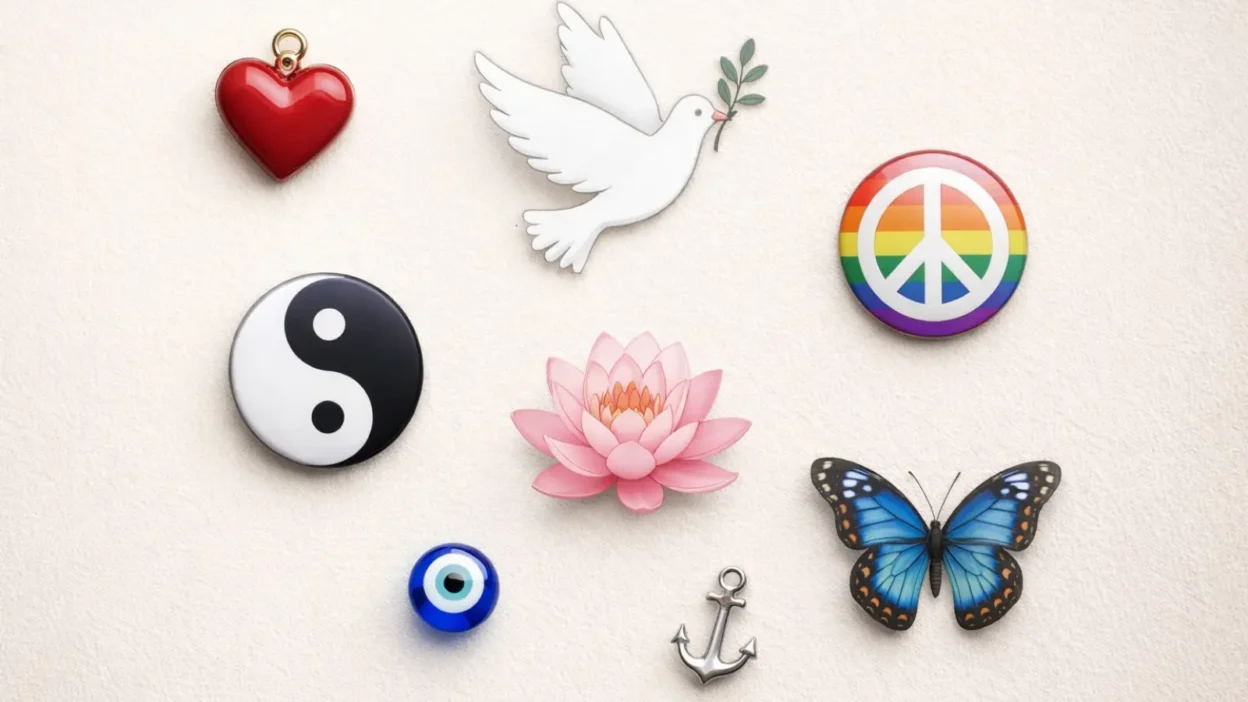
When people search for popular symbols meanings, they usually want a simple answer. What does this sign stand for? Why do people wear it, tattoo it, post it, or hang it in their homes?
The problem is that symbols rarely stay simple for long. A symbol can begin in religion, move into art, then into jewelry, fashion, protest, branding, or internet culture. Along the way, its meaning can widen, soften, or get distorted.
That is especially true in the United States, where symbols from many traditions now appear side by side in everyday life. Some still carry strong sacred meaning. Others are mostly decorative. Some do both at once.
The clearest way to read a symbol is to ask three questions: what people usually mean by it now, where that meaning came from, and what part of the story is later interpretation rather than settled history.
Quick Answer
In modern U.S. use, popular symbols meanings usually center on love, peace, protection, balance, hope, or personal change. But those meanings did not appear all at once: most came from a mix of religious tradition, visual habit, historical events, and later reuse in art, fashion, activism, and digital culture.
TL;DR
- Symbols change meaning over time.
- Context matters more than “universal meaning.”
- Love and peace symbols often have layered histories.
- Some symbols stay sacred in living traditions.
- Others became popular through protest, commerce, or design.
- Internet meanings are often newer than they look.
Main Article
Why some symbols become widely understood
A symbol becomes popular when enough people recognize it quickly. That usually happens because the symbol is easy to repeat and easy to attach to a feeling, story, or social value.
Sometimes the link comes from appearance. A lotus rising from muddy water lends itself to ideas of growth and renewal. An anchor holds fast, so it easily becomes a sign of steadiness. A butterfly changes form, so people connect it with transformation.
But symbols are also social. People learn them from religion, family customs, holidays, textbooks, movies, emojis, protest signs, and souvenirs. That means meanings are shared, not natural. They can also shift. A symbol that once worked inside one tradition can later become mainstream decoration or personal identity art.
That is why broad claims like “this symbol always means” are usually too confident. Symbols are better understood as patterns of meaning, with stronger and weaker uses depending on place, time, and audience.
Heart: love first, but not only love
For most Americans today, the heart means romantic love, affection, emotional closeness, or care. It is one of the few symbols that works almost instantly across greeting cards, phone screens, jewelry, and tattoos.
Its modern meaning feels obvious, but its history is less tidy. The heart shape did not arrive with one proven origin story. Scholars and historians have pointed to plant forms, medieval anatomy, and older decorative shapes. What is more certain is that by the late medieval and early modern periods, the heart was strongly tied to love in European art and courtly culture.
Later, Christianity added another layer through the Sacred Heart, where the heart became a sign not of romance but of divine love, suffering, and devotion. That matters because it shows how one shape can carry both everyday and sacred meanings at once.
In modern U.S. life, the heart now works on several levels:
- romance and desire
- family love and friendship
- compassion and care
- memorial feeling after loss
- health and wellness branding
That range is why heart tattoos, heart emojis, and heart-shaped gifts do not all say the same thing. The symbol is broad, but context still narrows it. A red heart in a text message, a sacred heart pendant, and a black memorial heart each speak differently.
Dove: peace, innocence, and spiritual reassurance
The dove is one of the softest-looking symbols in common use, and that softness shaped its meaning. In the U.S. today, people mostly read a dove as peace, gentleness, innocence, or comfort after grief.
Part of that comes from Christian tradition. In Christian art and belief, the dove can represent the Holy Spirit. It also appears in the Noah story carrying an olive branch, which helped tie the bird to peace after danger and to the hope of safe return.
Its modern political meaning became stronger in the 20th century, especially after war. A white bird with an olive branch was visually simple, hopeful, and easy to reproduce on posters, jewelry, stamps, and memorial art. That made the dove especially useful in public peace imagery.
Still, the dove is not a universal peace symbol in every setting. Sometimes it means purity. Sometimes it means soul, release, or mourning. In weddings, it may suggest harmony. In funeral programs, it often signals comfort and spiritual rest.
The main thing to remember is that the dove’s peaceful meaning is real and widely shared, but it grew from both religious and modern public use.
Lotus: purity, rebirth, and spiritual growth
The lotus is one of the most reused symbols in modern American design. It appears in yoga studios, skincare branding, tattoo flash, meditation apps, and home décor. Most people now read it as peace, inner growth, resilience, or spiritual awakening.
That modern reading did not come out of nowhere. The flower’s physical form helped shape the symbolism. It grows through muddy water, then opens clean above the surface. That visible contrast made it a strong image for purity, rebirth, and enlightenment in several Asian religious and artistic traditions.
This is where care matters. In Hindu, Buddhist, and related visual traditions, the lotus is not just a pretty self-care icon. It can carry sacred meaning tied to divine figures, spiritual liberation, moral purity, and ritual imagery. In American wellness culture, those meanings are often simplified into a general message of “rise above.”
That reuse is not always malicious, but it is often thinner than the older tradition. A lotus tattoo may mean personal healing. A lotus in a temple image may communicate something much more specific.
So the safest plain-English reading is this: the lotus usually symbolizes growth through difficulty, but its deeper religious meanings depend on tradition and setting.
Yin-yang: balance, not a battle of good and evil
Many Americans recognize the yin-yang symbol right away. They tend to read it as balance, opposites, or the idea that life has two sides.
That basic reading is close, but the common shortcut “good versus evil” is misleading. In Chinese thought, yin and yang are complementary forces. They describe relationships such as dark and light, receptive and active, earth and heaven. The point is not moral combat. The point is interdependence, movement, and balance.
That is why the familiar black-and-white circle matters. Each side curves into the other. Each contains a small part of the other. The image suggests that life is not split into sealed boxes.
In the U.S., yin-yang has moved far beyond its philosophical roots. It appears in fashion, dorm room art, tattoos, and pop spirituality. That wider use often keeps the idea of balance, but it may drop the symbol’s deeper connection to Chinese cosmology and intellectual history.
A fair modern reading is balance and complementarity. A fair historical reading is more precise: yin-yang belongs to a specific Chinese tradition and should not be reduced to a generic slogan about opposites.
Peace sign: a modern protest symbol with a clear birth date
Unlike many older symbols, the peace sign has a remarkably clear origin. It was created in 1958 for the British Campaign for Nuclear Disarmament.
That history matters because people often assume the peace sign is ancient. It is not. Its lines were designed from semaphore signals for the letters N and D, then enclosed in a circle. From there, the symbol spread quickly and became especially visible in American anti-war culture during the 1960s and after.
That shift is a great example of how symbols evolve. The original meaning was specific: nuclear disarmament. The later American meaning became broader: peace, protest, anti-war feeling, idealism, and countercultural identity.
Today in the U.S., the peace sign can still carry some of that activist history, but it is also lighter than before. It may show up in retro graphics, fashion prints, stickers, and casual social media posts where it means little more than calm or good vibes.
Even so, its protest roots are worth remembering. The symbol became popular not because it looked nice, but because it was useful in a public movement.
Evil eye and hamsa: protection symbols, not just “mystic decor”
The evil eye is one of the most misunderstood popular symbols in American shopping culture. Many people think it is a symbol of bad luck. More accurately, it is usually used as protection against harmful envy, ill will, or the feared “evil eye” itself.
That distinction matters. The symbol does not usually mean “I am giving you evil.” It usually means “may I be protected from it.”
The hamsa, often shown as an open hand, overlaps with this protective world in parts of the Middle East, North Africa, and nearby traditions. In some contexts, hand-shaped amulets and eye imagery are used by Muslims, Jews, and others as protection against envy or harm. These are belief-based traditions, not scientific claims, and they are also not interchangeable with every modern “boho” product that borrows the look.
In U.S. use now, the evil eye and hamsa often show up in:
- jewelry and charms
- nursery or home décor
- travel souvenirs
- social posts about protection
- tattoo culture
The challenge is oversimplification. A blue eye charm bought for style may be decorative. A family amulet may carry real inherited meaning. Those are not the same use, even if the shape looks similar.
Butterfly: change, remembrance, and fragile beauty
In modern American life, the butterfly usually stands for transformation. That is the meaning most people have in mind when they choose it for a tattoo, memorial print, or recovery story.
The life cycle helps explain why. A creature that visibly changes form is easy to connect with growth, transition, and becoming someone new. That is also why butterflies appear so often in grief writing and remembrance art. They suggest movement without harshness.
But historical meanings vary more than many people realize. In some traditions, butterflies connect with joy, marriage, longevity, soul, fire, death, or rebirth. There is no single global butterfly meaning.
That makes the butterfly a good example of how modern U.S. meaning can be both real and selective. Americans tend to favor the hopeful reading: healing, freedom, new chapter. Other cultures and periods have layered very different ideas onto the same insect.
So if you see a butterfly in a U.S. setting, change is the safest first guess. It is just not the only one history has ever allowed.
Anchor: steadiness, hope, and holding fast
The anchor works so well as a symbol because its literal function is clear. It stabilizes. It keeps a vessel from drifting. That practical role made it an easy sign for steadiness, safety, and reliability.
In Christian history, the anchor also became a symbol of hope. That older religious use still echoes in memorial art and devotional imagery. In the United States, the anchor’s meaning widened again through nautical culture, military traditions, state symbols, and tattoo design.
Today, anchor tattoos and jewelry often suggest one of four ideas:
- staying grounded
- loyalty or commitment
- hope during hardship
- connection to the sea, service, or home
This is one of the cleaner symbol stories. The metaphor grew naturally from the object’s job. Even when the anchor is used decoratively, people still tend to read it as something stable in unstable conditions.
When a symbol’s older meaning gets overshadowed
Some symbols do not simply change. They become historically charged in a way that permanently alters public reading.
The clearest case is the swastika. Long before the 20th century, versions of the symbol appeared in several cultures and religious traditions as signs associated with good fortune, well-being, or sacred order. That older history is real.
But in the modern West, Nazi appropriation changed the symbol’s public meaning so completely that it is now overwhelmingly read through genocide, fascism, and antisemitic violence. In the United States, that modern meaning dominates public life.
This is why “original meaning” is not always the most socially relevant meaning. A symbol can have an older history and still be unusable or deeply harmful in many present-day settings.
That lesson reaches beyond one symbol. It reminds us that symbolism is not frozen. Public memory, trauma, and politics can reshape what a sign communicates far more strongly than ancient origin stories do.
How Americans use popular symbols now
In the U.S., symbols often work as shorthand for identity, mood, values, or belonging. People use them in tattoos, jewelry, home décor, protest signs, wedding details, memorial graphics, app icons, and social media posts.
That means a symbol’s current life is often practical before it is scholarly. A person chooses a lotus because they want growth. A heart because they want love. A peace sign because they want anti-war history or a 1960s feel. An evil-eye charm because protection language feels emotionally reassuring, whether or not the wearer belongs to the tradition that shaped it.
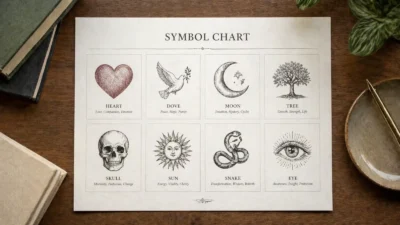
Here is a simple way to read common symbols in everyday U.S. use:
| Symbol | Common U.S. meaning now | What to remember |
| Heart | Love, care, emotion | Shape origin is debated; meaning widened over time |
| Dove | Peace, innocence, comfort | Also carries strong Christian associations |
| Lotus | Growth, rebirth, calm | Still sacred in living traditions |
| Yin-yang | Balance, interdependence | Not just “good versus evil” |
| Peace sign | Peace, protest | Began as a 1958 nuclear-disarmament symbol |
The best habit is to read symbols in layers. Start with the common meaning. Then ask whether the symbol also has a religious, regional, political, or historical weight that changes how it should be used.
That approach is more accurate, and it is also more respectful.
FAQs
What do popular symbols usually represent today?
Most widely used symbols point to big ideas people want to express quickly, like love, peace, protection, hope, or change. The exact meaning depends on context, because the same symbol can be sacred in one setting and decorative in another.
Which symbol is most commonly linked with love?
In the United States, the heart is by far the most common symbol of love. It also has broader meanings now, including care, compassion, grief, and emotional connection.
Does a peace sign still mean nuclear disarmament?
Historically, yes, that was its original meaning. In current U.S. use, it usually means peace or anti-war feeling more broadly, though the older activist history is still part of the symbol’s story.
Is yin-yang a religious symbol?
It is more accurate to call it a philosophical and cosmological symbol from Chinese thought, though it also appears in religious contexts. In everyday American use, people often reduce it to “balance,” which is only part of the fuller meaning.
What does the evil eye symbolize?
It usually refers to a belief that envy or harmful attention can cause misfortune, and the symbol is used as protection against that harm. In American retail culture, that older meaning is often simplified into general “protection” imagery.
Why are butterfly tattoos so popular?
Butterflies are easy to connect with visible change, so they work well for personal transformation, healing, and new beginnings. They are also visually flexible, which makes them popular in memorial and self-expression tattoos.
Can a symbol have both positive and negative meanings?
Yes. Symbols often gather new meanings over time, and some become deeply contested. The swastika is the clearest example of a sign with older sacred meanings that now carries overwhelming modern harm in much of the West.
Conclusion
Most symbols become popular because they turn a complex idea into something people can recognize at a glance. That is why they last. A heart can carry love. A peace sign can carry protest. A lotus can carry renewal.