A symbolism and meaning chart is a quick way to organize symbols people see all the time and the ideas they usually carry. It helps readers connect an image, object, or sign with the meanings most often attached to it in culture, religion, storytelling, design, and everyday life.
That sounds simple, but symbols are rarely simple for long. A heart may suggest love, a skull may suggest death, and a dove may suggest peace, yet those meanings came from different places and changed over time. Some are old religious or artistic associations. Others are modern habits shaped by movies, school lessons, logos, tattoos, and social media.
For U.S. readers, this matters because symbols are everywhere now. They show up in home decor, wedding themes, memorial art, awareness campaigns, classroom posters, emoji keyboards, and personal identity. A chart can be useful, but only if it stays honest about what is common, what is local, and what is only one interpretation.
Quick Answer
In modern U.S. use, a symbolism and meaning chart usually symbolizes a guide to shared cultural meanings: a way to match common symbols with the ideas people most often read into them, such as love, hope, protection, death, luck, or renewal. The deeper truth is that no chart is fully universal, because symbol meanings come from convention, religion, folklore, history, and modern media as much as from the image itself.
TL;DR
- A chart gives likely meanings, not final answers.
- U.S. meanings are often modern and media-shaped.
- One symbol can carry opposite meanings.
- Sacred meanings are not the same as decor.
- Folklore meanings are belief, not proof.
- Context matters more than any list.
What a symbolism and meaning chart is really for
A symbolism chart is best understood as a starter map. It gives the meaning a reader is most likely to meet first, especially in American classrooms, popular culture, design, and everyday conversation.
That makes it useful. It also makes it limited. A chart can tell you that a tree often suggests life or growth, but it cannot tell you everything a tree means in Christianity, Norse myth, family history, environmental activism, tattoo culture, or a specific novel.
This is why strong charts work like dictionaries, not laws. They summarize a pattern people recognize. They do not freeze that pattern forever. Dictionaries and reference works define a symbol as something that stands for or suggests something else, which already tells us that symbolism depends on shared understanding rather than pure fact.
Why symbols do not mean the same thing everywhere
People often search for a universal meaning when what they really need is a likely meaning in a given setting. Symbolic anthropology and cultural studies make the reason plain: symbols work inside systems of belief, memory, and social habits. The same image can point to very different ideas in different groups.
A symbol’s meaning is usually shaped by four things:
- Visible traits: A snake sheds its skin, so people link it with renewal.
- Practical function: A key opens locks, so it can suggest access or authority.
- Tradition: A symbol may carry religious or ceremonial meaning for centuries.
- Reuse: Film, advertising, fashion, and the internet can push a newer meaning to the front.
That is why one chart can never settle every question. It can only tell you what a symbol most commonly signals in a certain place and time.
The most common meanings readers look for first
When readers type this keyword, they usually want a fast answer about the symbols they see most often. In the United States today, a few meanings come up again and again.
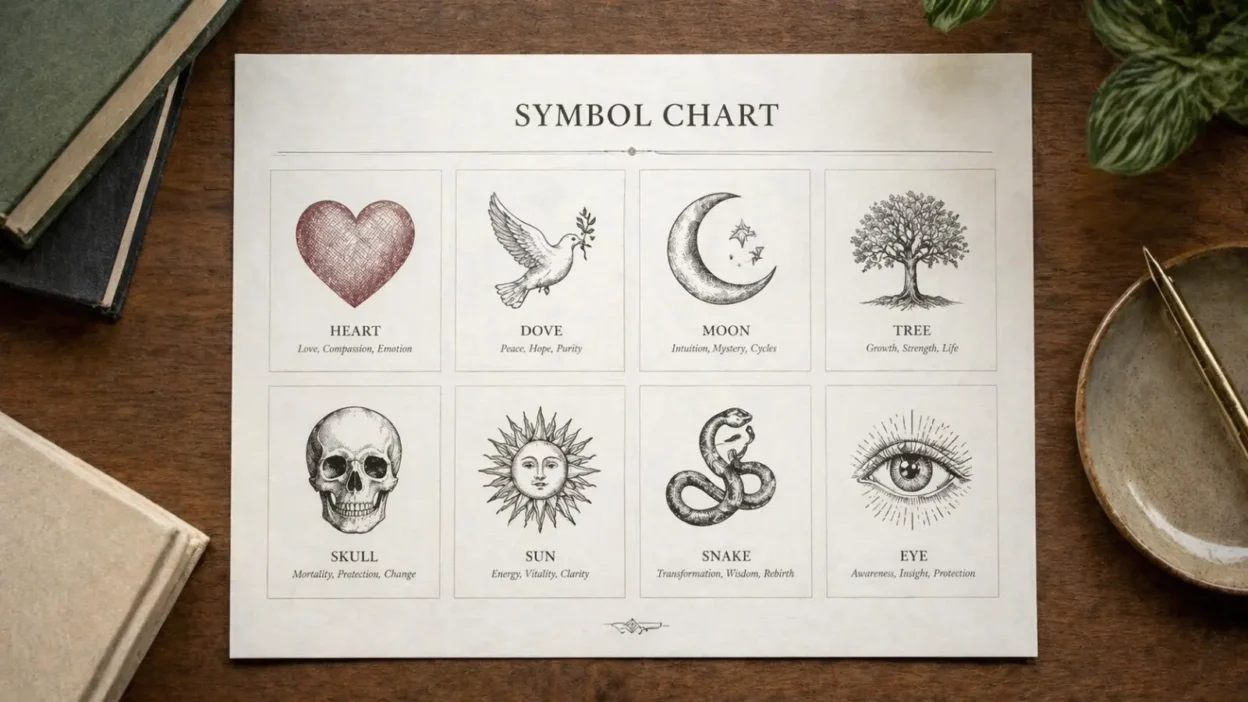
A heart usually points to love, affection, care, or emotional closeness. A dove often stands for peace, gentleness, or hope. A skull most often signals death, danger, mortality, or a deliberately edgy style. A tree tends to suggest life, grounding, family, or endurance. A moon often points to cycles, mystery, night, or femininity in modern spiritual language.
None of that means these symbols started with only one meaning. The heart, for example, became a popular shorthand for love through long artistic and devotional traditions, and later through greeting-card and digital culture. The skull has long signaled mortality, yet in some contexts it can also signal remembrance, bravery, rebellion, or even celebration tied to specific traditions. That is exactly why charts need short caution notes, not just labels.
Quick symbolism and meaning chart
Here is a practical chart built for a general U.S. reader. It does not claim universal truth. It shows the meaning people are most likely to encounter first, along with the main caution that keeps the chart honest.
| Symbol | Most common U.S. meaning today | Where it often appears | Caution |
| Heart | Love, affection, care | Emoji, gifts, tattoos, cards | Not every heart symbol is romantic |
| Dove | Peace, hope, gentleness | Memorials, weddings, religious art | In some traditions it has specific sacred meaning |
| Skull | Death, danger, mortality | Tattoos, fashion, Halloween, warnings | Can also mean remembrance or defiance |
| Tree | Life, growth, roots, family | Family art, tattoos, decor | Specific tree species can change meaning |
| Moon | Cycles, mystery, reflection | Jewelry, spirituality, digital aesthetics | Spiritual meanings vary widely |
| Eye | Awareness, protection, watchfulness | Jewelry, design, spiritual goods | Often oversimplified across different traditions |
This kind of table works because it stays modest. It gives the first meaning most readers want, but it leaves room for tradition, region, and context to change the reading.
How older meanings changed over time
Symbol meanings move because cultures move. A symbol may start in ritual, pass into art, then move into commerce, then turn into a social-media shorthand. Once that happens, many people encounter the later version first.
That is one reason modern readers can overestimate “ancient meaning.” A present-day moon pendant may feel spiritual to its wearer, but that does not mean every moon image in history carried the same message. The same is true of snakes, eyes, suns, flowers, and geometric forms. A symbol can survive while its dominant meaning shifts.
In the United States, this change often happens through mass circulation. Schools, churches, films, album covers, protest art, awareness campaigns, sports branding, and emoji all teach people how to read a symbol. Unicode’s emoji charts are a good reminder that modern symbols are now standardized and distributed digitally, which gives certain meanings huge reach very quickly.
Religious, spiritual, and sacred meanings need extra care
This is where many weak symbolism articles make their biggest mistake. They treat a living sacred symbol like a loose decorative icon.
A respectful chart should separate at least three layers:
- Internal sacred meaning inside the tradition
- Public cultural recognition outside the tradition
- Commercial or aesthetic reuse in jewelry, decor, fashion, or internet imagery
Those are not the same thing. A symbol used in prayer, ritual, or doctrine carries a meaning that cannot be reduced to “protection” or “good vibes.” Even when outsiders recognize the symbol, they may know only a simplified version.
This matters because modern shopping culture loves flattening. It turns old religious imagery into wall art, necklace charms, and mood-board graphics. Readers deserve to know when a symbol is still part of a living practice and when the popular meaning is a later, lighter reuse.
Folklore, superstition, and omen meanings are not the same as history
Many symbol charts also mix folklore with documented history. That leads to confusion.
If a raven is listed as a sign of death, that usually reflects folklore, literary tradition, or omen belief, not a proven fact about ravens themselves. If a four-leaf clover is listed as lucky, that belongs to custom and superstition, not science. If the moon is tied to intuition or feminine energy, that may reflect a blend of poetry, spiritual tradition, and modern wellness language rather than one agreed historical rule.
A careful reader should sort these layers:
- History: what is documented
- Religion: what a tradition teaches
- Folklore: what stories and customs say
- Superstition: what people believe may bring luck or warning
- Modern self-expression: what people mean now in tattoos, design, or posts
That sorting does not weaken symbolism. It makes it more accurate.
How Americans use symbol charts now
In the United States, symbolism charts are rarely used only for study. They are often used for decision-making.
People use them when choosing a tattoo, planning a memorial, picking wedding decor, creating a classroom handout, naming a small business, selecting a sympathy gift, or deciding whether a symbol on jewelry feels meaningful or offensive. In that sense, the chart becomes a cultural shortcut.
Modern American use also blends older and newer symbol systems. Someone might pair a traditional symbol like a tree or moon with an emoji heart, a zodiac sign, or a minimalist geometric mark. That mix is part of current U.S. style. It reflects how design culture, internet culture, and personal identity now overlap.
That overlap is one reason symbol charts remain popular. They help people ask, “What will others think this means?” That is a very American question because it sits at the intersection of self-expression and public readability.
Where symbolism charts go wrong
The internet has made symbol lists easier to find and easier to trust too quickly. The most common problems are easy to spot.
First, many charts claim universality where there is none. They say a symbol “always” means one thing, even though meanings vary across religion, language, and region. That kind of certainty is usually a red flag.
Second, some charts pile together myth, religion, folklore, psychology, and aesthetics as if they were one category. They might place a sacred symbol next to a mood-board reading and present both with the same level of confidence.
Third, charts often erase harm or controversy. A symbol can have an older sacred meaning and still carry painful or politicized associations in the present. Good interpretation has room for both facts at once.
Finally, many charts are too vague to help. Words like “strength,” “energy,” or “transformation” sound nice, but without context they do not tell a reader much. A better chart says where that meaning is common, how stable it is, and what kind of meaning it is.
How to read a symbolism chart responsibly
The best way to use a symbolism chart is to treat it like the first stop, not the last word.
Ask these questions:
- Where am I seeing this symbol? Tattoo, church, app, memorial, logo, poem?
- Whose meaning matters here? The wearer, the tradition, the audience, or the designer?
- Is this historical, religious, folkloric, or just popular online?
- Is the chart describing modern U.S. use or something broader?
- Is the source careful about uncertainty?
If you do that, a chart becomes much more useful. It stops being a list of fixed truths and starts becoming what it should be: a readable guide to likely meanings, shaped by culture and context.
FAQs
Is there one official symbolism and meaning chart?
No. There are many charts, but no single chart covers every culture, religion, period, or use case. The most useful charts are honest about being general guides rather than universal rules.
What does a symbolism and meaning chart help with most?
Usually, it helps with first-pass interpretation. People use it to understand common symbols in art, tattoos, decor, gifts, social media, and daily visual culture.
Are tattoo meanings the same as traditional symbol meanings?
Not always. A tattoo can borrow from older symbolism, but it can also reflect private memory, identity, or style. In practice, the wearer’s intent and the audience’s likely reading both matter.
Are spiritual symbol meanings proven facts?
Usually not in the scientific sense. Spiritual readings may be deeply meaningful within a belief system, but they should be described as tradition-based or faith-based, not as proven universal truths.
Do symbol meanings differ in the United States?
Yes. U.S. meanings are often shaped by Christianity, public-school symbolism, advertising, movies, memorial culture, and digital communication. That can make an American reading different from a reading in another country or tradition.
Can one symbol have both positive and negative meanings?
Yes. A snake can suggest healing, danger, wisdom, or renewal depending on context. A skull can suggest death, warning, rebellion, remembrance, or ritual art, so the setting matters.
Conclusion
A good chart does not pretend that symbols speak one language everywhere. It gives the reader the most likely meaning first, then leaves room for history, culture, religion, and modern reuse to complicate the picture.