Symbols are not just old religious signs or museum objects. They are part of daily life. People use them in texts, tattoos, storefronts, jewelry, protests, profile pictures, and gifts.
That is why modern symbolism examples matter. A simple shape can stand for love, identity, solidarity, warning, memory, or protection long before anyone explains it out loud.
In the United States, modern symbols often work fast. They travel through pop culture, social media, activism, advertising, and fashion. Some have clear historical roots. Others picked up new meanings as they moved into digital life.
Understanding them well means asking two questions at once: what does this symbol usually mean now, and how did it get that meaning?
Quick Answer
Modern symbolism examples usually point to shared meanings people recognize in everyday life, such as love, peace, identity, protection, or endless connection. Most of these meanings are not ancient and universal; they come from specific histories, religious traditions, political movements, design choices, and modern habits of communication.
TL;DR
- Modern symbols work as fast social shorthand.
- Meaning depends on context, not shape alone.
- Some symbols have clear origins; some do not.
- U.S. use often differs from older traditions.
- Digital culture sped up symbolic meaning.
- Fashion reuse can blur sacred or cultural meaning.
What “modern symbolism examples” usually means today
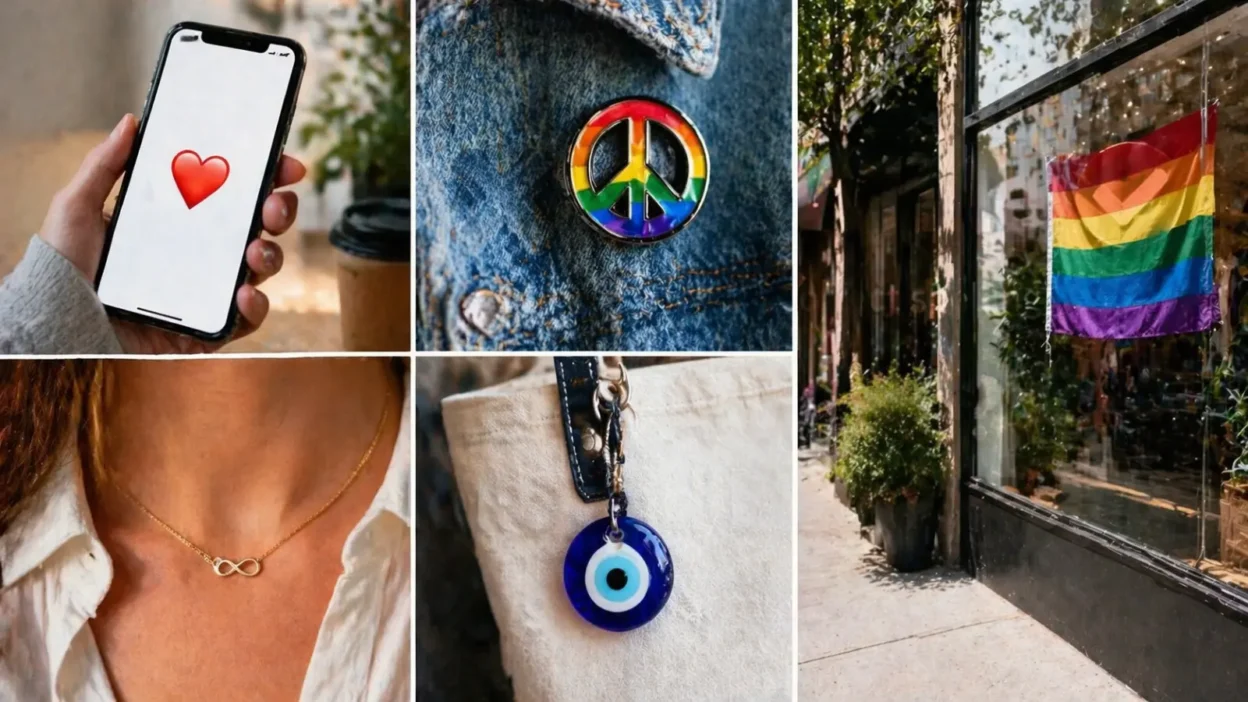
When people look for modern symbolism examples, they usually are not asking about every symbol ever used in history. They want the symbols they actually meet now: the heart, the peace sign, the rainbow flag, the infinity mark, the evil eye charm, and a growing set of digital icons.
A modern symbol is usually something simple, portable, and easy to repeat. It can live on a sticker, a T-shirt, a necklace, an app button, or a phone screen. That portability matters. The easier a symbol is to copy, the faster it can spread.
Modern symbolism also tends to be social before it is scholarly. People often learn what a symbol “means” from seeing how others use it. A heart under a post signals warmth or approval. A rainbow flag in a window signals welcome, solidarity, or identity. An infinity necklace may suggest lasting love more than mathematics.
That does not mean history disappears. It means history and current use have to be read together.
Why some symbols spread so fast in modern life
Some symbols survive because they are visually simple. Others spread because they fill a social need. In modern U.S. life, the strongest symbols often do both.
A symbol spreads faster when it can:
- say a lot with very little space
- work across age groups
- carry emotion quickly
- fit both personal and public use
- move easily from physical objects to screens
That is why the same symbol can show up in very different places. A peace sign can appear on a protest poster, a backpack patch, or retro decor. A heart can appear in a text, a Valentine’s card, or a hospital logo. A rainbow flag can signal personal identity, community support, or public celebration.
Modern media also reward repetition. The more often a symbol appears, the more natural its meaning starts to feel. Over time, that repeated use can make a recent meaning seem much older than it really is.
A quick comparison of common modern symbols
| Symbol | Most common meaning in the U.S. today | What shaped that meaning | Main caution |
| Heart | Love, care, affection, approval | Medieval love imagery, greeting culture, emoji use | Exact visual origin is debated |
| Peace sign | Peace, antiwar values, idealism | Nuclear disarmament activism, 1960s protest culture | It did not begin as a generic peace symbol |
| Rainbow flag | LGBTQ pride, visibility, solidarity | U.S. gay rights history, Pride events, activism | Not every rainbow is a Pride symbol |
| Infinity symbol | Endless connection, devotion, continuity | Mathematical symbol later reused in jewelry and tattoos | Romantic meanings are modern reinterpretations |
| Evil eye charm | Protection from envy or harm | Folk belief, amulets, heritage traditions | Often reduced to fashion with little context |
The heart: from older love imagery to digital affection
The heart is probably the clearest example of a modern symbol that feels obvious now but has a less obvious backstory.
In modern American life, the heart usually means love, affection, care, or approval. It can be romantic, but it does not have to be. A red heart text can signal intimacy. A heart reaction on social media can simply mean “I care” or “I like this.” In health campaigns, the same shape can also suggest life, compassion, or wellbeing.
That broad usefulness helps explain its strength. The heart is emotionally legible. People read it quickly.
Its history is more complicated. The familiar shape does not come from anatomy in any direct way. Scholars and popular history writers point to medieval European art and literature as a major stage in turning the heart into a sign of love. The exact visual path is still debated, which is important to say plainly. The association is old, but not every detail of the symbol’s origin is settled.
The symbol also gained force through repetition. Religious art, love poetry, Valentine traditions, cards, jewelry, and printed design all helped fix the heart as a sign of love. Digital culture then made it even more flexible. Once the symbol became an emoji and a reaction icon, it expanded from romance into everyday emotional shorthand.
That is why the modern heart can mean three different things in one day: “I love you,” “I support this,” or “this moved me.”
The peace sign: a protest design that became general shorthand
Unlike the heart, the peace sign has a very clear origin. It was created in 1958 for the British Campaign for Nuclear Disarmament. Its design combined the semaphore signals for N and D inside a circle.
That original meaning matters because it shows how specific the symbol once was. It was not born as a loose sign for harmony. It began as a political design linked to nuclear danger and organized protest.
So how did it become a general peace symbol in the United States?
The answer is visibility. Once antiwar activism expanded in the 1960s, especially around Vietnam, the sign moved from one campaign into a broader protest culture. It began to stand for antiwar politics, youth dissent, nonviolence, and a wider hope for peace. Over time, it drifted even further into fashion and nostalgia.
Today, many Americans read the peace sign as friendly, idealistic, or retro. Some people use it with very little political thought. That shift is a good example of how symbols change when movements go mainstream. The original message does not disappear, but it becomes less precise.
This is also why symbols can feel deeper than they look. A simple circle and three lines can carry decades of activism, conflict, and visual memory.
The rainbow flag: pride, visibility, and community
Few modern U.S. symbols are as socially charged and as immediately recognizable as the rainbow flag.
Today, it most commonly signals LGBTQ pride, visibility, belonging, and solidarity. In the United States, it appears in Pride marches, storefront windows, schools, churches, city events, profile graphics, and neighborhood displays. It can communicate personal identity, community support, or a promise of welcome.
Its modern history is unusually clear. Gilbert Baker designed the original rainbow flag in 1978 in San Francisco, and it grew from U.S. gay rights activism. That matters because the flag is not just a decorative rainbow. Its cultural force comes from movement history, community use, and public struggle.
Over time, the flag changed form. Stripe counts shifted for practical reasons, and newer versions added elements meant to highlight inclusion and visibility for groups seen as underrepresented. Those updates show how living symbols adapt when communities want them to say more.
This section also needs care. Not every rainbow is a Pride symbol. Rainbows have older meanings too, including weather imagery, hope, promise, and child-friendly brightness. But in modern U.S. public life, the rainbow flag has a distinct identity meaning that most people recognize quickly.
The biggest oversimplification is treating it as a vague sign of “love is love” and stopping there. For many people, it is not just cheerful color. It is memory, visibility, loss, safety, protest, and belonging.
The infinity symbol: math mark, promise mark, and tattoo favorite
The infinity symbol started as a mathematical sign. That origin is much more solid than many of its modern emotional meanings.
In contemporary U.S. life, though, most people do not meet it first in math. They meet it on necklaces, rings, tattoos, wedding-adjacent gifts, memorial pieces, and inspirational graphics. In those settings, it usually means endless love, continuity, loyalty, or something meant to last.
This shift makes sense. The symbol is visually balanced and easy to stylize. It also carries a clear core idea: no end. That makes it useful in personal symbolism, especially when people want to express lasting bonds without using words.
Still, it helps to separate original use from later reuse. The shape did not begin as a romance symbol. It became one because modern culture likes to personalize abstract ideas. Infinity moved from mathematics into emotion because people found it elegant, legible, and adaptable.
That is why infinity tattoos and jewelry can mean very different things depending on context. For one person, it marks marriage. For another, grief. For another, faith, recovery, or a reminder to keep going. The shared thread is continuity, not one fixed universal message.
The evil eye: protection belief, heritage symbol, and fashion object
The evil eye is one of the easiest modern symbols to misunderstand.
In popular U.S. shopping culture, it is often treated as a stylish blue charm that means “protection.” That is not completely wrong, but it is incomplete. The evil eye is better understood as part of a long-running belief tradition found across different regions and communities, especially around the Mediterranean, the Middle East, and beyond. It is connected to the idea that envy, praise without protection, or a harmful gaze can bring misfortune. Protective objects are then used to guard against that danger.
So the symbol is not only a design. It belongs to a belief world.
That is why context matters. In some families, an evil eye amulet is a living part of heritage and daily practice. In U.S. retail culture, the same image may appear on earrings, home decor, or wellness products with little explanation at all. Those are not identical uses, even if the object looks the same.
This is also where respectful interpretation matters. It is fine to say the evil eye charm is widely understood as protective. It is less responsible to claim that every culture means exactly the same thing by it, or that wearing one has a proven effect. Protection here belongs to belief, folklore, and tradition, not established science.
Modern symbolism often flattens that difference. Good interpretation puts it back.
How digital culture created new symbolic habits
Modern symbols no longer live only on fabric, paper, or jewelry. They live in interfaces.
That shift changed how symbolism works. In digital life, symbols have to do emotional work fast. A heart, check mark, broken heart, fire emoji, or lock icon can shape tone in a second.
Two things happened here.
First, old symbols became faster. The heart moved from poem and greeting card into reaction button and emoji. Its meaning broadened because people now use it many times a day.
Second, digital culture created new symbolic habits. People now read icons and emoji as part of ordinary conversation. Some stand for emotion. Others stand for identity, irony, urgency, trust, or group belonging.
A few patterns stand out:
- Interface symbols often signal action or trust: lock, check, bell, bookmark
- Emotional symbols often soften tone: heart, sparkle, crying-laughing face
- Identity symbols often signal values or community: flags, ribbons, pronoun markers
- Aesthetic symbols often create vibe more than literal meaning: stars, moons, butterflies
This does not make them shallow. It means modern symbolism is now tied to speed. People often interpret symbols before they read full sentences.
How to read a modern symbol without oversimplifying it
The safest way to interpret a modern symbol is to ask four basic questions.
What does it usually mean here?
Context comes first. A rainbow on a child’s mural and a rainbow flag at Pride may overlap visually, but they do not function the same way.
Where did that meaning come from?
Some symbols have a documented origin. Others developed slowly or have multiple roots. That difference matters.
Is this history, belief, identity, or aesthetic reuse?
A protective amulet, a protest sign, and a fashion motif are not the same kind of symbol even if they share a shape.
Who is using it?
Meaning changes depending on who displays the symbol and why. Heritage use, religious use, activist use, commercial use, and internet use can all pull in different directions.
This is where misuse and oversimplification happen most often. A symbol gets lifted out of context, reduced to a slogan, and sold back as a mood or trend. Sometimes that is harmless. Sometimes it erases the people and histories that made the symbol meaningful in the first place.
Modern symbolism is not hard to read because it is mysterious. It is hard to read because it is layered.
FAQs
What are the best-known modern symbolism examples today?
In the United States, some of the clearest examples are the heart, peace sign, rainbow flag, infinity symbol, and evil eye charm. They are common because people see them across digital media, fashion, activism, gifts, and public spaces.
Does the heart symbol always mean romantic love?
No. In modern use, it can mean romance, affection, support, sympathy, approval, or emotional warmth. Context matters, especially online, where a heart can be intimate in one message and casual in another.
Why is the peace sign so widely understood in America?
It spread beyond its original anti-nuclear purpose because protest culture, especially in the 1960s, made it highly visible. Over time, it became a broader visual shorthand for antiwar values, idealism, and peace in general.
Is the rainbow flag just a general symbol of happiness?
Not in most modern U.S. contexts. While rainbows can have broader meanings, the rainbow flag specifically carries LGBTQ identity, pride, and community history, so reducing it to simple cheerfulness misses its main public meaning.
What does the infinity symbol mean in tattoos or jewelry?
Most often, it suggests lasting connection, continuity, or something a person wants to frame as enduring. That meaning is modern and personal, even though the symbol itself began as a mathematical sign.
Is the evil eye religious or superstitious?
It is better described as a belief tradition with folk, cultural, and sometimes religious overlap depending on the community. In modern American retail culture, it is often sold as a general protective charm, which is a simplified version of a deeper heritage context.
Conclusion
Modern symbols matter because they let people say big things in small spaces. In the United States, that can mean love in a heart, protest in a peace sign, belonging in a rainbow flag, continuity in infinity, or protection in an evil eye charm.