When people talk about symbolism in music, they usually mean more than clever lyrics. They mean the way music itself can stand for emotion, identity, belief, memory, protest, or belonging.
That idea shows up everywhere in American life. A graduation march does not just mark time. It signals a life change. A national anthem does not only fill a stadium. It points to shared identity, conflict, and public ritual. A funeral song can hold grief that plain speech cannot.
Music matters because people keep using it as a sign. It can say “this is sacred,” “this is ours,” “this is a protest,” or “this reminds me of home” before anyone explains it out loud.
The most common modern meaning is simple: music symbolizes feeling and human connection. But that meaning did not come from nowhere. It grew from long histories of ceremony, performance, religion, social life, and memory.
Quick Answer
Symbolism in music most often points to emotion, identity, memory, and shared human experience. In modern U.S. life, music commonly symbolizes personal expression, community, ritual, protest, and belonging, though its exact meaning depends on the setting, the audience, and the tradition behind it.
TL;DR
- Music often symbolizes emotion and memory.
- Meanings change with culture and context.
- Instruments can carry social or sacred meaning.
- In the U.S., music often marks identity and protest.
- Lyrics and music symbolism are related, not identical.
- Not every musical meaning is universal.
What people usually mean by symbolism in music
The phrase can mean a few different things.
Sometimes it means that music stands for something beyond sound. A lullaby may suggest safety. A bugle call may suggest duty. A church organ may signal worship. In those cases, music works like a social sign.
Sometimes it means that certain musical choices seem to carry meaning on their own. Slow tempos, heavy repetition, and low tones may feel solemn. Bright fanfares may feel ceremonial. Listeners do not all react in exactly the same way, but repeated use builds shared associations.
And sometimes people mean symbolism inside songs, where lyrics use images like fire, rain, roads, birds, or oceans to express bigger ideas. That matters too, but it is only one part of the topic.
So the broad idea is this: music becomes symbolic when people attach meaning to it beyond its literal sound.
Why music came to symbolize feeling, memory, and inner life
In the United States today, many people think of music as a symbol of emotion first. That is why people say a song “captures heartbreak,” “feels like home,” or “sounds like freedom.”
Part of that comes from how the body responds to music. Rhythm, repetition, tension, release, and vocal tone can shape attention and mood. Over time, people learn to connect certain sounds with certain feelings.
Part of it also comes from memory. Music often marks first dances, funerals, road trips, school events, military ceremonies, worship services, and breakups. Once a song becomes tied to a life event, it stops being only a song. It becomes a memory trigger.
That helps explain why music often symbolizes the inner life. It feels personal, even when it is shared. A song can seem private and collective at the same time.
How sound becomes symbolic even without words
Music does not need lyrics to carry meaning. Sound can become symbolic through repetition and use.
Think about a few familiar patterns:
- Bells often suggest warning, worship, celebration, or loss.
- Drums often suggest movement, power, discipline, or communal energy.
- Fanfares often suggest arrival, honor, or public ceremony.
- Soft repeating melodies often suggest reflection, grief, or tenderness.
None of those meanings are locked in by nature. They develop because communities use the same sounds in the same kinds of moments over long periods.
That is why the same sound can shift meaning by setting. A drumline at a football game does not mean the same thing as a drum in a military march or a sacred ceremony. The sound may overlap, but the symbolism changes with the event, the history, and the audience.
Why instruments often stand for more than sound
Instruments carry symbolism because they are visible objects with social histories.
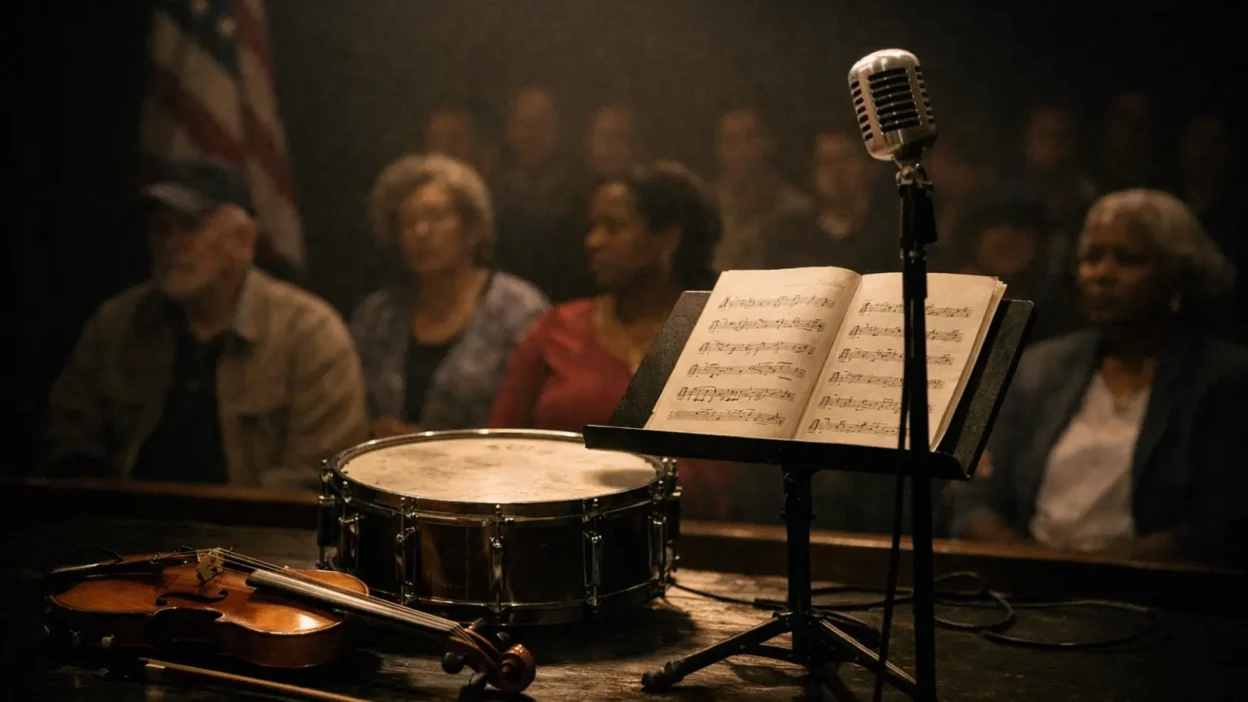
A violin may suggest refinement, training, intimacy, or sorrow, depending on the piece and setting. An electric guitar may suggest rebellion, youth culture, virtuosity, or nostalgia. A piano can suggest home life, formal education, or emotional depth. A church bell or ceremonial horn can signal public ritual before a listener even thinks about melody.
In many traditions, instruments also mark rank, sacred function, or communal role. Some were used in court life. Some were tied to worship. Some were linked to labor, dance, mourning, or military power. That history sticks.
Here is a simple way to think about it:
| Musical element or instrument | Common symbolic reading | Why it developed | Meaning can change when… |
| Drum | power, movement, unity | used in marching, dance, ritual, gathering | the setting shifts from sacred to commercial |
| Bell | warning, worship, remembrance | heard in churches, clocks, ceremonies, mourning | it appears in festive or decorative contexts |
| Violin | intimacy, sorrow, elegance | close vocal-like tone and strong concert history | genre or performance style changes |
| Electric guitar | rebellion, freedom, youth | tied to rock performance and amplified presence | it is used in jazz, worship, or soft ballads |
| Piano | reflection, skill, domestic culture | central in homes, schools, recitals, songwriting | it is used for comedy, ceremony, or minimal pop |
The point is not that every instrument has one fixed meaning. The point is that function and history shape symbolism.
Music in religion, ritual, and sacred practice
Music often symbolizes access to something larger than ordinary speech. In many traditions, it marks reverence, prayer, mourning, celebration, or spiritual attention.
That does not mean all sacred music means the same thing. It does not. Religious music is highly tradition-specific. A chant, hymn, devotional song, bell pattern, or ritual instrument belongs to a particular history and community.
This matters because modern culture often lifts sacred sounds out of context. A sound once tied to worship may get reused in film, branding, wellness culture, or social media. That reuse may seem harmless, but it can flatten living traditions into mood or aesthetic.
So it is worth keeping two truths together. Music has long been part of sacred life. But sacred musical meaning is not a free-floating universal code. It depends on the people who practice it.
How music became a symbol of identity and belonging
Music helps people say who they are.
Families pass down songs. Regions become known for genres. Faith communities build shared sound worlds. Schools, sports teams, and military branches use music to create loyalty and rhythm. Generations often define themselves partly by what they listen to and reject.
In that sense, music symbolizes belonging. It can mark class, neighborhood, race, faith, politics, age, or scene. It can also help people cross those lines, but it never does so in a neutral way.
That is especially clear in the United States, where music has long been tied to migration, cultural mixing, racial history, and commercial media. Genres do not just entertain. They often signal community, struggle, aspiration, or resistance.
This is also why debates over music can become debates over identity. When people argue about what counts as “real country,” “serious jazz,” “respectable church music,” or “authentic folk,” they are usually arguing about more than taste.
Why songs can become symbols of protest, nationhood, and public memory in the United States
In U.S. history, songs have often worked as public symbols.
An anthem can symbolize nationhood, but also tension. Patriotic music can unite people, yet it can also expose conflict over war, race, exclusion, and who gets represented inside the nation.
Protest songs do something similar. They condense a cause into a form people can remember, repeat, and share. That is one reason music has mattered in labor struggles, antiwar movements, and the Civil Rights Movement. A song can hold grief, courage, and group resolve all at once.
Music also carries public memory. Certain songs become tied to national emergencies, memorial ceremonies, or historical eras. Once that happens, hearing them in a new setting may still pull old meanings forward.
This is one of the clearest examples of symbolism in music: a song becomes more than a performance. It becomes a stand-in for a people, a conflict, or a story about the country itself.
How symbolism in music differs from symbolism in lyrics
These ideas overlap, but they are not the same.
Symbolism in lyrics usually works through words and images. A songwriter may use rain to suggest grief, roads to suggest change, or light to suggest hope. That is literary symbolism.
Symbolism in music can happen without any words at all. It may come from rhythm, instrumentation, repetition, performance setting, or collective use.
Sometimes both happen together:
- A protest song may use symbolic lyrics and also become a political symbol in public life.
- A hymn may carry sacred words, while the melody itself signals reverence before anyone hears the text.
- A love song may use romantic imagery, while the arrangement gives it a nostalgic or mournful symbolic layer.
Keeping that distinction clear helps readers avoid treating all musical meaning as if it were just hidden poetry.
What music symbolizes in modern American life
Today in the U.S., music shows up as a symbol in ordinary places, not just in concert halls.
At weddings, music often symbolizes union, joy, and the start of a public bond. At funerals, it can symbolize remembrance, grief, and continuity. At graduation, it often stands for passage from one stage of life to another.
In sports, music can symbolize team loyalty and crowd identity. In advertising, it can suggest youth, trust, luxury, rebellion, or nostalgia in seconds. On social media, songs are often used as shorthand for a mood, an era, or a personal identity.
Music also appears in tattoos and memorial art. Notes, staffs, instruments, or favorite lyrics may symbolize a lost loved one, a creative life, a family bond, or survival through a hard period. The meaning there is usually personal first, not universal.
That is an important modern shift. In daily American use, music often symbolizes the self as much as society.
Where people overread music: myths, oversimplifications, and commercial reuse
This topic attracts overstatement.
One common claim is that music is a universal language with one shared meaning for everyone. That is too broad. Music is widespread across human societies, but interpretation is shaped by culture, context, habit, and power.
Another weak claim is that every instrument or sound has an ancient spiritual meaning. Sometimes there is real historical grounding. Sometimes there is only later symbolism, internet folklore, or commercial rebranding.
A third problem is aesthetic borrowing. Sacred sounds, ceremonial instruments, and culturally specific musical forms are sometimes repackaged as “healing,” “tribal,” “pure,” or “ancient wisdom” without enough care. That can erase the communities that gave those forms meaning in the first place.
So caution matters here. Some meanings are established by long use. Others are modern interpretations. Others are branding.
Why symbolism in music keeps changing
Music symbolism changes because culture changes.
A melody once tied to court life may later sound formal or old-fashioned. A genre once treated as rebellious may later become mainstream. A protest song may turn into a classroom staple. A spiritual sound may be borrowed into pop culture and take on new layers, for better or worse.
Technology speeds that up. Recording, film, streaming, and short-form video let music move fast across settings. That can spread meanings quickly, but it can also strip them from their original context.
So music does not carry one permanent message through time. It gathers meaning from use. People keep hearing it, reusing it, fighting over it, and giving it new jobs.
FAQs
What does music usually symbolize?
Most often, music symbolizes emotion, connection, memory, and expression. In public life, it can also symbolize identity, ceremony, protest, faith, or belonging, depending on where and how it is used.
Is music a universal symbol?
Not in one fixed sense. Music is widely important across cultures, but the meanings attached to styles, sounds, and instruments are shaped by local history and social use.
What is the difference between music symbolism and symbolism in songs?
Music symbolism includes sound, instruments, performance setting, and social meaning. Symbolism in songs is narrower and usually refers to images and metaphors in the lyrics.
What can music symbolize in a tattoo?
A music tattoo often symbolizes personal identity, creativity, memory, or a bond with a specific person or life period. Its meaning is usually individual unless the design borrows a well-known religious, national, or cultural symbol.
Does music have spiritual meaning?
It can, but that depends on the tradition and the believer. In many religions, music plays a real sacred role, but those meanings should be understood inside the living practice rather than turned into a vague universal claim.
Can a song become a political symbol?
Yes. In the United States, songs have often become symbols of protest, patriotism, resistance, mourning, or movement-building. Once a community adopts a song in public action, its symbolism can grow far beyond the original performance.
Conclusion
The clearest modern meaning of music is that it stands for human feeling and shared experience. But that is only the starting point. Music also becomes a symbol through use — in ritual, protest, memory, identity, ceremony, and everyday life.