Color is one of the fastest ways people read a room, a logo, an outfit, or a public sign. The psychology of color meaning matters because colors often speak before words do.
A red sale sign, a black suit, a white wedding dress, a blue app icon, and a green recycling label all send messages. Some of those messages come from emotion. Others come from habit, law, religion, history, marketing, or personal memory.
In the United States, color meaning shows up in branding, clothing, home decor, holidays, weddings, politics, sports, health campaigns, and digital design. It can feel instant, but it is rarely simple.
Quick Answer
In modern U.S. culture, the psychology of color meaning usually refers to the way colors communicate emotion, social cues, and identity before words do. Red often signals urgency or passion, blue suggests calm or trust, green points to nature or money, and black and white carry meanings shaped by mourning, fashion, purity, and formality. These meanings come from biology, language, design systems, religion, commerce, and habit, so they change by shade, setting, and culture.
TL;DR
- Color meanings are cues, not fixed rules.
- U.S. meanings often come from signs, brands, holidays, and media.
- Shade and context can reverse a color’s message.
- Research supports associations more than guaranteed mood effects.
- Cross-cultural meanings overlap, but they are not identical.
What Color Psychology Means—and What It Does Not Mean
Color psychology is the study of how people connect colors with feelings, ideas, and behavior. In everyday language, it also means the symbolic meanings people attach to colors.
That second use is broader. It includes science, but also culture, memory, fashion, religion, branding, and folklore.
A careful article about color should not say, “Blue makes everyone calm” or “Yellow makes people happy.” Better wording is: “Many people in the United States associate blue with calm” or “Yellow is often used to suggest cheer, attention, and warmth.”
That difference matters. An association is not the same as a guaranteed emotional effect.
Color can influence attention, expectation, and mood. But it does not control a person like a switch. The room, the person, the shade, the lighting, the culture, and the situation all matter.
The Core Meaning Today: Color as a Social and Emotional Signal
The most common modern meaning of color is communication. Color helps people sort information quickly.
Red says stop, danger, sale, passion, anger, or celebration, depending on where it appears. Blue can suggest trust, calm, technology, cleanliness, or sadness. Green may point to nature, safety, money, health, or envy.
People use these cues without always noticing them. A hospital may choose pale blue or green to feel clean and calm. A sports team may use bold colors to build identity. A brand may choose black to feel sleek, white to feel simple, or orange to feel friendly.
Color also helps people signal who they are. Clothing color can feel professional, playful, romantic, bold, modest, artistic, or rebellious. Home color can suggest warmth, quiet, order, nostalgia, or luxury.
The meaning is not hidden. It is social. People learn it through repeated use.
Why Colors Develop Meanings in the First Place
Colors gain meaning for several reasons.
Some meanings come from visible life. Red is linked with blood, heat, ripe fruit, flushed skin, and warning. Green is linked with leaves, growth, gardens, and healthy landscapes. Brown is linked with soil, wood, leather, coffee, and earth.
Some meanings come from language. Americans say “seeing red,” “feeling blue,” “green with envy,” “black tie,” “white lie,” and “gray area.” These phrases keep color meanings alive even when no actual color is present.
Some meanings come from objects. People often like colors that remind them of things they like. A person may love blue because it suggests sky, water, denim, or a favorite sports team. Another person may dislike a yellow-green shade because it reminds them of illness or spoiled food.
Other meanings come from systems. School colors, flag colors, road signals, medical labels, political maps, sports uniforms, and awareness ribbons teach people what colors mean in public life.
This is why color meaning feels natural even when it is partly learned.
Warm Colors: Red, Orange, and Yellow
Warm colors tend to feel active. They are often used where people want attention, appetite, speed, joy, or urgency.
Red is the strongest example. In the United States, red often means love, danger, anger, heat, urgency, and importance. It appears in Valentine’s Day imagery, warning labels, emergency equipment, sale signs, sports uniforms, and political maps.
Red’s double meaning makes sense. It is tied to both attraction and alarm. A red rose and a red warning light are not saying the same thing, but both ask to be noticed.
Orange often suggests warmth, movement, playfulness, creativity, autumn, affordability, or visibility. It appears in pumpkins, construction gear, school supplies, athletic branding, and Halloween design. Because it sits between red and yellow, orange can feel energetic without the same seriousness as red.
Yellow often suggests sunlight, optimism, caution, attention, and mental brightness. It appears in school buses, warning signs, smiley faces, sunflowers, highlighters, and spring decor. But yellow can also feel harsh or anxious when it is too bright or overused.
Warm colors do not always mean happiness. They can also mean pressure, danger, heat, noise, or demand.
Cool Colors: Blue, Green, and Purple
Cool colors are often read as calmer, more spacious, or more reflective than warm colors. But they have complex meanings too.
Blue is one of the most trusted colors in modern U.S. design. It appears in banks, healthcare, technology, uniforms, and social platforms because it often suggests calm, order, confidence, and reliability. It also carries sadness in phrases like “feeling blue.”
This mix is not a contradiction. Blue can feel still, distant, clean, or serious. Those qualities can become peace in one setting and loneliness in another.
Green is tied to nature, growth, health, freshness, luck, safety, and money. It appears in environmental design, finance, wellness brands, food packaging, St. Patrick’s Day imagery, and “go” signals.
Green also has negative meanings. It can suggest envy, sickness, inexperience, or artificial “eco-friendly” claims when the use feels shallow.
Purple often suggests imagination, mystery, spirituality, luxury, mourning, or creative identity. Its older status meanings came partly from rare and costly dyes. Today, purple appears in beauty, fantasy, wellness, spiritual aesthetics, and awareness campaigns.
Purple is a good example of a color whose meaning changes by shade. Deep purple may feel formal or regal. Lavender may feel gentle, nostalgic, or romantic.
Neutral Colors: Black, White, Gray, and Brown
Neutral colors may look quiet, but they carry some of the strongest symbolic meanings.
Black can mean mourning, formality, elegance, power, mystery, rebellion, or seriousness. In the United States, black clothing is common at funerals, formal events, concerts, offices, and fashion spaces. A black dress, a black suit, and a black protest shirt can all say different things.
White often suggests cleanliness, simplicity, peace, innocence, newness, or openness. It appears in weddings, medical settings, minimalist homes, and product design. Yet white is not universally tied to weddings or purity, and its meaning changes in other cultural and religious settings.
Gray often suggests neutrality, balance, maturity, restraint, uncertainty, or dullness. It is common in business clothing, technology, interiors, and modern branding. It can feel calm and sophisticated, but also cold or indecisive.
Brown suggests earth, wood, leather, coffee, warmth, practicality, age, comfort, or plainness. In design, brown can feel grounded and durable. In some contexts, it may also be treated as unfashionable or heavy.
Neutrals prove that color meaning is not only about brightness. Social use matters just as much.
Shade, Brightness, and Setting Can Change the Message
A color does not carry one meaning in every form. Shade and setting reshape it.
A bright red sports jersey feels different from a dark burgundy velvet curtain. Pastel pink does not carry the same message as hot pink. Forest green feels different from neon green. Navy blue feels different from turquoise.
Several things affect meaning:
- Saturation: Bright colors often feel louder; muted colors feel softer.
- Lightness: Pale colors may feel gentle, clean, or distant.
- Material: Red silk, red plastic, and red brick do not feel the same.
- Pairing: Black with gold suggests something different from black with orange.
- Setting: White in a wedding, clinic, kitchen, or memorial space changes meaning.
This is why color charts can help, but they should not be treated as rules. A color’s meaning lives in use.
Historical Roots: Pigments, Religion, Trade, and Technology
Color meanings did not begin as modern mood charts. Many came from materials, labor, ritual, and access.
Before synthetic dyes and mass printing, some colors were hard to make, expensive to maintain, or tied to specific materials. Purple became linked with status in many contexts because certain purple dyes were rare and costly. Blue pigments and dyes also carried different values depending on region and period.
Religion shaped color meaning too. White, red, purple, black, green, and gold have carried ceremonial meanings in different traditions. These meanings should not be reduced to decoration. For people inside a tradition, color can mark sacred time, spiritual status, mourning, celebration, sacrifice, renewal, or devotion.
Technology changed color meaning as well. Printing, photography, electric signs, television, synthetic dyes, plastic, digital screens, and app icons made color cheaper, brighter, and more repeatable. Once a color can be reproduced everywhere, it can become part of mass culture.
That is why modern color meaning is layered. It carries old material history, religious meaning, public systems, advertising, media, and personal memory at the same time.
How Color Meaning Works in the United States Today
In the United States, color is often used as a shared public code. These meanings are not all ancient. Many are modern, practical, and repeated through daily life.
| Setting | Common Color Use | What It Usually Communicates |
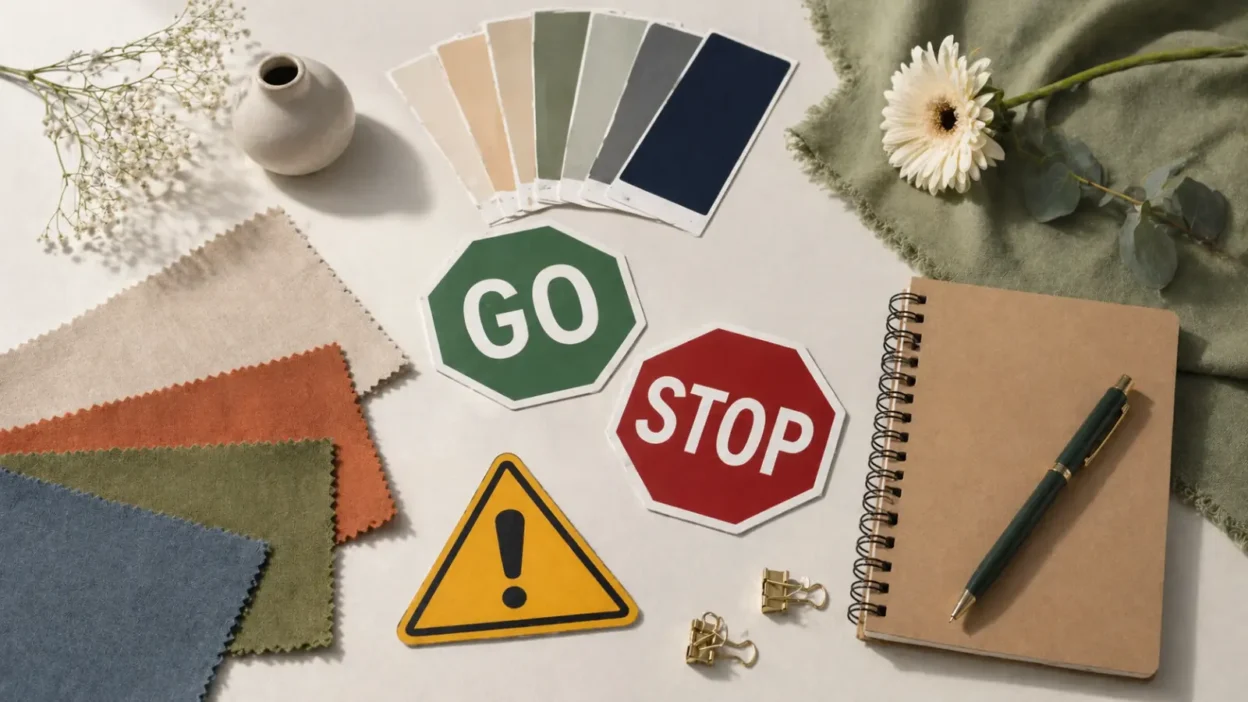
| Road signals and signs | Red, yellow, green | Stop, caution, go, warning, movement |
| Politics | Red and blue | Republican and Democratic identity |
| Holidays | Red/green, orange/black, red/white/blue | Christmas, Halloween, patriotic themes |
| Weddings and funerals | White, black, soft neutrals | Celebration, formality, mourning, restraint |
| Awareness campaigns | Colored ribbons | Cause identity and public solidarity |
| Branding and apps | Blue, black, green, red | Trust, luxury, nature, urgency, action |
These meanings work because people see them again and again. A red button can feel urgent because red already appears in warnings and alerts. A green label can suggest environmental care because green already points to plants, growth, and freshness.
Sports also shape color meaning. Team colors can become part of regional identity. A color that means elegance in fashion may mean rivalry in a stadium.
Color in the U.S. is not only emotional. It is civic, commercial, seasonal, and social.
Cross-Cultural Meanings: Overlap Without Universality
Some color associations appear in many places. Red often draws attention. Dark colors often connect with seriousness or grief. Green often connects with vegetation where the landscape supports that link.
But no color has one meaning everywhere.
White may suggest weddings in much of the United States, but it can be linked with mourning in some Asian traditions. Red may suggest danger or romance in one setting and good fortune or celebration in another. Black may mean grief, elegance, authority, protest, or sacred depth depending on use.
Even within one country, meanings change by community, age, religion, region, and situation. A color used in a church, a protest, a fashion show, a wedding, a sports arena, and a phone app will not carry one identical message.
This is why “universal color meaning” should be handled carefully. There can be shared tendencies, but culture gives those tendencies shape.
Modern Reuse in Branding, Fashion, Decor, Tattoos, and Digital Life
Most Americans meet color symbolism through ordinary choices.
In branding, color helps a company feel familiar before a customer reads a word. Blue often supports trust. Green often supports nature, wellness, finance, or freshness. Black can suggest luxury or control. Red can push urgency or appetite. Pink can feel playful, romantic, soft, ironic, or bold, depending on shade.
In fashion, color can frame identity. Black may feel polished or protective. White may feel crisp. Red may feel confident. Beige may feel understated. Bright colors can feel expressive or youthful. Muted tones can feel calm or practical.
In decor, people use color to create atmosphere. Soft blues and greens are common in bedrooms and bathrooms. Warm neutrals make a room feel grounded. Dark colors can make a space feel intimate, dramatic, or formal.
In tattoos, color adds emotional tone. Red may intensify love, blood, courage, or grief. Blue may suggest loyalty, water, calm, or memory. Green may suggest growth, luck, nature, or healing. Blackwork can suggest clarity, permanence, mourning, strength, or graphic style.
Digital life has added another layer. App icons, notification badges, emojis, filters, and profile themes teach people to read color quickly. A color can now signal mood, fandom, identity, taste, or platform behavior in a single glance.
Misuse and Oversimplification: Where Color Psychology Goes Too Far
Color psychology is useful, but it is often overstated.
The weakest claims are the ones that treat color as destiny. A favorite color does not reliably reveal a person’s full personality. A room color does not guarantee a mood. A logo color does not force people to buy. A tattoo color does not have one official meaning.
Spiritual color systems also need careful handling. Aura colors, chakra colors, candle colors, and color-magic meanings belong to belief systems or modern spiritual practice. They may be meaningful to people who use them, but they should not be presented as scientific fact.
Commercial reuse can flatten sacred or cultural meanings. A color used in a living religious tradition is not just an aesthetic. A color tied to mourning, protest, national identity, or community memory should be treated with care.
The best way to interpret color is to ask three questions:
- Where is the color being used?
- Who is using it?
- What meanings would that audience likely recognize?
Color meaning is strongest when it is read in context.
FAQs
What does color symbolize in psychology?
Color usually symbolizes emotional association, attention, memory, and social meaning. It can influence how people read a setting, but it does not create the same feeling in every person.
What color means trust?
Blue is often used to suggest trust, calm, order, and reliability in the United States. That is why it appears often in finance, healthcare, technology, uniforms, and official-looking design.
What color means love?
Red is the most common U.S. color for romantic love, especially around Valentine’s Day. Pink can also suggest affection, tenderness, sweetness, or playful romance.
Are color meanings spiritual?
They can be spiritual in some traditions and belief systems, but not every color meaning is religious. Some meanings come from ritual, while others come from design, language, fashion, public signs, or personal memory.
What do colors mean in tattoos?
Tattoo colors often add emotional tone rather than one fixed meaning. Red can intensify passion or grief, blue can suggest calm or loyalty, green can suggest growth, and black can suggest strength, mourning, clarity, or classic style.
Are color meanings the same in every culture?
No. Some associations overlap, but color meanings vary by language, religion, history, region, and setting. A color that suggests celebration in one culture may suggest mourning or warning in another.
Can colors affect mood?
Colors can affect attention, expectation, and atmosphere, and people often associate colors with feelings. But mood is shaped by many factors, so color should be treated as one influence, not a guaranteed cause.
Conclusion
Color meaning is a learned language as much as an emotional response. Red, blue, green, black, white, yellow, purple, orange, brown, and gray all carry common meanings, but those meanings depend on shade, setting, culture, and use.