If you search for symbolism meaning, you are usually trying to understand one simple idea: how one thing can stand for something bigger than itself. A color, animal, object, gesture, or image may look ordinary on the surface, yet still carry an added meaning people recognize through culture, story, belief, or repeated use.
That is why symbolism shows up in so many places. It appears in literature, art, religion, national identity, branding, memorials, and everyday communication. Even common modern examples like logos, road signs, and emojis work because people connect a visible form to an idea beyond the literal thing itself.
In the United States, symbolism matters because public life is full of shared signs. The flag, the Liberty Bell, the bald eagle, and the Statue of Liberty are not just objects. They carry ideas about freedom, history, nationhood, and belonging, even though those meanings can shift over time or become contested.
Quick Answer
The simplest symbolism meaning is the use of one thing to represent another idea, feeling, value, or belief. In modern American use, symbolism usually means that an object, color, image, action, or character has a deeper meaning beyond its literal one, while history, culture, and context shape what that meaning becomes.
TL;DR
- Symbolism means using one thing to suggest another idea.
- A symbol can be visual, verbal, cultural, or religious.
- Meaning depends on context, not just the object itself.
- Literature uses symbolism to add layers and themes.
- American culture relies on shared public symbols.
- Not every popular symbolic claim is historical fact.
What symbolism means in simple words
In plain English, symbolism is the practice of using symbols to express something that may be invisible, abstract, emotional, or hard to say directly. A symbol might suggest love, danger, grief, hope, loyalty, rebellion, faith, or memory. The thing itself stays real, but people attach an extra layer of meaning to it.
A symbol is not limited to one format. It can be a color, a flower, a national emblem, a religious image, a repeated object in a novel, or even a public gesture. What makes it symbolic is not the object alone, but the shared understanding around it.
How symbolism works
Symbolism works through association. People connect one thing with another because of repeated cultural use, social memory, belief, story, convention, or emotional pattern. A symbol becomes meaningful when a community, tradition, or audience reads it that way.
That is why symbols are powerful but not automatic. A rose may suggest romance in one context, mourning in another, and simple decoration in a third. The same object can carry several meanings at once, and the surrounding setting usually tells you which meaning matters most.
Why context matters so much
One of the biggest mistakes people make is treating symbolism like a fixed codebook. In real life, symbols are often flexible. Oregon State’s literary guide notes that even a color like red can suggest passion, love, blood, danger, or political identity depending on the setting. That is a helpful reminder that meaning is shaped by use, not by the object alone.
This matters for readers, writers, and anyone interested in cultural meaning. If you ignore context, you can overread a symbol or assign a meaning that the audience would never have recognized. Good interpretation asks where the symbol appears, who is using it, what tradition surrounds it, and what emotional or cultural associations are active in that moment.
Symbolism in literature and art
In literature, symbolism allows writers to suggest deeper ideas without explaining everything directly. Objects, settings, characters, or events can represent themes such as innocence, fear, order, death, renewal, or freedom. That added layer gives a story more depth and emotional force.
The word Symbolism also refers to a specific late-19th-century literary and artistic movement. Britannica describes it as a movement that began with French poets, spread into painting and theater, and influenced European and American literature in the 20th century. In that sense, Symbolism is not just a general technique. It is also a historical movement tied to art and literature.
Symbolism in religion and sacred traditions
Religion uses symbolism in especially rich ways. Britannica describes religious symbolism and iconography as artistic forms, gestures, and representations that help convey religious ideas and events. That helps explain why sacred objects, colors, animals, shapes, and rituals often carry meanings that go far beyond decoration.
This is also where caution matters. A religious symbol may have a specific meaning inside one tradition, but the internet often strips it from that setting and turns it into a vague “spiritual” sign. Respectful interpretation means separating documented tradition from modern reuse, trend-based content, or personal belief.
Symbolism in everyday American life
In the United States, symbolism is part of daily public culture. The Library of Congress notes that national symbols help represent beliefs, values, traditions, and other intangible ideas tied to the nation. That is why public symbols can feel so emotionally charged. They stand for more than themselves.
The U.S. flag is a clear example. USAGov explains that the flag functions as a symbol of freedom, while its stripes and stars stand for the original colonies and the states. Those meanings are taught formally, but the flag also takes on added meanings in politics, mourning, military memory, protest, sports, and civic ritual.
The Liberty Bell shows how meanings change over time. The Library of Congress notes that abolitionists in the 1830s adopted it as a symbol of their anti-slavery cause and helped popularize the name “Liberty Bell.” That is a strong example of symbolism evolving through American history rather than staying frozen at its first use.
Common kinds of symbols people ask about
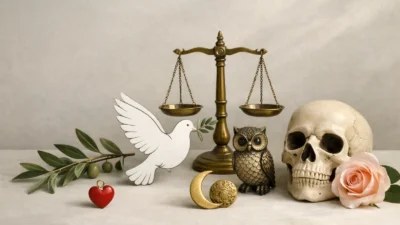
Most readers looking up symbolism mean one of a few broad categories. Colors often symbolize emotions or social meanings. Animals often symbolize traits people project onto them. Flowers can suggest love, grief, purity, or remembrance. Numbers can pick up lucky, unlucky, religious, or superstitious associations. Objects can become symbols through ritual, public memory, or repeated storytelling.
Modern culture adds more layers. Symbols now move through tattoos, logos, fashion, fandoms, digital design, and social media. That fast circulation can make meanings more popular, but it can also make them flatter, looser, or historically inaccurate.
A quick table: how symbolism changes by context
| Context | Example type | Possible meaning | Why it changes |
|---|---|---|---|
| Literature | Repeated object or image | Theme, mood, inner conflict | The author builds meaning through story context |
| Religion | Sacred image, gesture, color | Belief, doctrine, ritual memory | Tradition gives the symbol its meaning |
| U.S. public life | Flag, bell, monument | Freedom, identity, nationhood | History and civic use shape the association |
| Everyday culture | Emoji, logo, design | Mood, brand values, social signal | Shared habits make the meaning recognizable |
| Internet culture | Tattoo motif or viral symbol | Personal identity or trend meaning | Meanings spread fast and often drift from origin |
The table shows a simple truth: symbolism is not one system with one rule. Meaning depends on who is using the symbol, where it appears, and what shared knowledge the audience brings to it.
Why symbolism gets oversimplified online
Online content often turns symbolism into a list of fixed meanings. That makes articles easy to skim, but it can also erase history, culture, disagreement, and uncertainty. A post may claim that one animal or color “always” means one thing, even though real symbolic use is often much messier.
That simplification becomes more serious with sacred, Indigenous, national, or politically charged symbols. In those cases, careless writing can confuse living traditions with aesthetic trends, or present recent internet beliefs as if they were ancient truths. Strong symbolism writing has to be more careful than that.
How to interpret symbolism better
A better way to read symbolism is to ask a few grounded questions. What is the literal object or image? What tradition, story, or culture gives it meaning? Is the meaning historical, religious, literary, political, personal, or commercial? Has the meaning changed over time?
It also helps to separate strong evidence from weaker claims. A documented national emblem, literary pattern, or religious use carries more weight than a random social post claiming a universal spiritual meaning. The safest reading is usually the one that stays closest to context and avoids turning one interpretation into a law.
Why symbolism still matters
Symbolism still matters because people do not live by literal description alone. They build meaning through stories, rituals, images, memory, and shared signs. Symbols help communities express values, help writers create depth, and help ordinary people communicate feelings that are hard to spell out directly.
That is also why symbolism can unite or divide. A symbol can inspire pride, grief, protest, faith, belonging, or conflict depending on who sees it and what history they bring to it. Understanding symbolism is really about understanding how meaning travels through culture.
FAQs
What is symbolism in simple words?
Symbolism is when one thing stands for another idea, feeling, or belief. Instead of saying everything directly, a writer, artist, culture, or tradition uses an image, object, color, or action to suggest more than its literal meaning.
Is symbolism only used in literature?
No. Symbolism appears in literature, art, religion, public life, national identity, and everyday communication. Modern examples include flags, monuments, logos, emojis, and repeated visual motifs in media.
What is the difference between a symbol and symbolism?
A symbol is the thing that carries meaning, like a flag, rose, or animal. Symbolism is the larger practice or system of using symbols to represent ideas or qualities beyond the literal level.
Does every symbol have one fixed meaning?
Usually not. Meaning often changes with context, culture, time period, and audience. The same symbol may suggest different things in religion, literature, politics, or personal expression.
Why do people care about symbolism so much?
People care because symbols make abstract ideas easier to feel and remember. They connect everyday things to identity, memory, belief, history, and emotion, which is why they matter in both personal life and public culture.
Is online symbolism advice always accurate?
No. A lot of online symbolism content oversimplifies meanings or treats tradition-based beliefs as universal fact. The most reliable interpretations stay close to context and distinguish documented history from modern trend-based claims.
Conclusion
The clearest way to understand symbolism meaning is this: symbolism happens when something visible, familiar, or concrete points beyond itself to an added idea. That meaning might come from literature, religion, social memory, national identity, or repeated cultural use.