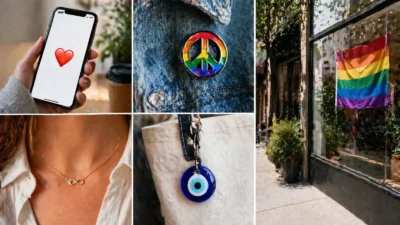
People use symbols every day, even when they do not think of them that way. A heart on a text message, a peace sign on a T-shirt, scales outside a courthouse, or an eye charm on a bracelet all carry meaning beyond their literal shape.
That is why interest in symbolism signs meanings stays high. People want a quick answer, but they also want to know whether a meaning is old, modern, religious, cultural, or just popular online.
In the United States, symbols often work like visual shorthand. They help people signal love, warning, identity, protest, grief, luck, belief, or belonging in a single image.
The hard part is that symbols are not fixed forever. Some have clear origins. Some grew over time. Some mean one thing in a museum, another in a church, and something else on social media.
Quick Answer
In modern U.S. use, symbolism signs meanings usually point to a simple idea: symbols are visual shortcuts for larger ideas like love, peace, danger, justice, protection, or identity. Those meanings often come from long habits of use, religious tradition, folklore, design, and public culture, but they are not always universal or historically exact.
TL;DR
- Symbols turn big ideas into quick visuals.
- Meanings come from use, not shape alone.
- U.S. meanings are often modern and practical.
- Older origins and current meanings can differ.
- Folklore meanings are not the same as facts.
- Context changes everything.
What people mean when they ask about signs and symbols
A sign usually points you toward an action or a direct message. Stop signs, restroom icons, and hazard labels are good examples. Their job is speed and clarity.
A symbol usually works at a deeper level. It stands for an idea, feeling, value, memory, or social meaning. A dove does not literally equal peace, and a heart does not literally equal romance, but both have become widely understood that way.
In everyday speech, people blur those categories. That is normal. Still, the difference helps. A sign tells you what to do. A symbol helps you understand what something stands for.
Why symbols feel meaningful so quickly
Symbols work because people learn them together. A shape gains force when a group repeats it in the same setting over time.
That can happen through:
- religion and ritual
- law and government
- art and storytelling
- family custom
- protest movements
- branding and design
- digital culture
Once that repetition sticks, a symbol starts to feel obvious. But “obvious” does not mean timeless. It usually means familiar.
A good example is the peace sign. Many Americans see it as a broad symbol of peace, but that meaning became common because it was reused in protest culture, fashion, posters, and youth identity. The symbol felt natural only after a lot of public repetition.
The most common meaning today: symbols compress ideas
The clearest modern meaning of symbols is practical: they compress big ideas into small forms.
That is why symbols show up in places where speed matters:
- emojis and texting
- tattoos
- logos and packaging
- memorials
- jewelry
- protest signs
- holiday decor
- social media profiles
A symbol can also do emotional work. It lets people say something that would take much longer in words. A black ribbon can signal mourning. A wedding ring can signal commitment. A flag pin can signal loyalty, belonging, or political positioning, depending on context.
In the United States, this quick-use function is one reason symbols stay powerful. They are not only old cultural leftovers. They are active tools in modern life.
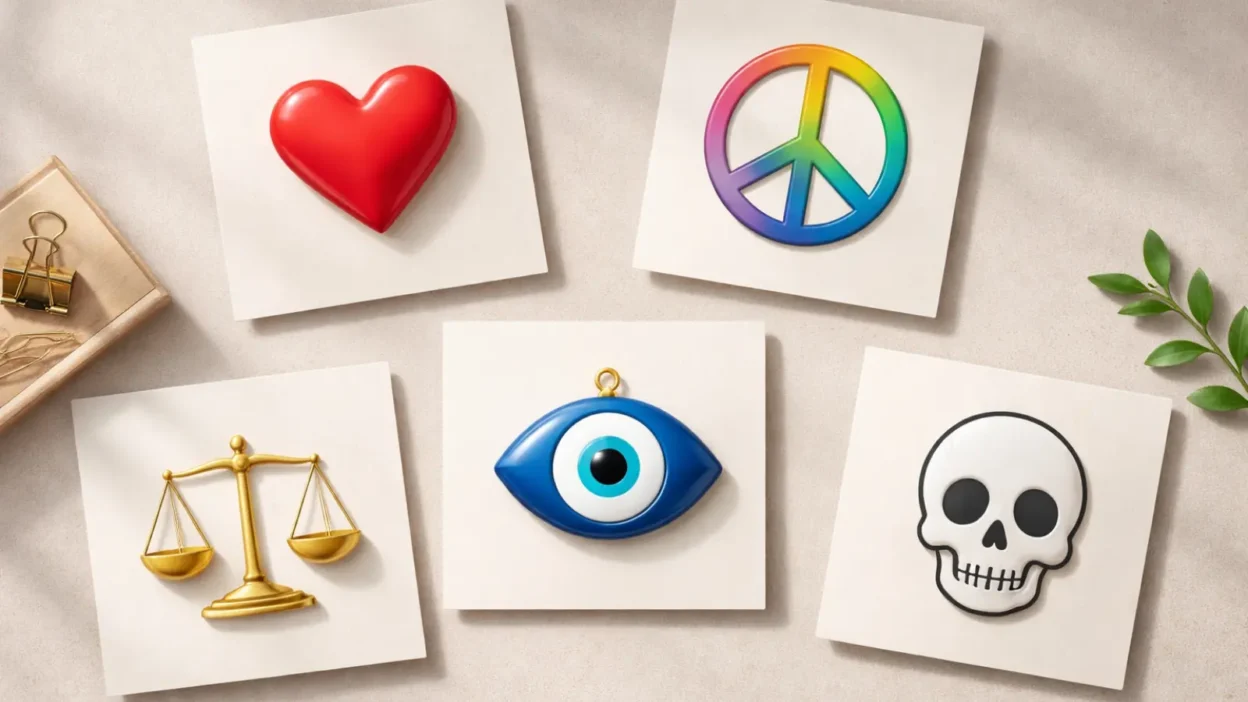
A quick comparison of common symbols and what they usually signal
| Symbol | Most common U.S. meaning today | Where people see it | Important caution |
|---|---|---|---|
| Heart | Love, care, affection | Texting, gifts, tattoos, branding | Older origin is debated |
| Peace sign | Peace, antiwar values, harmony | Posters, shirts, accessories | Clear modern origin, later broadened |
| Scales | Justice, balance, fairness | Courts, legal logos, civic art | Legal meaning is symbolic, not literal fairness |
| Skull | Death, danger, rebellion | Warnings, fashion, tattoos | Can signal risk or style depending on context |
| Evil eye charm | Protection from envy or harm | Jewelry, decor, gifts | Belief-based meaning, not proven fact |
The pattern is simple: a symbol’s current meaning often depends less on its original source than on how people use it now.
Why the heart came to mean love
The heart symbol is one of the best examples of a meaning that feels stable even though its origin is not fully settled.
Today, most Americans read it as love, affection, romance, care, or emotional warmth. That reading is so strong that the shape works almost instantly in texting, greeting cards, and app design.
Its deeper history is less tidy. The shape does not come from a realistic drawing of the human heart. Scholars and popular history writers have pointed to several influences over time, including older ideas about the heart as the seat of feeling, medieval art, and stylized visual traditions that gradually pushed the shape toward the form we now know.
What matters most for a modern reader is this: the heart means love because culture kept teaching people to read it that way. The emotional idea came first. The exact shape became standard later.
That also explains why the symbol now reaches beyond romance. In the U.S., a heart can signal friendship, family love, sympathy, school spirit, or even simple approval online.
Why the peace sign means peace in modern American culture
Unlike the heart, the peace sign has a clear modern paper trail.
It was created in 1958 for the British nuclear disarmament movement. From there, it spread into wider protest culture and became deeply tied to antiwar activism, especially in the 1960s.
That history matters because it shows how quickly a symbol can expand. What began as a specific political design became a broader sign of peace, nonviolence, idealism, and youth culture.
In the United States, the peace sign now appears in at least four overlapping ways:
- as a historical antiwar emblem
- as a general sign of peace
- as a fashion motif
- as a retro symbol linked to the 1960s and 1970s
That layered meaning is common in symbolism. A symbol may start in one movement and later become more general, softer, or more commercial.
Why justice is pictured with scales
Scales make symbolic sense because they measure and compare. Even before people know the classical background, they understand the visual logic.
That is why scales became tied to justice. The image suggests weighing evidence, balancing claims, and trying to reach fairness rather than acting on impulse.
In Western legal tradition, this meaning became closely linked to personified justice figures. Over time, Americans came to recognize scales as one of the clearest public symbols of law.
The symbol still works because the object itself helps explain the idea. Some symbols depend heavily on tradition. This one also depends on function. A balance scale naturally suggests judgment, proportion, and restraint.
Of course, the symbol does not guarantee reality. A courthouse can display scales and still produce unfair outcomes. That gap between ideal and reality is part of why legal symbolism remains powerful. It points to what justice is supposed to be.
Belief-based symbols, omens, and protective signs
Not every symbolic meaning belongs to documented civic or design history. Some belong to folklore, religion, or protective belief.
The evil eye is a good example. In many traditions, it refers to a harmful glance associated with envy, misfortune, or spiritual danger. Protective eye charms, hand-shaped amulets, prayers, and gestures developed around that belief in different regions.
For a U.S. reader, the key distinction is this:
- the evil eye belief belongs to folklore and living tradition
- the evil eye charm functions as a protective symbol
- neither should be presented as scientifically proven fact
Today in the U.S., the symbol often appears as jewelry, home decor, and gifting. Sometimes people use it because they actively believe in its protective role. Sometimes they use it more loosely as a cultural sign of protection, luck, or warding off negativity.
That difference matters. A living tradition should not be reduced to “just aesthetics,” but aesthetic reuse is real too.
How symbols shift across cultures and over time
One of the biggest mistakes in symbolism writing is treating a meaning as universal when it is actually local, historical, or heavily modernized.
A few patterns help explain why meanings change:
Context changes the reading.
A skull on a poison label, a biker jacket, and a memorial artwork does not say the same thing in each place.
Cultures reuse old images differently.
A symbol can travel, pick up new associations, and lose older ones.
Technology speeds up change.
Online culture can turn symbols into reaction markers, meme language, or identity signals very quickly.
Commercial use softens or repackages meaning.
Symbols once tied to religion, protest, or ritual may get turned into jewelry, wallpaper, or lifestyle branding.
This is why “What does this symbol mean?” is often the wrong first question. A better one is, “What does this symbol mean here?”
When symbols become controversial, commercial, or misunderstood
Some symbols become difficult because later history changes how the public reads them.
The clearest case is the swastika. It is an ancient symbol with older sacred and auspicious uses in several traditions. But in the modern United States and much of Europe, it is overwhelmingly understood through Nazism, genocide, and hate.
That does not erase its older history. It does mean context must be handled with great care.
More broadly, symbols become controversial when:
- an extremist movement adopts them
- commercial culture strips away their original meaning
- people assume one culture’s reading is the only valid one
- internet use turns a serious symbol into decoration
- tattoo or fashion use ignores living religious or cultural importance
This is also where oversimplification causes harm. Saying a symbol “always means” one thing is often inaccurate. Saying it “can mean anything” is not helpful either.
The responsible middle ground is context, history, audience, and current public understanding.
How to read a symbol more responsibly
If you want to interpret a symbol without overreaching, use a short checklist:
- Look at the setting. Is it legal, religious, decorative, digital, or political?
- Ask who is using it. Insider meaning and outsider meaning may differ.
- Check the timeline. Older origin and current meaning may not match.
- Separate belief from fact. Protective and omen meanings belong to tradition, not proof.
- Watch for U.S. public meaning. That may differ from older or global use.
- Notice whether the symbol has been misused. Later appropriation can reshape public understanding.
This method is especially helpful for tattoos, gifts, logos, and home decor. A symbol may look appealing, but its public meaning can be much heavier or more specific than expected.
What symbolism signs meanings tell us about modern life
Symbols matter because people still rely on them to organize public life and private feeling. They help turn values into visible forms.
In modern American culture, that happens everywhere: in courtrooms, emojis, protest marches, wellness branding, school mascots, memorial design, and holiday customs. Symbols are not fading out. They are multiplying.
That is the main lesson of symbolism signs meanings. A symbol is rarely just a shape. It is a record of what people chose to attach to that shape, what they repeated, what they forgot, and what they still feel when they see it.
FAQs
Are symbol meanings universal?
Usually not. Some meanings are widely recognized, but symbols still depend on culture, religion, era, and setting. A meaning that feels obvious in the United States may be weaker, different, or even opposite somewhere else.
What do symbols mean in tattoos?
In tattoos, symbols often stand for identity, grief, memory, belief, protection, or personal values. But tattoo meaning is shaped both by public convention and by the wearer’s own intention, so the same symbol can carry shared and private meanings at once.
Is the evil eye religious or spiritual?
It is better described as a belief tradition that appears across multiple cultures and religious settings rather than belonging to one single religion. In modern use, the symbol may be devotional, cultural, folkloric, or decorative depending on who is using it.
Why does the heart symbol mean love?
Because generations of art, writing, ritual, and popular culture taught people to read it that way. The exact visual origin is debated, but the emotional meaning became stable through long, repeated use.
Are modern symbol meanings different from historical ones?
Very often, yes. A symbol may begin in religion, politics, law, or folklore and later move into fashion, branding, or digital culture. That is why modern meaning should not automatically be treated as original meaning.
Can a symbol become negative over time?
Yes. Public events, political movements, or extremist appropriation can reshape how a symbol is read. In some cases, later harmful meaning becomes so dominant that people can no longer treat the symbol as neutral in everyday U.S. use.
Conclusion
Most people looking up symbols are really asking a practical question: what does this image signal now, and why do people read it that way? That is the right place to start.