This ancient symbolism overview is really about a simple question: how did old signs and images come to carry meaning, and why do people still use them now?
Many readers come to this topic looking for one fixed answer. They want to know what an ancient symbol “really means.” But symbols rarely worked that way. In most cases, their meaning came from a specific culture, a specific setting, and a specific use.
That matters even more in the United States today. Ancient symbols show up in tattoos, jewelry, home décor, classrooms, wellness spaces, gaming art, and social media. People often recognize the image long before they know the history behind it.
So the most useful way to approach ancient symbolism is not to ask for a secret code. It is to ask what a symbol meant in its original setting, how that meaning changed, and what Americans usually read into it now.
Quick Answer
In modern U.S. usage, ancient symbolism overview usually points to old symbols as signs of protection, wisdom, spirituality, power, identity, or mystery. Historically, though, ancient symbols did not share one universal meaning; their meanings grew out of local religion, art, writing, politics, and everyday practice, then shifted as later cultures reused them.
TL;DR
- Ancient symbols were context-based, not universal.
- Meaning often came from ritual, myth, and function.
- Similar shapes can mean different things.
- Modern U.S. readings are often simplified.
- Sacred symbols need more care than décor trends.
- Some symbols carry present-day harm and controversy.
What “ancient symbolism overview” actually covers
When people say “ancient symbolism,” they often mean a broad mix of old signs, sacred images, written marks, protective charms, mythic motifs, and decorative forms from early civilizations.
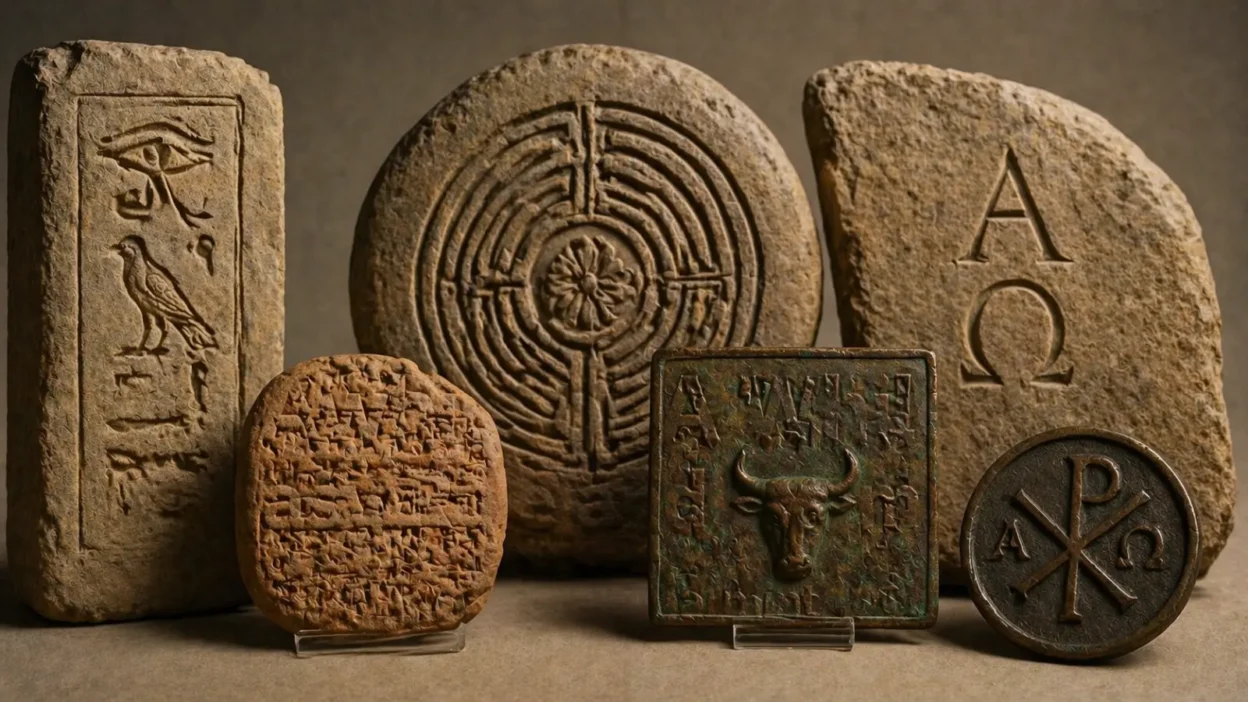
That mix can include things from very different worlds: Egyptian amulets, Greek myth images, Mesopotamian signs, South Asian sacred motifs, and geometric forms that later cultures kept reusing. Putting all of that into one basket is convenient, but it can also be misleading.
A better definition is this: ancient symbolism is the study of how old cultures used visual forms to represent ideas, forces, stories, status, protection, divinity, memory, or belonging.
That does not mean every symbol had one official meaning. It means symbols helped people organize meaning in a visual way.
Why symbols mattered before most people could read
In ancient societies, symbols did practical work.
They marked power. They signaled divine protection. They linked rulers to gods. They helped identify a group, a place, or a social role. They also appeared in tombs, temples, household objects, clothing, and trade goods.
In some cultures, symbols stood beside writing. In others, they were part of writing. In still others, they worked through ritual and visual memory more than text.
That helps explain why ancient symbols can look so durable. They were not just decoration. They carried meaning in public life.
They also helped bridge a world where literacy was limited. A sign carved into stone, painted on a wall, or worn as an amulet could communicate something important even to people who could not read a long text.
How symbols get their meanings
Ancient symbols usually gained meaning through repeated use, not magic.
A symbol could mean something because of its shape. A circle might suggest wholeness or cycles. A path with one route in and out could suggest a journey or ordeal. An eye could stand for sight, awareness, or divine watching.
It could also mean something because of use. If an object was worn for protection, buried with the dead, or placed in a temple, people would connect it with protection, afterlife care, or sacred power.
Myth mattered too. If a symbol was tied to a god, a founding story, or a ritual drama, its meaning could become deeper and more specific.
Material mattered as well. Stone, gold, faience, ink, cloth, and carved wood each carried different kinds of value and visibility.
So when readers ask what a symbol “means,” the real answer often has several parts:
- what it looked like
- where it appeared
- who used it
- what story or belief surrounded it
- what later generations changed about it
Ancient symbols were not one shared world language
This is where many modern explainers go wrong.
They treat ancient symbols as if all cultures were tapping into the same global code. That makes for neat lists, but it is not good history.
Different cultures could use similar forms for different reasons. A sun shape, spiral, cross-form, or eye motif might appear in multiple places, but that does not prove a shared meaning. It may reflect common human concerns like daylight, motion, protection, or the body. It may also be coincidence, parallel design, or later borrowing.
Even within one culture, a symbol could shift over time. Meanings moved with politics, religion, conquest, trade, translation, and art.
That is why broad claims like “this symbol always meant rebirth” or “all ancient cultures saw this as feminine” should raise caution. Some meanings are well documented. Others are modern guesses layered onto old forms.
A few well-known examples and what they originally signaled
A short comparison helps show how this works.
| Symbol | Original or early context | Common U.S. reading now | Caution |
| Ankh | Ancient Egyptian sign linked with life | life, immortality, spiritual wisdom | Modern use is often broader than the original context |
| Eye of Horus | Egyptian protective and regenerative amulet | protection, insight, “third eye” style spirituality | The modern intuition reading is later and selective |
| Labyrinth | Ancient path image tied to ordeal, myth, or sacred movement | inner journey, meditation, self-discovery | Not every maze-like image has the same history |
| Spiral | Ancient decorative and symbolic form in many cultures | growth, motion, life cycles | Often overgeneralized as “universal spiritual meaning” |
| Swastika | Ancient sacred and auspicious sign in several traditions | in the U.S., overwhelmingly linked to Nazism and hate | Requires strong historical and ethical context |
These examples show why an overview has to do two jobs at once. It has to explain the older setting, and it has to explain the modern reading people actually bring to the symbol now.
That second part matters. In daily American life, people respond to the current cultural meaning first.
Why ancient meanings changed over time
Symbols do not sit still.
Some changed because religions changed. Some moved through conquest or trade. Some were copied into new art styles. Some were translated badly. Some were revived by later spiritual movements, national movements, or commercial design trends.
Archaeology also played a role. Once museums, textbooks, films, and popular history books began circulating ancient imagery, symbols left their original settings and entered mass culture. A funerary amulet could become jewelry. A sacred sign could become wall art. A political or religious symbol could become a graphic motif.
Then the internet sped all of this up. Today, one image can be posted with a dozen different claims about what it means. Some of those claims reflect scholarship. Some reflect living tradition. Some come from modern self-help or aesthetic trends. Some are just invented.
That is why modern meanings are often layered:
- historical meaning from documented use
- religious meaning inside a living tradition
- folk meaning passed through story and custom
- modern spiritual meaning shaped by newer belief systems
- commercial meaning driven by fashion and design
What ancient symbols usually mean in the United States now
In the United States, ancient symbols are often read less literally and more personally.
People may use them to signal protection, depth, old wisdom, mystery, resilience, heritage, or a connection to something older than modern life. That is especially common in tattoos, jewelry, home décor, and spiritual-adjacent spaces.
Americans also tend to read symbols through individual identity. A person may choose an ancient image not because they belong to its original culture, but because the image feels meaningful to their own story.
That can be thoughtful. It can also flatten history.
For example, a symbol once tied to a funerary ritual may now be read as general healing. A sign once tied to royal power may be recast as self-empowerment. A sacred emblem may be treated as a style choice.
None of that means modern use is fake. It means modern use is different.
Religion, folklore, and modern spirituality are not the same thing
This distinction matters more than most symbol guides admit.
A symbol may have had a formal place in religion. It may also have circulated in folk protection practices. Later, it may have been picked up by modern spiritual movements that are not historically continuous with the original tradition.
Those layers should not be collapsed into one.
A living religious symbol is not just an “aesthetic.” It may still be used in prayer, ritual, temple life, or sacred instruction. Treating it as a generic vibe can erase the people who still hold it as meaningful in a specific way.
Folklore is different too. Folk beliefs often adapt official religion, local custom, regional fears, and household practice. That makes them real as tradition, but not the same as doctrine.
Then there is modern spirituality. In the U.S., many people borrow symbols across traditions to express intuition, healing, cosmic balance, or personal growth. That is a real social use. It is just not the same as historical origin.
Where people encounter ancient symbols today
Ancient symbols are now part of ordinary visual culture in the United States.
You see them in places like these:
- Tattoos: chosen for protection, rebirth, endurance, mystery, or identity
- Jewelry: worn as charms, heritage markers, or spiritual accessories
- Home décor: used to create a feeling of age, ritual, travel, or calm
- Fashion: printed or engraved as bold visual shorthand
- Branding and design: borrowed for prestige, depth, or “timeless” appeal
- Entertainment: used in fantasy, gaming, horror, and historical fiction
- Social media: recirculated with simplified or exaggerated meanings
This is one reason broad symbol claims spread so easily. A symbol leaves the museum, enters lifestyle culture, and then gets explained in shorter and looser ways each time it is reposted.
Misuse, distortion, and symbols that need extra care
Some ancient symbols can be used casually. Others need real caution.
The clearest example is the swastika. Historically, it is older than Nazism and sacred in several traditions. But in present-day American public life, it is overwhelmingly understood through Nazi violence, antisemitism, and extremist use. That modern meaning cannot be brushed aside.
Other problems are softer but still important.
A sacred symbol may be stripped of its religious meaning and sold as décor. A symbol from one culture may be given a made-up “universal” meaning because that sounds easier to market. A tattoo trend may present a symbol as ancient truth when the specific interpretation is actually modern and online.
There is also a habit of romanticizing the ancient world itself. People sometimes assume that older means purer, deeper, or more authentic. History does not support that kind of shortcut. Ancient symbols were part of real societies, with power struggles, changing beliefs, and competing interpretations of their own.
Respect starts with context.
How to read ancient symbols responsibly now
A responsible reading of ancient symbols is not complicated. It just takes restraint.
Start with a few questions:
- What culture and period is this symbol actually tied to?
- Was it religious, political, protective, funerary, decorative, or mixed?
- Is the meaning documented, or mostly repeated online?
- Is it still sacred to a living community?
- How is it commonly read in the United States today?
That last question matters because meaning is not only historical. It is social. A symbol can carry an old meaning and a current public meaning at the same time.
The most honest approach is usually the best one: name the original context, acknowledge later reinterpretations, and avoid claiming more certainty than the evidence allows.
FAQs
What does ancient symbolism usually mean today?
In modern U.S. usage, ancient symbolism usually points to ideas like protection, wisdom, mystery, continuity, and spiritual depth. Historically, though, those meanings were not one-size-fits-all and often came from very specific cultural settings.
Are ancient symbols universal across cultures?
Not in a strict sense. Different cultures sometimes used similar shapes, but that does not mean they shared the same beliefs about them.
Do ancient symbols make good tattoos?
They can, but only if the wearer understands the symbol’s background and present-day meaning. A design that looks personal or artistic may still be sacred, culturally specific, or widely misunderstood in public.
Are ancient symbols religious?
Some are, some are not, and some sit in between. A symbol can be tied to formal worship, household protection, myth, kingship, burial, or plain ornament depending on the culture and period.
Why do websites give different meanings for the same symbol?
Because symbols change across time, and many modern explainers blend history with folklore, spiritual reinterpretation, and internet shorthand. Disagreement often comes from mixing these layers together.
Is it disrespectful to use an ancient symbol in décor or fashion?
Sometimes it can be, especially if the symbol still has sacred meaning in a living tradition or if the modern public meaning involves harm. Context, awareness, and presentation make a big difference.
Conclusion
The clearest way to understand old symbols is to stop looking for one final meaning and start looking at context. Ancient symbols were shaped by ritual, myth, power, memory, art, and daily use. Their meanings grew through repetition inside real communities.