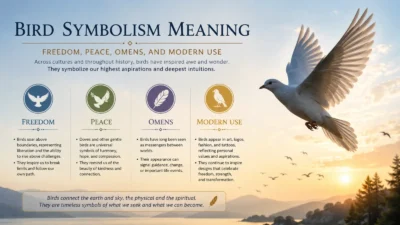

The phrase eagle symbolism meaning usually points to freedom, strength, vision, and courage. In the United States, it also carries a strong national meaning because the bald eagle has long stood for independence, self-government, and public authority.
But the eagle is not only an American symbol. Eagles appear in religious art, Indigenous traditions, ancient myth, military emblems, tattoos, sports teams, logos, and personal spiritual language. Each setting changes the meaning.
That is why eagle symbolism needs care. A tattoo, a national seal, a sacred feather, and a dream about an eagle are not the same kind of symbol. They may share a few themes, but they do not carry the same history.
Quick Answer
Eagle symbolism meaning most often centers on freedom, strength, vision, courage, and independence, especially for U.S. readers who connect the bald eagle with American identity. Historically, these meanings grew from the bird’s high flight, sharp eyesight, hunting power, and use in civic, religious, and military imagery. Some spiritual, dream, and omen meanings are belief-based interpretations rather than proven facts.
TL;DR
- Eagles often symbolize freedom, strength, and vision.
- The bald eagle is central to U.S. identity.
- Sacred eagle meanings vary by Native nation.
- Christian symbolism links eagles with John and renewal.
- Tattoos often show courage, service, or independence.
- Context decides whether eagle imagery feels noble or troubling.
What the Eagle Symbolizes Most Often Today
Today, the eagle most often symbolizes freedom, strength, vision, courage, independence, and authority. In the United States, the bald eagle adds another layer: national identity.
That meaning is easy to recognize. Americans see eagle imagery on official seals, military insignia, currency, public buildings, sports logos, patriotic decor, and memorial art. Even when people do not know the full history, they often understand the basic message: the eagle suggests a nation that wants to be seen as free, strong, watchful, and self-governing.
Outside official use, the eagle can feel more personal. Someone may choose an eagle tattoo to show independence after hardship. A brand may use an eagle to suggest confidence. A school or sports team may use it to suggest ambition, speed, and competitive pride.
| Context | Common meaning | Important caution |
|---|---|---|
| U.S. civic imagery | freedom, independence, national authority | This is a specific American use, not a universal meaning. |
| Tattoos | courage, resilience, service, personal freedom | Meaning depends on design and wearer. |
| Religion | renewal, divine care, spiritual height | Meaning changes by tradition. |
| Indigenous contexts | sacred relationship, ceremony, honor | Do not reduce many Native nations to one meaning. |
| Logos and mascots | strength, speed, ambition | Often decorative or commercial, not sacred. |
The strongest modern meanings come from the eagle’s image: wide wings, high flight, hooked beak, sharp talons, and a direct gaze. Those traits make the bird feel commanding, even before history enters the picture.
Why Eagle Meanings Developed from the Bird Itself
Many symbols begin with observation. Eagles are large birds of prey. They soar high, watch from exposed perches, hunt with force, and often nest in high places. Those visible traits help explain why people connect them with power and perspective.
High flight supports the meaning of freedom. An eagle in the sky looks unconfined. It moves above fences, roads, crowds, and borders. That makes it a natural image for independence, escape, and wide possibility.
Sharp vision supports the meaning of insight. The phrase “eagle-eyed” still means alert, precise, or hard to fool. Symbolically, the eagle sees what others miss. This is why it often represents strategy, leadership, and clear judgment.
Its beak and talons support meanings of force and courage. Eagles are predators, not gentle songbirds. That is part of the reason they appear in military, imperial, and competitive imagery.
Still, symbolic meaning is not the same as animal behavior. Eagles are not morally pure because they fly high. Bald eagles may scavenge, steal food from other birds, and gather in groups when food is available. Real animals are more complex than the values people attach to them.
The Bald Eagle and American Identity
For a U.S. audience, eagle symbolism almost always leads to the bald eagle. The bald eagle has appeared as a national emblem since the late eighteenth century, especially through the Great Seal of the United States.
On the seal, the eagle holds an olive branch and arrows. The design expresses a country that claims to prefer peace while remaining ready to defend itself. The shield, stars, motto, arrows, and branch all work together. The bird is not just decoration. It carries the idea of sovereignty.
In December 2024, the bald eagle was formally designated the national bird of the United States. That change matters because many people had assumed it already held that legal title. Symbolically, though, the bird had been doing that work for generations.
The bald eagle’s American meaning usually includes:
- freedom
- independence
- strength
- vigilance
- public authority
- national pride
- military service
- conservation recovery
There is also a conservation layer. The bald eagle’s recovery after major population decline made it a symbol of environmental repair for many Americans. In that context, it does not only represent national power. It can also represent what protection, regulation, and public attention can restore.
A common myth says the bald eagle “won” against the turkey as the national bird. The better version is more careful: a famous founder criticized the bald eagle in a private letter and praised the turkey’s character, but that was not an official national-bird election. The story survives because it adds humor to a serious symbol.
Eagles in Indigenous and Native American Contexts
Eagles and eagle feathers hold deep religious and cultural significance for many Native American and Alaska Native communities. This is one of the most important areas to treat with respect.
There is no single “Native American eagle meaning.” Native nations are distinct peoples with their own languages, histories, ceremonies, and teachings. In some contexts, eagles may be connected with prayer, honor, healing, leadership, courage, or relationship with the Creator. But those meanings cannot be safely blended into one universal statement.
Eagle feathers are especially sensitive. They are not just rustic decor or a fashion symbol in many Native contexts. They can be part of ceremony, responsibility, earned honor, and living religious practice.
For that reason, non-Native use of eagle feathers or Native-style eagle imagery can become disrespectful when it treats sacred objects as costume, trend, or fantasy. This is especially true when the design copies ceremonial forms without permission, context, or relationship.
A respectful article should not claim to explain private ceremonies. It is enough to say this: eagle meanings in Native communities are living meanings, not ancient aesthetics for general use. They deserve accuracy, humility, and boundaries.
Eagles in Ancient Power, Empire, and Myth
Long before modern America, eagles appeared in ancient Mediterranean and imperial imagery. In Greek tradition, the eagle is closely linked with Zeus, the sky god. In Roman tradition, the eagle became tied to Jupiter and to military power.
The Roman aquila, or eagle standard, was more than a battlefield marker. It represented the legion’s identity, honor, and loyalty. Losing it was a serious disgrace. This helped connect the eagle with command, empire, and disciplined force.
That older imperial history still shapes how eagle imagery feels today. A spread-winged eagle can suggest nobility and authority. It can also feel severe, official, or militarized, depending on the design.
This is why context matters. An eagle on a nature poster feels different from an eagle carved above a government doorway. An eagle on a military badge feels different from an eagle in a dream journal.
Eagles also appear in stories as messengers, sky beings, guardians, and signs of victory. But it is not accurate to say “all ancient cultures believed the eagle meant the same thing.” Similar traits led to similar ideas, but each tradition gave the bird its own setting.
Eagle Meaning in Christianity and the Bible
In Christian symbolism, the eagle has several meanings. One of the clearest is its link with John the Evangelist. In Christian art, John is often represented by an eagle because his Gospel is associated with spiritual height, divine vision, and a lofty opening about the Word.
Biblical language also uses eagle imagery for renewal and protection. The image of rising on eagle’s wings is often read as hope, restored strength, and trust in God. Other passages use eagle-wing imagery to describe rescue or divine care.
These meanings are religious, not merely decorative. For believers, the eagle can point toward God’s strength, spiritual endurance, and a view beyond immediate trouble.
At the same time, Christian eagle symbolism should not be confused with every modern “spiritual eagle” meaning online. A Bible verse, a church carving, and a personal sign from nature are different forms of interpretation.
Cross-Cultural Eagle Meanings Without Forcing One Universal Message
Eagles appear in many parts of the world because many cultures have lived near large birds of prey. It makes sense that people noticed their height, speed, hunting skill, and dramatic shape.
Common cross-cultural themes include:
- sky and height
- rulership or authority
- courage and combat
- spiritual distance or divine nearness
- watchfulness
- victory
- national or tribal identity
But similar themes do not prove one universal eagle meaning. A golden eagle in one region, a bald eagle in another, and an eagle in a coat of arms may carry different stories.
For example, eagle imagery in the United States is tied to the bald eagle and republican government. Eagle imagery in Mexico carries a different national story. Eagle imagery in ancient Rome carries still another meaning tied to military identity and state power.
The safest approach is to ask: Which eagle? Used by whom?
That question prevents shallow interpretation.
Seeing an Eagle: Omens, Dreams, and Personal Interpretation
Many people search for the meaning of seeing an eagle. Some read it as a sign of courage, freedom, spiritual guidance, or a reminder to rise above a problem.
Those interpretations can be meaningful on a personal level. A person who sees an eagle during a hard season may connect it with strength or hope. A dream about an eagle may help someone think about ambition, fear, protection, or independence.
But omen and dream meanings are belief-based. They are not historical facts and should not be presented as guaranteed messages.
A balanced way to interpret an eagle sighting is to combine context and reflection. Ask what the bird was doing. Was it soaring, perched, hunting, injured, or defending a nest? Then ask what the image stirred in you.
For many people, the useful meaning is not “the universe sent a fixed message.” It is “this image helped me notice something I already needed to face.”
Eagle Tattoos and Personal Identity
Eagle tattoos are popular because the image is bold, readable, and flexible. The wings, head, talons, feathers, and flight pose all carry different emotional tones.
Common eagle tattoo meanings include:
- independence after a major life change
- courage during hardship
- military service or remembrance
- patriotism
- protection
- ambition
- spiritual focus
- loyalty to family, country, or personal values
A bald eagle tattoo often reads as American, especially when paired with a flag, shield, stars, military dates, or memorial text. A flying eagle may suggest freedom or forward motion. An eagle head can suggest focus, vigilance, or pride.
Cultural care matters here. Eagle feathers, Native-inspired designs, and ceremonial-looking imagery should not be treated casually. If a tattoo borrows from a living tradition, the wearer should understand that the image may carry responsibilities or boundaries outside their own personal meaning.
Design also affects interpretation. An eagle with aggressive angles can feel militant. A naturalistic eagle can feel wild and observant. A memorial eagle can feel protective and solemn.
Eagles in Logos, Sports, Decor, and Digital Culture
Eagles are common in modern U.S. design because they communicate quickly. A viewer does not need a long explanation to understand the basic message: strength, speed, height, pride, and alertness.
Sports teams use eagles to suggest competitive power. Schools use them to suggest ambition and achievement. Outdoor brands may use them to suggest wilderness and self-reliance. Government offices use them to signal authority and public trust.
In home decor, eagle imagery can lean patriotic, rustic, military, or nature-focused. A carved eagle over a mantel may suggest heritage. A minimalist eagle print may suggest independence or clean strength.
In digital culture, eagle symbols are often flattened into icons. A profile image, emoji-style graphic, or logo may keep the feeling of power while losing the older history. That is not always bad, but it can make the symbol feel generic.
The more commercial the setting, the less specific the meaning usually becomes. A logo eagle may not be about faith, country, or ceremony. It may simply be visual shorthand for confidence.
Misuse, Oversimplification, and Responsible Interpretation
Eagle symbolism can be inspiring, but it can also be misused. The same traits that make the eagle feel noble—height, command, force, and dominance—can be used in harsh or exclusionary imagery.
One major example is Nazi eagle imagery. That specific form, especially when connected with a swastika or related hate symbols, is not the same as a plain eagle, a U.S. bald eagle, or a wildlife illustration. But it shows how eagle imagery can be turned toward authoritarian and hateful messages.
Responsible interpretation depends on context. Look at what the eagle is holding, where it appears, what style it uses, and what group is using it. A bird alone does not tell the whole story.
Oversimplification is another problem. It is easy to say “the eagle means freedom” and stop there. That answer is partly true, but incomplete. The eagle can also mean state power, sacred responsibility, military identity, spiritual renewal, personal resilience, or commercial confidence.
The best reading is specific. An eagle’s meaning comes from the bird, the culture, the design, and the person using it.
FAQs
What does an eagle symbolize?
An eagle most often symbolizes freedom, strength, courage, vision, and independence. In the United States, the bald eagle also symbolizes national identity, public authority, and self-government.
What does an eagle tattoo mean?
An eagle tattoo usually means personal freedom, resilience, courage, patriotism, or service. The exact meaning depends on the design, such as a flying eagle, eagle head, feather, flag pairing, or memorial tattoo.
What does seeing an eagle mean spiritually?
Many people interpret seeing an eagle as a reminder of courage, higher perspective, or spiritual strength. That is a belief-based or personal reading, not a fixed fact that applies to everyone.
Is eagle symbolism mainly American?
No. Eagles appear in many cultures, religions, myths, and political systems. The bald eagle’s link with freedom and national identity is especially American, but eagle symbolism is much broader.
Are eagle symbols always positive?
No. Eagles can symbolize courage and freedom, but they can also suggest domination, militarism, aggression, or authoritarian power in some designs. Context decides whether the image feels protective, patriotic, sacred, commercial, or threatening.
What does the eagle mean in Christianity?
In Christian art, the eagle is strongly connected with John the Evangelist. Biblical eagle imagery can also suggest renewal, divine care, protection, and rising strength.
Is it disrespectful to use eagle feathers as decoration?
It can be, especially when eagle feathers are treated as costume, trend, or generic “spiritual” decor. In many Native American contexts, eagle feathers have sacred and ceremonial importance, so they should be approached with respect and cultural awareness.
Conclusion
The eagle is one of the clearest examples of how a real animal becomes a layered symbol. Its high flight, sharp sight, hunting power, and dramatic outline help explain why people connect it with freedom, courage, authority, and vision.