When people search for bird symbolism meaning, they are usually asking why birds so often stand for freedom, hope, messages, spirit, change, or warning. The answer starts with something simple: birds live close to us, but they also move through the sky in a way humans have long treated as special.
That does not mean every bird has one fixed meaning. A dove on a wedding invitation does not mean the same thing as a raven in a horror film, an eagle on a government seal, or a cardinal remembered after a loss.
In the United States today, birds appear in tattoos, memorial art, home decor, sports logos, national symbols, faith imagery, and social media posts about signs from loved ones. Their meanings are familiar, but they still need context.
Quick Answer
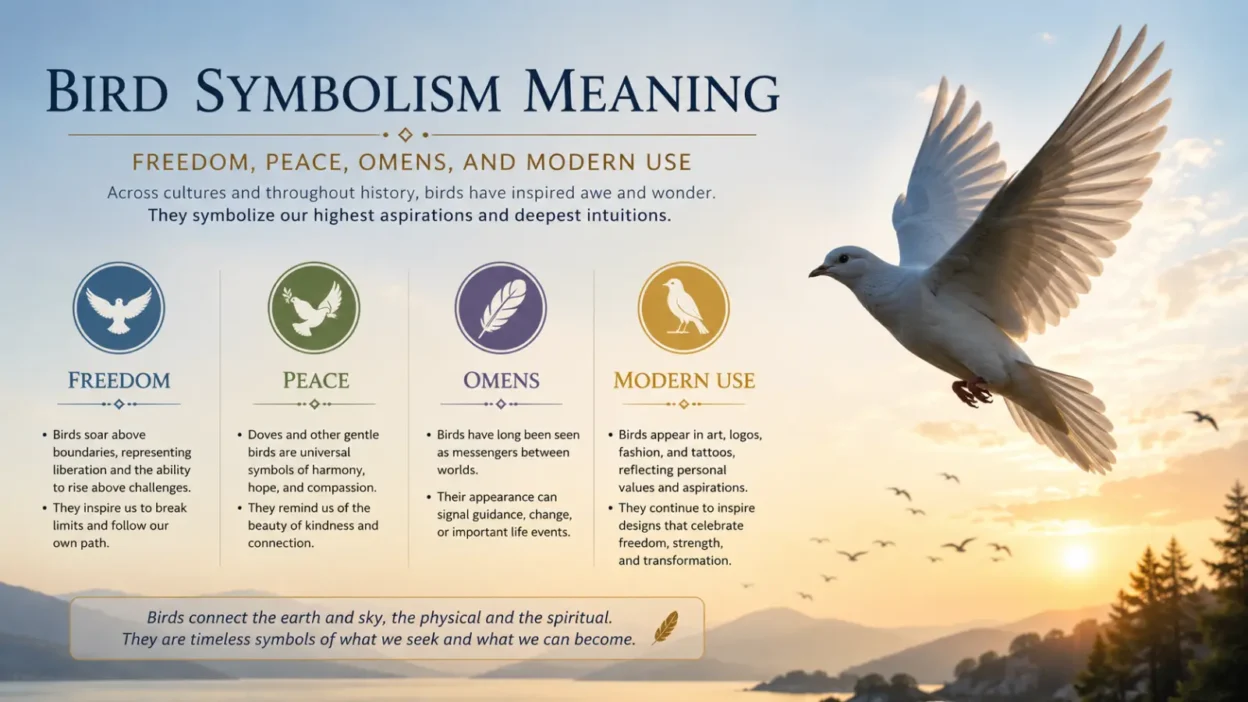
In modern U.S. culture, bird symbolism meaning most often points to freedom, hope, perspective, and movement through change. Older religious, mythic, and folklore traditions also treat birds as messengers, souls, omens, signs of peace, or symbols of power, but the exact meaning depends on species, setting, and culture.
TL;DR
- Birds often symbolize freedom and movement.
- Doves commonly suggest peace, love, or spirit.
- Eagles carry power and U.S. identity.
- Owls, ravens, and crows have mixed meanings.
- Omens are beliefs, not proven signs.
- Species and context change the meaning.
What Bird Symbolism Refers To
Bird symbolism means using a bird, feather, wing, nest, flock, or bird-shaped image to express an idea beyond the animal itself. It can appear in art, religion, jewelry, tattoos, flags, cards, stories, or everyday sayings.
The symbol may be very broad, such as a bird standing for freedom. It may also be very specific, such as a dove suggesting peace, an eagle suggesting strength, or an owl suggesting wisdom or mystery.
The meaning usually grows from visible traits. Birds fly. Many sing. Others gather in flocks. People turn those traits into human ideas such as escape, longing, protection, loyalty, alertness, and renewal.
That does not make the meaning universal. Symbolism is a human reading placed on the bird. Real birds are animals with their own behavior, not spiritual props. A careful interpretation keeps both truths in view.
The Core Modern Meanings: Freedom, Hope, and Perspective
The most common bird meaning in the United States today is freedom. This comes through in phrases like “free as a bird,” “spread your wings,” and “fly away.” A bird in flight can suggest release from limits, a fresh start, or the courage to leave a narrow place.
Hope is another common meaning. Birds are often seen at sunrise, in spring, or after storms, so they can feel like signs of return and renewal. This is why small birds often appear on greeting cards, memorial art, and gentle home decor.
Birds can also symbolize perspective. From the ground, a flying bird seems to see more than we do. That makes it a useful image for distance, wisdom, and emotional clarity.
These meanings are modern and easy to understand, but they are not random. They developed because birds move in ways humans notice: upward, across distance, over borders, and back again with the seasons.
Why Flight Became the Main Symbolic Trigger
Flight is the heart of most bird symbolism. Before airplanes, the ability to rise into the sky belonged to birds, insects, bats, and imagination. Birds made the sky feel alive.
Because of that, many cultures linked birds with higher vision, divine places, souls, prayers, or messages. A bird could leave the ground and return, so it became a natural image for moving between levels of life: earth and sky, body and spirit, home and distance, grief and hope.
This does not mean all cultures believed the same thing. It means the same visible feature, flight, invited many different interpretations. One culture might see a bird as a messenger. Another might see it as an ancestor, omen, deity companion, or national emblem.
In modern writing, tattoos, and design, flight still does the same work. A flying bird usually reads as motion, independence, or escape. A caged bird often means restriction. A bird with open wings often suggests readiness, protection, or release.
Birds as Messengers Between Places and Worlds
Birds are often treated as messengers because they cross distance. Some birds migrate across continents. Others return to nests. Humans have also used birds such as pigeons to carry messages, which gives the symbolism a practical base as well as a poetic one.
In religion, myth, and folklore, the messenger meaning often becomes larger. Birds may carry prayers, warnings, blessings, or news from a spiritual realm. In literature and art, a bird at a window can suggest memory, longing, or a message that has not been spoken aloud.
In U.S. popular culture, this idea shows up when people describe a cardinal, dove, or sudden bird sighting as a sign from someone who died. For many people, that belief brings comfort. It should be described as personal or spiritual interpretation, not as something that can be proven.
The safest reading is this: birds make strong symbols of contact. They seem to arrive from elsewhere, stay briefly, and leave. That pattern makes them easy to connect with memory, distance, and emotion.
Peace, Love, and Renewal: Why Doves Became So Familiar
The dove is one of the most recognizable bird symbols in the United States. It often means peace, gentleness, love, purity, or the presence of spirit. A white dove especially carries those associations because white is often used in U.S. weddings, memorials, and religious art to suggest innocence or solemn beauty.
The dove’s peace meaning has deep religious and artistic roots.
The same bird image now appears in wedding decor, sympathy cards, church art, memorial tattoos, and peace signs. In those settings, the meaning is usually gentle and hopeful.
Still, the dove should not be treated as one flat symbol. A dove in a church window, a dove tattoo, and a dove released at a funeral can overlap in meaning, but each has a different setting. The symbol becomes clearer when the setting is named.
Power, Nationhood, and Protection: Eagles in U.S. Culture
For a U.S. audience, the eagle carries a special public meaning. The bald eagle has long appeared in national imagery and was formally named the national bird in the 2020s. In civic use, it often stands for strength, independence, authority, protection, and national identity.
The eagle works as a national symbol because it is large, visually striking, native to North America, and associated with high flight and sharp sight. In official imagery, the eagle often appears with other symbols of peace, defense, unity, or sovereignty.
But eagle symbolism has more than one layer. For many Indigenous nations, eagles and eagle feathers have deep ceremonial and spiritual importance. Those meanings are not generic “Native American symbolism.” They belong to specific peoples, teachings, and protocols.
That matters in modern use. An eagle logo, patriotic tattoo, or sports mascot may read as strength in mainstream U.S. culture. An eagle feather used as decoration can raise serious cultural and legal concerns. Respectful interpretation does not treat sacred items as a trend.
The eagle also carries a conservation layer today. Many Americans know the bald eagle as a recovery story after serious decline. That gives the bird an added meaning of survival, environmental care, and return.
Wisdom, Mystery, and Fear: Owls, Ravens, and Crows
Not every bird symbol feels gentle. Owls, ravens, and crows often carry mixed meanings because their traits are more dramatic.
Owls are commonly linked with wisdom, learning, night vision, and secrecy. The wisdom link is strong in classical imagery, where the owl is tied to a goddess of practical reason. In other traditions, owls may be linked with death, danger, witchcraft, or warning because they are nocturnal, quiet, and heard in darkness.
Ravens and crows are also complex. Their black feathers, harsh calls, carrion feeding, and presence around death made them easy to cast as omens in many stories. At the same time, they are intelligent birds, and many myths treat them as tricksters, creators, messengers, or clever survivors.
In the United States today, these birds often appear in Halloween design, gothic fashion, fantasy stories, dark academia style, and tattoos about grief, intelligence, or independence. Calling them simply “bad” misses the point. Their meaning is usually about mystery, memory, cleverness, and the edge between life and death.
Religion, Myth, and Folklore Without Blending Them Together
Bird symbolism becomes confusing when all traditions are blended into one big “spiritual meaning.” A responsible reading separates religion, myth, folklore, and modern personal use.
The phoenix is a helpful example. It is not a normal bird species. It is a legendary bird associated with burning, renewal, and return. Today, people use the phoenix as a symbol of recovery after loss, illness, trauma, or major change.
Other bird meanings are tied to specific cultures. Cranes may suggest longevity in some East Asian contexts. Ravens carry major roles in some northern and Indigenous stories. Eagles have sacred meaning in many Native traditions. These examples should be handled with care, not used as decoration without understanding.
The better question is not “What do birds mean everywhere?” The better question is “Which bird, in which tradition, and for what purpose?”
Omens and Superstitions: What Bird Sightings Are Believed to Mean
Bird omens are common because birds are visible, mobile, and unpredictable. A bird at a window, a bird entering a house, an owl calling at night, or a crow appearing after a loss can feel meaningful, especially during emotional moments.
In ancient and folk settings, people sometimes read bird flight, direction, calls, or numbers as signs of good or bad fortune. Some modern readers still do this informally. They may see a cardinal as a loved one’s visit, a dove as reassurance, or a black bird as a warning.
These are beliefs and interpretations, not established facts. A bird tapping a window may be reacting to reflection. A crow near a road may be feeding. An owl calling at night may simply be behaving like an owl.
That does not make the emotional meaning worthless. It only means the meaning belongs to the person or tradition reading the event. A careful article should allow comfort without turning every bird sighting into a guaranteed message.
Bird Tattoos, Decor, Branding, and Personal Identity
Birds remain popular in tattoos because they can say a lot with a small shape. A single flying bird may suggest independence. A flock may suggest family, migration, or a life transition. A dove may suggest peace, faith, or remembrance. A raven may suggest grief, intelligence, or attraction to the unknown.
Some tattoo meanings are more specific. Swallows have long been associated with sailors, safe return, loyalty, and travel. Phoenix tattoos often mean survival or starting over. Eagle tattoos may show patriotism, courage, military identity, or personal strength.
In home decor, birds usually soften a space. Songbirds, cranes, herons, and small silhouettes can suggest calm, nature, spring, coastal life, or lightness. In branding, wings and birds often suggest speed, vision, freedom, elevation, or trust.
The same symbol can shift quickly. A bird on baby nursery wallpaper feels gentle. A black raven on a book cover feels ominous. An eagle on a uniform feels official. Meaning comes from design, color, posture, and setting.
How Bird Symbolism Changes by Species, Color, and Context
A bird symbol becomes more accurate when you identify the kind of bird and the scene around it. A white bird flying upward does not read the same way as a black bird perched on a bare branch.
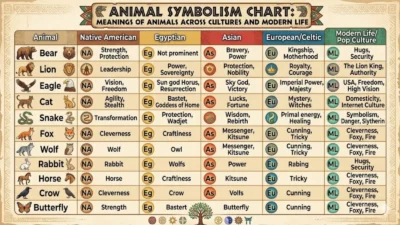
| Bird Image | Common Modern U.S. Reading | Why It Developed | Read With Caution |
|---|---|---|---|
| Dove or white bird | Peace, love, spirit, remembrance | Gentle image, religious art, peace imagery | Not every white bird has sacred meaning |
| Eagle | Strength, freedom, national identity | Size, flight, sharp sight, civic use | Eagle feathers may be sacred and restricted |
| Owl | Wisdom, secrecy, night awareness | Nocturnal vision and classical imagery | Some traditions read owls as death omens |
| Crow or raven | Mystery, grief, intelligence, warning | Black plumage, carrion, clever behavior | They are not simply evil symbols |
| Flock in flight | Change, community, migration, release | Seasonal movement and group motion | Can also suggest leaving or loss |
Color matters too. White often softens a bird’s meaning. Black can make it feel mysterious or mournful. Red, as with a cardinal, may suggest vitality, memory, or emotional presence in modern U.S. use.
Posture matters as well. A perched bird feels watchful. A flying bird feels free. A nesting bird feels protective. A wounded bird feels vulnerable. Symbolism is rarely just the species alone.
Common Misreadings and Respectful Interpretation
The biggest mistake is treating bird symbolism as universal. Birds are found almost everywhere, but people do not interpret them the same way everywhere. Even within one country, family beliefs, religion, region, and personal experience change the meaning.
Another mistake is turning every bird into an omen. A bird can feel meaningful without being a prediction. Personal meaning is valid, but it should not be sold as certainty.
A third mistake is flattening Indigenous traditions. There is no single “Native American bird meaning.” Different nations have different relationships with eagles, ravens, owls, cranes, feathers, songs, and ceremonial objects. Sacred meanings should not be copied casually for fashion, decor, or branding.
Before interpreting a bird symbol, ask three questions:
- What species or bird image is shown?
- Where does it appear?
- Who is using it, and why?
Those questions keep the meaning grounded. They also make the symbol more interesting than a one-word answer.
FAQs
What do birds symbolize most often?
Birds most often symbolize freedom, hope, movement, perspective, and change. Those meanings come mainly from flight, migration, song, and the way birds move between ground and sky.
What does a bird tattoo mean?
A bird tattoo often means freedom, independence, travel, remembrance, or personal transformation. The exact meaning depends on the species, such as a dove for peace, a swallow for return, a raven for mystery, or a phoenix for renewal.
Are birds spiritual symbols?
Birds can be spiritual symbols in many religions and personal belief systems. They may represent spirit, prayer, divine messages, the soul, or connection with the dead, but those meanings should be described as belief-based unless tied to a specific tradition.
Is seeing a bird a sign from someone who died?
Many people in the United States find comfort in seeing a cardinal, dove, or other bird after a loved one dies. That interpretation can be emotionally meaningful, but it is a personal or spiritual belief rather than a provable fact.
Do birds have negative meanings?
Yes, some birds can carry negative or unsettling meanings in certain contexts. Owls, crows, ravens, and vultures may be linked with death, warning, secrecy, or decay, but they can also mean wisdom, intelligence, protection, or transformation.
Why is the eagle important in American symbolism?
The eagle is important in American symbolism because it represents strength, independence, authority, and national identity. The bald eagle also has living significance for many Indigenous peoples, so its feathers and sacred meanings should not be treated casually.
Does bird meaning change by culture?
Yes. Bird meaning changes by culture, religion, species, color, and setting. A dove in Christian art, a crane in East Asian design, a raven in myth, and an eagle on a U.S. seal do not carry the same exact message.
Conclusion
Birds are easy to symbolize because they are familiar and extraordinary at the same time. They perch near our homes, cross our roads, sing at dawn, and then rise into a space we cannot enter without tools.
The clearest bird symbolism meaning today is freedom, but that is only the starting point. Birds can also suggest peace, spirit, grief, wisdom, power, memory, warning, renewal, and belonging.
The most responsible interpretation is specific. Name the bird, notice the setting, and separate history from belief. That is where the symbol becomes clearer, kinder, and more useful.