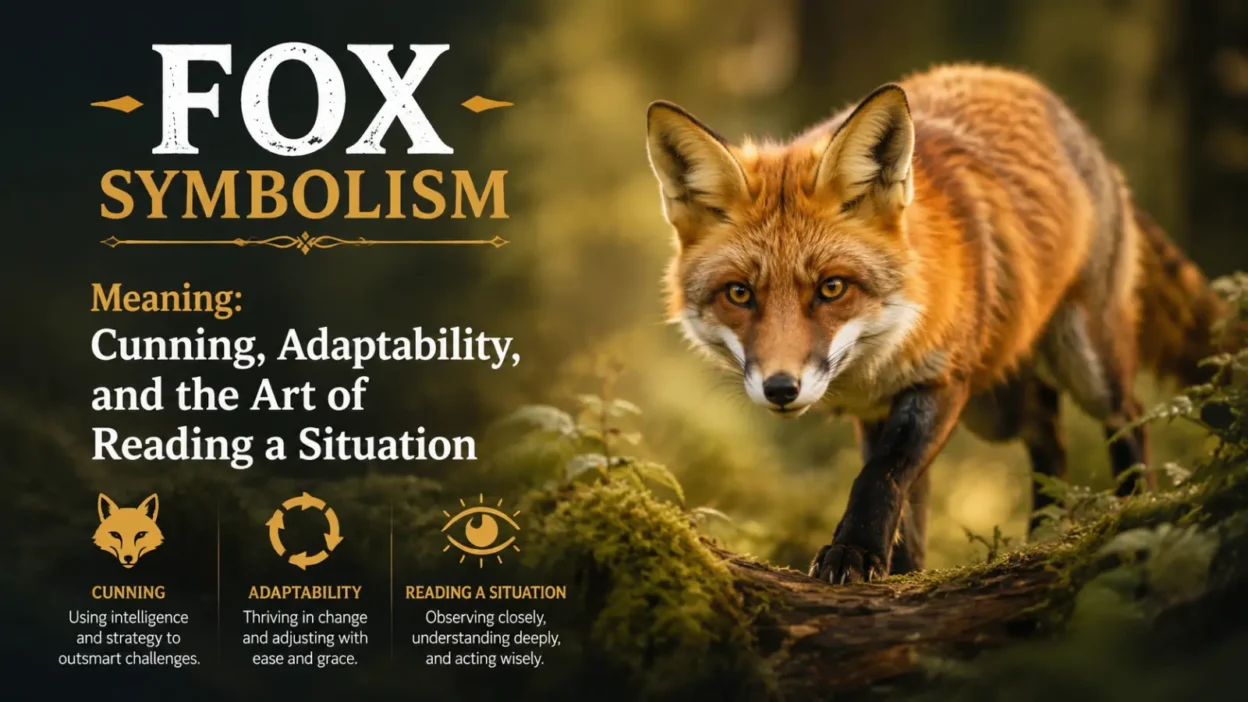
The fox symbolism meaning most U.S. readers know is simple: the fox represents cleverness. But that meaning is only the beginning. Foxes also carry ideas of adaptability, caution, independence, charm, secrecy, and survival through wit rather than force.
People care about fox symbolism because the animal feels familiar and hard to pin down at the same time. A fox can look beautiful, playful, watchful, and slightly suspicious in one glance. That mix makes it useful in stories, tattoos, branding, dreams, decor, and spiritual interpretation.
In modern U.S. culture, the fox often stands for someone who can read a room, move quietly, and find a smart path through a difficult situation. Older traditions add more layers, but they do not all say the same thing. Some treat the fox as a trickster. Some see it as a messenger, guardian, nuisance, seducer, survivor, or teacher.
Quick Answer
In modern U.S. use, fox symbolism meaning usually points to cleverness, adaptability, and quiet strategy. Historically, those ideas grew from the fox’s real-world habits and from stories that cast the animal as a trickster, survivor, messenger, or warning figure depending on the culture.
TL;DR
- Foxes most often symbolize cleverness and adaptability.
- Folklore often makes the fox a trickster.
- Real fox behavior shaped many symbolic meanings.
- Some spiritual meanings are belief-based, not proven.
- U.S. usage favors wit, style, and independence.
- Context changes whether fox symbolism feels positive or negative.
What a Fox Symbol Usually Refers To
A fox symbol usually refers to a small wild canid with pointed ears, a narrow face, quick movement, and a full tail. In the United States, most people picture a red fox first, even though foxes come in several species and colors.
That image matters. Symbolism often begins with what people notice. The fox looks alert. It appears to listen before acting. It often slips away before people get close. Its body is light, fast, and compact, so it becomes easy to connect with stealth, timing, and quick judgment.
A fox symbol may appear as a realistic animal, a cartoon figure, a tattoo, a logo, a mask, a charm, a woodland decoration, or a character in a story. The meaning shifts with the setting. A fox on a children’s book cover may suggest mischief. A fox tattoo may suggest independence. A fox in a dream journal may be read as a warning to pay attention.
The safest starting point is this: the fox symbolizes intelligence used in motion. It is not the wisdom of a still mountain or the strength of a lion. It is a sharper kind of awareness, the kind that notices openings, risks, and hidden motives.
The Core Meaning Today: Clever Survival
Today, the fox most commonly symbolizes clever survival. This does not always mean deceit. It often means using observation, timing, flexibility, and restraint instead of brute strength.
That is why the fox feels different from many animal symbols. A bear may stand for force. An eagle may stand for vision and freedom. A wolf may stand for loyalty, appetite, or the pack. The fox stands for the person who survives because they notice what others miss.
In everyday U.S. interpretation, fox symbolism often points to:
- quick thinking
- independence
- adaptability
- strategic silence
- playful confidence
- suspicion of easy appearances
These meanings can be positive or negative. A “foxy” person may be attractive or clever. A “sly fox” may be admired for wit or distrusted for manipulation. A “fox in the henhouse” is not charming at all; it signals danger, especially danger that has been allowed too close.
That double edge is central. The fox is rarely a simple hero or villain. Its symbolism lives between admiration and caution.
Why Foxes Became Symbols of Cunning
Foxes became symbols of cunning because people watched how they lived near farms, forests, fields, and settlements. They are small compared with many predators, so they cannot rely on size alone. They hunt, scavenge, hide food, avoid danger, and adjust to changing habitats.
To human observers, those habits can look like planning. A fox that raids a henhouse or vanishes into brush seems not only fast, but calculating. A fox seen at twilight feels secretive because it appears when visibility is low and the world is shifting from day to night.
This is where symbolism and biology part ways. A fox is not morally “sly.” It is an animal trying to eat, avoid threats, raise young, and survive. Humans turned those traits into stories about cleverness, trickery, and hidden intention.
That shift is common in animal symbolism. We notice a behavior, give it a human meaning, and then pass that meaning through stories. Over time, the story can become stronger than the animal itself.
With foxes, the link is easy to see. Their light steps suggest stealth. Their eyes suggest watchfulness. Their ability to live near people without fully belonging to human spaces suggests independence. Their success in many environments suggests adaptability.
Folklore Roots: Tricksters, Fables, and Moral Lessons
In many European story traditions, the fox became a trickster. It outwits stronger animals, cheats rivals, talks its way out of danger, and exposes foolishness. These tales often use the fox to teach a moral lesson about pride, greed, gullibility, or clever speech.
This is one reason the fox’s reputation became so durable in English-speaking culture. Older fables and medieval animal tales helped make the fox a shorthand for wit that bends rules. The fox could be funny, useful, selfish, dishonest, or strangely likable.
The trickster role matters because tricksters are not only “bad.” They reveal weak spots in a system. They test rules. They punish arrogance. They get in trouble because they push too far. A fox in folklore often shows what intelligence can do when it is not guided by honesty.
For a modern reader, this makes the fox a more interesting symbol. It can mean problem-solving, but it can also ask a moral question: Are you using your cleverness to adapt, or to deceive?
Sacred and Spiritual Meanings: Handle Them by Tradition
Foxes appear in religious and spiritual settings, but the meaning depends on the tradition. It is not accurate to say that foxes have one single sacred meaning.
In some Japanese contexts, foxes are connected with Inari, rice, prosperity, and shrine imagery. Fox figures may serve as messengers or guardians in that setting. At the same time, Japanese folklore also includes fox spirits that can transform, deceive, charm, protect, or unsettle humans. The meaning is layered, not simply “good” or “bad.”
In Christian interpretation, foxes often carry more cautionary meanings. Biblical images of foxes can point to destruction, threat, cunning, or vulnerability, depending on the passage and interpretation. For modern readers, that does not mean every fox image is religiously negative. It means Christian symbolic readings often come through warning, metaphor, and moral contrast.
Modern spiritual writing sometimes treats the fox as a guide to intuition, hidden knowledge, or personal transformation. Those meanings can be meaningful to people who use that framework. They should be presented as belief-based interpretation, not as proven history or universal truth.
The respectful approach is simple: name the tradition, avoid flattening it, and do not borrow sacred meaning as decoration without context.
Fox Symbolism Across Cultures Without Flattening Them
Fox symbolism changes across cultures because different communities told different stories about the animal. Similar meanings appear in many places, especially cleverness and trickery, but that does not make the fox a universal symbol with one fixed message.
In parts of East Asian folklore, fox spirits can be magical, long-lived, seductive, wise, dangerous, protective, or connected with transformation. In European tales, foxes often act as clever tricksters who expose weakness in others. In some Indigenous North American traditions, fox figures may appear as culture heroes, helpers, minor tricksters, or wise beings, depending on the specific nation and story.
That last point needs care. There is no single “Native American fox meaning.” Indigenous nations have distinct languages, lands, histories, and oral traditions. A fox story from one people should not be treated as the belief of all.
A U.S. reader may encounter all these meanings online, but online summaries often compress them into one vague idea: “the fox means wisdom and trickery.” That may be partly true in a broad sense, but it loses the details that make each tradition meaningful.
A better reading asks: Which fox? Which culture? Which story? Which time period? Which use today?
Positive and Negative Meanings Compared
Fox symbolism is strongest when its two sides are kept together. The same traits that make the fox admirable can also make it suspicious.
| Fox Meaning | Positive Reading | Cautionary Reading |
|---|---|---|
| Cleverness | Solving problems with insight | Manipulating others |
| Adaptability | Thriving during change | Shifting loyalties too easily |
| Stealth | Moving carefully and safely | Hiding motives |
| Charm | Playful confidence and beauty | Seduction or distraction |
| Independence | Self-trust and resourcefulness | Isolation or avoidance |
The symbol is not unstable. It is contextual. The meaning changes because people use the fox to talk about different kinds of intelligence.
What Seeing a Fox Means in Modern U.S. Life
In the United States, seeing a fox is often a real wildlife moment before it is a spiritual sign. Foxes may live near suburbs, parks, farms, wooded edges, and open fields. A person may see one crossing a road, slipping through a yard, or standing at the edge of a tree line.
Symbolically, many people read that moment as a reminder to pay attention. The fox seems to appear between spaces: wild and domestic, day and night, visible and hidden. That “in-between” quality makes it easy to connect with transition, caution, and alertness.
Still, it is important not to overstate the meaning. A fox crossing your path is not proof that something mystical is happening. It can be interpreted as meaningful if that fits your beliefs, but it is also an animal moving through its habitat.
A grounded symbolic reading might be: What situation in my life needs more observation, flexibility, or restraint? That question keeps the meaning useful without turning folklore into certainty.
Fox Tattoos, Decor, Branding, and Personal Identity
Fox tattoos are popular because the animal offers several meanings in one image. A fox tattoo can suggest cleverness, independence, resilience, beauty, mischief, secrecy, or personal reinvention.
Style changes the reading. A realistic red fox may feel wild and watchful. A geometric fox may suggest strategy and modern design. A small minimalist fox may feel private and personal. A nine-tailed fox design may point toward East Asian folklore, so it deserves more cultural care than a general woodland fox.
Fox decor often leans softer. In U.S. homes, nurseries, seasonal decorations, and woodland-themed art, foxes usually suggest warmth, curiosity, autumn, and gentle wildness. This is more aesthetic than historical. It comes from the animal’s visual appeal as much as from older folklore.
In branding, the fox often signals clever service, speed, alertness, or smart problem-solving. It can also suggest style. The animal is memorable because it feels both friendly and sharp.
As an identity symbol, the fox may appeal to people who see themselves as observant, independent, socially quick, or hard to fool. The best use is personal without pretending that every culture reads the fox the same way.
Dreams, Omens, and Internet Spirituality
Dream meanings and omen meanings are best treated as interpretation. They can be emotionally useful, but they are not evidence in the historical sense.
A fox in a dream is often read as a sign of hidden motives, clever choices, attraction, evasion, or the need to be more strategic. If the fox is friendly, the dream may feel like encouragement to trust your instincts. If it is threatening, it may point to distrust, secrecy, or fear of being tricked.
Omen beliefs are similar. Some people believe a fox sighting means a warning, a coming change, or a need to move quietly. Others see it as a sign of luck or guidance. These readings vary widely and often come from modern spiritual practice as much as older folklore.
Internet spirituality has made fox symbolism more personal and less tied to specific traditions. That can make the symbol accessible, but it can also make claims too broad. A careful article should not say “the fox means transformation in all cultures” or “a fox appears when the universe sends a message.” Those are beliefs, not shared facts.
A balanced reading leaves room for meaning without demanding certainty.
Common Misreadings and Oversimplifications
The biggest mistake is treating the fox as only a trickster. Trickery is a major part of fox symbolism, but it is not the whole symbol. Foxes also represent survival, timing, awareness, beauty, independence, and adaptation.
Another mistake is calling fox symbolism “ancient” without saying where or when. Many fox meanings are old, but others are modern combinations of folklore, tattoo culture, fantasy, social media, and personal spirituality.
A third mistake is treating living traditions as mood boards. Japanese shrine foxes, East Asian fox spirits, Christian metaphors, and Indigenous stories do not all belong to the same symbolic system. They should not be blended into one vague spiritual claim.
There is also a gendered issue. Fox imagery has sometimes been used to describe women as seductive, sly, or dangerous. That reading has roots in some folklore, but it can become shallow or sexist when repeated without care. A modern article should explain the association without endorsing it.
The fox is most useful as a symbol when it remains complex. It asks us to value intelligence, but also to question how that intelligence is used.
FAQs
What does a fox symbolize most often?
A fox most often symbolizes cleverness, adaptability, and strategic awareness. In many stories, it also carries a trickster meaning, which can be playful, morally risky, or cautionary.
Is fox symbolism positive or negative?
It can be either. The fox may represent smart survival and independence, but it can also suggest deceit, hidden motives, or danger when the context is warning-based.
What does a fox tattoo mean?
A fox tattoo often means cleverness, resilience, independence, or quiet confidence. Designs connected to specific folklore, such as a nine-tailed fox, should be chosen with attention to cultural context.
What does seeing a fox mean spiritually?
Some people interpret seeing a fox as a reminder to trust intuition, move carefully, or notice hidden details. That is a spiritual interpretation, not a proven sign, so it depends on the person’s beliefs.
What does the fox mean in Japanese symbolism?
In Japanese contexts, foxes can be connected with Inari, shrine guardianship, prosperity, and messenger imagery. Folklore also includes fox spirits with complex roles, including transformation, protection, mischief, and deception.
Is the fox a trickster in every culture?
No. Trickster meanings are common, especially in European fables and some other traditions, but they are not universal. Some traditions give fox figures protective, wise, sacred, or creator-related roles.
Why is the fox associated with women or seduction?
Some folklore links fox spirits or fox-like figures with beauty, charm, shapeshifting, and seduction. Modern readers should treat that as a cultural motif, not as a fair or universal statement about women.
Conclusion
The clearest modern meaning of the fox is clever adaptability. It is the symbol of watching closely, moving lightly, and finding another path when force will not work.
At the same time, fox symbolism meaning is never only one thing. The fox can be a survivor, trickster, messenger, warning, style marker, tattoo symbol, or spiritual prompt depending on context.