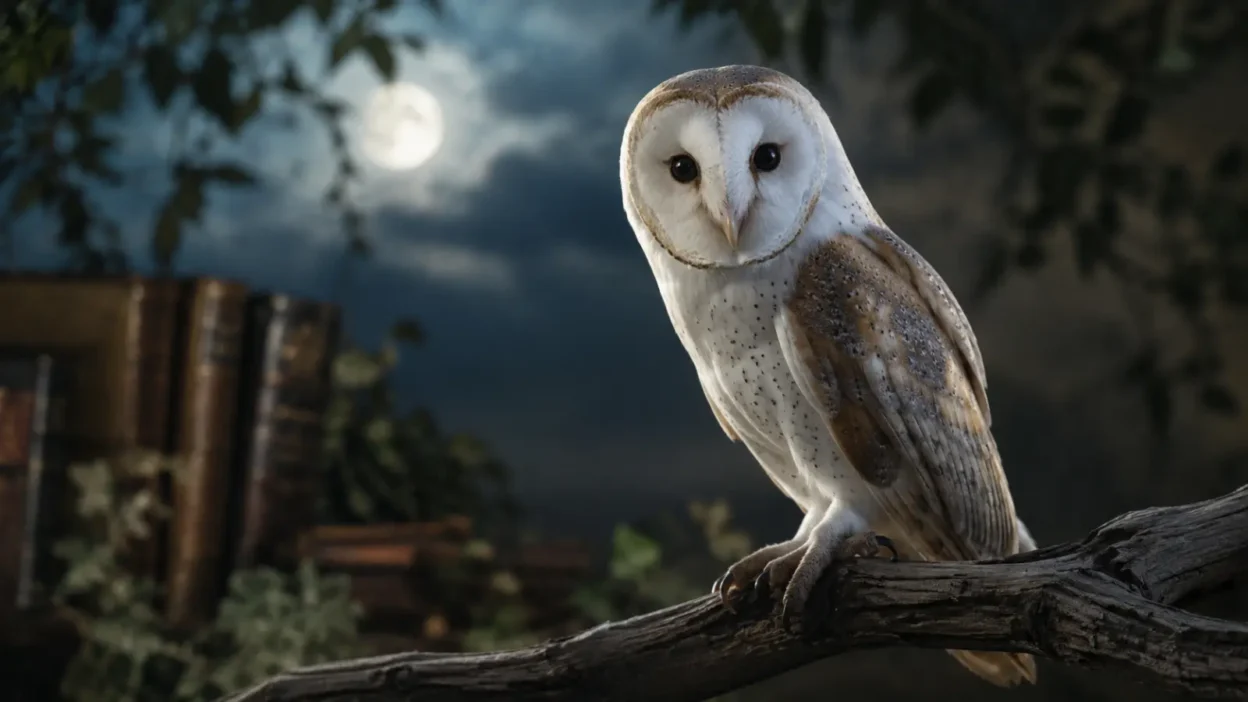
The owl is one of the few birds that can feel scholarly, eerie, beautiful, and unsettling at the same time. That mix is why owl symbolism meaning usually begins with wisdom, but rarely ends there.
In the United States today, people see owls on school logos, graduation cards, tattoos, Halloween decorations, nursery art, jewelry, and book covers. The same bird can suggest intelligence in one setting and a ghostly warning in another.
That range comes from real owl traits, ancient art, religious texts, folklore, and modern design. Owls hunt at night, fly quietly, stare with large forward-facing eyes, and call from places people often cannot see. It is easy to understand why people connected them with insight, secrecy, death, magic, and hidden truth.
The key is context. An owl on a diploma does not mean the same thing as an owl in a ghost story, a sacred story, a tattoo, or a dream.
Quick Answer
In the United States today, owl symbolism meaning most often points to wisdom, learning, alertness, and the ability to notice what others miss. Older traditions also connect owls with night, mystery, death omens, wilderness, and spiritual warning, but those meanings vary widely by culture and should not be treated as universal.
TL;DR
- Owls most often symbolize wisdom today.
- Their night habits shaped mystery meanings.
- Ancient Greece strengthened the wise owl image.
- Some traditions treat owls as warnings.
- U.S. use includes tattoos, schools, decor, and books.
- Cultural context matters more than one fixed meaning.
What Owls Symbolize Today in the United States
In modern U.S. culture, the owl most commonly symbolizes wisdom. It often stands for careful thinking, education, observation, and mature judgment. That is why owl designs appear on school supplies, teacher gifts, graduation cards, libraries, and reading programs.
But the owl also carries a second layer. Because it is a night bird, it can suggest mystery, secrecy, intuition, and the unknown. In softer spiritual contexts, people may use the owl as a symbol of inner guidance. In darker folklore settings, it may suggest warning, death, ghosts, or bad luck.
These meanings are not contradictions. They come from different uses of the same bird. A creature that sees in darkness can become a symbol of wisdom. The same creature, calling from the dark, can become a symbol of fear.
| Context | Common Meaning | Important Caution |
|---|---|---|
| School or library imagery | Learning, wisdom, study | Usually decorative, not religious |
| Tattoo or jewelry | Insight, independence, protection | Meaning depends on the wearer |
| Halloween or gothic design | Night, fear, mystery | Often aesthetic, not old folklore |
| Folklore or omen stories | Warning, death, unseen forces | Belief-based, not factual proof |
| Sacred or Indigenous context | Varies by community | Avoid generic claims |
The owl is best understood as a layered symbol. Its meaning changes with setting, culture, and intent.
Why the Owl’s Body and Behavior Shaped Its Meaning
Owl symbolism begins with what people notice about real owls.
Owls are often active at dusk or night. Many species are hard to see during the day, then suddenly become present through sound, movement, or a flash of pale feathers. To people before electric light, that would have felt even more dramatic.
Their eyes also matter. Owls face forward more than many birds do, which gives them a stare that feels almost human. They do not look like casual background animals. They look as if they are watching.
Their quiet flight adds another layer. An owl can seem to appear without warning. This helped create symbolic links with stealth, hidden knowledge, secrecy, and the unseen.
Their calls also shaped meaning. A hoot, shriek, or rasping night call can feel beautiful in one moment and chilling in another. When a sound comes from darkness, people often fill the unknown with story.
This does not mean owls are magical or wise in a human sense. It means their real traits gave people strong images to think with. Night vision became insight. Silence became mystery. Stillness became patience. Sudden calls became warnings.
The Ancient Greek Root of the Wise Owl
The modern Western idea of the wise owl owes a great deal to ancient Greece.
In Greek tradition, the owl was closely associated with Athena, the goddess linked with wisdom, strategy, craft, and the city of Athens. Ancient Athenian coins often showed Athena on one side and an owl on the other. That image helped make the owl a public symbol of intelligence, civic identity, and thoughtful power.
This is one reason the wise owl still feels natural in U.S. culture. The idea came through classical education, art history, literature, museums, coins, and school traditions. By the time owls appeared on graduation cards or library posters, the wisdom meaning already had deep roots in Western visual culture.
Still, this does not mean every ancient culture saw owls as wise. The Greek connection is important, but it is not universal. In some places, the owl was feared. In others, it belonged to stories of death, spirits, wilderness, or transformation.
So the “wise owl” is historically grounded, but it is also culturally specific. It became especially strong in Western education and later American popular culture.
The Night Side: Mystery, Fear, and the Unknown
Owls are symbols of wisdom partly because they can “see in the dark.” But darkness has never meant only knowledge. It also means uncertainty.
That is why owls often appear in spooky stories, Halloween scenes, haunted forests, and gothic design. Their symbolism fits the edge between knowing and not knowing. They seem calm in places where humans feel unsure.
The owl’s mystery meaning often includes:
- hidden truth
- private knowledge
- watchfulness
- secrecy
- the unconscious mind
- things noticed too late
- the feeling of being observed
This is also why owls show up in dream interpretation and modern spiritual writing. A person who dreams of an owl may read it as a sign to pay attention, trust intuition, or look more closely at something hidden.
That can be meaningful as personal reflection. But it should be framed as interpretation, not proof. A dream owl does not carry one fixed message for everyone. Its meaning depends on the dream, the person, and the emotional setting.
Owls as Omens of Death, Warning, and Change
Many people ask whether owls are good or bad omens. The honest answer is: it depends on the tradition.
In some folklore, hearing or seeing an owl is treated as a warning. The owl may be linked with death, sickness, ghosts, or an approaching change. These beliefs often come from the owl’s night habits, strange calls, and presence near quiet or abandoned places.
In modern writing, this older death symbolism is often softened into “transformation.” That can be useful, but it is also a later interpretation. In older omen traditions, the meaning was not always gentle or metaphorical.
A careful reading separates the layers:
- Folklore: An owl may warn of danger, death, or bad luck.
- Modern spirituality: An owl may symbolize change, transition, or awakening.
- Psychological interpretation: An owl may represent fear of the unknown.
- Everyday reality: Seeing an owl usually means an owl is hunting, nesting, or moving through its habitat.
This does not make omen traditions foolish. Folklore is part of how communities have explained fear, death, and uncertainty. But it should not be confused with scientific fact.
Religious Meanings: Wilderness, Desolation, and Sacred Context
It is closer to an image of desolation, isolation, and land emptied of ordinary human life.
This matters because modern readers may assume the owl always means wisdom. In biblical imagery, the setting often matters more than the bird alone. An owl in a ruined city, desert, or abandoned place carries a different feeling than an owl beside a stack of books.
Other religious or spiritual traditions may use owl imagery differently. Some may connect night birds with spirits, ancestors, protection, warning, or liminal spaces. But those meanings belong to specific traditions, not to a single global code.
The respectful approach is to ask: Which tradition
Without that context, “spiritual meaning of an owl” becomes too broad to be reliable.
Indigenous Traditions and Why Generalizations Are Risky
In the United States, owl symbolism is often discussed through Native American traditions. This needs care.
There is no single Native American meaning of the owl. Native nations have distinct languages, histories, stories, ceremonies, and relationships with animals. In some traditions, owls may be connected with warning, death, night beings, or frightening children’s stories. In others, owl figures may appear in teaching stories, ceremonial art, or community-specific contexts.
The problem comes when modern writers turn these varied traditions into one easy sentence, such as “the owl is a Native American spirit animal of wisdom.” That kind of claim flattens living cultures and often uses language that Native educators have asked people to avoid.
A better approach is simple: do not borrow sacred or community-specific meanings as decoration. Do not copy tribal imagery for tattoos, logos, or products without understanding where it comes from. Do not assume one Native story represents all Native peoples.
If an owl design is inspired by Indigenous art or story, the ethical questions matter as much as the design itself. Who made it?
Respectful interpretation leaves room for difference.
What Owl Symbolism Does Not Mean About Real Owls
Symbolism often says more about people than animals.
Owls are not wise teachers in the human sense. They are predators with specialized bodies. They hunt, nest, defend territory, feed young, and survive. Their stillness may look thoughtful to us, but it is also practical behavior.
This distinction matters because symbolic language can make animals seem like props for human feelings. An owl does not exist to deliver a message. It may become meaningful to a person, but it is still a living bird with its own ecological role.
The same caution applies to fear-based symbolism. Owls are not evil because they hunt at night. They are not bad luck because their calls sound eerie. Human cultures have attached those ideas to them.
Good symbolism keeps both truths in view. The owl can represent wisdom, mystery, or warning in art and story. The real owl is also an animal shaped by habitat, prey, season, and instinct.
Owl Tattoos, Jewelry, and Personal Identity
In U.S. tattoo and jewelry culture, the owl often becomes a personal symbol. People choose it because it can feel intelligent, quiet, protective, and independent.
Common owl tattoo meanings include:
- learning from hardship
- seeing through deception
- valuing knowledge
- trusting intuition
- protection during change
- comfort with solitude
- interest in night, magic, or mystery
The design style changes the meaning. A realistic owl may suggest respect for nature. A geometric owl may feel modern and intellectual. A skull-and-owl tattoo leans toward mortality, change, or gothic imagery. An owl with books points toward learning. An owl with the moon suggests night, intuition, or the unconscious.
Placement can add personal meaning, but it does not create a universal code. A forearm owl is visible and public. A back or chest owl may feel more private or protective. The person wearing it gets the final say.
The main caution is cultural borrowing. Avoid sacred patterns, tribal designs, or religious imagery unless you understand the source and have a respectful reason to use it.
Owls in Decor, Schools, Books, Branding, and Pop Culture
Owls are everywhere in modern American design because they are easy to recognize. Large eyes, rounded head, feathers, and a perched shape make a strong graphic symbol.
In schools and libraries, owls usually mean learning. They feel friendly, bookish, and wise. This is why owl characters often appear in children’s classrooms, reading corners, and teacher gifts.
In home decor, the meaning depends on style. A soft ceramic owl may feel cozy and woodland-themed. A black owl silhouette may feel gothic or Halloween-like. A gold owl can suggest elegance, intelligence, or vintage taste.
In branding, owls often imply watchfulness, knowledge, strategy, or careful service. A tutoring company, security product, bookstore, or research project might use an owl because it suggests attention and intelligence.
Pop culture has added new layers. Owls can be magical messengers, forest watchers, comic sidekicks, school mascots, or symbols of secret societies. These uses borrow from older meanings, but they also reshape them for entertainment.
That is why many Americans understand owls through a blend of classroom imagery, fantasy stories, Halloween design, tattoos, and nature media. The old meanings are still present, but they now live inside modern visual culture.
How to Interpret an Owl Symbol Without Oversimplifying It
The best way to understand an owl symbol is to start with context, not a fixed definition.
Ask where the owl appears. A school emblem, a funeral poem, a dream, a sacred story, and a tattoo are not using the same symbolic language. The same bird can carry different emotional weight in each place.
Then ask which meaning fits the setting:
- Is the owl paired with books, lamps, or graduation imagery?
- Is it shown at night, with a moon or forest?
- Is it part of a religious or cultural tradition?
- Is it used in a scary, gothic, or Halloween setting?
- Is it personal art, such as a tattoo or necklace?
- Is it being treated as an omen or dream sign?
A careful interpretation does not erase uncertainty. It may say, “Here, the owl likely suggests wisdom,” or “In this setting, it seems closer to warning or mystery.”
That kind of caution makes the symbol more interesting, not less. Owls have lasted as symbols because they hold tension. They are learned and wild, calm and unsettling, beautiful and predatory, familiar and strange.
FAQs About Owl Symbolism
What does an owl symbolize most commonly?
Today, an owl most commonly symbolizes wisdom, learning, and careful observation. In U.S. culture, this meaning is especially common in schools, libraries, graduation gifts, and book-related imagery.
Is seeing an owl a good or bad sign?
Seeing an owl is not automatically good or bad. In folklore, some communities treated owls as warnings, while modern spiritual interpretation often reads them as signs of insight or change. In ordinary life, an owl sighting usually means the bird is moving through its habitat.
Why are owls connected with wisdom?
The strongest Western source is the owl’s ancient association with Athena and Athens. Real owl traits also helped: large eyes, night activity, quiet movement, and watchful stillness all make the bird seem alert and knowing.
What does an owl tattoo mean?
An owl tattoo often means wisdom, intuition, independence, protection, or learning through difficult experience. Darker designs may also point to death, mystery, shadow work, or personal transformation.
What does an owl mean spiritually?
Spiritual meanings vary by belief system. Many modern readers see the owl as a sign of intuition, hidden truth, or inner guidance, but that is an interpretation rather than a proven universal meaning.
Are owls symbols of death?
In some folklore and religious contexts, yes, owls can be linked with death, mourning, warning, or desolate places. That does not mean every owl image has a death meaning; in many modern U.S. settings, the owl simply means wisdom or learning.
Is it respectful to use owl imagery from Indigenous traditions?
It depends on the source, artist, and context. Generic owl imagery is common, but copying sacred designs, tribal styles, or community-specific symbols without permission can be disrespectful. When in doubt, choose original artwork or buy from Native artists directly.
Conclusion
The owl remains meaningful because it sits between light and dark. It can stand for wisdom, study, and patient observation, but it can also point toward mystery, fear, warning, or change.
The clearest modern U.S. meaning is wisdom, yet the older layers still matter. Owl symbolism meaning becomes more accurate when we separate classroom imagery from folklore, religious context, Indigenous traditions, dream interpretation, and personal design.