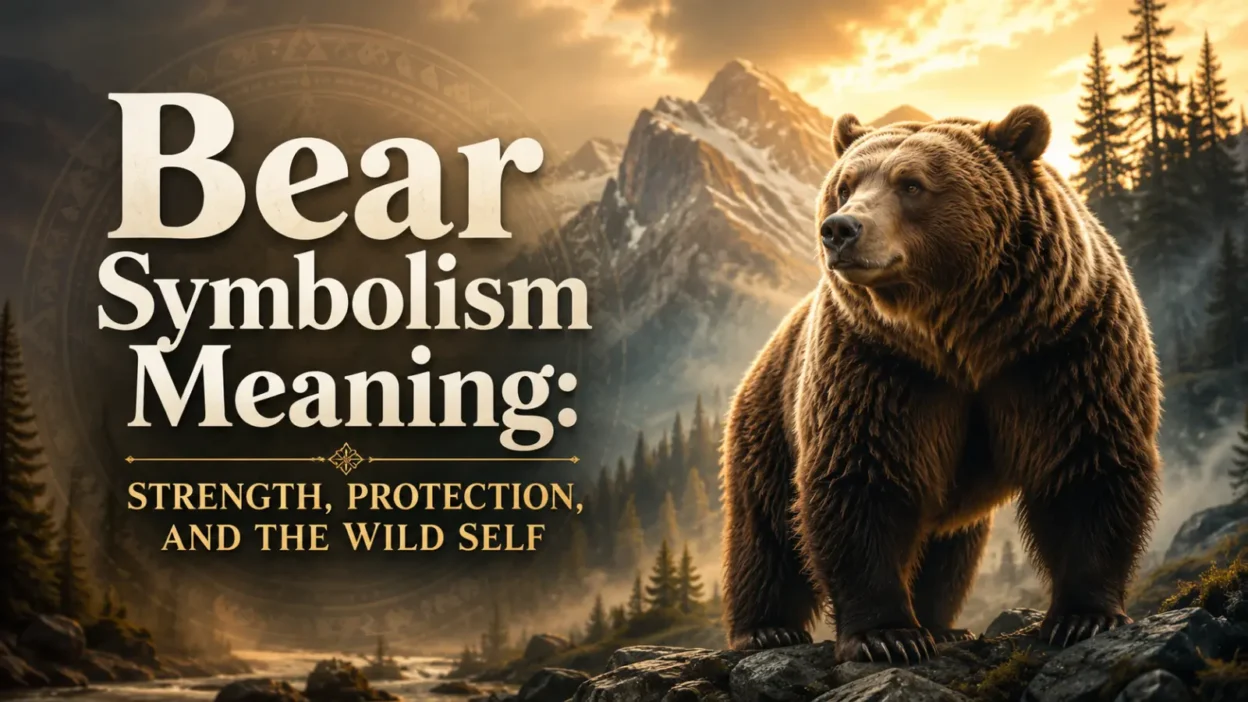
A bear is one of the easiest animal symbols to recognize. It can look fierce, warm, solitary, protective, or almost human depending on where it appears. That range is why bear symbolism meaning usually centers on strength, protection, courage, and the ability to endure difficult seasons.
For many readers in the United States, the bear is both wild and familiar. It appears on state symbols, sports names, children’s toys, tattoos, outdoor brands, financial language, and wildlife signs at national parks. Few animals move so easily between danger and comfort.
That split matters. A real bear is not a mascot or a mood board. It is a powerful animal with its own behavior. Symbolism begins when people take visible traits, such as size, solitude, winter denning, and fierce defense of young, and turn them into human meaning.
Quick Answer
In modern U.S. use, bear symbolism meaning most often points to strength, protection, courage, resilience, and grounded confidence. Older meanings also connect bears with healing, wilderness danger, motherhood, winter rest, and spiritual authority, but those meanings vary by culture and should not be treated as universal.
TL;DR
- Bears usually symbolize strength, courage, and protection.
- Mother bears add meanings of care and boundaries.
- Winter denning shaped ideas of rest and renewal.
- Indigenous meanings vary by nation and tradition.
- Modern use includes tattoos, mascots, toys, and logos.
- Bear symbolism can be misread when cultures are flattened.
What the Bear Symbol Usually Means Today
Today, the bear most often means strength that does not need to perform. It suggests a quiet, heavy presence: someone or something steady, capable, and hard to push around.
That is why bear images work so well in tattoos, team names, outdoor brands, and personal symbols. The animal looks powerful even when it is standing still. It does not need speed or ornament to communicate force.
The most common modern meanings include courage, protection, endurance, independence, and confidence. These are not random. They come from the way people notice bears: large bodies, strong paws, thick fur, solitary habits, and an ability to survive harsh conditions.
Still, the bear is not only a positive symbol. It can also suggest danger, anger, territorial power, or a force that should not be provoked. A bear symbol can feel protective in one setting and threatening in another.
Why Bears Became Symbols of Strength and Protection
The strength meaning comes from the bear’s body. Bears are large mammals with visible muscle, heavy shoulders, strong jaws, and the ability to stand upright. Even people who know little about wildlife understand that a bear deserves respect.
Protection comes from a more specific image: the mother bear. In popular speech, a “mama bear” is a parent or caregiver who becomes fierce when someone threatens a child. The phrase works because the public already understands the mother bear as a boundary-setter.
This symbolism is partly based on real animal behavior, but it is still a human interpretation. A bear does not “represent courage” to itself. People create the meaning by reading human values into an animal that appears strong, defensive, and hard to dominate.
That is also why bear symbolism often feels practical rather than delicate. It is about standing your ground, guarding what matters, and surviving a season that would weaken something smaller.
The Bear as Mother, Guardian, and Boundary Keeper
The mother-bear image is one of the strongest bear meanings in the United States. It appears in family language, politics, sports commentary, parenting blogs, and casual conversation.
In this use, the bear does not mean softness alone. It means care with teeth. The symbol says love can be warm, but it can also become firm when safety is at stake.
This makes the bear different from many other protective animals. A dog may symbolize loyalty. A lion may symbolize royal power. A bear often suggests private protection: the defense of home, children, body, rest, or personal space.
That is why the bear also works as a boundary symbol. A bear image can say, “I am peaceful, but do not mistake that for weakness.” For tattoos and personal art, this is often the deeper message.
Hibernation, Rest, and Renewal
Many popular interpretations connect bears with winter sleep, retreat, and renewal. This is one of the most useful symbolic links, but it needs care.
In everyday language, people call it hibernation. Biologists often describe bear winter dormancy in more precise terms because bears do not behave exactly like smaller true hibernators. The symbolic idea, though, comes from what people see: the bear withdraws, slows down, and later returns.
That pattern made the bear a natural image for rest, recovery, and inner work. It can symbolize a period when someone steps away from noise to heal, think, conserve strength, or prepare for a new stage.
The key is not to turn biology into a mystical rule. A bear’s winter behavior is a survival strategy. The human meaning is a metaphor built from that strategy.
Bear Meaning in Indigenous North American Traditions
Bear symbolism in Indigenous North American traditions must be handled with respect because there is no single Native meaning of the bear. Many Native nations have bear stories, clans, ceremonies, medicines, and teachings, but the details differ widely.
For a U.S. reader, the most important point is not to treat these meanings as decorative. A bear claw design, a “totem” label, or a “spirit animal” phrase may carry cultural weight that outsiders do not fully understand.
It is more accurate to say that bear meanings are tradition-specific. They belong to living communities, not to a generic mystical category anyone can borrow without context.
Bears in European, Greek, and Northern Myth
Bears also appear in European and classical traditions, though again the meanings are not one single story. In Greek myth, the bear is linked with transformation, hunting, motherhood, and the stars through stories connected with the Great Bear constellation.
In parts of northern and western Europe, bear imagery could suggest wild strength, warriors, forests, and the edge between human society and untamed nature. The bear’s ability to stand on two legs also made it feel strangely human to many storytellers.
Some old European bear traditions are difficult to reconstruct with certainty. Later writers, national movements, and modern spirituality have added new layers. Because of that, it is better to speak in patterns rather than claim one fixed ancient meaning.
The common thread is clear enough: the bear often marks the border between human life and the wild. It can be ancestor, monster, guardian, fighter, or transformed human, depending on the story.
Bears in Biblical and Religious Imagination
In biblical imagery, bears are usually not cozy symbols. They appear as signs of danger, force, judgment, or fierce protection. The image of a bear robbed of her cubs, for example, depends on the frightening intensity of a mother defending her young.
Some Christian readers also interpret the bear as a reminder of strength under divine control or of destructive power when authority becomes cruel. These are interpretations drawn from religious reading, not a universal animal code.
Other religious and spiritual traditions treat bears differently. In some northern Asian contexts, bear ceremonies have expressed a relationship between human communities, animal spirits, food, death, and return. These traditions should not be simplified into “the bear means rebirth” without explaining the cultural setting.
Religious bear symbolism is strongest when it stays connected to the tradition that produced it. Removed from that context, it becomes easy to turn a serious sacred image into a vague inspirational symbol.
Bear Folklore, Omens, and Dreams
Bear dreams and bear omens are popular topics, but they belong mostly to interpretation, folklore, and personal belief. They should not be treated as proven messages.
In modern dream interpretation, a bear may be read as anger, fear, protection, a powerful parent, hidden strength, or a problem the dreamer is avoiding. A chasing bear may feel like pressure. A calm bear may feel like grounded power. A mother bear may point to care, control, or boundaries.
These meanings can be emotionally useful, but they are not fixed. The same dream can mean different things depending on the dreamer’s life, fear, memory, and cultural background.
Folklore works the same way. Seeing a bear may be understood as a warning in one tradition, a blessing in another, or simply a wildlife encounter in ordinary life.
Bear Symbolism in Modern U.S. Culture
In the United States, the bear has several public meanings at once. It is a wild animal in parks and forests, a state emblem, a sports identity, a childhood toy, and a financial metaphor.
The California bear is one of the clearest civic examples. It suggests strength, regional identity, and frontier history, but it also carries an uncomfortable truth: the California grizzly shown on public symbols is gone from the state. The emblem now points to both pride and loss.
The teddy bear changed the animal’s public meaning in another direction. It made the bear soft, childlike, comforting, and giftable. This is a very American twist: the dangerous wild animal became a plush symbol of care.
In finance, a bear market means falling prices and pessimism. That usage does not mean the bear is “bad.” It shows how animal imagery can become shorthand for movement, mood, and public emotion.
Bear Tattoos, Jewelry, Decor, and Personal Identity
A bear tattoo usually means strength, protection, courage, survival, or loyalty to family. A roaring bear may emphasize force and fearlessness. A calm bear may suggest quiet confidence. A mother bear with cubs points more directly to caregiving and defense.
Bear claws and paw prints often mean resilience, movement through hardship, or connection to wilderness. However, designs that imitate specific Indigenous art styles or sacred items need extra care. A respectful design avoids borrowing cultural signs without understanding or permission.
In home decor, bears often create a rustic, cabin, mountain, or woodland feeling. Here the meaning is usually less spiritual and more atmospheric. The bear stands for nature, warmth, retreat, and life away from city noise.
In jewelry or clothing, a small bear can mean courage in a gentle form. It can also act as a private reminder to rest, protect your peace, or trust your own weight.
Positive and Negative Bear Meanings Compared
Bear symbolism works because it holds opposites together. The same animal can look nurturing or dangerous, calm or explosive, solitary or family-centered.
| Bear meaning | Positive reading | Cautious reading |
|---|---|---|
| Strength | Resilience and self-trust | Force, intimidation, or domination |
| Protection | Care, loyalty, and safety | Possessiveness or overcontrol |
| Solitude | Rest, healing, and reflection | Withdrawal or avoidance |
| Wildness | Freedom and natural instinct | Unpredictability or danger |
| Motherhood | Fierce care and devotion | Fear of crossing boundaries |
The right meaning depends on context. A bear on a child’s blanket does not send the same message as a bear on a warning sign, a biker jacket, or a state flag.
This is why the best interpretation starts with where the bear appears, who is using it, and what emotional tone surrounds it.
Common Mistakes When Interpreting Bear Symbols
The first mistake is saying the bear has one universal meaning. It does not. Strength is widespread, but the deeper meanings change across cultures, religions, and modern uses.
The second mistake is treating Indigenous meanings as one blended category. Different Native nations have different bear teachings. Respectful writing should avoid turning those traditions into generic “spirit animal” language.
The third mistake is making every bear symbol spiritual. A bear logo may simply be branding. A teddy bear may mean comfort. A bear market is financial slang. A tattoo may be personal rather than religious.
The fourth mistake is ignoring the real animal. Bears are not symbols first. They are living creatures affected by habitat loss, hunting history, conservation policy, tourism, and human fear. Strong symbolism should make the animal more real, not less.
FAQs
What does a bear symbolize spiritually?
Spiritually, a bear is often interpreted as strength, protection, grounding, healing, and retreat. These meanings are belief-based and vary by tradition, so it is better to treat them as interpretations rather than facts.
Is bear symbolism positive or negative?
It can be either. A bear may symbolize courage, care, and resilience, but it can also suggest danger, anger, or overwhelming force depending on the setting.
What does a bear tattoo mean?
A bear tattoo most often means strength, protection, courage, survival, or loyalty to family. The pose changes the tone: a roaring bear feels more aggressive, while a calm bear feels steadier and more reflective.
What does a bear mean in Native American symbolism?
There is no single Native American meaning of the bear. In many traditions, bears are associated with strength, medicine, protection, and wisdom, but the details belong to specific nations, stories, and ceremonies.
What does a bear in a dream mean?
A bear dream is usually interpreted as a sign of power, fear, protection, anger, or a need for solitude. The meaning depends on the dream’s mood and the dreamer’s own life rather than a fixed rule.
Why are bears linked with rest and renewal?
People connect bears with rest and renewal because bears withdraw during winter and return in spring. The biological behavior is about survival, while the symbolic meaning is a human metaphor for recovery and patience.
Conclusion
The bear remains one of the most flexible animal symbols because it joins force with care. It can stand for courage, protection, solitude, motherhood, danger, healing, or wild independence depending on how it is used.
The clearest bear symbolism meaning in modern U.S. culture is strength with boundaries: the power to endure, protect, and step back when needed. The most responsible reading keeps that meaning grounded in context.
A bear symbol is strongest when it respects both the cultures that shaped it and the living animal behind the image.