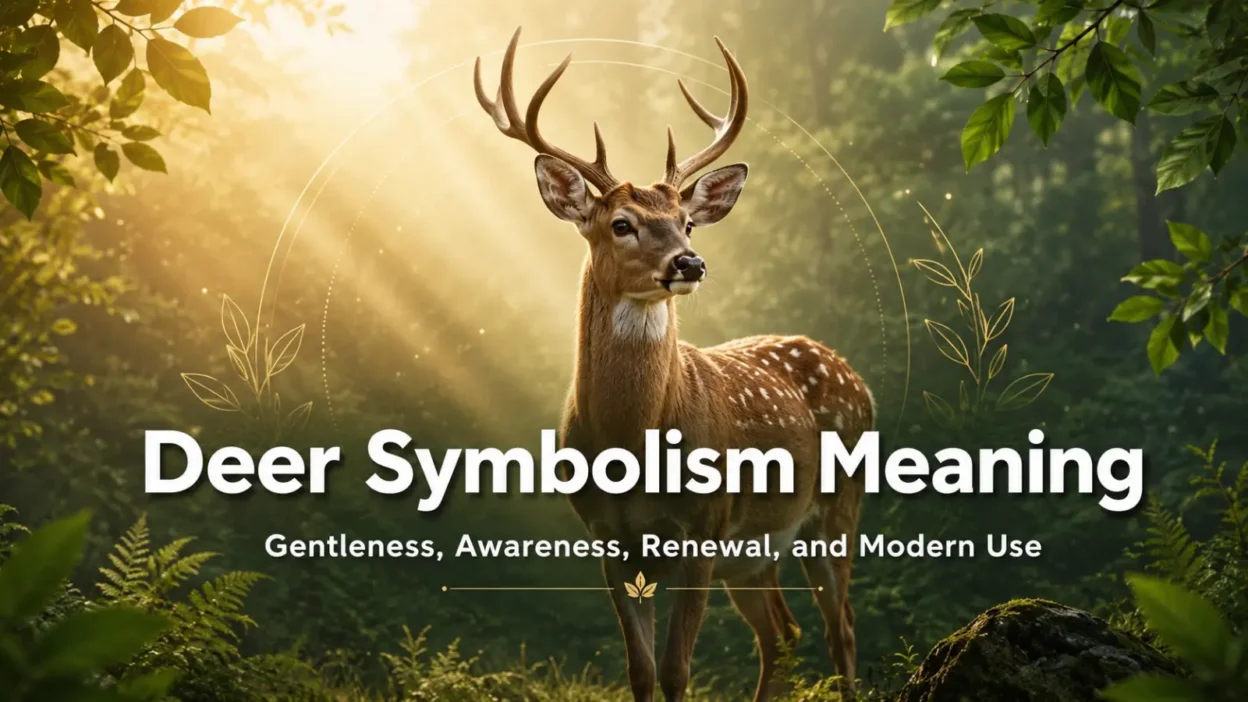
A deer is one of the most familiar animal symbols in American life. People see deer in forests, suburbs, parks, road signs, tattoos, holiday decor, sports imagery, and stories about nature.
The phrase deer symbolism meaning usually points to gentleness, grace, sensitivity, alertness, and renewal. These meanings come from how deer look and move, but they have also been shaped by religion, folklore, hunting culture, popular movies, and modern spirituality.
Deer are easy to romanticize. They look quiet and delicate, yet they survive by speed, awareness, and adaptation. That contrast is why the deer can symbolize both softness and strength.
This article separates modern interpretation from older religious, cultural, and folk meanings so the symbol stays clear, useful, and respectful.
Quick Answer
In modern U.S. symbolism, deer symbolism meaning most often centers on gentleness, grace, sensitivity, alert awareness, and renewal. Older meanings vary widely: stags appear in Christian and European symbolism, deer are important in Buddhist imagery, and some Indigenous traditions have specific deer meanings that should not be generalized.
TL;DR
- Deer often symbolize gentleness and quiet awareness.
- Antlers add renewal, growth, and seasonal change.
- Stags, does, and fawns carry different meanings.
- Religious meanings depend on the tradition.
- Deer omens are belief-based, not proven signs.
- Modern tattoos and decor are highly personal.
What Deer Symbolism Means Today
Today, deer usually symbolize a calm kind of strength. They are not fierce in the way lions, wolves, or eagles are often imagined. Their meaning is quieter.
For many people in the United States, a deer suggests gentleness, grace, innocence, and closeness to nature. It may also suggest caution because deer are watchful animals. A deer lifting its head, listening, and pausing at the tree line easily becomes an image of awareness.
This is why deer symbolism often appeals to people who value softness without weakness. The deer does not represent domination. It represents survival through attention, speed, sensitivity, and careful movement.
A deer can also symbolize vulnerability. A fawn, especially, brings up ideas of childhood, protection, and tenderness. That meaning has become stronger in U.S. culture because of children’s stories, animated films, and the familiar image of a spotted fawn hidden in grass.
Still, deer symbolism is not only sweet. A buck with antlers may suggest maturity, endurance, masculinity, protection, or natural authority. A deer skull or antlers in art can point to mortality, wilderness, hunting, or the life cycle.
So the clearest modern meaning is not one word. It is a balance: gentleness, awareness, vulnerability, and renewal.
Why Deer Became Symbols of Gentleness and Awareness
Most deer meanings start with visible traits. Deer move lightly. They pause often. Their eyes and ears make them look alert. Their bodies seem delicate compared with predators, even though deer are fast, strong, and capable of surviving harsh conditions.
People often turn animal behavior into symbolism. Because deer are prey animals, they depend on noticing danger early. That is why they are linked with intuition, watchfulness, and sensitivity.
Their quiet movement also matters. A deer slipping through trees can seem almost silent. In symbolic language, that becomes grace, subtlety, and the ability to move through difficulty without force.
The problem comes when symbolic meaning is confused with literal animal behavior. Deer are not moral teachers in a factual sense. They are wild animals with feeding patterns, mating behavior, territorial habits, and survival instincts.
But symbols do not work by biology alone. They work through human attention. People notice a deer’s softness, speed, and alertness, then turn those traits into emotional meaning.
That is why deer symbolism feels personal to many readers. The animal looks gentle, but it is never careless.
The Stag, the Doe, and the Fawn Mean Different Things
A major weakness in many deer symbolism explanations is that they treat every deer image the same. In practice, the symbol changes depending on the kind of deer shown.
A stag with antlers does not feel the same as a doe with a fawn. A deer skull does not carry the same emotional tone as a living deer in a meadow.
| Deer Image | Common Symbolic Meaning | Why It Reads That Way |
|---|---|---|
| Stag or buck | Strength, maturity, leadership, wild nature | Antlers create a bold, crowned appearance. |
| Doe | Gentleness, care, watchfulness, nurturing | The doe is often imagined through motherhood and protection. |
| Fawn | Innocence, vulnerability, new life | Spots and small size create a childlike image. |
| Antlers | Renewal, growth, natural cycles | Antlers shed and regrow over time. |
| Deer skull | Mortality, wilderness, hunting, transformation | Bone imagery points to death and survival. |
These meanings are not fixed laws. A tattoo artist, painter, hunter, spiritual writer, or designer may use the same deer image in different ways.
Still, these distinctions help readers avoid vague interpretation. A stag tattoo may say “resilience” or “independence.” A fawn illustration may say “innocence” or “protection.” A pair of deer in a peaceful landscape may say “harmony.”
The details shape the meaning.
Antlers and the Meaning of Renewal
Antlers are one of the strongest reasons deer became symbols of renewal. In many deer species, males grow, shed, and regrow antlers in a repeating cycle.
That visible cycle makes antlers easy to connect with growth, return, and seasonal change. Something falls away, and something new grows in its place.
In modern symbolism, this often becomes a personal message: release what is old, recover from loss, or grow into a stronger version of yourself. That meaning is interpretive, not a scientific fact. But it comes from a real feature of deer life.
Antlers can also symbolize status, maturity, and competition. In nature, antlers are connected to mating season, display, and contests between males. In human symbolism, those same features often become strength, confidence, protection, or masculine energy.
This is why stag imagery feels different from doe imagery. A stag carries more force. It can suggest wilderness, leadership, and self-possession.
But antlers should not be reduced to only “power.” Their yearly cycle also gives them a softer meaning: change is natural, and growth can return after loss.
Deer in Christian and Medieval Symbolism
In Christian and medieval European symbolism, the stag often had a more specific meaning than “gentleness.” Medieval writers and artists used animals as moral and religious signs. The stag could represent the soul seeking God, Christ overcoming evil, or spiritual renewal through pure water.
One important image is the stag and the serpent. In medieval bestiary tradition, the stag was described as an enemy of snakes. Christian allegory could turn that into a picture of Christ defeating the devil or the faithful soul resisting sin.
Water also mattered. The image of a thirsty deer seeking streams was connected with spiritual longing. That reading was shaped by biblical language and devotional imagination.
This does not mean every deer in Christian art has the same meaning. Context matters. A deer in a hunting scene may be part of courtly culture. A stag in a religious manuscript may carry moral meaning. A deer in decorative art may simply belong to a natural setting.
The safest way to say it is this: in Christian symbolism, especially medieval symbolism, the stag often represented spiritual longing, renewal, and victory over evil. That is a documented religious interpretation, but it should not be stretched to every deer image.
Deer in Buddhist Symbolism
In Buddhism, deer symbolism is strongly tied to the Deer Park at Sarnath, where the Buddha is traditionally said to have given his first teaching after awakening.
This is why Buddhist art often shows two deer beside a wheel. The wheel represents the teaching, or dharma, being set in motion. The deer refer to the place of that first teaching and the peaceful attention given to the dharma.
This is a more grounded meaning than simply saying “deer mean spirituality.” In Buddhist imagery, the deer are part of a specific religious scene and symbol system.
The paired deer can suggest receptivity, peace, listening, and the beginning of the Buddhist teaching path. In temple architecture and devotional art, they are not just forest animals. They are visual reminders of the first turning of the wheel of dharma.
For a general U.S. reader, this distinction matters. A deer tattoo or necklace is not automatically Buddhist. But when deer appear with the dharma wheel, especially as a pair, the Buddhist reference becomes much clearer.
Respectful interpretation depends on context.
Deer in Celtic and European Folklore
European folklore often gives deer a mysterious role. Stags and white deer may appear as animals that lead hunters into the forest, mark a boundary, or start a quest.
In Celtic-related material, the stag is often linked with wild nature, fertility, and the forest. The antlered figure often called Cernunnos is one reason modern readers connect stags with nature, animals, and the wild.
This area needs caution. Ancient Celtic religion did not leave the same kind of written record as some other traditions. Some meanings are based on archaeology, later literature, Roman-era evidence, and modern interpretation.
That does not make the symbolism meaningless. It means we should avoid pretending every modern “Celtic stag meaning” is ancient fact.
The white stag is another important European motif. In stories, it often marks the start of a chase or a passage into the unknown. It can stand for mystery, pursuit, spiritual testing, or the unreachable goal.
In modern U.S. use, these older associations often appear in fantasy art, pagan-inspired jewelry, forest tattoos, and nature-centered decor. Many people use the stag as a sign of independence, wilderness, or spiritual searching.
That modern use is real. It just should not be confused with one single ancient Celtic doctrine.
Indigenous North American Meanings Need Specificity
Deer have deep importance in many Indigenous North American communities, but there is no single “Native American deer meaning.” Different nations, languages, regions, stories, and ceremonies treat deer in different ways.
Some traditions include deer clans. Some stories treat deer as food, relatives, helpers, or beings connected with beauty, discipline, ceremony, or the land. In some contexts, deer are practical and sacred at the same time because they provide food, hides, tools, and ceremonial materials.
A respectful approach keeps these points separate:
- A clan meaning is not the same as a tattoo meaning.
- A ceremonial meaning is not the same as a general animal symbol.
- One nation’s teaching should not be applied to all Indigenous peoples.
- Decorative antlers or “tribal deer” designs can become disrespectful when they borrow sacred aesthetics without context.
For a U.S. audience, this is one of the most important cautions. Deer symbolism can be beautiful, but broad claims like “to Native Americans, deer means peace” are too flat.
It is better to say: deer hold specific meanings in specific Indigenous traditions, and those meanings should be learned from those communities or reliable cultural sources rather than generalized.
What Seeing a Deer Means as a Sign or Omen
Many people search deer symbolism after a striking encounter. A deer crosses the road. One stands in the yard. A buck appears during a hard season. A fawn shows up near the house.
In modern spiritual interpretation, seeing a deer is often read as a reminder to slow down, stay gentle, trust intuition, or move carefully. If the deer pauses and looks at you, people may interpret that as a moment of awareness or reflection.
These are belief-based meanings. They are not proven messages from nature.
That does not make them useless. Symbols can help people reflect. If a deer encounter makes someone think about patience, protection, grief, or a need for quiet, that meaning may be personally valuable.
But it is important not to turn every deer sighting into an omen. In many parts of the United States, deer are common. They move through suburbs, roadsides, yards, farms, and parks because those spaces overlap with their habitat.
A grounded interpretation might sound like this: seeing a deer can feel meaningful because deer already carry associations with gentleness, alertness, and vulnerability. Whether it is a “sign” depends on personal belief.
Deer Symbolism in Modern U.S. Life
In the United States, deer symbolism is especially shaped by the white-tailed deer. This animal is common enough that many Americans have real-life contact with deer, even outside rural areas.
That everyday familiarity gives deer a mixed symbolic role. They can feel peaceful and beautiful. They can also be tied to hunting, road danger, garden damage, conservation, and suburban wildlife debates.
Modern U.S. deer symbolism shows up in several places:
- Tattoos: Deer tattoos often mean grace, resilience, renewal, sensitivity, wildness, or protection.
- Home decor: Deer prints, antlers, and woodland art often suggest rustic comfort, nature, winter, or cabin style.
- Fashion and jewelry: Small deer designs often lean toward delicacy, innocence, and natural beauty.
- Outdoor culture: Bucks and antlers may symbolize hunting skill, wilderness, masculinity, or regional identity.
- Holiday design: Reindeer imagery brings in winter, childhood, travel, generosity, and seasonal wonder.
- Pop culture: Fawn imagery often suggests innocence and emotional vulnerability.
The fawn’s meaning in the United States cannot be separated from animated storytelling. The young deer has become a shorthand for innocence, loss, and the emotional bond people feel with gentle-looking animals.
That has also caused debate. Some hunters and wildlife managers criticize overly sentimental deer imagery because it can hide the realities of ecology, population control, predation, disease, and habitat management.
So modern deer symbolism has two sides. It can be tender and comforting, but it can also simplify wild nature into something cute and harmless.
Common Mistakes When Interpreting Deer Symbolism
The biggest mistake is treating deer symbolism as universal. Deer do not mean the same thing in every culture, religion, or artistic setting.
A medieval Christian stag, a Buddhist pair of deer beside a wheel, a Diné deer design, a hunter’s antler mount, and a minimalist deer tattoo are not the same symbol. They may overlap, but their meanings come from different worlds.
Another mistake is making every deer meaning mystical. A deer crossing your path may be meaningful to you, but it is also a common animal moving through its environment. Good interpretation can hold both ideas at once.
A third mistake is romanticizing living traditions. Sacred and cultural meanings should not be reduced to mood-board aesthetics. If a design borrows from Indigenous, Buddhist, or religious imagery, the original context matters.
It is also easy to ignore the real animal. Deer are not only delicate. Bucks fight. Does protect young. Deer adapt to human-shaped environments. They can be abundant, scarce, beloved, hunted, managed, and debated depending on the place.
The best interpretation stays balanced. Deer can symbolize gentleness without becoming weak. They can symbolize renewal without making every antler image spiritual. They can symbolize innocence without turning wild animals into cartoons.
FAQs
What does a deer symbolize spiritually?
Spiritually, a deer often symbolizes gentleness, sensitivity, awareness, and peaceful movement through life. This is a modern interpretive meaning, so it should be understood as reflection or belief rather than a proven message.
What does a deer tattoo mean?
A deer tattoo can mean grace, renewal, resilience, innocence, protection, or connection to nature. A stag tattoo often feels stronger and more independent, while a doe or fawn design usually feels softer and more nurturing.
What does a stag symbolize?
A stag often symbolizes maturity, strength, wildness, leadership, and renewal. Its antlers make it visually different from other deer images, which is why stag symbolism is often more forceful than doe or fawn symbolism.
Is seeing a deer a good sign?
Many people interpret seeing a deer as a positive sign of calm, gentleness, or intuition. In a grounded sense, it may simply mean deer live nearby, so the meaning depends on personal belief and context.
What does a deer mean in Christianity?
In Christian and medieval symbolism, the stag can represent spiritual longing, renewal, and victory over evil. This meaning is strongest when the deer appears in religious art, bestiary tradition, or imagery tied to water and the soul.
What does a deer mean in Buddhism?
In Buddhist symbolism, deer are closely connected with the Deer Park at Sarnath, where the Buddha is traditionally said to have given his first teaching. Two deer beside a dharma wheel usually point to that teaching and the peaceful reception of the dharma.
Are deer symbols the same in Indigenous cultures?
No. Deer meanings vary across Indigenous nations and should not be reduced to one broad interpretation. Some traditions include deer in clan systems, stories, ceremonies, or material culture, but each meaning needs its own context.
Conclusion
The clearest modern meaning of the deer is gentle awareness. It represents softness, grace, sensitivity, and the ability to survive by paying attention.
Older meanings add depth. Antlers bring renewal. Stags can suggest strength and spiritual longing. Buddhist deer imagery points to the first teaching. Indigenous meanings require specific cultural context, not broad generalization.