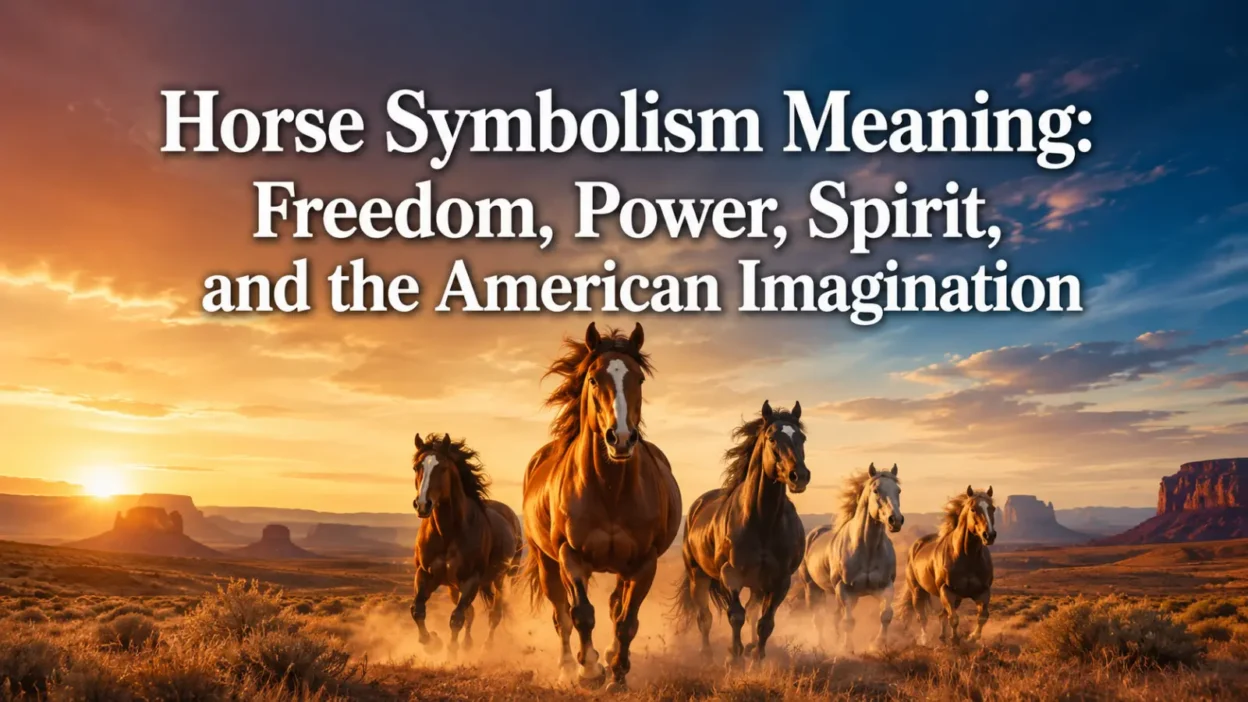
A horse is more than an animal in human imagination. The phrase horse symbolism meaning usually points to ideas of freedom, strength, movement, courage, status, and partnership.
People care about this symbol because horses sit at the meeting point of nature and culture. They are living animals with real needs and behaviors, but they are also tied to migration, farming, war, sports, stories, luxury, and the American West.
In the United States, the horse often suggests open space and personal independence. A running horse on a shirt, tattoo, logo, poster, or car badge can feel like a promise of motion: go farther, move faster, break loose, keep going.
Still, horse meaning is not one fixed code. A horse can symbolize freedom in one setting, conquest in another, sacred duty in another, and danger in another. The best interpretation depends on context.
Quick Answer
In the United States today, horse symbolism meaning most often centers on freedom, strength, movement, and independence. Historically, these meanings grew from the horse’s role in travel, work, warfare, wealth, and myth, but religious, cultural, tattoo, and dream interpretations can vary widely.
TL;DR
- Horses often symbolize freedom and forward motion.
- They also suggest strength, endurance, and courage.
- In art, horses can signal power or status.
- White and black horses carry different associations.
- Dream meanings are interpretive, not proven.
- U.S. meanings often connect to the West.
What a Horse Symbol Represents Today
Today, a horse most commonly represents freedom, strength, movement, and independence. In everyday American culture, this is the meaning people usually recognize first.
That meaning comes from the way horses look in motion. A galloping horse gives a clear visual impression of speed, force, and open space. Even people who have never ridden a horse understand the image.
But the horse is not only a symbol of escape. It can also suggest discipline, loyalty, grace, social status, and controlled power. A wild horse and a mounted military horse do not carry the same emotional message.
| Context | Common Meaning | Important Caution |
|---|---|---|
| Running horse | Freedom, motion, independence | Often modern and emotional, not ancient proof |
| Work horse | Endurance, reliability, service | Symbolic strength should not erase animal labor |
| Mounted ruler or soldier | Status, command, victory | Can also suggest conquest or domination |
| White horse | Purity, victory, sacred arrival | Meaning depends heavily on religion or story |
| Black horse | Mystery, danger, death, elegance | Not negative in every setting |
The horse is strongest as a symbol when its setting is clear. A horse in a pasture feels different from a horse in battle, a horse in a parade, or a horse in a dream.
Why Horses Became Symbols of Freedom and Movement
The link between horses and freedom is easy to understand. Horses made distance feel smaller. Before cars, trains, and planes, riding or driving horses changed how far people could travel, trade, hunt, fight, or settle.
That practical role shaped the emotional meaning. A horse could mean leaving home, crossing land, escaping danger, or reaching a place that would be impossible on foot.
In U.S. culture, this meaning became especially tied to the open range and the American West. The image of a horse moving across wide land still carries ideas of self-reliance, risk, and personal space.
This does not mean horses are “freedom” in every culture or every period. It means that, in many modern American images, the horse has become a shorthand for movement without walls.
The symbol also comes from posture. A horse with its head lifted, mane moving, and body stretched in a run looks active and uncontained. That visual feeling is why horses remain common in posters, car logos, sports imagery, and motivational art.
Strength, Work, and Endurance: The Practical Roots of the Symbol
Horses also symbolize strength because people used them for hard work. They pulled wagons, carried riders, hauled goods, helped farms, and supported armies.
This is where the phrase “workhorse” gets its force. In modern English, a “workhorse” can mean a person, tool, machine, or system that keeps going under pressure. The meaning comes from usefulness, not fantasy.
Endurance is another major horse meaning. Horses can be trained for long travel, racing, herding, sport, and performance. Because of that, they often stand for persistence and stamina.
There is a caution here. Symbolism should not turn the real animal into a machine. Horses are sensitive herd animals. They can startle, bond, learn, resist, suffer, and depend on good care.
That gap matters. A horse can symbolize courage to humans, but real horses are prey animals with strong survival responses. The symbol is human-made. The animal is real.
Status and Power: Horses in War, Rule, and Public Art
For much of recorded history, horses were expensive and strategically important. Owning, training, and displaying them often signaled wealth and rank.
That is why rulers, generals, and conquerors were so often shown on horseback. The rider appears elevated above others. The horse makes the person look larger, faster, and harder to challenge.
Equestrian statues use this effect clearly. A leader on horseback is not just being shown with an animal. The image says something about command, victory, control, or public honor.
In military settings, horses also carried meanings of speed and force. Cavalry could change the shape of a battle. Chariots, mounted archers, knights, and cavalry units all helped attach the horse to warfare and political power.
This side of the symbol is more serious than the soft idea of freedom. A horse can mean liberation, but it can also mean domination. The difference depends on who is riding, who is watching, and what history surrounds the image.
Horses in the American Imagination
In the United States, the horse carries a special mix of meanings. Some are historical. Some are romanticized. Some are commercial.
Common U.S. associations include:
- The American West and open land
- Wild horses and public-land debates
- Ranch work, rodeo, and cowboy imagery
- Sports teams and mascots
- Car culture, especially the mustang image
- Parades, police horses, and public ceremonies
- Children’s stories about trust and independence
The wild horse is one of the clearest American examples. It often stands for untamed land, freedom, and the pioneer imagination. At the same time, real wild-horse management is complicated and debated.
The horse also appears in American branding because it is easy to read quickly. A horse logo can suggest speed, performance, elegance, and control. That is why the horse works so well in cars, sports, luxury goods, and clothing.
Still, the American horse image is not neutral. It can carry nostalgia for a past that was never simple. Western horse imagery can inspire, but it can also hide histories of displacement, labor, violence, and land conflict.
Indigenous Horse Traditions Deserve a Careful Lens
Horse meaning in Native American cultures should never be reduced to one sentence. There is no single “Native American horse symbol.” Different nations, regions, histories, and living traditions have different relationships with horses.
The strongest broad U.S. historical pattern is that horses transformed many Plains and western Indigenous communities after their spread through Native trade networks and colonial contact. Horses changed travel, hunting, warfare, art, wealth, ceremony, and diplomacy for many groups.
For some communities, horses became deeply connected to family, status, generosity, protection, and spiritual life. For others, the horse’s meaning is tied to survival, adaptation, trade, and resistance.
A respectful article must avoid turning those histories into decoration. It is not accurate to say “the horse means spirit” in all Indigenous traditions. It is better to say that horses became important in many Native cultures, especially on the Great Plains, and that meanings vary by people, place, and tradition.
Modern horse imagery sometimes borrows Native patterns, beadwork, feathers, or “spirit animal” language without context. That can flatten living cultures into a mood board. Careful interpretation keeps the difference between admiration and appropriation clear.
Religious and Mythic Horses: Sacred Meaning, Not One Universal Code
Horses appear in many religious and mythic traditions, but they do not mean the same thing everywhere.
In Greek myth, Pegasus is a winged horse linked with heroic action, divine help, and ascent. Modern readers often turn Pegasus into a simple image of imagination or freedom, but the older story is more complex. It includes danger, ambition, and the limits of human pride.
In the Book of Revelation, horses appear in intense apocalyptic imagery. The Four Horsemen are connected with conquest, war, famine, and death. This is one reason horses can sometimes carry warning, judgment, or world-ending imagery in Christian art and popular culture.
White-horse imagery in religious settings can also suggest victory, purity, sacred authority, or divine arrival. But even there, meaning depends on the passage, tradition, and interpreter.
In the Chinese zodiac, the horse is one of the twelve animal signs. It is commonly associated with energy, independence, motion, and confidence. For U.S. readers, this often appears through Lunar New Year celebrations, gifts, decor, and yearly horoscopes.
In Hindu traditions, the future figure Kalki is often shown with a white horse in end-times imagery. That image belongs to a specific religious world and should not be treated as a general “white horse meaning” for everyone.
The main point is simple: mythic and religious horses are context-specific. A horse in a Greek story, a biblical vision, a Chinese zodiac year, and a Hindu image may overlap visually, but they do not share one universal message.
White, Black, and Wild Horses: How Color and Setting Change Meaning
Horse color changes interpretation because color already carries symbolic weight.
A white horse often suggests purity, victory, spiritual arrival, nobility, or rescue. It can also feel heroic because many stories picture saviors, rulers, saints, or mythic figures riding white horses. But a white horse is not automatically sacred in every setting.
A black horse often suggests mystery, danger, elegance, mourning, or hidden force. In some stories, it may be linked with death or the unknown. In modern fashion and design, though, a black horse can simply look sleek, dramatic, or refined.
A brown horse feels more grounded. It can suggest work, earthiness, steadiness, ranch life, or dependable strength. It often feels less supernatural and more practical.
A wild horse usually points to freedom, instinct, resistance, and open land. In the U.S., this image is closely tied to mustangs and western landscapes. Yet real wild horses live within ecological, legal, and land-management debates, so the symbol should not erase the living situation.
A running horse means motion. A standing horse may suggest alertness, patience, or quiet power. A horse with a rider can mean partnership, control, class, or conquest, depending on the scene.
Horse Tattoos, Jewelry, and Personal Identity
Horse tattoos are usually chosen for personal reasons. The most common meanings are freedom, strength, independence, endurance, loyalty, beauty, and a love of horses.
A running horse tattoo often means the wearer values movement, escape, or self-direction. A horse head can feel more intimate, especially for someone who has cared for or lost a horse. A rider and horse together can suggest trust, discipline, and partnership.
A winged horse tattoo may point to imagination, ambition, or myth. A white horse can feel spiritual or hopeful. A black horse can feel mysterious, protective, or intense.
Jewelry works in a similar way. A small horse pendant may be a sign of identity, memory, sport, childhood, or connection to rural life. Horseshoes, while separate symbols, often add luck and protection meanings.
The best tattoo interpretation comes from the wearer. Horse imagery has common meanings, but body art is personal. A horse tattoo may be about a real animal, a family memory, a riding life, a recovery story, or simply the feeling of refusing to be boxed in.
Horses in Decor, Fashion, Branding, and Digital Culture
In home decor, horse images often create a feeling of movement and open space. A painting of running horses can make a room feel energetic. A calm horse portrait can feel rustic, elegant, or grounded.
In fashion, horses often suggest heritage, sport, luxury, or country life. Equestrian style carries associations of discipline, class, leather goods, outdoor activity, and old-world polish.
Branding uses horses because the image is fast and readable. A horse can suggest performance, speed, endurance, control, and beauty in a single mark. That makes it useful for cars, sports teams, ranch brands, hotels, clothing, and wellness spaces.
Digital culture has made horse meaning more flexible. A horse emoji, meme, profile image, or sticker may mean freedom, chaos, stubbornness, confidence, or absurd humor depending on context.
This is where old meanings and new meanings mix. A horse can still draw on deep cultural memory, but a social media image may be playful rather than sacred. Not every horse graphic is trying to carry ancient meaning.
Dreams, Omens, and Spiritual Readings: Belief Rather Than Proof
Dream and omen meanings should be handled carefully. Many people do find personal meaning in seeing horses in dreams, meditation, or repeated images. That does not make one interpretation a proven fact.
Common modern readings include:
- A running horse may suggest a desire for freedom.
- A calm horse may suggest trust or emotional balance.
- A frightened horse may suggest anxiety or loss of control.
- Riding a horse may suggest direction, confidence, or discipline.
- A black horse may suggest the unknown or a difficult transition.
- A white horse may suggest hope, renewal, or spiritual guidance.
These readings can be useful for reflection, but they are not rules. A dream about a horse may come from memory, stress, movies, a recent ride, childhood experiences, or personal fear.
Omen beliefs work the same way. Some traditions read animal appearances as signs. In a modern U.S. context, it is better to describe those as folklore, spirituality, or personal belief rather than objective prediction.
Misuse, Oversimplification, and Myths to Avoid
The biggest mistake with horse meaning is making it too universal. Horses do not “always” mean freedom. They can also mean status, war, labor, wealth, death, sacred authority, sport, or personal memory.
Another mistake is treating sacred traditions as decorative. A horse with feathers, beads, or “tribal” styling can become careless if it borrows from Indigenous cultures without understanding or respect.
Public horse monuments also need context. A rider on horseback may look grand, but the image often supports a specific message about power. In some U.S. monuments, especially those tied to Confederate memory or colonial conquest, horse imagery can help glorify people and causes that remain harmful or contested.
There is also a common myth that the number of raised hooves on an equestrian statue tells how the rider died. This is not a reliable rule. Sometimes it appears to match, but there are too many exceptions for it to work as a code.
Horse symbolism is strongest when it stays honest. A horse can inspire, but it can also carry difficult history. Good interpretation makes room for both.
FAQs
What does a horse symbolize most often?
A horse most often symbolizes freedom, strength, movement, and independence. In modern U.S. culture, the clearest image is usually a horse running through open space.
Is horse meaning positive or negative?
It can be either. Horses often carry positive meanings such as courage, endurance, and loyalty, but in religious art, war imagery, and folklore they can also suggest conquest, death, danger, or judgment.
What does a horse tattoo mean?
A horse tattoo often means freedom, personal strength, independence, or love for horses. The exact meaning depends on the design, such as a running horse, winged horse, horse head, or rider with horse.
What does a white horse symbolize spiritually?
A white horse often suggests purity, victory, hope, sacred arrival, or spiritual authority. That meaning depends on context, especially whether the image comes from religion, myth, dreams, or modern art.
What do horses mean in dreams?
In dream interpretation, horses are often read as signs of energy, freedom, control, or emotional direction. These meanings are personal and belief-based, not fixed facts.
Why are horses important in American symbolism?
In the United States, horses are tied to the West, ranching, wild mustangs, cavalry history, sports, cars, and open-land imagery. They often suggest independence, but they can also carry complicated histories of conquest, labor, and land conflict.
Conclusion
The clearest modern meaning of the horse is freedom in motion. Horses also carry ideas of strength, endurance, courage, loyalty, status, and spiritual force, depending on the setting.
The history behind the symbol is practical as much as poetic. Horses changed travel, work, war, wealth, ceremony, and imagination, so people gave them meanings that matched those roles.
The best way to understand horse symbolism meaning is to look at the whole scene: the horse’s color, movement, rider, culture, and use. A horse symbol works best when it is read with both imagination and care.