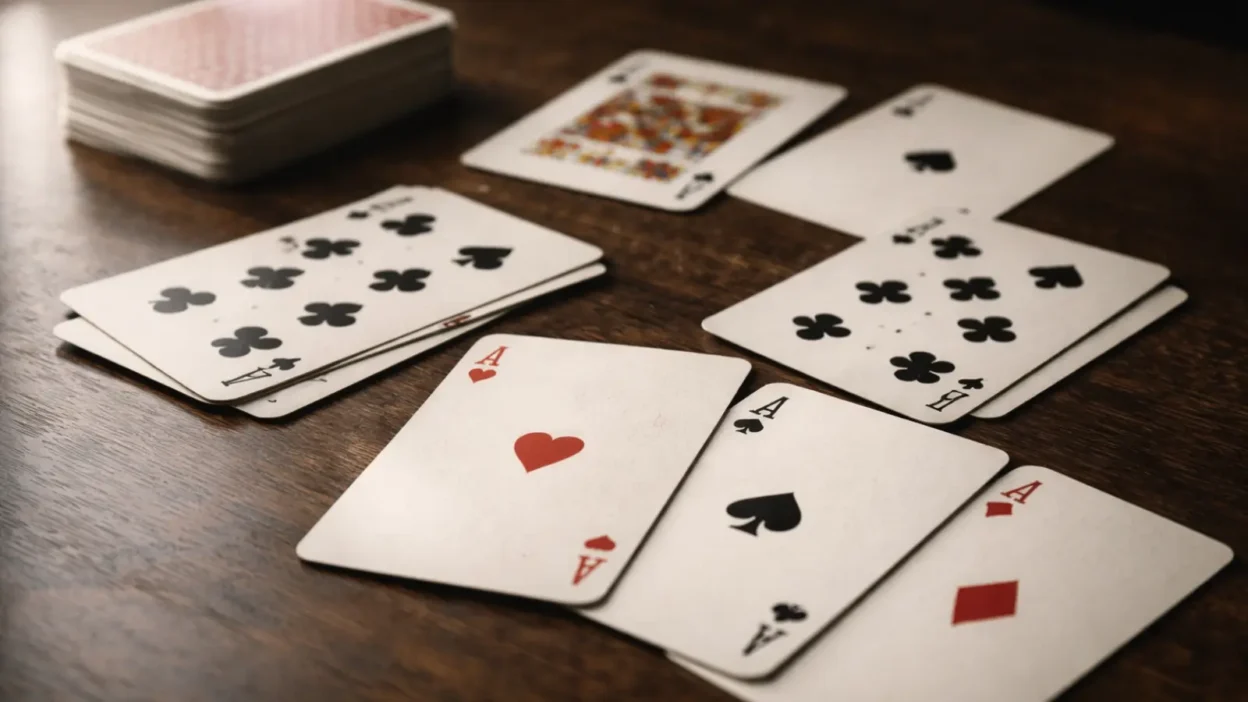
When people search for symbolism cards meaning, they are usually asking about ordinary playing cards: the kind used for poker, rummy, solitaire, and party games. They want to know what the suits mean, why the ace of spades feels special, and whether cards stand for luck, fate, love, money, or something deeper.
That question makes sense because cards sit in a strange place in American life. They are everyday objects, but they also carry drama. A deck can suggest fun, gambling, risk, confidence, secrecy, skill, or temptation depending on the setting.
Cards also picked up meaning over time. Some of that meaning comes from real deck history. Some comes from fortune-telling traditions, military use, tattoos, music, and pop culture. The trick is telling those layers apart.
Quick Answer
Symbolism cards meaning usually points to playing cards as symbols of chance, choice, luck, risk, and social strategy in modern U.S. culture. The four suits often carry added meanings such as love, wealth, conflict, or labor, but many of those suit-by-suit readings are later interpretations rather than one fixed original message.
TL;DR
- Cards usually symbolize luck, risk, and decision-making.
- The four suits did not begin with one universal code.
- Hearts are often read as emotion or relationships.
- Spades often suggest struggle, power, or seriousness.
- The ace of spades gained extra meaning later.
- Fortune-telling meanings are real traditions, not proven origins.
Main Article
What people usually mean by “symbolism cards meaning”
In most cases, this phrase refers to the symbolism of a standard playing deck. That means 52 cards, four suits, and familiar face cards like king, queen, and jack.
It does not usually mean greeting cards. It also does not automatically mean tarot, even though tarot and playing cards are historically related card traditions. In everyday American use, people are usually asking what deck imagery suggests in culture, art, tattoos, games, or personal interpretation.
At the broadest level, cards symbolize a mix of control and uncertainty. You can play skillfully, but you cannot choose the hand you are dealt. That simple fact helps explain why card imagery shows up so often when people talk about luck, fate, character, and risk.
The clearest modern meaning: chance, choice, luck, and social play
Today, the most common symbolic meaning of playing cards is not religious or mystical. It is social and emotional.
A deck often stands for:
- luck
- risk
- strategy
- hidden information
- confidence under pressure
- the unpredictability of life
That symbolism is easy to understand because it grows out of how cards work. A card game always mixes structure with uncertainty. There are rules, ranks, and patterns. But there is also chance, bluffing, timing, and imperfect knowledge.
That is why card imagery feels so useful in American culture. A person can be “holding their cards close.” Someone else can be “playing their hand.” A big risk can be “a gamble.” Even outside the casino, card language helps people talk about life as something partly planned and partly uncontrollable.
Why cards picked up symbolic meaning in the first place
Cards became symbolic because they are compact systems of order. Every deck sorts people and possibilities into ranks, suits, and outcomes.
That makes them good at representing more than games. Cards can suggest:
- hierarchy, because some cards outrank others
- personality, because face cards look human
- conflict, because players compete
- fortune, because the draw is uncertain
- identity, because people choose favorite suits or signature cards
This is also why cards work so well in stories and design. They are simple to recognize, but they already carry tension. One image can suggest romance, danger, luck, greed, or swagger without much explanation.
In that sense, the object itself shaped the symbolism. Cards did not need a secret origin story to become meaningful. Their everyday use gave them symbolic weight.
The deck did not start with one universal message
This is the part many articles rush past.
The modern Anglo-American deck feels fixed and familiar, but earlier playing cards were much less uniform. Suit systems varied by region. Some decks used cups, swords, coins, and batons. Others used bells, leaves, acorns, flowers, birds, hunting animals, or other local images. Court structures varied too.
So the four-suit system most Americans know today should not be treated as the one ancient code behind all cards. The familiar hearts, diamonds, clubs, and spades came out of the French suit system and later became dominant in English-speaking card culture.
That matters because many tidy explanations come later. For example, you will often see claims that each suit “always” represented one class of society or one element of life from the beginning. Those systems can be meaningful as later interpretations, but they should not be confused with a single proven original design plan.
In other words, card symbolism is real, but it is layered. Some meanings are historical. Some are traditional. Some are modern shorthand.
What the four suits usually symbolize now
In modern American use, the suits often take on stable everyday meanings, especially in tattoos, visual design, card games, and informal spiritual readings. These are best understood as common interpretive habits, not hard historical facts.
| Suit | Common meaning today | Why people read it that way | Caution |
| Hearts | love, emotion, relationships | heart shape strongly cues feeling and affection | more modern visual association than original deck proof |
| Diamonds | money, value, status | diamond shape suggests wealth and polish | often tied to modern luxury culture |
| Clubs | work, force, growth, action | club implies effort, blunt force, movement | meaning varies the most |
| Spades | struggle, power, intellect, death, seriousness | dark color and link to sword/spade history feel sharper | strongest dramatic baggage, especially later on |
Hearts are the easiest for most Americans to read. Even outside cards, the heart symbol already means love and feeling. So hearts on a card naturally pick up meanings tied to romance, closeness, warmth, or emotional stakes.
Diamonds often suggest wealth or value. That is partly visual. In modern culture, diamonds are tied to money, luxury, and reward. In card symbolism, that can make the suit feel polished, ambitious, or material.
Clubs are less settled. Some people connect them with labor, willpower, or rough action. Others read them as growth or energy. Because the shape is less obvious in modern life, club meanings are often more interpretive and less fixed.
Spades usually carry the heaviest tone. They can suggest conflict, seriousness, sharp thinking, hard truth, or danger. Part of that comes from the suit’s darker look. Part comes from its historical tie to the sword in earlier suit systems. Part comes from everything later Americans loaded onto the ace of spades.
Court cards and number cards: rank, personality, and storytelling
Face cards feel symbolic because they look like people. They are the most openly social part of the deck.
A king often suggests authority, command, or established power. A queen often suggests influence, intelligence, or presence, though modern readers may interpret her in many ways beyond old gender roles. A jack usually signals youth, movement, service, or a lower but still active position in the hierarchy.
That does not mean every deck was designed as a personality test. It means the visual structure invites that kind of reading. Once you place human figures into a rank order, people naturally start reading them as types.
Number cards work a little differently. They are less personal and more abstract. Low numbers can feel simple or early. Middle numbers can suggest growth or development. High numbers can imply pressure, buildup, or completion. Aces often stand apart because they can symbolize both the beginning and the strongest point, depending on the game.
This is one reason cards became so useful in storytelling and fortune-telling. They already divide life into characters, stages, and stakes.
Why the ace of spades became unusually loaded
No single card in the standard deck carries more symbolic baggage in the United States than the ace of spades.
Part of that history is practical. In Britain, the ace of spades became visually elaborate because it was used for tax and printing authority. That helped set it apart from the rest of the deck. Over time, it started to feel official, marked, and important.
Part of it comes from gameplay. In many games, the ace is powerful, and the ace of spades often gained extra prestige. Once a card is both visually distinctive and often treated as high-ranking, it becomes a natural magnet for symbolism.
Then modern culture added more layers. The ace of spades became linked with toughness, luck, danger, rebellion, and sometimes death. Music, military imagery, biker culture, tattoo art, and gambling iconography all helped build that mood.
The Vietnam War pushed this further. American troops used the ace of spades as a psychological symbol and calling card. But that history should be described carefully. The U.S. use of the symbol is well known. Claims that Vietnamese fighters broadly shared the same superstition are much less certain and are often repeated too confidently.
So when people treat the ace of spades as if it has always meant death, that oversimplifies the story. Its meaning became heavy through layers of state control, gaming prestige, wartime symbolism, and later pop-culture reuse.
Cards in fortune-telling, spirituality, and folklore
Ordinary playing cards have long been used in cartomancy, or card-based fortune-telling. In that setting, the suits and ranks take on more specific interpretive meanings.
This is a real tradition. It matters to many people. But it should be framed as a belief-based or practice-based meaning system, not as proof of the deck’s one original purpose.
That distinction is important.
Playing cards were used for games long before many modern readers encountered them as spiritual tools. Later systems mapped moral, emotional, or predictive meanings onto the deck. Some readers also connect ordinary suits to tarot suits, which is historically understandable, but that does not turn every casual card meaning into ancient fact.
Folklore adds another layer. In stories and superstition, cards can symbolize fate, temptation, warning, deception, or destiny. A “bad hand” can stand for hard luck. A hidden card can suggest secrecy. A winning draw can suggest undeserved fortune or sudden grace.
These meanings are culturally real because people use them. They are just not the same thing as proven origin history.
How Americans use card symbolism now
In the United States, playing card imagery is everywhere because it is easy to read and emotionally flexible.
Tattoos
Card tattoos often signal luck, risk-taking, confidence, love of gambling, or a personal “signature card.” The ace of spades is especially common because it feels bold and loaded. A paired king and queen can suggest romance or partnership, though sometimes it simply signals style.
Fashion and graphic design
Card symbols are common in streetwear, band art, posters, bar signage, and casino-themed visuals. They work because they are clean, recognizable shapes with built-in mood.
Branding and identity
Businesses use card imagery to suggest play, boldness, exclusivity, reward, or strategy. Even when the business has nothing to do with gambling, a card symbol can imply confidence and calculated risk.
Digital culture
Online, cards often stand in for personality, dating, bluffing, memes about luck, or “the hand you were dealt.” That language still feels fresh because people instantly understand it.
In U.S. culture, then, playing cards are not just game tools. They are symbols people use to talk about nerves, style, romance, swagger, luck, and self-presentation.
What card symbolism can and cannot tell you
Card symbolism works best when you keep it in context.
It can tell you how people attach meaning to a familiar object. It can show how design, games, folklore, and pop culture interact. It can help explain why one suit feels romantic while another feels severe.
What it cannot do is give you one final, universal answer that has always existed.
There is no single master key that unlocks every card symbol across all times and places. The history is too mixed for that. The meanings changed as decks changed. They changed again when cards moved between countries. They changed again when people started using them in divination, military symbolism, tattoos, and entertainment.
That does not make card symbolism fake. It makes it human.
People keep reusing the deck because it already carries structure, suspense, and social meaning. But the most responsible way to read it is to separate documented history from later interpretation and to avoid treating one modern system as eternal truth.
FAQs
What do playing cards symbolize overall?
Playing cards usually symbolize luck, risk, choice, hierarchy, and social strategy. In modern American culture, they often stand for “the hand you’re dealt” in life as much as for literal games.
Do the four suits have official meanings?
Not in one universal historical sense. Hearts, diamonds, clubs, and spades do carry common modern meanings, but many of those are later interpretations rather than a single original code built into the deck.
What does an ace of spades tattoo usually mean?
It often suggests boldness, luck, risk, resilience, or a rebellious edge. For some people it is also tied to gambling culture, music, military imagery, or simply the card’s strong visual reputation.
Are playing cards connected to tarot?
Yes, but they are not the same thing. Tarot is a different card tradition with a larger symbolic system, while ordinary playing cards were mainly used for games and later adapted into fortune-telling practices.
Is card symbolism spiritual or just cultural?
It can be either, depending on how a person uses it. In popular culture, card symbols are often aesthetic or emotional, while in cartomancy they may carry spiritual or divinatory meaning within that practice.
Why do people treat spades as darker than hearts?
Partly because spades are black and visually sharper, and partly because later associations linked them to conflict, seriousness, and the famous ace of spades. Hearts, by contrast, borrow meaning from the wider heart symbol, which already suggests affection and feeling.
Conclusion
The clearest answer to symbolism cards meaning is that playing cards usually symbolize chance, choice, rank, and the tension between luck and strategy. That broad meaning comes less from hidden ancient secrets and more from how the deck actually works in games, stories, and modern life.