Religion often uses ordinary things—a shape, sound, color, gesture, animal, flower, building, or ritual object—to point toward something larger. Symbolism in religion matters because many beliefs are hard to explain in plain speech: holiness, suffering, forgiveness, belonging, rebirth, duty, and hope.
A symbol can teach, remind, comfort, warn, or unite. It can also divide when people disagree about who may use it, where it belongs, or what it has come to represent.
Quick Answer
In the United States today, symbolism in religion most often symbolizes faith, identity, memory, moral values, and connection to a sacred tradition. These meanings grew from ritual use, scripture, community practice, art, and public life, but no single symbol means the same thing in every religion or every setting.
TL;DR
- Religious symbols make abstract beliefs easier to see.
- Meanings depend on tradition, place, and use.
- Sacred symbols are not just decoration for believers.
- U.S. usage mixes faith, culture, law, and identity.
- Misuse can change how a symbol is received.
- Responsible interpretation starts with context.
What Religious Symbols Mean in Everyday Life
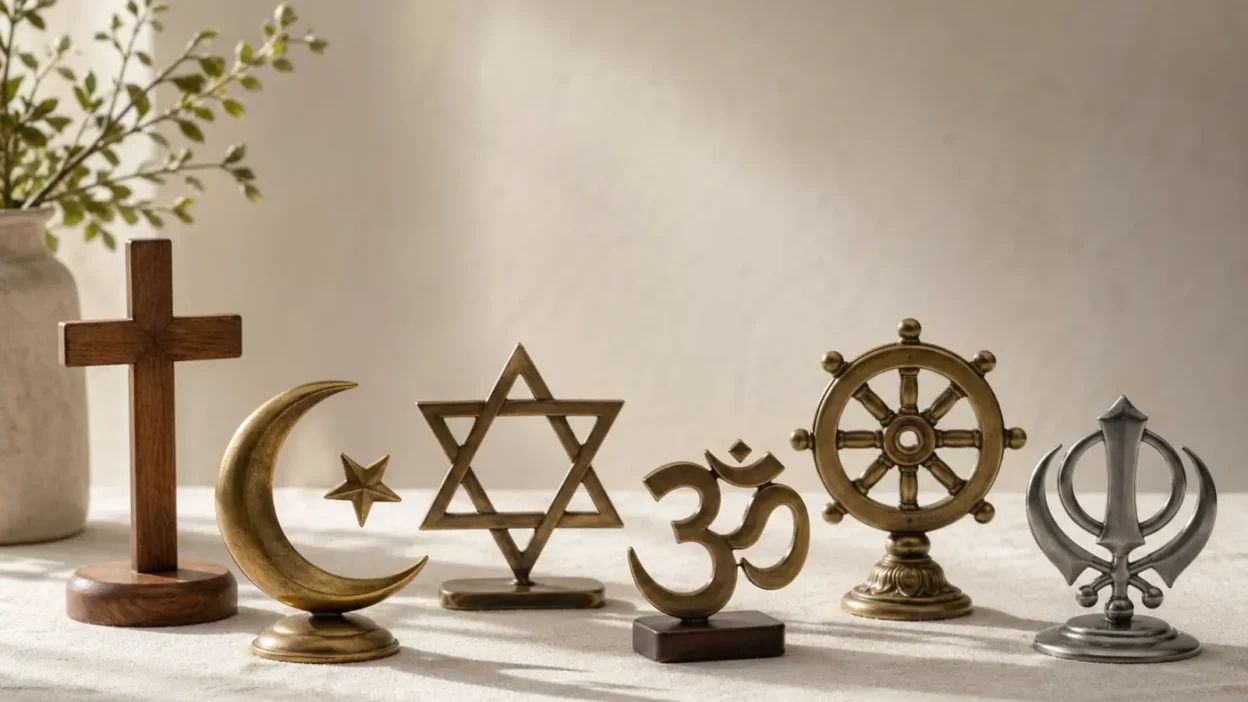
A religious symbol is a sign that carries meaning within a faith community. It may be visual, like a cross or Star of David. It may be spoken or sounded, like Om. It may be performed, like kneeling, bowing, lighting a candle, or making a hand gesture.
Most people first meet religious symbols in familiar places. They see them on a necklace, a grave marker, a church window, a prayer rug, a holiday display, a tattoo, or a family altar. The symbol may seem simple, but it often carries many layers at once.
For a believer, a symbol may be a reminder of God, enlightenment, covenant, discipline, mercy, suffering, liberation, or moral duty. For someone outside that tradition, the same symbol may function more like a cultural marker. It may say, “This is a Christian church,” “This is a Jewish home,” or “This space is connected to Buddhist practice.”
That difference matters. A symbol can identify a tradition from the outside while carrying a deeper inner meaning for those who practice it.
Why Religions Use Symbols Instead of Words Alone
Religions deal with ideas that are difficult to hold in ordinary language. The sacred, the afterlife, sin, compassion, awakening, sacrifice, purity, and divine presence are not simple objects. Symbols give those ideas a shape people can return to.
Symbols also help communities remember. A child may not understand a full theology of redemption, but they may recognize a cross. A person may not know every layer of Buddhist teaching, but a wheel can suggest a path, motion, and discipline. A candle can mark prayer, grief, hope, or a holy day without needing a long explanation.
Religious symbols work because they are repeatable. They appear in worship, art, clothing, architecture, holidays, and rites of passage. Each repetition teaches the meaning again.
They also bring emotion into belief. A wedding ring, prayer shawl, rosary, menorah, or temple bell is not only an idea. It is touched, worn, heard, lit, carried, inherited, and remembered.
How Sacred Symbols Began in Ritual, Story, and Art
Many religious symbols began in practice before they became neat “meanings” in a guidebook. A ritual object was used again and again. A story was told in images. A sound was chanted. A shape became linked with a sacred event or community memory.
The Christian cross is a clear example. It began as an instrument of Roman execution, but Christians came to read it through the death and resurrection of Jesus. Over time, it became a sign of suffering, sacrifice, salvation, and Christian identity.
The Star of David has a different kind of history. Its six-pointed shape appeared in many settings before it became widely recognized as a Jewish emblem. Its modern identity grew through community use, European Jewish history, and later national and public meanings.
The crescent and star is another case where modern recognition can hide a complicated past. Many people now read it as Islamic, but its link to Muslim identity grew strongly through political and imperial use, especially through Ottoman association. It is not equal to scripture itself, and not all Muslims treat it as a sacred sign.
These examples show a larger rule: a symbol’s present meaning is often real even when its origin is layered, gradual, or debated.
Common Religious Symbols and Their Core Meanings
The table below gives a careful snapshot, not a complete map. Each symbol has internal meanings that vary by community, denomination, region, and use.
| Symbol | Common religious meaning | Common U.S. encounter | Interpretation caution |
| Cross | Christ, sacrifice, resurrection, Christian faith | Churches, jewelry, graves, tattoos | Meanings differ across Christian traditions |
| Star of David | Jewish identity, community, heritage | Synagogues, flags, jewelry, memorials | Not originally a biblical command symbol |
| Crescent and star | Muslim identity in modern public use | Mosques, flags, calendars, emblems | Not universally accepted as sacred by Muslims |
| Om | Sacred sound, prayer, meditation, Hindu and Indian religious practice | Yoga spaces, tattoos, decor, music | Often commercialized outside its ritual context |
| Dharma wheel | Buddhist teaching, path, moral order | Buddhist centers, art, tattoos | Spokes and meanings vary by tradition |
A table can make these symbols easier to compare, but comparison has limits. A cross in a sanctuary, an Om on a yoga shirt, and a dharma wheel on a tattoo do not all function the same way. Setting changes meaning.
How Meaning Changes Across Traditions
Religious symbols rarely stay fixed. They move through languages, empires, migrations, reforms, art styles, and political events. As they move, they gather new associations.
A flower may symbolize purity in one tradition, rebirth in another, and mourning in a third. A circle may suggest eternity, wholeness, divine order, or the cycle of life depending on the setting. A flame may suggest the Holy Spirit, wisdom, remembrance, purification, or danger.
This does not mean symbols can mean anything at all. Tradition still matters. A meaning becomes strong when a community repeats it through ritual, teaching, art, and memory. But it does mean readers should be careful with broad claims like “this symbol means peace in all religions.”
The safer question is not “What does this symbol universally mean?” It is “Who uses this symbol, in what setting, and why?”
U.S. Religious Symbolism Today
In the United States, religious symbols carry extra layers because the country is both religiously active and religiously diverse. Many Americans encounter symbols from traditions they do not personally practice.
A cross may appear as a church sign, a family heirloom, a fashion pendant, a roadside memorial, or a political image. A menorah may be part of Jewish worship, a Hanukkah display, or a public sign of religious inclusion. A crescent may mark Muslim identity in a school calendar, a mosque logo, or a veterans’ cemetery emblem.
This plural setting makes symbols visible, but also contested. Public religious displays can raise questions about government neutrality, free exercise, local tradition, and whether minority faiths feel equally included. In private life, the same symbols may feel intimate and protective.
Modern U.S. meaning is therefore not only spiritual. It is also social. Religious symbols can say, “I belong here,” “I remember my family,” “I honor my dead,” “I practice this faith,” or “I want my tradition to be seen.”
When Symbols Become Identity, Memory, and Belonging
Some religious symbols become personal because they are tied to family life. A grandmother’s rosary, a mezuzah on a doorpost, a prayer rug, a Bible, a Qur’an stand, a wedding garland, or a memorial candle may carry meaning beyond formal doctrine.
These objects may remind people of prayer, migration, survival, conversion, grief, or childhood. Even someone who no longer practices a religion may keep a symbol because it holds family memory.
This is common in the United States, where religious identity can be ethnic, cultural, spiritual, inherited, chosen, or partial. Someone may wear a Star of David as Jewish identity, not only as a statement about ritual observance. Someone may wear a cross because it reminds them of a parent, a church upbringing, or a moment of recovery.
Symbols are often strongest when public meaning and personal memory meet.
Tattoos, Jewelry, Decor, and Fashion
Religious symbols are now widely used in tattoos, jewelry, home decor, clothing, and digital design. Some uses are devotional. Others are artistic, protective, memorial, or identity-based.
A religious tattoo may mark faith, survival, grief, gratitude, or a life change. Cross tattoos, rosaries, sacred hearts, mandalas, Om designs, lotus flowers, angels, and scriptural phrases are common in American tattoo culture. But a tattoo can also create tension if the symbol belongs to a tradition the wearer does not understand.
Jewelry works in a similar way. A small cross, hamsa, pendant, medal, or prayer bead bracelet may be a private reminder. It may also be fashion. Neither meaning is automatically false, but respectful use depends on awareness.
Decor and fashion are more complicated when sacred images become surface pattern. A symbol used in worship may feel reduced when it appears on a throw pillow, party theme, costume, or trend item. The question is not only “Is it beautiful?” but “What does it mean to the people who hold it sacred?”
Folklore, Omens, and Personal Interpretation
People often give religious symbols private meanings that go beyond official teaching. A candle that will not stay lit, a bird at a funeral, a repeated number, or a cross-shaped mark may be read as a sign by some people.
These readings belong to the world of folklore, devotion, grief, and personal interpretation. They can be emotionally meaningful, especially during loss or uncertainty. But they should not be presented as proven facts.
There is also a difference between religious symbolism and superstition. A tradition may teach that a ritual object helps focus prayer. A folk belief may say the same object guarantees luck or protection. Those are not the same claim.
Careful interpretation leaves room for belief without turning every belief into established history.
Misuse, Distortion, and Public Controversy
Religious symbols can be harmed by misuse. They can be commercialized, mocked, turned into political weapons, or taken over by hate movements.
The clearest example is the swastika. In several Asian religious traditions, related forms have long carried meanings such as auspiciousness, well-being, or sacred order. In the West, Nazi use turned the hooked cross into a symbol strongly associated with antisemitism, genocide, and white supremacy. Both facts matter. The older sacred use should not be erased, and the modern harm should not be softened.
Other symbols face different problems. Sacred Indigenous objects and designs are sometimes sold as decor without community consent. Hindu, Buddhist, Christian, Jewish, Muslim, and other symbols can be used in fashion or advertising with little understanding. Public displays of religious symbols can become legal and political disputes when people disagree about whether they express heritage, faith, government preference, or exclusion.
A symbol’s history does not excuse harmful use. But harmful use does not always erase every older or living meaning. The responsible answer is usually specific, not sweeping.
How to Interpret a Religious Symbol Responsibly
A good interpretation starts with humility. Ask what the symbol means inside the tradition before asking what it means to you.
Look at setting first. Is the symbol in a house of worship, cemetery, protest, tattoo studio, museum, store, school, altar, or online post? The same image may shift meaning across those places.
Then ask who is using it. A symbol used by a practicing community, a grieving family, an artist, a brand, or an extremist group may carry different force.
Finally, avoid universal claims. Most religious symbols are not one-line answers. They are living signs shaped by people, rituals, conflict, memory, and time.
Respect does not require belonging to every tradition. It does require care.
FAQs
What does a religious symbol usually mean?
A religious symbol usually points to a belief, story, sacred presence, moral value, or community identity. Its meaning depends on the tradition and the setting where it appears.
Are religious symbols always sacred?
No. Some are sacred in worship but cultural, decorative, or personal in other settings. A symbol can still deserve respect even when it is used outside formal ritual.
What does a religious tattoo mean?
A religious tattoo often expresses faith, protection, memory, grief, gratitude, or personal change. The meaning is strongest when the wearer understands the symbol’s tradition and uses it with care.
Why do the same symbols mean different things in different religions?
Many symbols come from simple forms found in nature, art, geometry, or ritual life. Traditions then give those forms specific meanings through teaching, repetition, and community memory.
Is it disrespectful to wear a religious symbol from another faith?
It depends on the symbol, the tradition, and the reason for wearing it. It is more respectful when the wearer learns the meaning, avoids mockery, and does not treat a sacred sign as a costume or trend.
Why are religious symbols controversial in public spaces?
In the United States, public religious symbols can raise questions about inclusion, history, free expression, and government neutrality. A display may feel like heritage to one group and exclusion to another.
Can a symbol recover after being misused?
Sometimes, but not always in every setting. A community may preserve an older sacred meaning while another public audience still reads the symbol through later harm or political use.
Conclusion
Religious symbols are not simple decorations. They help people see, touch, remember, and share beliefs that are often too large for plain words.