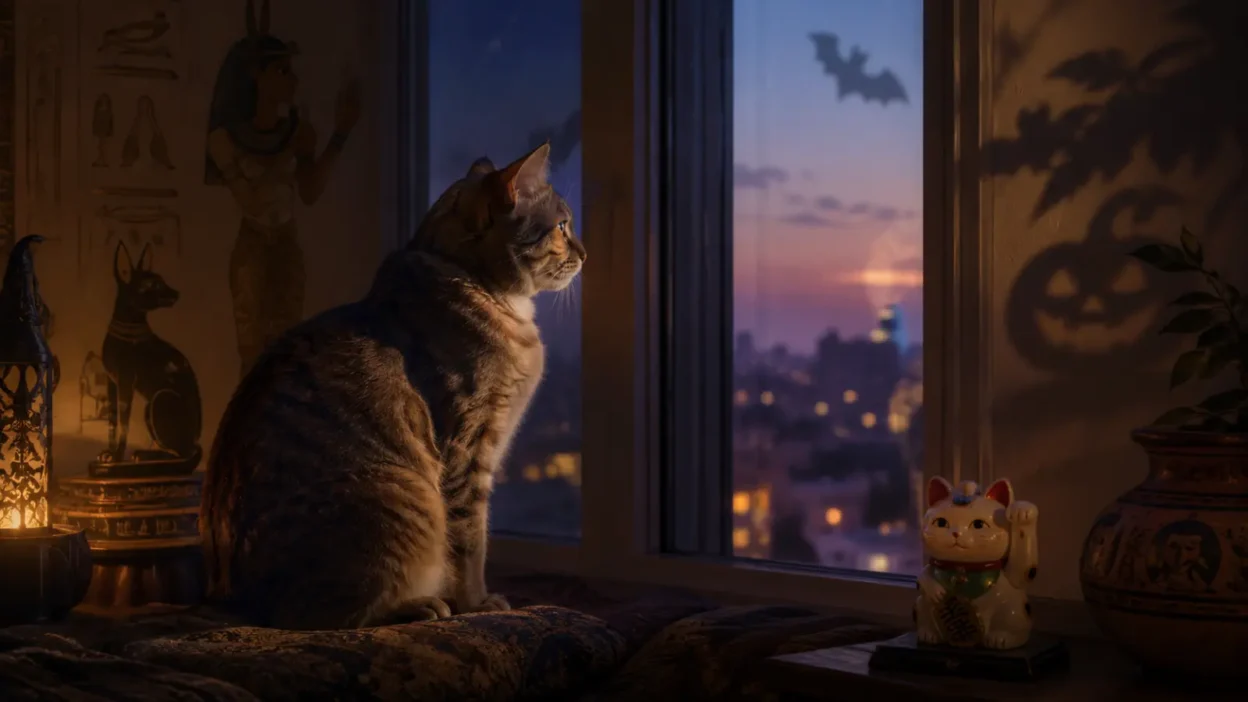
The cat symbolism meaning most readers look for today is tied to independence, mystery, intuition, and protection. Cats are familiar animals, but they often feel hard to read. That mix of closeness and distance is a big reason they became symbolic.
In the United States, cats appear in homes, tattoos, Halloween decorations, internet jokes, jewelry, logos, and spiritual discussions. They can feel cozy in one setting and eerie in another.
That does not mean cats have one fixed meaning. A cat in ancient Egyptian religion, a black cat on a Halloween card, a lucky cat near a restaurant register, and a memorial tattoo all carry different layers.
This guide separates history, folklore, religion, superstition, and modern use so the symbol stays clear without losing its depth.
Quick Answer
In modern U.S. culture, cat symbolism meaning most often points to independence, mystery, intuition, grace, and self-protection. Older meanings come from ancient Egyptian religion, European folklore, black-cat superstition, Japanese lucky-cat traditions, and the way real cats move between closeness and distance.
TL;DR
- Cats often symbolize independence and mystery.
- Egyptian cat meaning is tied to protection.
- Black-cat bad luck is superstition, not fact.
- Lucky cats come from Japanese tradition.
- Cat tattoos often express identity or memory.
- Modern meanings depend heavily on context.
What Cats Most Commonly Symbolize Today
Today, cats most often symbolize independence. They live with people, but they do not usually perform loyalty in the same obvious way dogs do. That public image makes the cat a natural symbol for people who value privacy, self-direction, and personal space.
Cats also symbolize mystery. Their quiet movement, alert eyes, and nighttime activity make them feel watchful. People often read that stillness as secrecy, wisdom, or hidden awareness.
Another common meaning is intuition. This does not mean cats have supernatural knowledge. It means people notice how quickly cats react to sound, motion, mood, and space. Symbolically, that becomes a sign of instinct.
A cat can also mean comfort. In U.S. homes, cats are not only mysterious figures. They are companions, emotional support animals, family pets, and everyday sources of routine. That softer meaning matters just as much as the darker folklore.
So the modern cat symbol is not one thing. It sits between freedom and affection, silence and play, softness and sharpness.
Cat Meanings at a Glance
Cat symbolism changes with color, setting, culture, and use. The same animal can feel protective in one context and unlucky in another.
| Cat Symbol Context | Common Meaning | Important Caution |
|---|---|---|
| Domestic cat | Independence, comfort, self-trust | Not all cats act the same way |
| Black cat | Mystery, bad luck, protection, rebellion | Bad luck is superstition |
| Egyptian cat imagery | Protection, household safety, Bastet | Do not reduce it to décor only |
| Lucky cat figurine | Prosperity, welcome, customers | Japanese tradition, not generic “Asian” meaning |
| Cat tattoo | Identity, memory, freedom, mystery | Meaning depends on design and wearer |
This is why context matters. A cat on a business counter, a cat in a dream, and a cat in a museum case are not saying the same thing.
Why Cat Symbolism Developed from Real Cat Traits
These traits made cats easy to symbolize.
A few visible traits shaped the main meanings:
- Independence: Cats often choose when to approach and when to withdraw.
- Mystery: Their quiet movement makes them seem secretive.
- Protection: Their hunting helped protect food stores from rodents.
- Grace: Their balance and soft movement made them symbols of elegance.
- Curiosity: Their habit of exploring small spaces became a sign of inquiry.
Still, symbolism is not the same as biology. Saying a cat represents independence does not mean cats are emotionless. Many form strong bonds with people. The symbol comes from human interpretation of cat behavior, not from a full scientific description of cats.
That difference keeps the meaning honest.
Ancient Egypt: Protection, Household Life, and Bastet
The most famous historical cat symbolism comes from ancient Egypt. Cats were valued in daily life because they helped control pests such as rodents and snakes. That practical role supported a larger religious and symbolic role.
The goddess Bastet is central here. She was connected with protection, household life, health, and sometimes fertility or motherhood. Earlier feline divine imagery could be fierce and lion-like, while later Bastet was often shown with a domestic cat form or cat features.
Cats were also mummified and offered in religious settings. This was not the same as modern pet memorial culture, and it should not be treated as a simple “Egyptians loved cats” story. It belonged to a religious world with temples, offerings, divine images, and ritual practice.
For modern readers, the key point is this: Egyptian cat symbolism was not just about mystery. It was strongly tied to protection, the home, and divine care.
Because Egyptian symbols are often reused in jewelry, tattoos, and décor, it is worth being careful. A Bastet image is not only an aesthetic cat design. It comes from a religious culture with its own meanings.
Medieval Europe and the Rise of the Witch’s Cat
In parts of medieval and early modern Europe, cat symbolism took a darker turn. Cats, especially black cats, became linked with witches, the devil, night, and hidden danger.
This association did not erase older positive meanings, but it changed how many Europeans imagined cats. Their independence, night movement, and hard-to-control nature made them easy targets in a culture already anxious about heresy, witchcraft, and unseen evil.
The idea of the witch’s familiar became especially important. In folklore and witch-trial imagination, an animal familiar could be seen as a spirit helper. Cats fit that image because they were domestic but not fully obedient.
This history should be handled with care. It reflects fear, suspicion, and religious conflict more than anything true about cats. It also helped build the visual language still used in Halloween cards, movies, costumes, and decorations.
In modern U.S. culture, the witch’s cat is often playful or stylish. But behind the image is a history of fear directed at both animals and people, especially women accused of witchcraft.
Black Cat Symbolism: Luck, Fear, and Reclaiming the Image
Black cats carry some of the strongest mixed symbolism. In much of modern U.S. culture, a black cat can suggest bad luck, Halloween, witches, shadows, or the supernatural. These meanings come from folklore and superstition, not from fact.
But black cats have never meant only bad luck. In some traditions, they have been viewed as lucky, protective, or connected with prosperity. Modern people also reclaim black cats as symbols of beauty, resilience, independence, and misunderstood identity.
That reclaiming matters. Many black-cat tattoos, stickers, and social media posts now push back against the old superstition. The cat becomes a symbol of refusing unfair labels.
Black cat symbolism is also a good example of how meanings change. A symbol once used to create fear can later become a symbol of confidence, style, humor, or affection.
The safest interpretation is this: a black cat symbolizes mystery and cultural ambiguity. Whether it reads as lucky, unlucky, protective, gothic, cute, or rebellious depends on the setting.
Lucky Cats and Cross-Cultural Meanings
One of the most familiar cat symbols in the United States is the raised-paw lucky cat, often seen in restaurants, shops, salons, and homes. This figure is commonly called the maneki-neko, or beckoning cat.
It comes from Japanese tradition and is associated with welcome, customers, good fortune, and prosperity. A raised paw is often read as a beckoning gesture. In many modern versions, details such as paw position, color, coin, or placement affect the meaning.
For U.S. readers, the important point is not to treat this as a vague “Asian lucky cat.” It has a specific Japanese background, even though it is now used globally and sold in many styles.
Other cultures also have cat stories, but they should not be blended into one universal meaning. A cat may be sacred in one setting, feared in another, lucky in another, and simply beloved in another.
Cross-cultural symbolism is useful only when it stays specific.
Spiritual, Dream, and Omen Interpretations
Many people search for cat meaning after a real encounter. A cat crosses their path. A stray appears at the door. A cat shows up in a dream. A black cat appears again and again.
These interpretations belong mostly to folklore, superstition, dream interpretation, and modern spirituality. They can be meaningful to the person, but they are not proven messages.
Common belief-based readings include:
- A cat crossing your path may suggest paying attention.
- A black cat may represent mystery, warning, or protection.
- A cat at your door may be read as luck or invitation.
- A dream cat may point to independence, instinct, or hidden feelings.
- A friendly cat may suggest comfort or trust.
These meanings work best as reflective tools, not fixed predictions. A cat crossing the sidewalk is also just a cat crossing the sidewalk.
That does not make the symbol useless. It simply means the meaning comes from interpretation, culture, and personal response.
Cat Tattoos, Jewelry, Décor, and Personal Identity
Cat tattoos are popular because the symbol is flexible. A small outline can feel simple and personal. A black cat can look gothic or protective. A realistic portrait can honor a beloved pet. A Bastet design can refer to Egyptian religion, protection, or divine feminine imagery, though it should be used respectfully.
Common tattoo meanings include independence, intuition, mystery, survival, elegance, and memory. The “nine lives” idea often adds resilience. A person may choose a cat tattoo after illness, grief, reinvention, or a period of learning to live on their own terms.
Cat jewelry and décor work in a similar way. A cat ring may feel playful. A black cat print may feel witchy or seasonal. A ceramic lucky cat may suggest welcome and prosperity.
In modern style, cats are not only symbols of the occult or ancient religion. They are also symbols of personality. For many people, loving cats is part of identity.
That is especially true online, where “cat person” can signal humor, introversion, tenderness, independence, or a preference for quiet companionship.
Cats in Modern U.S. Culture: Pets, Memes, Halloween, and Branding
In the United States, cats are part of daily life. Millions of households have them, and many people understand cat symbolism through pet ownership before they ever think about mythology.
This changes the symbol. A cat is not only an ancient or mysterious figure. It may represent a real animal sleeping on someone’s couch, waking them for breakfast, or becoming part of a family routine.
The internet added another layer. Cat videos, memes, reaction images, and cartoon cats turned feline behavior into a shared language. Cats can now symbolize chaos, judgment, laziness, cuteness, stubbornness, elegance, or comic indifference.
Halloween adds the darker layer. Black cats appear with pumpkins, witches, moons, bats, and haunted houses. In that setting, the cat usually means spooky mystery rather than a literal omen.
Branding also uses cats because they are memorable. A cat can make a brand feel sleek, clever, cozy, rebellious, feminine, magical, or independent. The exact message depends on the design.
Modern U.S. cat symbolism is layered because cats are both ordinary and strange. They are pets, jokes, icons, companions, and folklore figures at the same time.
Misuse, Oversimplification, and How to Read Cat Symbols Carefully
Cat symbolism is easy to overstate. Many articles claim cats mean the same thing everywhere, or that every cat encounter is a spiritual message. That is not responsible interpretation.
A better approach is to ask a few simple questions:
- What kind of cat is shown?
- What culture or tradition is being referenced?
- Is the meaning historical, religious, folkloric, personal, or decorative?
- Is the claim based on evidence or belief?
- Is the symbol being used respectfully?
Black cat superstition is the clearest example of misuse. Treating black cats as dangerous or unlucky can reinforce old fear. In real life, a black cat is simply a cat.
Another problem is turning sacred symbols into vague style. Bastet imagery, Egyptian cat statues, and temple-related objects should not be flattened into “mystical cat vibes.” They have religious and historical context.
The strongest interpretation is usually the most specific one. A cat can mean independence in a tattoo, protection in Egyptian-inspired art, luck in a maneki-neko figurine, and Halloween mystery in October décor.
The symbol gets clearer when we stop forcing it to mean everything at once.
FAQs
What does a cat symbolize?
A cat usually symbolizes independence, mystery, intuition, grace, and self-protection. In modern U.S. culture, it can also mean comfort, pet companionship, humor, and personal identity.
Is a cat a good luck symbol?
Sometimes, yes. The Japanese maneki-neko is widely used as a lucky cat connected with welcome, customers, and prosperity. In other settings, especially black-cat folklore, cats may be linked with bad luck, but that is superstition.
What does a black cat symbolize?
A black cat often symbolizes mystery, night, magic, Halloween, or misunderstood beauty. In some traditions it is unlucky, while in others it is protective or fortunate, so context matters.
What does a cat tattoo mean?
A cat tattoo often means independence, intuition, resilience, elegance, or love for a specific pet. A black cat tattoo may also reclaim a feared symbol and turn it into one of confidence or protection.
What did cats symbolize in ancient Egypt?
In ancient Egypt, cats were linked with protection, household safety, and the goddess Bastet. Their meaning was both practical and religious, since cats helped protect food stores and also appeared in sacred imagery and offerings.
What does it mean when a cat crosses your path?
In folklore, a cat crossing your path may be read as luck, warning, protection, or a reminder to trust your instincts. In factual terms, it is not a proven sign, so the meaning depends on personal belief and cultural background.
Are cats spiritual symbols?
Cats can be spiritual symbols in some traditions and modern practices. They are often linked with intuition, protection, liminal spaces, and unseen awareness, but those are interpretations rather than universal facts.
Conclusion
Cats most clearly symbolize independence, mystery, intuition, and protection. Those meanings developed from real cat traits, household roles, religious history, folklore, and modern culture.
The deeper cat symbolism meaning is not one universal message. It changes when the cat appears as a pet, a black cat, a lucky figurine, a tattoo, a sacred image, or a Halloween symbol.
Read the cat by its context, and the meaning becomes much more useful.