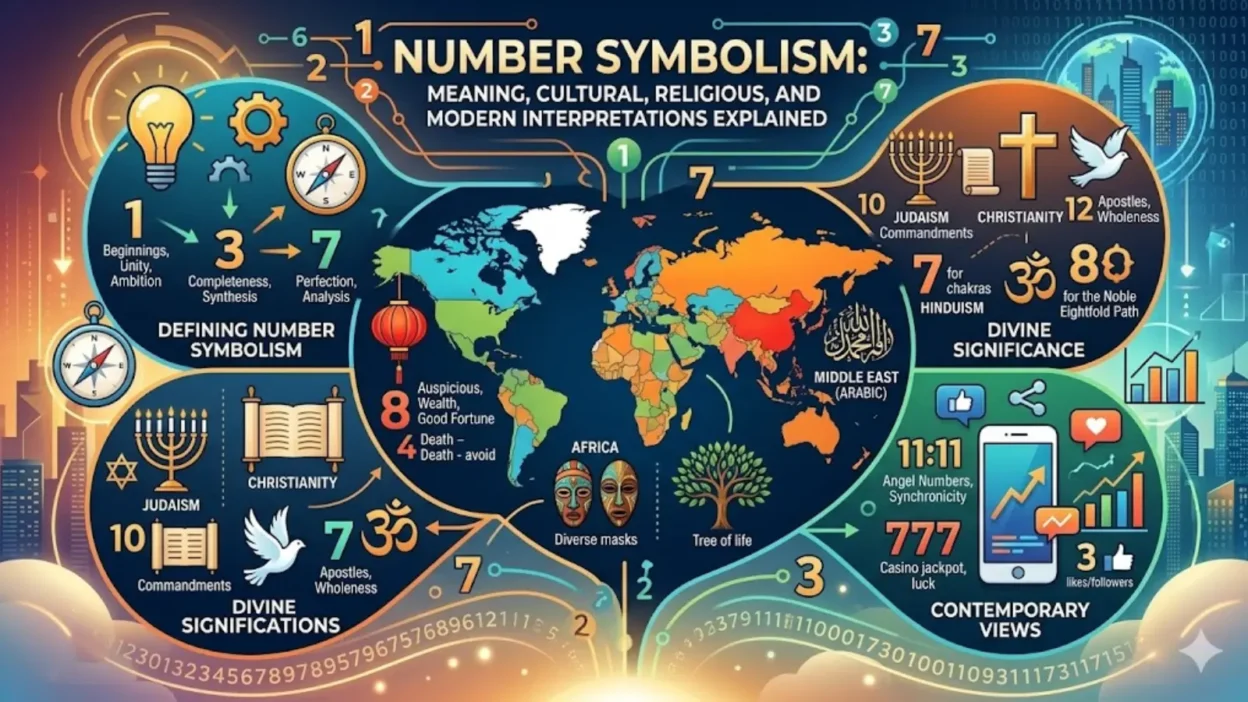
Number symbolism meaning is the idea that numbers can represent ideas, emotions, or beliefs beyond their mathematical function. People don’t just see numbers as tools for counting. They often connect them with luck, identity, spirituality, or personal memory.
In modern U.S. culture, this shows up in everyday choices—like selecting a jersey number, noticing repeating digits on clocks, or avoiding certain numbers in buildings. Some of these meanings come from religion or long-standing tradition. Others are shaped by psychology, storytelling, or newer internet trends.
The important thing to understand is that numbers do not carry fixed meaning on their own. Instead, meaning is created by human interpretation. That is what makes number symbolism meaning both flexible and culturally interesting.
At its core, it reflects how people turn neutral patterns into personal or shared significance.
Quick Answer
Number symbolism meaning refers to the way cultures, religions, and individuals assign ideas or emotions to numbers beyond math. In the U.S., it commonly includes lucky numbers like 7, unlucky associations like 13, and modern interpretations like repeating “angel numbers.”
TL;DR
- Numbers gain meaning through culture, not science
- Religion strongly influences symbolic number systems
- Lucky and unlucky numbers vary across regions
- Modern U.S. use includes tattoos and personal identity
- Internet culture reshapes number interpretation today
- Meaning changes depending on context and belief
Why Humans Attach Meaning to Numbers
The human brain is built to recognize patterns. This ability helps with survival, planning, and decision-making. But it also leads people to connect meaning to random or neutral information, including numbers.
When a number appears during an emotional moment—like a birthday, accident, success, or loss—it can become mentally “linked” to that experience. Over time, repetition strengthens that connection, even if there is no logical relationship.
Early human societies also used numbers for survival tasks like counting crops, tracking seasons, and organizing trade. Because numbers were tied to important life events, they naturally became symbolic over time.
Psychologically, this is called associative thinking. It explains why people still feel that certain numbers are “lucky” or “unlucky” even in modern life.
Ancient Roots of Number Symbolism Across Civilizations
Long before modern interpretations, ancient societies used numbers as part of philosophy, design, and storytelling. In early Egypt, Greece, and Mesopotamia, numbers were often connected to ideas of order and structure.
Greek thinkers explored mathematical relationships as part of understanding harmony in the universe. Numbers were seen as patterns that could explain both physical and abstract reality.
In ancient architecture and sacred spaces, repeated number patterns often appeared in design. These patterns were not random—they reflected cultural ideas about balance, stability, and meaning.
However, these interpretations were not universal. Each civilization developed its own symbolic systems based on language, environment, and belief structures.
Religious Number Symbolism in Major Traditions
Religious traditions have shaped many of the number meanings still recognized today. Numbers often appear in sacred texts, rituals, and symbolic storytelling.
In several traditions, numbers are used to organize meaning rather than act as literal instructions. For example, repeated numbers may emphasize importance or structure rather than mathematical value.
- Some traditions associate certain numbers with creation stories or cycles of time
- Others use numbers to structure prayer, ritual repetition, or teachings
- Certain numbers appear repeatedly in sacred narratives, reinforcing symbolic importance
It is important to note that these meanings exist within specific belief systems. They are meaningful internally but should not be treated as universal rules across all cultures.
Lucky and Unlucky Numbers Around the World
Different cultures interpret numbers in very different ways. What feels lucky in one region may feel neutral or negative in another.
| Number | Region | Common Association | Cultural Reasoning |
|---|---|---|---|
| 7 | Western cultures | Lucky | Religious + historical repetition |
| 13 | United States | Unlucky | Superstition and cultural storytelling |
| 4 | East Asia (some regions) | Unlucky | Sound similarity to word for “death” |
| 8 | China | Lucky | Associated with prosperity and success |
| 9 | Japan (some contexts) | Mixed | Sound-based linguistic association |
These meanings developed independently across cultures. There is no single global system that defines them.
In modern life, these associations can influence architecture, product design, and even travel choices in certain regions.
Numerology vs Cultural Symbolism (Important Distinction)
Numerology is a belief system that assigns deeper meaning to numbers based on patterns, names, or birthdates. It often suggests that numbers can reveal personality traits or life paths.
Cultural symbolism works differently. It comes from shared traditions, language, religion, and history rather than personal calculations.
A simple way to understand the difference:
- Numerology = personal interpretive system based on belief rules
- Cultural symbolism = shared meaning shaped by society over time
While both systems influence modern interpretations, they are not scientifically validated frameworks. They are forms of belief and cultural expression.
Common Number Meanings From 1 to 10
Numbers from 1 to 10 often carry widely recognized symbolic associations. These meanings vary, but certain patterns appear across cultures and traditions.
| Number | Common Symbolism | Broader Interpretation |
|---|---|---|
| 1 | Unity | Independence, beginnings |
| 2 | Balance | Partnership, duality |
| 3 | Structure | Expression, creativity patterns |
| 4 | Stability | Order, foundation |
| 5 | Change | Movement, unpredictability |
| 6 | Responsibility | Family, care, harmony |
| 7 | Reflection | Insight, introspection |
| 8 | Power | Material success, strength |
| 9 | Completion | Closure, transition |
| 10 | Wholeness | Cycle completion, reset |
These interpretations are not fixed rules. They are patterns that developed over time through repeated cultural use and storytelling.
Number Symbolism in Modern U.S. Life
In the United States, number symbolism is often personal rather than strictly traditional. People attach meaning to numbers through life experience rather than shared cultural systems.
Sports are a clear example. Athletes often choose jersey numbers based on personal significance, such as birthdates or milestones. Fans may also associate certain numbers with legendary players, giving them cultural weight.
In everyday life, numbers appear in addresses, phone numbers, and dates. People sometimes choose or avoid numbers based on comfort or belief, even in practical decisions.
Tattoos also play a major role. Numbers are commonly used to represent important life events such as anniversaries, birth years, or memories.
These meanings are usually personal, showing how flexible number symbolism has become in modern culture.
Internet Culture and “Angel Numbers”
A newer layer of number symbolism comes from digital culture. Repeating numbers like 111, 222, or 555 are often called “angel numbers.”
These interpretations suggest that repeated patterns carry personal messages or emotional guidance. This idea has spread widely through social media platforms, where users share personal experiences and interpretations.
Unlike traditional religious or historical systems, this is a modern belief trend. It is shaped by online communities rather than formal doctrine.
People often use these patterns as a way to reflect on emotions, decisions, or life changes. Even when not historically grounded, they serve as personal meaning-making tools.
Misuse, Overgeneralization, and Common Misconceptions
One of the biggest misunderstandings about number symbolism is assuming that meanings are fixed or universal. In reality, meanings change across cultures, time periods, and personal beliefs.
Another issue is blending different systems together. Numerology, religious symbolism, folklore, and internet trends often get mixed, even though they originate from very different contexts.
Some people also assume that numbers “cause” events or outcomes. This is a belief-based interpretation, not a factual relationship. Numbers themselves do not influence real-world events.
Understanding these differences helps keep interpretations grounded and prevents confusion between belief and fact.
How to Interpret Number Symbolism Responsibly
A balanced approach is to view number symbolism as cultural expression rather than objective truth. Context matters more than the number itself.
If a number feels meaningful, that meaning usually comes from personal experience or cultural influence. That emotional meaning can still be valid without being universal.
It also helps to ask where a meaning comes from—religion, tradition, personal memory, or modern internet culture. Each source carries a different level of context and reliability.
The key is not to reject meaning, but to understand how it is formed.
FAQs
1. What is number symbolism meaning in simple terms?
It is the idea that numbers can represent ideas or feelings beyond math. These meanings come from culture, religion, and personal interpretation.
2. Are number meanings the same in every culture?
No, number meanings vary widely across cultures. A number considered lucky in one region may have no meaning or a different meaning elsewhere.
3. Is numerology part of number symbolism?
Numerology is one system of interpreting numbers, but it is based on belief rather than shared cultural tradition. It is different from historical or religious symbolism.
4. Why is the number 13 seen as unlucky in the U.S.?
The belief comes from cultural superstition and storytelling over time. It has been reinforced through tradition, media, and social habits.
5. What are angel numbers?
Angel numbers are repeating number patterns like 111 or 444 that people interpret as meaningful signs. This idea comes from modern spiritual communities.
6. Do numbers actually have power or meaning?
Numbers do not have inherent power. Meaning comes from human interpretation, culture, and personal experience rather than the numbers themselves.
Conclusion
Number symbolism meaning reflects how humans turn simple patterns into meaningful ideas. While some interpretations come from religion or tradition, others are shaped by psychology, culture, and modern digital life.
In everyday understanding, numbers do not carry fixed meanings. People give them meaning based on experience, belief, and context, which is why interpretations vary so widely across cultures and time.
Ultimately, number symbolism meaning is less about what numbers are—and more about how people choose to understand them.