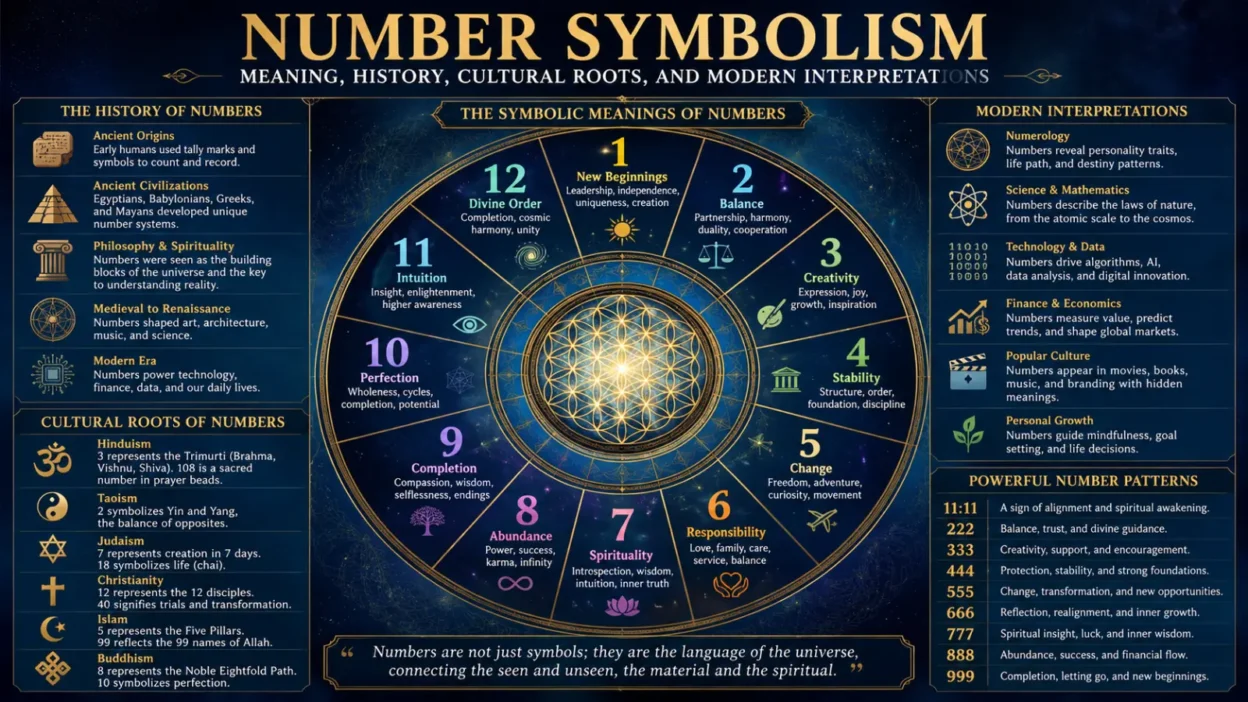
Number symbolism is the idea that numbers carry meaning beyond their mathematical value. People connect numbers to luck, identity, belief, and interpretation based on culture, religion, and personal experience. These meanings are not fixed rules, but shared ideas that evolve across time and place.
In modern U.S. culture, number symbolism shows up in everyday life more than people notice. It appears in birthday dates, sports jersey numbers, repeating number trends online, and even design choices in branding or tattoos. Some meanings come from religion or ancient tradition, while others are shaped by modern media and personal belief.
At its core, Number Symbolism is about how humans turn simple digits into meaningful ideas that help them explain patterns, choices, and experiences.
Quick Answer
Number symbolism refers to the cultural, religious, and personal meanings people assign to numbers beyond their mathematical use. In the United States today, it is often connected to ideas like luck, identity, and modern interpretations such as numerology or repeating number patterns. These meanings are symbolic and vary widely across cultures and beliefs.
TL;DR
- Numbers gain meaning through culture and belief systems
- Religion and history strongly shaped early number symbolism
- Modern meanings often come from internet culture and personal interpretation
- Lucky and unlucky numbers vary across regions
- Psychology explains why humans see patterns in numbers
- Meanings are symbolic, not universal facts
1. What Number Symbolism Means in Everyday Life
Number symbolism appears when people connect meaning to numbers beyond counting. A number might feel lucky, unlucky, meaningful, or even emotional depending on personal experience.
In everyday life, this shows up in small choices. Someone may prefer a certain number for passwords, addresses, or jerseys. Another person might avoid a number tied to a negative memory. These meanings are not universal—they are shaped by culture, habits, and personal stories.
Over time, these personal meanings can become shared cultural ideas, especially when communities repeat them.
2. Why Humans Attach Meaning to Numbers
Humans naturally look for patterns. The brain is built to organize information, even when patterns are random or unclear.
Numbers are especially powerful because they feel structured and predictable. When people repeatedly notice a number in meaningful moments, they may begin to associate it with significance. This does not require logic—just repetition and attention.
This process helps explain why number symbolism feels real to many people even when it is not based on measurable rules. It is a meaning-making system shaped by perception.
3. Ancient Roots of Number Symbolism
Number symbolism has deep historical roots. Early societies used numbers for practical tasks like tracking time, seasons, trade, and astronomy. But over time, those same numbers began to take on symbolic meaning.
In many ancient cultures, numbers were tied to order and balance in the universe. Repeating patterns in nature encouraged the idea that numbers reflected deeper structure in life.
As writing systems and religious traditions developed, numbers were often included in myths, teachings, and rituals. This strengthened their symbolic role, blending practical use with belief.
4. Religious Number Symbolism Across Traditions
Different religions use numbers symbolically, but meanings vary depending on tradition and context.
Some common patterns include:
- Certain numbers representing completeness or divine structure
- Numbers used to organize rituals or teachings
- Repeated numbers appearing in sacred stories or texts
These meanings are internal to each religion and should not be mixed into universal rules. A number that is meaningful in one tradition may have no symbolic role in another.
Religious number symbolism is best understood as structured belief, not mathematical fact.
5. Western Cultural Lucky and Unlucky Numbers
In Western culture, some numbers are widely associated with luck or superstition.
- The number 7 is often seen as lucky in many contexts
- The number 13 is often avoided in buildings, hotels, and elevators in some regions
These beliefs developed over time through a mix of tradition, storytelling, and cultural reinforcement. However, they are not consistent everywhere.
Outside Western contexts, these same numbers may have neutral or even positive meanings. This shows how cultural environment shapes interpretation.
6. Eastern Perspectives on Number Symbolism
In many East Asian cultures, number symbolism is closely connected to language. The sound of a number in spoken language can influence how it is interpreted.
Because of this, some numbers are considered favorable or unfavorable based on pronunciation rather than visual form. This creates symbolic systems that differ significantly from Western traditions.
It also means that the same number can carry very different emotional associations depending on cultural and linguistic background.
7. Numerology Systems and Modern Interpretations
Numerology is a belief system that assigns meaning to numbers based on structured interpretations, such as birth dates or name patterns. It is often used for personal reflection rather than scientific analysis.
Common Numerology Concepts
| System Element | What It Represents | How People Use It |
|---|---|---|
| Life Path Number | Core personality themes | Self-understanding |
| Repeating Numbers | Symbolic messages | Personal interpretation |
| Core Numbers | Traits or tendencies | Reflection tools |
| Master Numbers | Intense symbolic focus | Spiritual meaning |
These systems are interpretive frameworks. They are based on belief and symbolic logic, not measurable laws. People use them for guidance, curiosity, or personal insight.
8. Angel Numbers and Internet-Era Symbolism
Modern digital culture has expanded number symbolism through “angel numbers.” These are repeating number patterns like 111, 222, or 777.
Many people interpret these as meaningful signals. This idea is especially popular in online communities and social media spaces.
However, this interpretation is modern and not part of traditional religious systems in a consistent form. It reflects how digital culture creates new symbolic languages that spread quickly and evolve over time.
9. Number Symbolism in Tattoos, Branding, and Pop Culture
Numbers are widely used in modern U.S. culture as symbols of identity and expression.
They appear in:
- Tattoos representing personal milestones or memories
- Sports jerseys tied to identity and performance
- Brand names and product design choices
- Music lyrics and fashion aesthetics
In these cases, the meaning is usually personal rather than universal. A number may represent a date, a meaningful moment, or simply an aesthetic choice.
10. When Number Meanings Become Misunderstood
Number symbolism can become confusing when meanings are treated as universal truths.
Sometimes, people combine beliefs from different cultures without context. This can lead to oversimplified or incorrect interpretations.
A number that has meaning in one tradition may be assumed to have the same meaning everywhere, which is not accurate. Understanding cultural and historical context helps prevent this kind of misunderstanding.
11. How Number Symbolism Differs from Science
Mathematics and symbolism are very different systems.
Mathematics uses fixed rules and measurable relationships. Symbolic meaning is based on interpretation and belief.
Psychology helps explain why people see meaning in numbers. The human brain naturally connects events and patterns, even when those connections are coincidental. This does not reduce the importance of symbolism, but it explains its origin in perception rather than physical law.
12. Number Symbolism in Modern U.S. Culture
In the United States, number symbolism appears in many everyday settings.
People may choose numbers for:
- Personal identity or favorite digits
- Cultural or religious meaning
- Online spiritual trends
- Aesthetic or design preferences
Social media has also influenced how people interpret numbers, especially through viral ideas and repeating number patterns. These meanings are flexible and often change quickly with trends.
13. Do Numbers Really Have Meaning? A Balanced View
Numbers themselves do not contain meaning in a fixed way. Instead, meaning is created by people through culture, belief, and experience.
This makes number symbolism a shared human system rather than a universal truth. Its importance lies in how people use it to express ideas, make decisions, or find personal significance in everyday life.
FAQs
1. What is number symbolism in simple terms?
It is the idea that numbers can represent meanings beyond math. These meanings come from culture, religion, or personal belief.
2. Are numbers naturally lucky or unlucky?
No, luck associated with numbers comes from cultural traditions and beliefs. Different regions interpret the same numbers differently.
3. Why do people see repeating numbers as meaningful?
People naturally notice patterns, especially in repeated experiences. This can lead to personal interpretation of significance.
4. Is numerology a science?
No, numerology is a belief-based system used for reflection and interpretation. It is not supported by scientific measurement.
5. Why is 13 considered unlucky in some places?
In some Western traditions, 13 became associated with superstition over time. However, this belief is not global.
6. Do all cultures interpret numbers the same way?
No, number meanings vary widely across cultures, languages, and traditions. A number may be positive in one culture and neutral in another.
7. Can numbers have personal meaning even if not cultural?
Yes, many people assign personal meaning to numbers based on life events, memories, or emotional connections.
Conclusion
Number symbolism reflects how humans assign meaning to numbers through culture, belief, and personal experience. These meanings differ widely across history, religion, and modern life.
In the end, Number Symbolism is not about the numbers themselves but about how people use them to interpret patterns, identity, and meaning in the world around them.