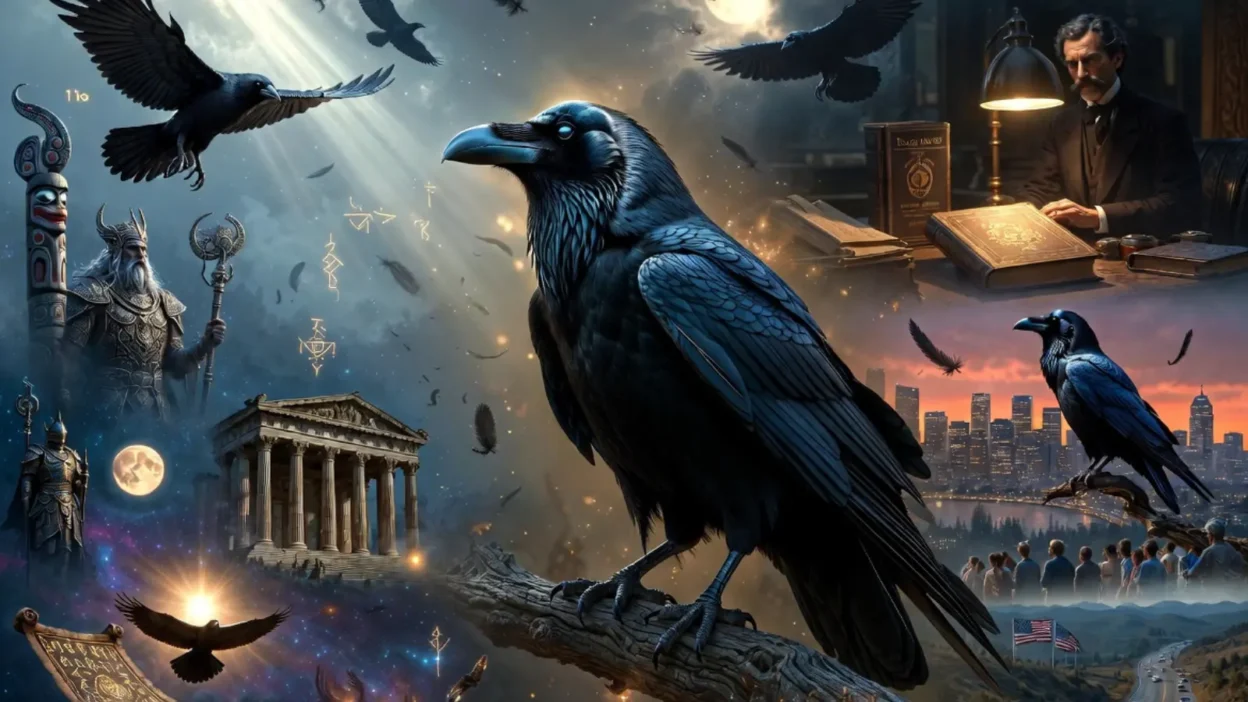
Ravens are large, intelligent black birds that many Americans notice during hikes in the mountains, drives through rural areas, or even in city outskirts where they have adapted to human environments. With their glossy black feathers showing hints of purple and blue in sunlight, thick beaks, and distinctive croaking calls, they stand out from other birds. In the United States, raven symbolism meaning carries weight because these birds seem to observe the world with unusual awareness.
People care about raven symbolism because it feels personal. The birds thrive in tough conditions, solve problems, and appear at moments of transition like dawn or dusk. This creates a symbol that speaks to change, hidden knowledge, and resilience. In modern American culture, ravens show up in everything from sports team logos to home decor and personal tattoos, helping people express complex feelings about life’s darker and brighter sides.
Quick Answer
In the United States today, the raven most commonly symbolizes intelligence, mystery, and transformation. These meanings come from the bird’s problem-solving skills and its role in stories as a boundary-crosser between worlds. Historically, it also links to death and messages, creating a complex symbol that Americans interpret in both dark and hopeful ways.
TL;DR
- Ravens stand for cleverness rooted in real behavior.
- They often represent change and adaptation.
- Many cultures link them to death due to scavenging.
- In US literature, they evoke mourning and loss.
- Tattoos use them for personal strength and insight.
- Symbolism varies and has evolved across time and place.
What Ravens Look Like and How We Encounter Them
Ravens belong to the corvid family and rank among the largest songbirds in North America. Adults measure about two feet long with a wingspan up to four feet. Their feathers have a metallic sheen, especially visible when they catch light at certain angles. The throat feathers look shaggy, and their tail forms a clear wedge shape during flight, which helps distinguish them from crows.
In the United States, you will most often find ravens in the western states, along the Appalachian Mountains, and in parts of New England. They prefer open country, cliffs, and forests but have learned to live near people, scavenging at campsites or landfills. Unlike crows, which gather in noisy groups, ravens usually appear in pairs or small family units, giving them a more solitary and watchful presence.
These physical and behavioral traits matter for symbolism. The black color connects to night and the unknown. Their scavenging habits put them at scenes of death or aftermath. Their intelligence shows in how they drop nuts on roads for cars to crack or remember specific human faces for years. These observable facts formed the foundation for human stories long before written records. Americans today still encounter ravens in national parks like Yellowstone or Grand Canyon, where rangers often share stories about their clever antics, making the bird feel like a living part of the landscape.
Why Ravens Became Symbols of Intelligence and Cleverness
The core of positive raven symbolism comes from the bird’s documented mental abilities. Researchers have watched ravens make and use tools, plan several steps ahead, and even trade items with other animals. They can solve multi-stage puzzles that stump many mammals. This is not recent discovery. People in earlier societies noticed ravens watching them, mimicking sounds, and finding creative ways to access food.
This real behavior explains why many traditions cast ravens as wise figures. When food is scarce, their ability to adapt and innovate stands out. Symbolism developed here because humans value survival skills. In a practical sense, seeing a raven succeed where others failed suggested a deeper understanding of the world.
In the US context, this cleverness resonates with ideas of self-reliance and ingenuity. American stories often celebrate those who think outside the box. The raven fits this cultural preference for resourcefulness, whether in frontier tales or modern tech culture. It is not mystical; it stems from watching the bird thrive in challenging environments like deserts or snowy mountains.
The Raven as Messenger and Trickster in Global Myths
Different cultures developed stories about ravens carrying information between realms. In Norse tradition, the god Odin kept two ravens named Huginn and Muninn. Each day they flew across the world and returned to tell him what they saw. This reinforced the idea of ravens as eyes and ears of higher powers, linking them to knowledge and foresight.
Greek myths connected ravens to Apollo, the god of prophecy. One story tells how a raven’s report angered Apollo, leading to the bird’s black color as punishment. These tales show ravens as imperfect messengers who sometimes mix truth with trouble. The trickster element appears widely. A raven might steal fire, trick other animals, or create chaos that ultimately leads to new order.
These myths developed because ravens appear intelligent enough to seem almost human in their decisions. They cross boundaries—between sky and ground, life and death scenes—making them natural symbols for transitions. While these stories come from specific traditions, they share the theme of clever disruption. This global background gives depth to American uses without claiming one single meaning.
Raven in Native American Traditions
In the Pacific Northwest, particularly among Haida, Tlingit, and Tsimshian peoples, Raven holds a central place as both creator and trickster. Stories describe Raven stealing the sun, moon, and stars from a powerful figure to bring light to the world. He changes shapes, plays jokes, and teaches humans important lessons through his mistakes as much as his successes.
These traditions view Raven as a transformer who shapes reality. The symbolism emphasizes curiosity, balance, and the consequences of actions. Raven stories often carry moral teachings about respect for nature and community. In the United States, these narratives remain living parts of cultural heritage for Native communities in Alaska, Washington, British Columbia, and surrounding areas.
It is important to note that Native American raven meanings are not uniform. Tribes in other regions may have different or less prominent associations. In modern America, these stories influence art, literature, and environmental education. Non-Native Americans who appreciate raven imagery should recognize the specific cultural origins rather than treating them as generic spiritual symbols. This respect keeps the symbolism grounded and avoids reducing sacred traditions to aesthetics.
Associations with Death, Mourning, and Omens
Ravens frequently appear at sites of death because they eat carrion. In historical battlefields across Europe and early America, their presence linked them to loss and the afterlife. Some Celtic and Germanic folklore portrayed them as spirits of the dead or companions of battle goddesses. In parts of Scandinavia, seeing ravens before a journey carried mixed signals.
This association makes sense from a practical viewpoint. Ravens clean up remains, which some cultures interpreted as helping souls move on. Others saw it as a warning. In American folklore, especially in rural areas, an unusual number of ravens might spark old superstitions about coming trouble. However, these remain beliefs, not proven predictions.
The death symbolism has both dark and renewing sides. By consuming the dead, ravens participate in nature’s cycle of decay and growth. In the US today, this appears in gothic fashion, Halloween decorations, and stories about mourning. Many Americans now interpret it as acknowledgment of life’s difficult parts rather than pure negativity. The key is context—what the raven means depends on the situation and the person’s own experiences.
Christian and European Religious Views
The Bible includes several references to ravens that highlight God’s provision. In the story of Elijah, ravens bring food to the prophet while he hides in the wilderness. This presents them as instruments of care during hardship. Other passages mention ravens as part of God’s creation, noting their intelligence.
Medieval European Christianity often took a different tone. Their black color and scavenging led some to associate them with sin or the devil, especially in contrast to white doves. This created a mixed legacy in Western thought. Ravens could represent divine care or serve as reminders of mortality.
These varying religious views developed as societies changed their relationship with nature. When people lived closer to wilderness, ravens symbolized practical lessons. As cities grew, they became more associated with the unknown or supernatural. In contemporary American Christianity, most people do not attach strong religious meaning to ravens, but the biblical feeding story still appears in discussions of trust and provision.
Edgar Allan Poe and the Raven in American Culture
No single work shaped US raven symbolism more than Edgar Allan Poe’s 1845 poem “The Raven.” In it, a grieving man is visited by a raven that perches above his chamber door and repeatedly says “Nevermore.” The bird becomes a symbol of unending sorrow, lost love, and mental descent into despair.
Poe drew from existing European folklore and his own experiences with loss. The poem’s rhythm and dark atmosphere made the raven a perfect embodiment of melancholy. It quickly became a cornerstone of American literature, taught in schools and referenced in countless adaptations. Baltimore named its NFL team the Ravens partly because of the poem and the bird’s clever reputation.
This literary moment shifted raven symbolism toward psychological depth in the United States. It moved beyond simple omens into explorations of grief and the limits of reason. Today, the poem still influences how Americans picture ravens—elegant, haunting, and tied to emotional complexity.
How Meanings Have Shifted Over Time
Early human encounters with ravens focused on survival observations: their scavenging tied them to death, their cleverness to wisdom. Ancient stories emphasized their role as messengers and creators. During the Middle Ages, religious interpretations added layers of moral judgment based on color and habits.
The 19th century brought romantic interest in the mysterious, which Poe captured perfectly for American audiences. The 20th century saw ravens appear in fantasy literature and counterculture as symbols of rebellion and insight. In recent years, scientific studies highlighting their intelligence have boosted positive interpretations focused on adaptability and problem-solving.
In the United States, this evolution reflects broader cultural shifts. Early settlers carried European superstitions. Later immigration and awareness of Native traditions added complexity. Today’s environmental movement celebrates ravens as indicators of healthy ecosystems. The symbol has grown more personal, allowing individuals to choose which aspects resonate with their lives.
Ravens in Contemporary American Life
| Context | Common Meaning | Example in US Use | Emotional Appeal |
|---|---|---|---|
| Tattoos | Transformation, inner wisdom | Memorial pieces after loss or change | Strength through difficulty |
| Sports & Branding | Resilience, sharp intelligence | Baltimore Ravens NFL team, various logos | Competitive edge and cleverness |
| Home Decor | Mystery, gothic elegance | Halloween wreaths, dark academia style | Atmospheric depth |
| Literature & Media | The unknown, psychological insight | Horror films, fantasy novels, poetry | Emotional exploration |
| Environmental | Adaptability, wilderness respect | Conservation campaigns, nature photography | Connection to natural world |
| Fashion | Edgy individuality | Jewelry, clothing prints | Non-conformist identity |
This table illustrates how raven symbolism adapts to different areas of American daily life while keeping core themes of intelligence and transition.
Ravens appear in video games, album covers, and social media aesthetics as symbols of thoughtful rebellion. Their image fits well with current interests in mental health, personal growth, and appreciation for nature’s tougher elements.
Raven Tattoos and Personal Symbolism
Raven tattoos have grown popular in the United States over the past two decades. Many people choose them to represent major life changes, such as overcoming grief, starting new careers, or embracing their intuitive side. The design often includes elements like keys, moons, or skulls to add layers of meaning about unlocking potential or accepting endings.
Tattoo artists report that clients frequently connect ravens to their own cleverness in difficult situations. A raven on the forearm might symbolize visible strength, while one near the heart represents private emotional wisdom. These tattoos rarely claim ancient religious power. Instead, they serve as personal reminders grounded in the bird’s real characteristics and cultural stories.
In American tattoo culture, ravens appeal across age groups and backgrounds. They offer a balance between dark aesthetic and hopeful message. This makes them versatile for both subtle small designs and large detailed pieces.
Distinguishing Ravens from Crows in Symbolism
Many Americans confuse ravens and crows, but the symbolism carries important differences. Ravens tend to represent larger transformations, solitary wisdom, and mythic depth. Crows often symbolize community messages, everyday trickery, and social intelligence. Physically, ravens are larger with deeper voices and wedge tails, while crows have fan-shaped tails and gather in bigger groups.
This distinction matters in storytelling. A lone raven in a poem feels more ominous or profound than a group of crows. In US folklore, crows might appear in lighter superstitions, while ravens carry heavier weight from literature and Northwest traditions. Recognizing these differences prevents oversimplification and helps people choose the right symbol for their needs.
FAQs
What does a raven symbolize most often in the US? Today it stands for intelligence, mystery, and personal change. This draws from both biology and stories but appears most in individual contexts like art or reflection rather than formal religion.
Are ravens always negative symbols? No. While linked to death in some folklore, they also represent renewal, clever problem-solving, and guidance. Context determines the reading more than any fixed rule.
What is the difference between raven and crow symbolism? Ravens often lean toward deeper wisdom and transformation. Crows connect more with community and everyday messages. The birds differ physically too, affecting how stories portray them.
Why do people get raven tattoos? Many choose them to symbolize resilience through change or honoring insight gained from hardship. It serves as a reminder of inner strength without needing one universal story.
How does Native American raven symbolism fit in modern America? It emphasizes creation, trickster lessons, and respect for nature in specific tribal traditions. Non-Native people should approach these stories with care to avoid oversimplification or appropriation.
Is seeing a raven an omen? In folklore, some viewed it that way, but this is belief rather than fact. In daily US life, it is more often a sign of a healthy ecosystem or a moment to pause and observe.
Can raven symbolism help with personal growth? Yes, when viewed as a prompt for adaptability and honest self-reflection. Many use the image to encourage facing unknowns with curiosity instead of fear.
Conclusion
Ravens hold meaning because they mirror human experiences of change, loss, and discovery. Their symbolism in the United States blends old stories with new uses, always grounded in the bird’s actual presence in our landscapes. The raven invites us to think twice about what we see and what it might teach, offering a symbol flexible enough for modern American life while rooted in centuries of observation and storytelling.