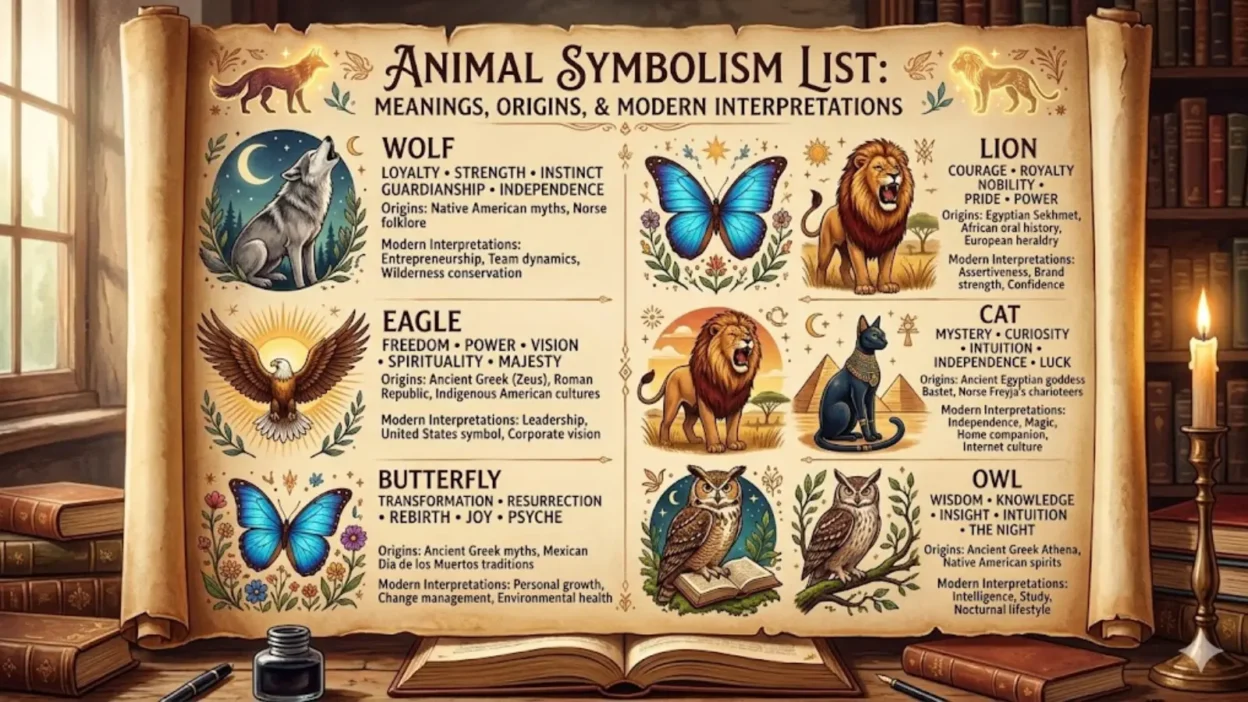
Animals appear everywhere in human culture. They show up in stories, religion, sports teams, national symbols, tattoos, artwork, and everyday language. Because of that, many people search for an animal symbolism list to better understand what different animals are commonly believed to represent.
Animal symbolism is not one fixed system. Meanings change across cultures, time periods, and traditions. A wolf may symbolize loyalty in one context and danger in another. An owl may represent wisdom in some traditions while carrying very different associations elsewhere.
In the United States today, animal symbolism is often influenced by a blend of historical traditions, folklore, religion, popular culture, and modern personal interpretation. Understanding where these meanings come from helps separate long-standing associations from newer trends.
Quick Answer
An animal symbolism list generally connects specific animals with ideas, traits, or values that people commonly associate with them. These meanings often developed from an animal’s appearance, behavior, cultural stories, religious traditions, folklore, and modern use in art, branding, sports, and personal identity.
TL;DR
- Animals often symbolize human traits.
- Meanings vary between cultures and eras.
- Folklore strongly shaped many interpretations.
- Modern symbolism differs from ancient traditions.
- Tattoos and branding influence current meanings.
- No animal has one universal meaning.
Why Animals Became Symbols in Human Culture
Long before written language, people observed animals closely. Animals could provide food, pose dangers, or help communities survive. Because of this relationship, people began assigning symbolic meanings to them.
Several factors influenced animal symbolism:
- Visible behavior
- Physical appearance
- Hunting and survival experiences
- Religious stories
- Mythology and folklore
- Cultural values
For example, eagles fly high above the landscape and have excellent eyesight. Those traits helped create associations with vision, power, and leadership.
Similarly, turtles move slowly and can live for many decades. These observable traits contributed to symbolism related to patience, endurance, and longevity.
Animal symbolism often reflects what people noticed about animals rather than what science later discovered about them.
Animal Symbolism List: Common Meanings at a Glance
The table below summarizes some of the most recognized symbolic associations in modern American culture.
| Animal | Common Symbolic Meaning | Modern U.S. Association |
|---|---|---|
| Eagle | Freedom, strength, vision | National identity |
| Owl | Wisdom, knowledge | Education and learning |
| Wolf | Loyalty, independence | Personal identity |
| Lion | Courage, leadership | Confidence and authority |
| Bear | Strength, protection | Resilience and power |
| Fox | Intelligence, adaptability | Cleverness |
| Deer | Gentleness, peace | Grace and kindness |
| Butterfly | Transformation | Personal growth |
| Turtle | Patience, longevity | Stability and endurance |
| Raven | Mystery, intelligence | Mythology and storytelling |
These meanings are broad summaries rather than fixed definitions.
Eagle Symbolism: Freedom, Vision, and National Identity
The eagle holds a unique place in American symbolism.
The choice of the bald eagle as a national emblem helped strengthen its association with freedom, independence, and strength. Because eagles soar at great heights and possess remarkable eyesight, they also became symbols of perspective and vision.
Today, Americans often encounter eagle symbolism through:
- Government seals
- Military imagery
- Sports branding
- Patriotic artwork
- National celebrations
It is important to note that some Indigenous traditions have their own distinct meanings for eagles. Those meanings may differ from modern patriotic interpretations and often carry spiritual significance within living cultural traditions.
Owl Symbolism: Wisdom, Learning, and Observation
Owls are among the most recognized symbolic animals in modern culture.
Their connection to wisdom developed partly because owls appear alert and observant. Their large eyes and nighttime activity created an image of a creature that sees what others miss.
Modern uses include:
- School mascots
- Educational logos
- Libraries
- Academic programs
- Children’s learning materials
However, owl symbolism is not consistent worldwide. Some traditions associate owls with mystery, warnings, or the unknown. These differing interpretations show how symbolism often reflects cultural context rather than universal meaning.
Wolf Symbolism: Independence, Loyalty, and Community
The wolf is one of the most misunderstood animals in symbolic traditions.
Historically, many European stories portrayed wolves as threats. Fairy tales and folklore often presented them as dangerous predators.
More recent interpretations frequently emphasize:
- Loyalty
- Family bonds
- Independence
- Leadership
- Survival
Part of this shift came from growing public interest in wolf behavior and conservation. Modern audiences often focus on the social structure of wolf packs and cooperative behavior.
In tattoos and personal branding, wolves commonly symbolize self-reliance combined with strong connections to family or community.
Lion Symbolism: Courage, Leadership, and Authority
Lions have long been associated with leadership and courage.
One reason is simple visibility. Lions are large, powerful predators whose appearance naturally inspired admiration and respect.
Throughout history, lions appeared in:
- Royal emblems
- Family crests
- Religious art
- Government symbols
- Military insignia
Today, lion imagery remains common in sports, business branding, and motivational imagery.
The lion’s symbolic role often says more about human ideas of leadership than about the actual behavior of lions in nature.
Bear Symbolism: Strength, Protection, and Resilience
Bears symbolize physical power in many traditions.
Because bears can survive harsh environments and protect their young aggressively, they often became symbols of resilience and protection.
In the United States, bear symbolism appears in several forms:
- Outdoor culture
- State symbols
- Conservation imagery
- Athletic mascots
- Wilderness branding
Different cultures have developed different meanings. Some traditions emphasize healing, others protection, and others survival.
Modern American interpretations often focus on inner strength and perseverance through difficult situations.
Fox Symbolism: Intelligence and Adaptability
Fox symbolism usually centers on intelligence and flexibility.
The fox appears frequently in folklore as a clever character who survives through quick thinking rather than physical strength.
Common modern meanings include:
- Adaptability
- Strategy
- Resourcefulness
- Creativity
- Problem-solving
Because foxes successfully live in both rural and urban environments, they have also become symbols of adjustment and resilience in changing circumstances.
Some folklore traditions portray foxes positively, while others present them as deceptive. Both interpretations continue to influence modern symbolism.
Deer, Turtle, and Butterfly Symbolism
Several animals are commonly associated with gentler qualities.
Deer
Deer symbolism often includes:
- Grace
- Kindness
- Peace
- Sensitivity
Their cautious behavior and elegant movement likely contributed to these associations.
Turtle
Turtles frequently symbolize:
- Patience
- Endurance
- Longevity
- Stability
Their slow movement and long lifespan played a major role in shaping these meanings.
Butterfly
Butterflies are strongly associated with:
- Transformation
- Personal growth
- Change
- Renewal
Unlike many symbolic meanings that developed over centuries, butterfly symbolism is reinforced by a visible biological process. The transformation from caterpillar to butterfly provides an easily understood metaphor for change and development.
Raven Symbolism: Mystery, Intelligence, and Storytelling
Ravens hold a complicated symbolic role.
Because they are highly intelligent birds with dark feathers and distinctive vocalizations, they often appear in myths, legends, and literature.
Depending on context, ravens may symbolize:
- Intelligence
- Mystery
- Transformation
- Knowledge
- Messages
- Death-related symbolism
It is important to separate folklore from fact. Ravens are not inherently connected to supernatural events. Many of their symbolic associations developed through storytelling traditions rather than observed behavior alone.
Modern audiences often encounter raven symbolism through literature, fantasy media, and artistic design.
Animal Symbolism in Tattoos, Branding, and Personal Identity
Animal symbolism remains highly visible in modern American life.
Many people choose animal imagery because it reflects traits they admire or hope to express.
Common examples include:
| Symbolic Use | Popular Animals | Typical Meaning |
|---|---|---|
| Tattoos | Wolf, lion, eagle | Identity and values |
| Sports mascots | Eagle, bear, tiger | Strength and competition |
| Business logos | Fox, owl, lion | Intelligence and leadership |
| Home décor | Deer, butterfly | Peace and growth |
| Clothing designs | Wolf, raven | Individuality |
These uses often simplify older symbolic traditions. A modern logo may emphasize one meaning while ignoring other historical interpretations.
That simplification is not necessarily wrong, but it helps explain why symbolism can vary widely between contexts.
Why Animal Meanings Change Over Time
Animal symbolism is constantly evolving.
Several forces influence change:
- Scientific knowledge
- Cultural shifts
- Media representation
- Religious interpretation
- Social values
- Internet culture
For example, wolves were often feared in older European folklore. Modern conservation efforts and wildlife documentaries have contributed to more positive perceptions.
Similarly, owls became strongly connected with education through modern institutions, even though historical meanings were often more varied.
New generations regularly reinterpret animal symbols to reflect current values and concerns.
Common Misunderstandings About Animal Symbolism
One of the biggest mistakes is assuming every animal has a single universal meaning.
In reality:
- Meanings differ between cultures.
- Historical meanings can conflict.
- Religious interpretations vary.
- Modern uses often simplify older traditions.
- Personal interpretations may differ from traditional ones.
Another misconception is that symbolism accurately reflects animal behavior.
Sometimes it does. Often it does not.
The lion, for example, symbolizes leadership largely because humans perceive it that way, not because lions consistently behave as human leaders do.
Understanding symbolism requires looking at cultural interpretation rather than treating symbolic meanings as scientific facts.
How to Use an Animal Symbolism List Thoughtfully
Animal symbolism works best as a tool for understanding cultural ideas rather than predicting events or revealing universal truths.
When exploring symbolic meanings:
- Consider cultural context.
- Separate folklore from history.
- Recognize religious differences.
- Understand that meanings evolve.
- Avoid assuming one interpretation fits everyone.
A symbol can be meaningful without being universally accepted.
That flexibility is one reason animal symbolism remains popular in modern life.
FAQs
What is the most common animal symbol?
There is no single answer, but the eagle, lion, owl, wolf, and butterfly are among the most widely recognized symbolic animals. Their meanings have become deeply embedded in education, media, national identity, and popular culture.
Do animal symbols mean the same thing in every culture?
No. Animal symbolism varies significantly across cultures, religions, and historical periods. An animal viewed positively in one tradition may carry a very different meaning elsewhere.
What does a wolf symbolize in modern culture?
Modern interpretations often connect wolves with loyalty, resilience, independence, and strong family bonds. Earlier folklore in some regions focused more heavily on danger and fear.
Why are butterflies associated with transformation?
The butterfly’s life cycle provides a visible example of dramatic change. Because people can observe this transformation directly, it became a natural symbol for personal growth and new beginnings.
Are animal tattoo meanings universal?
No. Tattoo meanings are often personal and may differ from traditional interpretations. Two people may choose the same animal for entirely different reasons.
Is animal symbolism based on science?
Not usually. Symbolism is primarily shaped by culture, storytelling, religion, folklore, and human observation. Scientific understanding may influence modern interpretations, but symbolic meanings are cultural rather than scientific facts.
Can one animal have both positive and negative meanings?
Yes. Many animals carry multiple symbolic interpretations. Ravens, wolves, foxes, and owls are good examples of animals whose meanings vary depending on cultural context and historical tradition.
Conclusion
Animals have served as symbols for thousands of years because people naturally connect visible traits with human ideas, values, and experiences. Strength, wisdom, courage, adaptability, patience, and transformation are just some of the qualities people have linked to different creatures over time.
A thoughtful animal symbolism list reveals more than what people believe about animals. It also shows what different cultures admire, fear, respect, or hope to become. Those meanings continue to evolve as societies change and new interpretations emerge.
The most useful approach is to view animal symbolism as a cultural language—one shaped by history, tradition, personal meaning, and the world people live in today.