Dreams have fascinated people for thousands of years. Across cultures and generations, people have looked for meaning in the animals that appear during sleep. A soaring eagle, a stalking wolf, a gentle deer, or even a common household cat can leave a lasting impression long after waking up.
Animal symbolism in dreams is often connected to emotions, instincts, fears, hopes, memories, and cultural beliefs. While no single interpretation applies to everyone, many people view dream animals as symbolic representations of aspects of themselves or situations they are experiencing in daily life.
In modern American culture, dream interpretation remains popular even though scientific research does not support fixed symbolic meanings for specific animals. Instead, dream symbols are often understood as personal, cultural, psychological, spiritual, or folkloric interpretations rather than proven facts.
Understanding animal symbolism in dreams requires looking at history, culture, psychology, religion, folklore, and modern life together. Each perspective offers a different way to understand why certain animals appear and what people believe they might represent.
Quick Answer
Animal symbolism in dreams most commonly represents instincts, emotions, personality traits, challenges, or life circumstances. The meaning often depends on the animal itself, the dream context, personal experiences, and cultural influences rather than any universal interpretation.
TL;DR
- Dream animals often symbolize emotions or instincts.
- Meanings vary across cultures and traditions.
- Psychology focuses on personal associations.
- Folklore often adds symbolic interpretations.
- No animal meaning is universally accepted.
- Context matters more than the animal alone.
Why Animals Appear So Frequently in Dreams
Animals have been part of human life for as long as humans have existed. People hunted them, feared them, domesticated them, admired them, and built stories around them. Because animals are deeply embedded in human culture, they naturally appear in dreams.
Dream researchers often note that dreams frequently draw from memories, emotions, recent experiences, and symbolic thinking. Animals can become powerful dream images because people already associate them with recognizable traits.
For example:
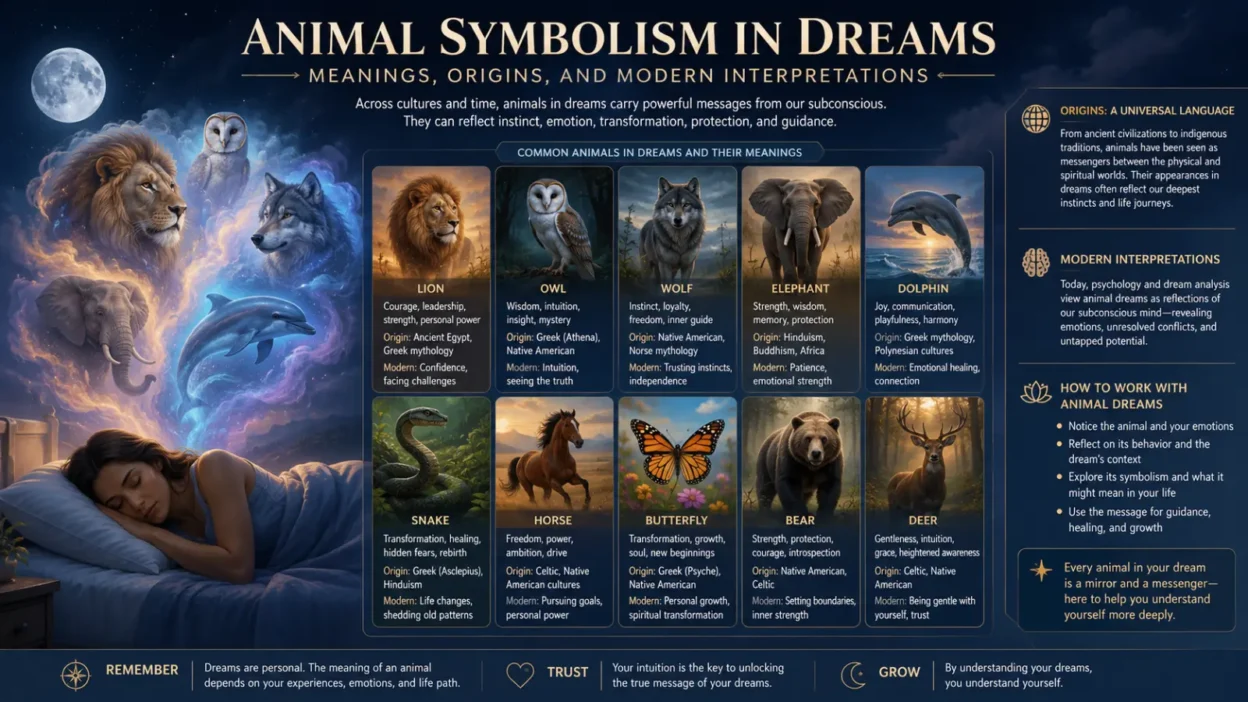
- Lions are often associated with courage and authority.
- Foxes are frequently linked with cleverness.
- Owls are commonly connected with wisdom.
- Deer are often viewed as gentle and alert.
- Wolves are frequently associated with independence or survival.
These associations do not mean the dream has a fixed meaning. Instead, they help explain why the mind may choose a particular animal as a symbolic image.
A person who fears dogs may experience a dog dream differently from someone who loves dogs. Personal experience often shapes interpretation as much as cultural symbolism.
How Animal Dream Symbolism Developed Over Time
Dream interpretation is not a modern invention. Ancient societies frequently recorded dreams and assigned symbolic meaning to animals that appeared within them.
In many early civilizations, dreams were sometimes viewed as messages from divine forces, ancestors, spirits, or the future. Animals appearing in dreams could be interpreted as warnings, guidance, blessings, or reflections of a person’s character.
Over time, dream symbolism evolved through several influences:
| Influence | Role in Dream Symbolism | Example |
|---|---|---|
| Folklore | Traditional stories and beliefs | Fox as a trickster |
| Religion | Spiritual interpretations | Dove representing peace |
| Mythology | Symbolic narratives | Eagle linked with power |
| Psychology | Personal unconscious meanings | Snake representing anxiety or change |
| Popular Culture | Modern symbolic associations | Wolf representing independence |
As societies changed, interpretations changed as well. Many meanings people encounter online today combine elements from folklore, psychology, spirituality, and modern self-help traditions.
The Psychological View of Animal Dreams
Modern psychology offers one of the most influential approaches to dream interpretation.
Rather than assuming dream animals carry universal messages, many psychologists suggest that animals often reflect emotions, instincts, personality traits, memories, or unconscious concerns.
For example:
- A chased animal may reflect feelings of vulnerability.
- A protective animal may represent security.
- A wild animal might symbolize strong emotions.
- An injured animal could reflect emotional stress.
- A friendly animal may represent comfort or trust.
Some psychological theories propose that dream animals represent parts of the dreamer’s personality. Others suggest they simply emerge from emotional processing during sleep.
Importantly, psychological approaches generally avoid claiming that one animal always means the same thing for every person.
Instead, context matters:
- What was the animal doing?
- How did the dreamer feel?
- Was the animal familiar?
- Was it threatening or helpful?
- Does the dreamer have personal experiences connected to that animal?
These questions often reveal more than generic dream dictionaries.
Common Animal Symbols and Their Popular Dream Meanings
Many animals appear repeatedly in dream discussions because they already carry strong cultural associations.
Wolves
Wolves are commonly associated with:
- Independence
- Survival
- Loyalty
- Leadership
- Isolation
A wolf dream may be interpreted as reflecting personal strength or a desire for freedom. In some traditions, it may symbolize caution regarding trust or group relationships.
Owls
Owls often symbolize:
- Wisdom
- Observation
- Hidden knowledge
- Awareness
Because owls are active at night, they are frequently linked with insight and seeing what others miss.
Snakes
Snakes are among the most interpreted dream animals.
Possible symbolic associations include:
- Transformation
- Fear
- Healing
- Hidden concerns
- Personal growth
Interpretations vary widely because snake symbolism differs significantly between cultures and religions.
Deer
Deer are commonly connected with:
- Gentleness
- Sensitivity
- Grace
- Awareness
Dreams involving deer are often interpreted as reflecting vulnerability, peace, or emotional balance.
Horses
Horse symbolism frequently includes:
- Freedom
- Energy
- Ambition
- Movement
- Determination
Many people interpret horse dreams as signs of personal drive or a desire for greater independence.
Animal Symbolism in Religious and Spiritual Traditions
Many dream interpretations draw influence from religious and spiritual traditions. However, meanings differ considerably across belief systems.
Some traditions view dream animals as symbolic messengers. Others see them as reflections of inner spiritual conditions.
Examples include:
- Doves associated with peace and purity.
- Eagles associated with vision and strength.
- Lambs associated with innocence.
- Fish associated with faith or abundance.
- Serpents associated with both wisdom and danger depending on context.
It is important to remember that these meanings belong to specific traditions and should not be treated as universal truths.
Modern spiritual dream interpretations often blend religious symbolism with personal reflection. As a result, two people may interpret the same dream animal in very different ways.
Folklore, Mythology, and Dream Animals
Folklore has contributed heavily to modern dream symbolism.
Traditional stories often gave animals distinct personalities and symbolic roles. These stories influenced how later generations interpreted dream encounters.
Common folkloric patterns include:
- Foxes as clever tricksters.
- Ravens as messengers.
- Bears as protectors or powerful forces.
- Rabbits as symbols of luck or fertility.
- Turtles as symbols of patience and endurance.
Many dream meanings found online today can be traced back to these older storytelling traditions.
However, folklore is not evidence that a dream has a specific meaning. Instead, it provides cultural context for why people associate particular ideas with certain animals.
This distinction helps separate traditional belief from established fact.
What Different Animal Behaviors in Dreams May Suggest
The behavior of an animal often influences interpretation more than the species itself.
Consider these examples:
Friendly Animals
Friendly animals may symbolize:
- Support
- Trust
- Comfort
- Emotional connection
Aggressive Animals
Aggressive animals may symbolize:
- Conflict
- Stress
- Fear
- Unresolved challenges
Injured Animals
Injured animals are sometimes interpreted as reflecting:
- Emotional wounds
- Vulnerability
- Personal struggles
- Compassion
Hunting Animals
Predatory behavior may suggest:
- Determination
- Competition
- Pressure
- Survival instincts
Escaping Animals
Animals running away may symbolize:
- Missed opportunities
- Avoidance
- Emotional distance
- Uncertainty
Because behavior often reflects emotional tone, many dream analysts consider it one of the most important factors in interpretation.
Animal Symbolism in Dreams Across Different Cultures
Animal symbolism varies greatly around the world.
A creature viewed positively in one culture may carry a very different meaning elsewhere.
For example:
- Owls symbolize wisdom in many Western traditions.
- Some cultures associate owls with mystery or omens.
- Snakes can symbolize healing in some traditions.
- Other traditions associate snakes with danger or deception.
This variation highlights why universal dream dictionaries should be approached cautiously.
Dream symbolism often reflects local history, religion, environment, and storytelling traditions.
In the United States, interpretations frequently blend influences from European folklore, Indigenous traditions, religious symbolism, psychology, and contemporary self-help culture.
The result is a diverse collection of meanings rather than a single accepted system.
Animal Dreams in Modern American Culture
Animal dream interpretation remains popular throughout the United States.
Today, people encounter dream symbolism through:
- Books
- Social media
- Podcasts
- Spiritual communities
- Psychology discussions
- Online dream journals
- Popular culture
Modern interpretations often focus on personal growth and self-reflection.
For example, someone dreaming about a soaring eagle may interpret it as a desire for freedom or a broader perspective on life. Another person may simply connect it to a recent documentary they watched.
Modern dream analysis increasingly recognizes that personal experience matters alongside cultural symbolism.
This shift moves interpretation away from rigid dream dictionaries and toward individual reflection.
Tattoos, Art, and Identity Connections to Dream Animals
Many people become interested in dream symbolism because an animal appears repeatedly in their dreams.
These recurring animals sometimes inspire:
- Tattoos
- Artwork
- Jewelry
- Personal symbols
- Creative projects
A recurring wolf dream may lead someone to adopt wolf imagery as a symbol of independence.
A person repeatedly dreaming of butterflies may connect them with personal change or resilience.
However, recurring dreams do not automatically prove spiritual significance. Sometimes repetition reflects ongoing emotions, concerns, interests, or experiences.
The meaning often comes from the individual’s relationship with the symbol rather than from a universal interpretation.
This is one reason modern symbolism discussions emphasize personal context.
Common Misconceptions About Animal Symbolism in Dreams
Many popular dream interpretations oversimplify complex subjects.
Several misconceptions appear repeatedly.
Every Animal Has One Meaning
This is one of the most common myths.
Animal meanings vary across cultures, traditions, and personal experiences.
Dream Dictionaries Are Always Accurate
Dream dictionaries can provide ideas, but they are not scientific authorities.
Most interpretations are cultural or symbolic rather than proven.
Dream Animals Predict the Future
Some traditions believe dreams may contain warnings or guidance. However, there is no scientific evidence that specific animal dreams reliably predict future events.
Spiritual Meanings Are Universal
Spiritual interpretations differ greatly among traditions.
What one group views as sacred symbolism may not carry the same meaning elsewhere.
Recognizing these limitations helps create a more balanced understanding of dream symbolism.
How to Interpret an Animal Dream Thoughtfully
When reflecting on an animal dream, consider several factors together.
Ask yourself:
- What animal appeared?
- What was it doing?
- How did you feel?
- Did the animal remind you of anything?
- Have you recently encountered that animal?
- What personal associations do you have with it?
A dream about a bear may symbolize strength for one person and fear for another.
The most useful interpretation often emerges when personal experience is combined with broader cultural symbolism.
Instead of searching for a single “correct” meaning, many people find value in exploring multiple possibilities and seeing which interpretation best fits their situation.
FAQs
What does animal symbolism in dreams usually mean?
Animal symbolism in dreams often reflects emotions, instincts, personality traits, or life situations. The meaning usually depends on personal experiences and cultural associations rather than fixed rules.
Are dream animal meanings scientifically proven?
No. Scientific research does not support universal meanings for specific dream animals. Most interpretations come from psychology, folklore, religion, spirituality, or cultural traditions.
What does it mean if the same animal appears repeatedly in dreams?
Recurring animal dreams may reflect ongoing emotions, concerns, memories, or interests. Some people also view repeated appearances through spiritual or symbolic frameworks, though interpretations vary.
Do different cultures interpret dream animals differently?
Yes. The same animal can carry very different meanings depending on cultural background, religion, folklore, and local traditions. Context plays a major role in interpretation.
Are animal dreams considered spiritual messages?
Some religious and spiritual traditions interpret certain dreams as meaningful messages. Others view dreams primarily as psychological experiences. There is no universally accepted explanation.
What is the most commonly interpreted dream animal?
Snakes are among the most frequently interpreted dream animals. They are often linked to transformation, fear, healing, wisdom, or change, depending on cultural and personal context.
Can an animal dream inspire a tattoo meaning?
Many people choose tattoos based on animals that appear repeatedly in dreams. The tattoo’s meaning usually reflects the individual’s personal interpretation rather than a universally accepted symbolic definition.
Conclusion
Animal dreams continue to capture human curiosity because animals already carry strong symbolic associations in culture, religion, folklore, art, and everyday life. When an animal appears during sleep, people naturally look for meaning in the encounter.
The most common understanding of animal symbolism in dreams is that animals can represent emotions, instincts, challenges, strengths, or personal experiences. Yet no single interpretation works for everyone. Context, culture, and individual perspective all shape meaning.
Rather than treating dream animals as fixed messages or predictions, it is often more useful to view them as symbolic possibilities. Looking at personal experiences alongside cultural traditions can provide a richer and more balanced understanding of what a dream animal might represent.