Animals have inspired symbolic meanings for as long as humans have told stories. Long before books, television, or the internet, people watched the natural world closely. Animals were sources of food, danger, guidance, companionship, and survival. Because they played such an important role in everyday life, they gradually became symbols that represented human qualities, emotions, hopes, fears, and beliefs.
Today, many people talk about “animal signs” when they notice a particular animal appearing repeatedly or at a meaningful moment. A deer crossing a road during a difficult period, an owl appearing unexpectedly, or a butterfly showing up after the loss of a loved one may feel significant. Some people view these experiences as spiritual messages. Others see them as reminders, coincidences, or opportunities for personal reflection.
In the United States, interest in animal signs continues to grow through social media, spirituality communities, wildlife appreciation, tattoo culture, and personal development discussions. Yet animal symbolism remains more complex than many online lists suggest. Meanings often vary across cultures, religions, historical periods, and individual experiences.
Understanding animal signs requires looking beyond simple definitions. Their meanings developed through centuries of storytelling, observation, belief, and cultural tradition.
Quick Answer
The most common modern interpretation of the meaning of animal signs is that animals symbolize qualities, emotions, lessons, or life experiences that people associate with their appearance or behavior. These meanings usually come from folklore, religion, cultural traditions, and personal interpretation rather than proven evidence that animals predict future events.
TL;DR
- Animal signs are symbolic interpretations.
- Meanings vary across cultures and traditions.
- Folklore shaped many modern associations.
- Repeated sightings often attract personal attention.
- Animal symbolism remains common in American culture.
- Context matters more than fixed meanings.
What Are Animal Signs?
Animal signs are symbolic interpretations attached to encounters with animals. The encounter may happen in real life, through dreams, in artwork, or through repeated appearances that capture a person’s attention.
People commonly describe animal signs in situations such as:
- Seeing the same animal repeatedly
- Encountering an unusual animal unexpectedly
- Noticing an animal during a major life event
- Dreaming about a specific animal
- Finding animal imagery appearing frequently
- Feeling emotionally connected to a particular creature
Not everyone interprets these experiences in the same way.
A wildlife enthusiast may simply enjoy the encounter. A spiritual person may view it as meaningful guidance. Someone else may see it as a reminder connected to a personal memory.
The key point is that animal signs are interpretations rather than universally accepted facts. Their significance comes from the meaning people attach to them.
Why Humans Assign Meaning to Animals
Humans naturally search for meaning in the world around them. This tendency has deep roots in both survival and culture.
For much of human history, paying attention to animals was essential. Knowing how animals behaved helped people find food, avoid danger, understand seasonal changes, and navigate unfamiliar environments.
Over time, people began connecting certain animal behaviors with human qualities.
A lion’s strength inspired ideas about courage.
An eagle’s ability to fly high suggested vision and leadership.
A turtle’s slow pace became associated with patience and persistence.
These observations evolved into stories, myths, and cultural traditions. As generations passed those stories down, symbolic meanings became more established.
Psychologists also note that people often look for patterns during uncertain periods of life. When someone is dealing with grief, change, stress, or important decisions, an animal encounter may feel especially meaningful because it stands out emotionally.
This does not necessarily make the experience less important. It simply shows that symbolism often involves both cultural tradition and personal interpretation.
How Animal Signs Were Viewed in Ancient and Traditional Societies
Many ancient societies believed that nature revealed important information about human life.
Animals frequently appeared in systems of symbolism, folklore, and divination.
In some cultures, bird movements were carefully observed before important decisions. Certain animals were believed to bring warnings, while others were associated with protection, prosperity, or success.
These traditions differed significantly from place to place.
An animal considered lucky in one region might be viewed negatively elsewhere. Environmental conditions, local myths, religious beliefs, and historical events all influenced symbolism.
In many traditional societies, animals were not necessarily seen as causing events. Instead, they were interpreted as signs that reflected larger patterns or spiritual forces already believed to be at work.
As scientific understanding expanded, many omen traditions became less influential in public decision-making. However, their symbolic meanings survived through folklore, literature, religion, and popular culture.
That legacy continues to shape modern interpretations of animal signs.
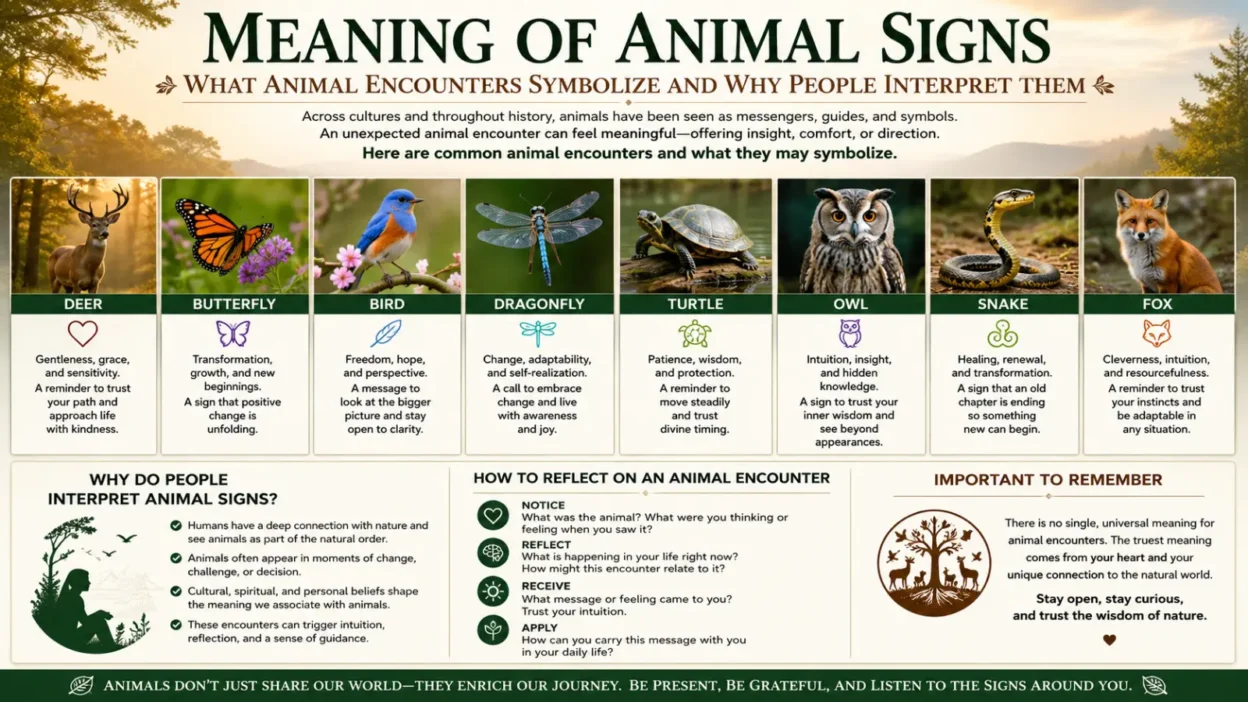
The Core Meanings People Associate With Animal Signs Today
Although there is no universal system of animal symbolism, several themes appear frequently in modern interpretations.
| Animal | Common Symbolic Meaning | Why the Meaning Developed |
|---|---|---|
| Eagle | Vision, freedom, leadership | Powerful flight and wide perspective |
| Owl | Wisdom, mystery, insight | Nocturnal behavior and folklore traditions |
| Butterfly | Transformation, renewal | Dramatic life cycle changes |
| Deer | Gentleness, awareness | Quiet movement and alert nature |
| Bear | Strength, protection | Physical power and maternal behavior |
| Fox | Adaptability, intelligence | Folklore portrayals of cleverness |
These associations developed because people connected visible animal traits to human experiences.
However, symbolic meanings should not be confused with scientific descriptions of animal behavior. Real animals are often far more complex than their symbolic representations.
Common Animal Signs and Their Modern Interpretations
Eagle
The eagle is one of the most recognizable symbols in American culture.
It often represents:
- Freedom
- Independence
- Leadership
- Strength
- Perspective
Its ability to soar at great heights contributes to the idea of seeing the bigger picture.
Owl
Owls are frequently associated with wisdom and knowledge.
At the same time, some traditions connect them to mystery, secrecy, or warnings.
Because owls are active at night, they often symbolize hidden knowledge or things that are not immediately obvious.
Butterfly
Butterflies are among the most popular symbolic animals today.
Their transformation from caterpillar to butterfly naturally supports themes of:
- Personal growth
- Change
- Renewal
- Recovery
- New beginnings
Many people associate butterfly encounters with important life transitions.
Deer
Deer commonly symbolize:
- Grace
- Sensitivity
- Awareness
- Peacefulness
Their alert behavior and gentle appearance have influenced these interpretations across many traditions.
Fox
Fox symbolism often centers on:
- Adaptability
- Problem-solving
- Intelligence
- Resourcefulness
Stories featuring clever foxes appear in numerous cultures, helping reinforce these associations.
Wolf
Modern symbolism often connects wolves with:
- Loyalty
- Independence
- Family bonds
- Survival
Popular culture has also shaped contemporary wolf symbolism, sometimes emphasizing traits that differ from historical traditions.
Why Different Cultures Interpret Animals Differently
One of the biggest misconceptions about animal symbolism is the idea that every animal has a single meaning.
Historical evidence suggests otherwise.
The same animal may symbolize completely different things depending on where and when it is being interpreted.
For example, owls are commonly associated with wisdom in modern American culture. Yet some traditions have linked owls with death, caution, or supernatural forces.
Snakes provide another example.
Depending on the cultural context, snakes have symbolized:
- Healing
- Wisdom
- Fertility
- Protection
- Danger
- Temptation
- Renewal
These differences developed because symbolism grows from local experiences, stories, beliefs, and environments.
Understanding animal signs responsibly means recognizing that no culture owns the only correct interpretation.
Animal Signs in Religion and Spiritual Traditions
Animals play important symbolic roles in many religious traditions.
Religious symbolism often differs from modern internet interpretations because it exists within a broader theological or cultural framework.
Some animals represent moral lessons.
Others symbolize divine protection, sacrifice, wisdom, purity, or transformation.
In many traditions, animals appear in sacred stories that help communicate spiritual teachings.
It is important to distinguish between:
- Official religious teachings
- Traditional folklore
- Local customs
- Contemporary spiritual interpretations
These categories sometimes overlap, but they are not identical.
Modern discussions often combine them into a single explanation, which can create confusion.
A respectful understanding of animal symbolism acknowledges the cultural and religious contexts from which many meanings originated.
Animal Signs in Folklore and Superstition
Folklore has contributed heavily to the meanings people assign to animals.
Many traditional stories explain unusual events through symbolic animal encounters.
Birds, ravens, crows, wolves, foxes, snakes, and owls frequently appear in folklore traditions.
Some stories portray animals as messengers.
Others treat them as warnings or indicators of coming change.
These beliefs were often shaped by everyday observations.
For example, nocturnal animals sometimes became associated with mystery because they were active when most people slept.
Predators often gained symbolic connections to danger because of their role in the environment.
Folklore should be understood as cultural storytelling rather than verified evidence.
Its value lies in what it reveals about human beliefs and traditions.
What Repeated Animal Encounters May Mean
Many people become interested in animal signs after repeatedly seeing the same animal.
There is no proven rule explaining why this happens.
Several explanations are possible.
The animal may simply be common in a particular location.
Seasonal behavior may increase sightings.
A person may become more aware of the animal after noticing it once.
Psychologists sometimes refer to this as selective attention. Once something becomes meaningful, people often notice it more frequently.
At the same time, some spiritual traditions interpret repeated encounters as symbolic messages or reminders.
Whether someone accepts that interpretation depends largely on personal belief.
A balanced approach considers both practical and symbolic possibilities.
Animal Signs in Modern American Culture
Animal symbolism remains highly visible throughout the United States.
It appears in countless aspects of everyday life.
Tattoos
Animal tattoos are often chosen to represent qualities people admire.
Examples include:
- Eagles for freedom
- Wolves for loyalty
- Butterflies for transformation
- Bears for strength
- Owls for wisdom
Sports and Mascots
Teams frequently adopt animals because they symbolize desirable traits.
A powerful animal can communicate determination, resilience, or competitive spirit.
Branding and Marketing
Companies regularly use animal imagery to shape public perception.
An animal logo can suggest speed, reliability, intelligence, or trustworthiness.
Home Decor and Fashion
Animal symbols also appear in jewelry, clothing, artwork, and interior design.
People often choose specific animals because they reflect personal values or experiences.
These modern uses demonstrate that animal symbolism remains culturally relevant even among people who do not view animal encounters as spiritual signs.
The Difference Between Symbolism and Real Animal Behavior
A common mistake is assuming symbolic meanings accurately describe animals themselves.
In reality, symbolism often simplifies complex creatures.
For example:
- Foxes are not always cunning.
- Owls are not inherently wise.
- Wolves are not constantly aggressive.
- Snakes are not naturally evil.
- Bears are not always fearless.
Symbolic meanings emerge from human interpretation rather than biological reality.
Understanding this distinction helps avoid stereotypes about wildlife while preserving the cultural value of symbolism.
Common Misunderstandings About Animal Signs
Several misconceptions appear repeatedly in discussions about animal symbolism.
Myth: Every Animal Has One Universal Meaning
Meanings vary across cultures, religions, and historical periods.
Myth: Every Encounter Is a Sign
Most animal encounters are ordinary events. Symbolic meaning comes from interpretation.
Myth: Animal Signs Predict the Future
Many traditions view signs as symbolic reflections rather than guaranteed predictions.
Myth: Online Symbol Dictionaries Are Definitive
Most simplified lists leave out cultural differences and historical complexity.
Myth: Personal Interpretation Does Not Matter
Personal experience often plays a major role in how people understand animal symbolism.
Recognizing these misconceptions creates a more balanced and accurate understanding.
A Thoughtful Approach to Interpreting Animal Signs
For many people, animal signs are meaningful because they encourage reflection.
Rather than asking, “What does this animal absolutely mean?” a more useful question may be, “Why does this encounter feel important to me?”
A thoughtful interpretation considers:
- The animal itself
- Cultural symbolism
- Personal experiences
- Current life circumstances
- Alternative explanations
This approach avoids extreme conclusions while still allowing room for personal meaning.
Many people find value in animal symbolism not because it predicts the future, but because it helps them think about their lives from a different perspective.
In that sense, animal signs function less as instructions and more as invitations to reflect.
FAQs
What do animal signs mean spiritually?
Many spiritual traditions view animal signs as symbolic reminders, lessons, or forms of guidance. These interpretations vary widely and should be understood as belief-based rather than universally accepted facts.
Why do I keep seeing the same animal?
Repeated sightings may result from environmental factors, increased awareness, or personal significance. Some spiritual traditions also interpret recurring encounters symbolically.
Are animal signs considered omens?
Some folklore traditions treat animal encounters as omens. Modern interpretations are usually broader and focus on symbolism rather than predicting future events.
What animal symbolizes change?
Butterflies are among the most common symbols of transformation because of their life cycle. Other animals may also represent change depending on cultural context.
Do animal tattoos have the same meanings as animal signs?
Sometimes, but tattoo symbolism is often more personal. An individual may choose an animal because of a life experience rather than traditional symbolism.
Are animal meanings universal?
No. Symbolic meanings vary greatly across cultures, religions, and historical periods. A symbol viewed positively in one tradition may carry a different meaning elsewhere.
Is there scientific proof that animal signs are messages?
There is no scientific evidence proving that animal encounters carry universal messages. Their significance is generally understood through cultural traditions, personal interpretation, spirituality, or psychology.
Conclusion
Animals have served as symbols for thousands of years because they occupy a unique place in human experience. People observe them, tell stories about them, admire them, fear them, and connect them to important ideas about life.
The meanings attached to animal signs developed through folklore, religion, cultural traditions, observation, and personal interpretation. Because those influences differ across societies, no single animal meaning applies everywhere.
Understanding the meaning of animal signs requires looking at history, culture, and context rather than relying on simple symbolic formulas. Whether viewed as spiritual reminders, cultural symbols, or opportunities for reflection, animal signs continue to help people find meaning in their relationship with the natural world.