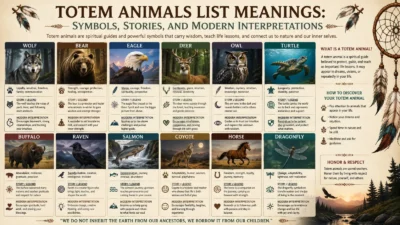
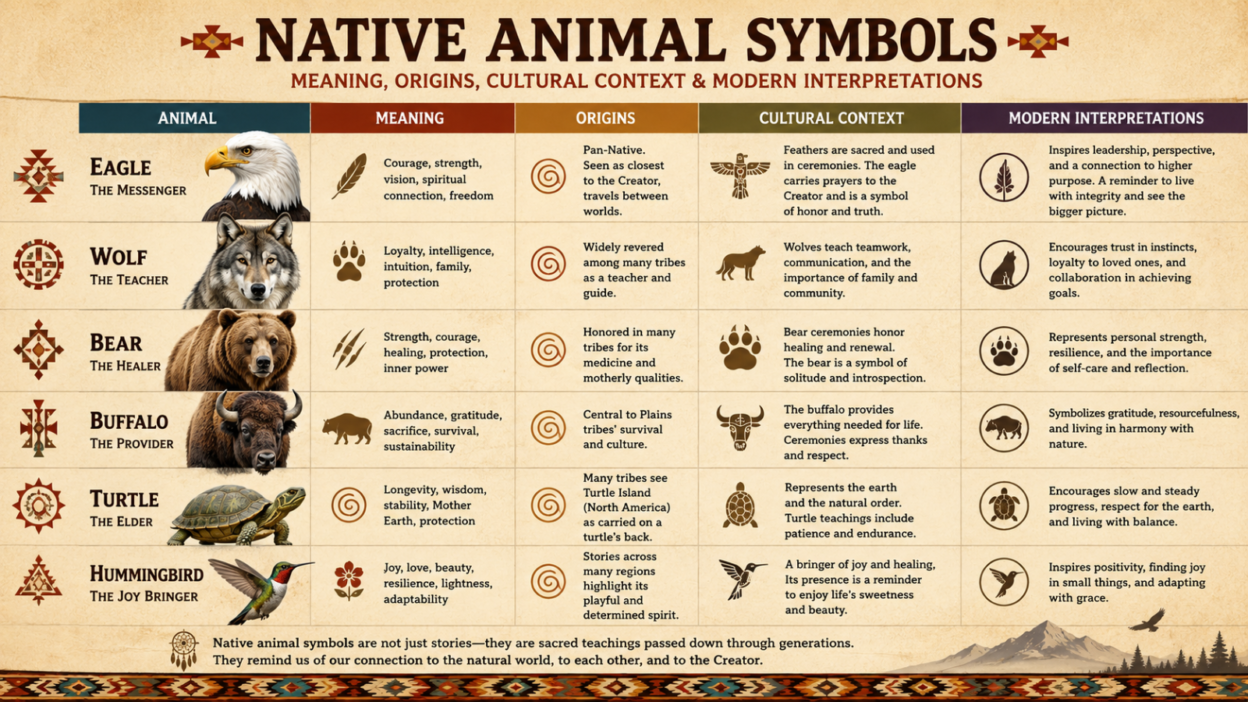
Animals have long been used as symbols to express ideas, values, beliefs, and identity. Across North America, native animals appear in stories, artwork, ceremonies, community traditions, sports mascots, conservation campaigns, and personal symbolism. People often look to these animals for lessons about courage, wisdom, endurance, family, adaptability, or connection to nature.
When discussing native animal symbols meaning, it is important to recognize that no single interpretation applies everywhere. Different Indigenous nations, regional traditions, historical communities, and modern American audiences may understand the same animal in very different ways. An eagle, wolf, or bear can represent one set of ideas in one tradition and something entirely different in another.
Today, many Americans encounter native animal symbolism through art, tattoos, educational materials, nature programs, state symbols, and popular culture. While some meanings have deep historical roots, others are modern interpretations that developed through literature, media, and contemporary spirituality. Understanding the difference helps create a more accurate picture of what these symbols represent.
Quick Answer
The most common modern understanding of native animal symbols meaning centers on qualities people associate with animals, such as strength, wisdom, freedom, resilience, protection, or adaptability. These meanings often developed through centuries of observation, storytelling, cultural traditions, and symbolic use, though interpretations vary widely among communities and cultures.
TL;DR
- Native animals often symbolize admired human qualities.
- Meanings vary across cultures and regions.
- Indigenous traditions are diverse, not universal.
- Modern symbolism sometimes differs from historical meanings.
- Animals appear in art, tattoos, logos, and identity symbols.
- Respectful interpretation requires cultural context.
Why Animals Became Symbols in the First Place
Before written communication became widespread, people often relied on stories, images, and oral traditions to share knowledge. Animals played a natural role in this process because they were familiar, visible, and important to daily survival.
Communities observed animal behavior closely. They watched migration patterns, hunting habits, nesting practices, family structures, and seasonal movements. Over time, certain traits became linked with symbolic ideas.
A wolf’s cooperation during hunts could become associated with teamwork. A turtle’s long lifespan could inspire ideas about endurance. An eagle’s ability to soar high above the landscape might become connected with vision or perspective.
These symbolic connections did not appear overnight. They developed gradually through repeated observation, storytelling, and cultural interpretation.
Importantly, symbolism reflects what people believed animals represented. It does not necessarily describe the actual behavior of every animal in nature.
The Eagle as a Symbol of Vision and Connection
Among native North American animals, few carry as much symbolic weight as the eagle.
In modern American culture, the eagle is strongly associated with freedom, independence, strength, and national identity. The bird’s role as a national emblem has reinforced these meanings for generations.
Many Indigenous traditions also hold eagles in special regard, although the meanings vary significantly among nations. In some traditions, eagles are viewed as messengers or as beings connected to spiritual realms because they fly high above the earth.
Part of the eagle’s symbolic power comes from its physical characteristics:
- Exceptional eyesight
- Ability to soar at great heights
- Strong hunting skills
- Commanding presence
These visible traits helped shape symbolic associations with vision, awareness, leadership, and perspective.
Modern interpretations often simplify the eagle into a general symbol of freedom. While that meaning remains common, historical traditions surrounding the bird are often much more specific and culturally rooted.
The Wolf and the Symbolism of Community
The wolf occupies a unique place in North American symbolism.
Popular culture frequently presents wolves as symbols of independence and personal strength. Yet many traditional interpretations focus just as strongly on cooperation and social bonds.
Wolves live in organized family groups and rely heavily on teamwork. Because of this, they are often associated with:
- Loyalty
- Family connections
- Cooperation
- Leadership
- Communication
In many modern contexts, people choose wolf imagery to represent resilience or self-reliance. However, this interpretation sometimes overlooks the animal’s highly social nature.
The symbolic meaning of wolves has also shifted over time. During periods when wolves were feared or viewed as threats to livestock, negative symbolism became more common in some communities. Later conservation movements helped reshape public perception, emphasizing ecological importance and natural balance.
Today, wolves often symbolize both individual strength and collective responsibility.
What Bears Commonly Represent
Bears appear throughout North American stories, folklore, and symbolic traditions.
Modern audiences usually associate bears with strength and power. Their large size and physical capabilities make this connection easy to understand.
However, bear symbolism extends beyond physical force.
Many symbolic interpretations also connect bears with:
- Protection
- Parenthood
- Courage
- Self-reliance
- Endurance
People frequently notice how mother bears defend their cubs. This behavior contributes to symbolic meanings related to guardianship and care.
Some traditions emphasize the bear’s ability to survive harsh conditions. Others focus on its relationship with seasonal cycles, particularly hibernation. In these contexts, bears may symbolize renewal, reflection, or periods of rest followed by renewed activity.
Modern American culture often presents bears as rugged symbols of determination and toughness. Yet historical meanings are often more nuanced and include wisdom, patience, and responsibility.
Turtle Symbolism and the Idea of Endurance
Turtles are among the most recognizable symbolic animals in North America.
One reason for this is their remarkable longevity. Many turtle species live for decades, creating natural associations with endurance and persistence.
Common symbolic meanings include:
| Animal Trait | Common Symbolic Meaning | Modern Use |
|---|---|---|
| Long lifespan | Endurance | Personal growth |
| Slow movement | Patience | Motivational symbolism |
| Protective shell | Security | Tattoos and artwork |
| Consistency | Stability | Life philosophy |
| Connection to land and water | Balance | Nature symbolism |
The turtle’s slow pace has often inspired lessons about persistence. Instead of representing speed or sudden success, turtle symbolism frequently emphasizes steady progress.
In some Indigenous traditions, turtles also play important roles in creation stories. Because these traditions belong to specific nations and communities, their meanings should not be generalized across all Indigenous cultures.
Modern interpretations commonly focus on patience, resilience, and long-term success.
Deer Symbolism and Gentle Strength
Deer occupy a different symbolic space than animals such as bears or wolves.
Rather than emphasizing physical dominance, deer symbolism often centers on awareness, grace, adaptability, and sensitivity.
People have long admired deer for their:
- Alertness
- Speed
- Elegance
- Ability to navigate changing environments
Because deer are highly attentive to their surroundings, they frequently symbolize perception and awareness. Their ability to move quickly when danger appears also contributes to meanings involving adaptability and survival.
In modern American culture, deer often represent a balance between gentleness and strength. This interpretation appeals to people who value resilience without aggression.
The symbolic image of the deer has also become popular in home décor, outdoor branding, nature-focused products, and personal artwork.
Animal Symbolism in Indigenous Traditions
Any discussion of native animal symbols should address Indigenous traditions carefully and respectfully.
A common mistake is assuming that Indigenous peoples share one unified system of animal meanings. In reality, hundreds of nations and communities across North America have distinct histories, languages, stories, and symbolic traditions.
An animal that carries one meaning in one community may hold a different meaning elsewhere.
Several important points deserve emphasis:
- Indigenous traditions are diverse.
- Animal meanings often depend on local stories.
- Sacred interpretations may not be publicly shared.
- Modern summaries sometimes oversimplify complex traditions.
Because of this diversity, broad statements such as “the wolf means this” or “the eagle always symbolizes that” can be misleading.
Respectful interpretation requires recognizing cultural specificity and avoiding assumptions about universal meanings.
How Native Animal Symbolism Changed Over Time
Animal symbolism is not static.
Meanings evolve as societies change, environments shift, and cultural priorities develop.
Several major influences have shaped modern interpretations:
Historical Storytelling
Stories passed through generations helped preserve symbolic associations and community values.
Colonial and Settlement Eras
New cultural groups brought their own beliefs about animals, creating additional layers of meaning.
Conservation Movements
As wildlife conservation gained attention, many animals became symbols of environmental responsibility.
Popular Media
Books, films, television programs, and social media introduced simplified animal meanings to wider audiences.
Modern Personal Symbolism
Today, many people choose animal symbols based on personal experiences rather than traditional cultural teachings.
As a result, modern interpretations often blend historical influences with contemporary values.
Native Animal Symbols in Tattoos, Art, and Identity
Animal symbolism remains highly visible in modern American life.
Tattoos are one of the most common examples. People often select animals that represent qualities they admire or experiences they have overcome.
Popular symbolic choices include:
- Eagle for vision and independence
- Wolf for loyalty and resilience
- Bear for courage and protection
- Turtle for patience and endurance
- Deer for grace and adaptability
Artists, designers, and organizations also use animal imagery to communicate identity. Schools, sports teams, conservation groups, and businesses frequently incorporate native animals into logos and branding.
These uses reflect how symbolism continues to evolve.
At the same time, there is growing awareness about the importance of understanding cultural context, particularly when imagery has roots in Indigenous traditions.
The Difference Between Symbolism and Animal Reality
One of the most important distinctions in symbolism is the difference between symbolic meaning and biological reality.
Humans often project values onto animals based on limited observations.
For example:
- Owls symbolize wisdom despite not being uniquely intelligent among birds.
- Wolves symbolize independence despite living socially.
- Bears symbolize aggression despite often avoiding human contact.
- Eagles symbolize freedom even though the concept is human rather than animal.
These symbolic associations are not scientific facts. They are cultural interpretations.
Understanding this distinction helps prevent oversimplification and encourages a more thoughtful approach to symbolism.
Animal symbols tell us as much about human values as they do about the animals themselves.
Modern American Views of Native Animal Symbols
In the United States today, animal symbolism is often less about religion or folklore and more about personal meaning.
People use animal symbols to express:
- Personal identity
- Life experiences
- Family values
- Career goals
- Environmental concerns
- Cultural connections
Social media has also contributed to the spread of simplified symbolic lists, where each animal is assigned a single meaning. While these lists can be engaging, they rarely capture the complexity of historical traditions.
A more balanced approach recognizes that symbolism develops through culture, history, storytelling, and interpretation.
For many Americans, native animal symbols serve as reminders of qualities they admire. For others, they represent cultural heritage, artistic expression, or appreciation for the natural world.
The meaning often depends as much on the person using the symbol as on the animal itself.
FAQs
What do native animal symbols generally mean?
Native animal symbols usually represent qualities that people associate with specific animals, such as courage, wisdom, endurance, loyalty, or adaptability. The exact meaning depends on cultural context, historical tradition, and personal interpretation.
Are animal meanings the same across all Indigenous cultures?
No. Indigenous nations throughout North America have diverse traditions and belief systems. An animal may carry different meanings depending on the community, story, or ceremonial context.
What is the most common animal symbol in the United States?
The eagle is among the most widely recognized animal symbols in the United States because of its connection to national identity. It is also associated with vision, leadership, and perspective in many symbolic interpretations.
What does a wolf symbolize today?
Modern wolf symbolism often combines loyalty, resilience, family bonds, leadership, and independence. Different cultural traditions may emphasize different aspects of the animal.
Are animal tattoo meanings historically accurate?
Sometimes, but not always. Many modern tattoo meanings are contemporary interpretations that draw inspiration from older traditions while adding personal significance.
Can one animal have both positive and negative meanings?
Yes. Symbolic meanings often vary by culture and historical period. Wolves, bears, ravens, and other animals have been viewed positively in some contexts and negatively in others.
Is animal symbolism based on science?
Not usually. Symbolism reflects cultural interpretation rather than scientific observation. While animal behavior may inspire symbolic ideas, the meanings themselves are created by people.
Conclusion
Animal symbolism remains one of the oldest and most recognizable ways people express values, beliefs, and identity. Across North America, native animals have inspired stories, traditions, artwork, and personal interpretations that continue to influence culture today.
Understanding native animal symbols meaning requires more than memorizing simple definitions. It involves recognizing historical context, cultural diversity, and the difference between traditional teachings and modern interpretations.
Whether represented by an eagle’s perspective, a wolf’s loyalty, a bear’s protection, a turtle’s endurance, or a deer’s adaptability, these symbols continue to reflect qualities that many people admire while reminding us of the enduring relationship between human culture and the natural world.