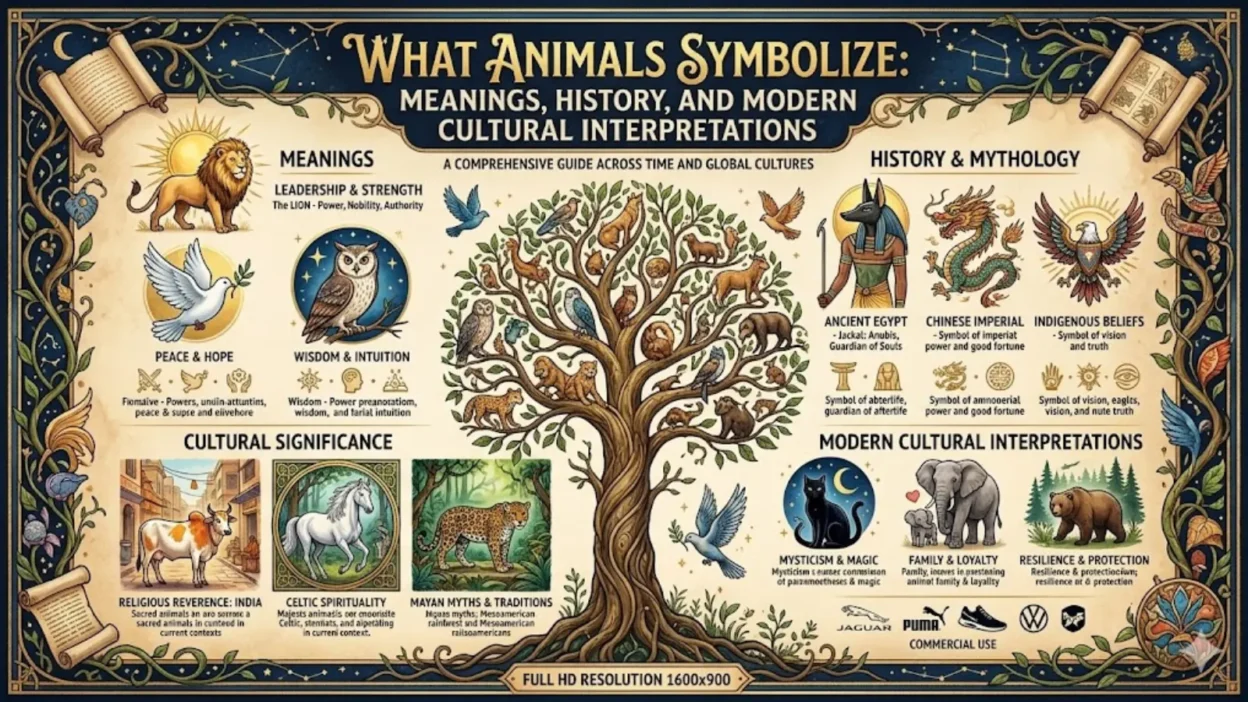
Animals have been part of human life for thousands of years. Long before books, movies, or social media existed, people watched animals closely to understand the world around them. They noticed how animals hunted, protected their young, traveled in groups, or survived harsh conditions. Over time, those observations turned into stories, beliefs, and symbols.
Today, when people ask what animals symbolize, they are usually looking for meaning beyond the physical creature itself. A wolf may represent independence. An eagle may stand for freedom. A snake may symbolize danger, wisdom, or transformation depending on the context. These associations appear in religion, folklore, literature, tattoos, sports teams, company logos, and everyday language.
Animal symbolism remains important because people naturally connect animal traits with human experiences. Yet animal meanings are rarely universal. The same animal can represent very different ideas depending on the culture, historical period, or personal perspective involved. Understanding animal symbolism requires looking at both its origins and its modern use.
Quick Answer
When discussing what animals symbolize, most animals represent qualities that people associate with their appearance, behavior, or cultural role. Common examples include wolves symbolizing loyalty or independence, eagles symbolizing freedom, bears symbolizing strength, and owls symbolizing wisdom. These meanings developed through folklore, religion, storytelling, art, and cultural traditions rather than scientific facts about the animals themselves.
TL;DR
- Animals often symbolize human traits and values.
- Meanings develop through culture and storytelling.
- Different societies interpret animals differently.
- U.S. symbolism is influenced by history and media.
- Tattoos and branding frequently use animal symbols.
- Animal meanings are interpretations, not facts.
Why Animals Became Symbols in Human Culture
Humans have always searched for ways to explain the world around them. Animals were among the earliest subjects of observation because people depended on them for food, protection, transportation, and survival.
As communities grew, people began attaching meaning to the traits they observed in animals. A fast animal became associated with speed and freedom. A powerful predator became linked to courage or leadership. Animals that survived difficult environments often became symbols of endurance.
Storytelling helped spread these associations. Once a culture connected a particular animal with a certain idea, that connection appeared in myths, legends, songs, artwork, and religious teachings.
Over generations, symbolic meanings became deeply rooted in cultural memory. Many modern interpretations still reflect patterns that emerged hundreds or even thousands of years ago.
However, symbolism is not the same as biology. The symbolic meaning of an animal reflects how humans interpret it, not necessarily how the animal behaves in reality.
The Most Common Things Animals Symbolize Today
Modern animal symbolism often revolves around recognizable human values and emotions.
Some of the most common symbolic themes include:
- Strength
- Courage
- Freedom
- Intelligence
- Wisdom
- Protection
- Loyalty
- Transformation
- Patience
- Adaptability
People tend to assign these qualities based on visible characteristics.
For example:
- Eagles soar high and see long distances, leading people to associate them with vision and freedom.
- Bears appear physically powerful, leading to associations with strength and protection.
- Foxes often appear clever in stories, making them symbols of intelligence and strategy.
- Deer are usually viewed as gentle and alert, contributing to meanings related to grace and sensitivity.
These symbolic connections become part of collective culture even when they do not perfectly match scientific observations.
How Ancient Civilizations Used Animal Symbolism
Many early civilizations incorporated animals into religious practices, government imagery, and mythology.
Animals often served as representations of natural forces, spiritual powers, or social values.
In ancient societies, people lived much closer to wildlife than most modern populations do today. Encounters with animals were common and often significant.
Large predators inspired respect and fear.
Migratory birds inspired wonder.
Strong herd animals represented survival and prosperity.
As a result, animals became important cultural symbols.
Ancient artwork frequently included animals as visual representations of power, fertility, protection, or divine influence.
In many traditions, animals acted as messengers between human beings and supernatural forces.
These symbolic uses varied greatly from one civilization to another, demonstrating that animal symbolism has never been completely universal.
Animal Symbolism in Religion and Sacred Traditions
Religious traditions around the world often include animals as symbolic figures.
These symbols usually communicate spiritual lessons, moral values, or sacred stories.
It is important to remember that religious animal symbolism should be understood within the context of the specific faith or tradition involved.
The same animal may have different meanings across different religions.
Examples include:
- Doves commonly symbolize peace and spiritual purity in Christian contexts.
- Lambs are frequently associated with innocence and sacrifice.
- Lions may symbolize authority, courage, or divine power.
- Snakes can represent temptation in some traditions but wisdom or renewal in others.
Because religious symbolism is deeply connected to belief systems, it should not be reduced to decorative meanings alone.
Many sacred animal symbols continue to hold important spiritual significance for believers today.
Animal Symbolism in Folklore and Mythology
Folklore played a major role in shaping the meanings people associate with animals.
Unlike formal religious traditions, folklore often developed through local stories, oral traditions, and community beliefs.
Animals in folklore frequently behave like human characters.
They make decisions.
They teach lessons.
They reward good behavior or punish bad behavior.
Because of this storytelling role, many animals gained symbolic identities that continue today.
For example:
- Foxes often became tricksters.
- Ravens became messengers or mystery figures.
- Wolves appeared as both protectors and threats.
- Owls became connected with knowledge and hidden understanding.
These symbolic identities were passed down through generations and continue to influence books, films, and popular culture.
Common Animal Symbols and Their Meanings
The following table highlights some of the most widely recognized animal symbols in modern American culture.
| Animal | Common Meaning | Why the Meaning Developed |
|---|---|---|
| Eagle | Freedom, vision, leadership | Flight, sharp eyesight, national symbolism |
| Wolf | Loyalty, independence, resilience | Pack behavior and folklore traditions |
| Bear | Strength, protection, endurance | Physical power and survival ability |
| Owl | Wisdom, knowledge, awareness | Historical links to learning and observation |
| Deer | Grace, gentleness, sensitivity | Calm behavior and elegant movement |
| Fox | Cleverness, adaptability | Folklore portrayals of intelligence |
These meanings are common but not universal. Different cultures may interpret the same animals differently.
Why the Eagle Became a Symbol of Freedom
Few animals carry stronger symbolic weight in the United States than the eagle.
The bald eagle became closely associated with national identity because of its strength, impressive appearance, and ability to soar high above the landscape.
Over time, the eagle came to symbolize:
- Freedom
- Independence
- Vision
- Leadership
- National pride
Today, eagle imagery appears on government seals, military insignia, monuments, and official documents.
The bird’s symbolic role extends beyond politics. Many people also associate eagles with personal ambition and the ability to rise above challenges.
This modern symbolism reflects centuries of cultural development rather than any single historical event.
Why Wolves Carry Both Positive and Negative Meanings
The wolf is one of the most complex animals in symbolic interpretation.
Many modern Americans associate wolves with:
- Independence
- Loyalty
- Survival
- Family bonds
- Resilience
These meanings often come from observations of wolf pack behavior and modern storytelling.
At the same time, wolves have historically been portrayed as dangerous predators in many folktales.
Because of this dual image, wolves can symbolize both protection and threat.
This contrast makes the wolf particularly interesting from a symbolic perspective.
Few animals demonstrate more clearly how symbolism can change depending on cultural context.
A person choosing a wolf tattoo may view it as a symbol of loyalty, while a traditional folktale may use the same animal to represent danger.
Neither interpretation is inherently right or wrong.
They simply come from different cultural traditions.
Why Snakes Represent Both Danger and Transformation
Snake symbolism often confuses people because it contains seemingly opposite meanings.
In some traditions, snakes symbolize:
- Temptation
- Risk
- Deception
- Fear
In others, snakes symbolize:
- Renewal
- Healing
- Wisdom
- Transformation
One reason for this dual symbolism is the snake’s ability to shed its skin.
Many cultures viewed this process as a visible sign of renewal and change.
At the same time, venomous snakes naturally inspired caution and fear.
These contrasting impressions helped create a symbolic image that remains complex today.
Modern interpretations frequently focus on personal growth and transformation, especially in tattoos and self-development imagery.
Animal Symbolism in the United States Today
Modern American culture uses animal symbolism in countless ways.
Animals appear in:
- Sports mascots
- School logos
- Corporate branding
- Tattoos
- Jewelry
- Home décor
- Social media content
- Entertainment franchises
People often choose animal symbols because they communicate ideas quickly.
A lion logo can suggest confidence.
A hawk logo can imply focus.
A wolf image can communicate resilience.
This visual shorthand helps organizations and individuals express identity without lengthy explanations.
As a result, animal symbolism remains highly visible even in a technology-driven society.
Animal Symbolism in Tattoos and Personal Identity
Animal tattoos are among the most popular symbolic tattoo choices.
Many people choose animals because they feel a personal connection to the qualities associated with them.
Some common examples include:
Wolf Tattoos
Often associated with loyalty, independence, family, and perseverance.
Eagle Tattoos
Frequently connected with freedom, ambition, and strength.
Owl Tattoos
Commonly chosen to represent wisdom, learning, and awareness.
Bear Tattoos
Often symbolize courage, resilience, and protection.
Deer Tattoos
Typically connected with grace, gentleness, and personal growth.
The meaning of a tattoo is often personal. While cultural symbolism influences interpretation, the wearer may assign additional significance based on life experiences.
Animals in Dreams and Personal Interpretation
Dream symbolism is one of the most popular areas of animal interpretation.
Many people wonder whether seeing an animal repeatedly in dreams carries special meaning.
Different traditions offer different explanations.
Some psychological approaches view dream animals as reflections of emotions or personal experiences.
Some spiritual traditions view them as symbolic messages.
Others see dreams primarily as products of memory and subconscious processing.
There is no single universally accepted system for interpreting animal dreams.
Because of this, dream symbolism should generally be viewed as interpretive rather than factual.
The meaning often depends on the dreamer’s experiences, emotions, and cultural background.
Spirit Animals, Totems, and Modern Spiritual Beliefs
The concept of spirit animals has become widespread in modern popular culture.
Many people use the phrase to describe an animal they strongly identify with or admire.
However, the term has deeper roots in certain Indigenous traditions, where animal relationships may carry specific cultural and spiritual meanings.
Modern internet usage often simplifies these traditions.
As a result, it is important to approach the topic carefully and respectfully.
Not all cultures use the concept in the same way.
Not all traditions interpret animal symbolism through spirit guides.
When discussing spirit animals or totems, context matters greatly.
Understanding cultural origins helps prevent oversimplification.
Common Misconceptions About Animal Symbolism
Several misconceptions appear repeatedly in discussions about animal meanings.
Myth 1: Every Animal Has One Universal Meaning
Animal symbolism varies widely across cultures.
There is rarely a single interpretation accepted everywhere.
Myth 2: Symbolism Is Scientific
Symbolism reflects cultural interpretation, not scientific fact.
Myth 3: Animal Behavior Always Explains Symbolism
Many symbolic meanings come from stories and traditions rather than actual animal behavior.
Myth 4: Ancient Meanings Never Change
Symbolic meanings evolve constantly.
Modern media, literature, and social trends regularly influence how people interpret animals.
Understanding these misconceptions helps create a more accurate view of symbolic traditions.
How Animal Symbolism Continues to Evolve
Animal symbolism is not frozen in history.
New meanings continue to emerge as society changes.
Movies, television, literature, social media, and environmental awareness all influence public perception.
For example, conservation efforts have changed how many people view wolves, bears, and birds of prey.
Animals once portrayed primarily as threats may now be viewed as important parts of healthy ecosystems.
Likewise, modern branding can strengthen particular symbolic associations.
Over time, these new influences become part of the broader symbolic landscape.
This ongoing evolution explains why animal symbolism remains relevant in modern culture.
FAQs
What animals symbolize strength?
Bears, lions, bulls, and eagles are commonly associated with strength. These meanings usually developed because of the animals’ physical power, survival abilities, or cultural reputation.
What animal symbolizes freedom?
In the United States, the eagle is the strongest symbol of freedom. Birds in general are often linked to freedom because of their ability to fly.
What animal symbolizes wisdom?
Owls are among the most recognized symbols of wisdom in Western culture. This association comes largely from historical storytelling and educational symbolism.
Are animal meanings universal?
No. Animal symbolism varies significantly across cultures, religions, and historical periods. The same animal may carry completely different meanings in different traditions.
What do animal tattoos usually represent?
Animal tattoos often represent qualities the wearer values or identifies with. Common themes include courage, independence, protection, resilience, and personal transformation.
What does it mean if I keep seeing the same animal?
Some people view repeated encounters as meaningful, while others see them as coincidence or increased awareness. There is no universally accepted explanation.
Are spirit animals the same as animal symbolism?
Not exactly. Animal symbolism refers broadly to cultural meanings attached to animals, while spirit animal concepts come from specific spiritual or cultural traditions and should not be generalized.
Conclusion
Animal symbolism developed because humans naturally looked to the animal world for lessons, explanations, and inspiration. Over time, observations of wildlife blended with mythology, religion, folklore, art, and storytelling to create the symbolic meanings people recognize today.
When exploring what animals symbolize, it is important to remember that meanings are shaped by culture rather than fixed by nature. A wolf, eagle, owl, bear, or snake may carry powerful associations, but those associations change across communities, historical periods, and personal experiences.
The most useful way to understand animal symbolism is to see it as a cultural language—one that continues to evolve while helping people express ideas about identity, values, challenges, and the world around them.