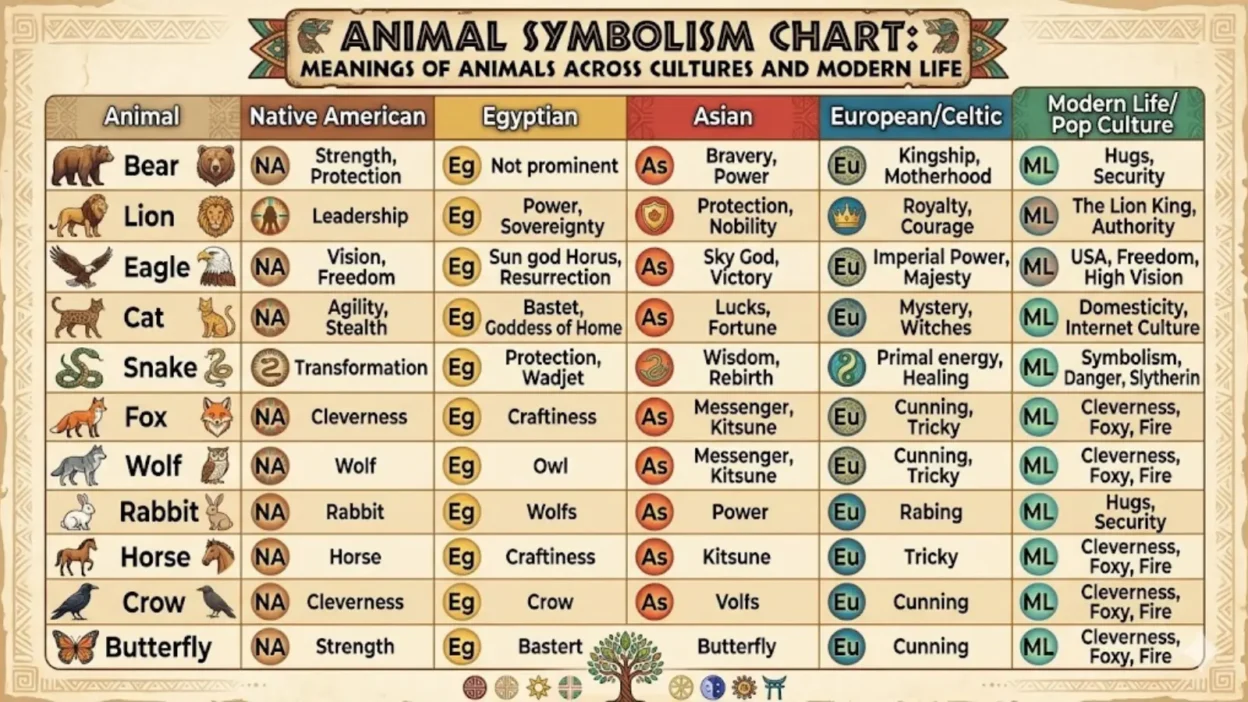
Animal symbolism appears in nearly every culture in the world. People have always looked at animals and connected their behavior, strength, or appearance with human qualities. This is why animals often represent ideas like courage, wisdom, freedom, or transformation.
An animal symbolism chart helps organize these meanings in a simple way. Instead of guessing what each animal represents, readers can see common interpretations side by side. These meanings are not fixed rules, but patterns shaped by culture, storytelling, religion, and modern interpretation.
Today, animal symbolism is widely used in tattoos, branding, education, and personal identity. It remains popular because it connects nature with human emotion in a direct and visual way.
Quick Answer
An animal symbolism chart is a reference guide that shows common symbolic meanings associated with different animals. In modern usage, it helps explain how animals represent human traits like strength, wisdom, freedom, or protection. These meanings vary by culture and belief, so they should be understood as interpretations rather than universal facts.
TL;DR
- Animals represent human traits and emotional ideas
- Meanings vary across cultures and history
- Birds often symbolize freedom and perspective
- Mammals often represent strength or instinct
- Modern use includes tattoos, branding, and identity
What Animal Symbolism Charts Represent in Everyday Use
Animal symbolism charts are used to simplify complex cultural meanings. Instead of studying each tradition separately, people use charts as quick references to understand common symbolic associations.
These charts usually group animals by type and assign general meanings. For example, predators often represent strength or leadership, while smaller animals may represent adaptability or awareness. While helpful, these meanings are interpretive, not scientific definitions.
Why Humans Assign Symbolic Meaning to Animals
People assign meaning to animals because animals are easy to observe and relate to. Their behavior often feels like it reflects human traits. A lion appears strong, an owl appears observant, and a fox appears clever.
This pattern comes from early storytelling traditions. Before written language, animals were used to explain human behavior and natural events. Over time, these associations became part of cultural symbolism.
How Animal Symbolism Differs Across Cultures
Animal symbolism is not the same everywhere. The same animal can have different meanings depending on cultural background.
For example, an owl may represent wisdom in some Western traditions, while in other cultures it may be linked to mystery or warning. These differences show that symbolism is shaped by environment, history, and storytelling traditions, not fixed universal meaning.
Because of this, animal symbolism charts should be read as general guides, not absolute definitions.
Mammal Symbolism: Strength, Instinct, and Social Power
Mammals are often linked with physical strength, survival instincts, and emotional depth. Many mammals live in structured groups, which also influences their symbolic meaning.
- Lions often represent leadership and courage
- Wolves are linked with loyalty and pack behavior
- Bears are associated with strength and protection
- Elephants often symbolize memory and stability
- Foxes are connected with intelligence and adaptability
These meanings come from long-standing observation of behavior, not exact scientific interpretation.
Bird Symbolism: Freedom, Perspective, and Transition
Birds are often associated with freedom because they can move beyond human physical limits. Their ability to fly also makes them symbolic of perspective and higher awareness.
- Eagles represent vision and authority
- Owls are linked with observation and knowledge
- Ravens often symbolize mystery or transformation
- Doves are connected with peace and harmony
- Hummingbirds are associated with joy and energy
Bird symbolism often reflects both physical traits and cultural storytelling.
Reptiles and Amphibians: Transformation and Survival
Reptiles and amphibians often carry symbolic meanings related to adaptation and survival. Their appearance and behavior can feel ancient or primal to humans.
- Snakes represent transformation and renewal in many cultures
- Turtles symbolize patience and longevity
- Crocodiles are associated with primal power and survival
- Frogs often represent change and transition due to metamorphosis
These meanings are highly context-dependent and vary widely across regions.
Insect Symbolism: Change, Patience, and Perspective
Insects are small but carry strong symbolic meanings because of their life cycles and behaviors.
- Butterflies represent transformation and emotional change
- Bees symbolize teamwork and productivity
- Ants are linked with discipline and cooperation
- Dragonflies often represent change and adaptability
Insect symbolism is often tied to observation of structure and life cycles.
Marine Animal Symbolism: Depth, Emotion, and Flow
Marine animals are often associated with emotional depth and subconscious meaning because they live in an environment hidden from daily human life.
- Dolphins symbolize intelligence and communication
- Whales represent emotional depth and memory
- Sharks are linked with survival and power
- Fish often represent abundance and flow
Water-based symbolism often connects with emotional interpretation rather than physical traits alone.
Animal Symbolism Chart (Quick Reference Guide)
Here is a simplified chart showing common symbolic meanings used in modern interpretation:
| Animal | Common Symbolism | Cultural Context |
|---|---|---|
| Lion | Courage, leadership | Strength-based leadership symbolism |
| Wolf | Loyalty, instinct | Social bonding and survival groups |
| Eagle | Vision, freedom | Authority and perspective |
| Owl | Wisdom, observation | Knowledge and awareness |
| Snake | Transformation | Renewal and change cycles |
| Bear | Strength, protection | Physical power and guardianship |
| Fox | Cleverness, adaptability | Strategy and intelligence |
| Deer | Gentleness, sensitivity | Calmness and awareness |
| Dolphin | Communication, harmony | Intelligence and social connection |
| Butterfly | Change, transformation | Personal and emotional growth |
| Elephant | Memory, stability | Wisdom and long life association |
| Turtle | Patience, endurance | Slow progress and resilience |
This chart reflects common modern interpretations rather than fixed universal meanings.
Modern Use of Animal Symbolism in the U.S.
In the United States, animal symbolism is widely used in personal expression. Tattoos are one of the most common ways people choose animals to represent identity or life experiences.
Brands also use animals to communicate traits like strength, speed, or reliability. Sports teams use animals as mascots to represent competitive energy and identity.
In all these cases, symbolism is more about communication than tradition.
Psychological Reasoning Behind Animal Symbolism
From a psychological perspective, animal symbolism works because humans naturally use metaphor to understand complex emotions. Animals provide simple visual comparisons for abstract ideas like courage or fear.
This does not mean animal meanings are fixed truths. Instead, they are mental shortcuts that help people explain feelings, behavior, and identity in relatable ways.
Limitations and Misinterpretation of Animal Symbolism
Animal symbolism should not be treated as strict fact. One common issue is oversimplification—assuming every animal has one universal meaning.
In reality:
- Meanings vary across cultures
- Context changes interpretation
- Modern usage often reshapes older meanings
- Internet culture can simplify or distort symbolism
A balanced view treats these meanings as flexible interpretations rather than fixed definitions.
FAQs
What is an animal symbolism chart used for?
It is used to understand common symbolic meanings associated with animals. People use it for education, tattoos, and cultural reference.
Are animal symbolism meanings the same in every culture?
No, meanings differ widely across cultures. The same animal can represent different ideas depending on tradition and region.
Why do animals have symbolic meanings?
Humans assign meanings based on observed behavior and storytelling traditions. Over time, these associations became cultural symbols.
What does a wolf symbolize in most charts?
Wolves are often linked with loyalty, instinct, and social connection. However, interpretations can vary depending on cultural context.
Is animal symbolism scientifically proven?
No, it is based on cultural interpretation and psychology, not scientific fact. It reflects human perception rather than biological truth.
Conclusion
Animal symbolism continues to be a simple way for people to connect nature with human experience. Whether used in education, identity, or design, these meanings help translate complex ideas into familiar images.
The animal symbolism chart provides a helpful overview, but its meanings should always be understood as interpretations shaped by culture, not fixed rules. In the end, animals become symbols because people see reflections of themselves in the natural world.