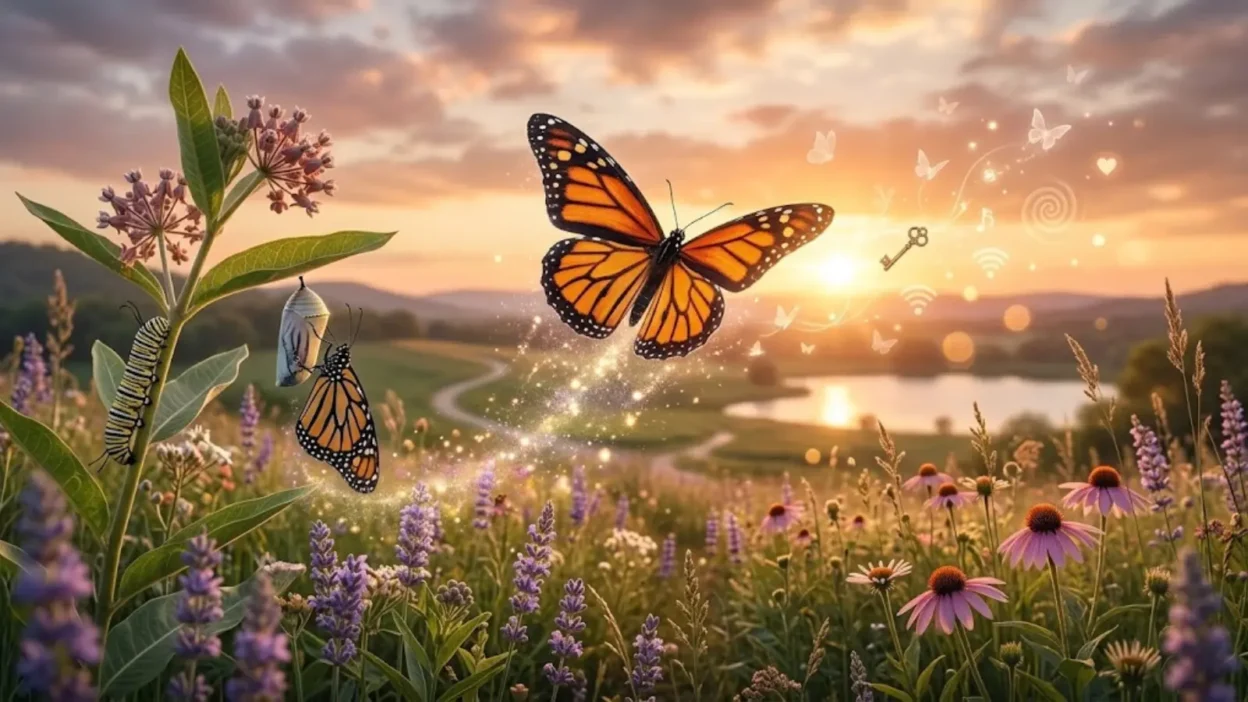
Butterflies often show up in moments when people are already thinking about change. That is one reason they carry strong emotional weight in everyday life. They are not just insects in symbolic language—they are tied to how people understand growth, loss, and new beginnings.
The idea of butterfly spiritual meaning is especially common in the United States, where it appears in conversations about healing, grief, and personal transformation. Some interpretations come from older cultural or religious ideas, while many others come from modern emotional experiences and personal belief.
At the center of it all is a simple connection: something that changes completely in nature becomes a way to explain change in human life.
Quick Answer
The most common interpretation of butterfly spiritual meaning is transformation—especially personal or emotional change that leads to a new stage of life. In modern U.S. culture, it is often linked with healing, growth, or remembrance after loss. Some traditions also associate butterflies with the soul or transition, but these meanings vary by belief system and are not universal.
TL;DR
- Symbol of transformation and personal change
- Often linked to healing after emotional difficulty
- Color meanings vary by modern interpretation
- Not a single universal or fixed spiritual belief
- Common in tattoos, grief symbolism, and identity expression
What the Butterfly Symbol Represents in Everyday Understanding
Most people today read butterflies as a sign of visible change. Unlike abstract symbols, this one is grounded in something real: the butterfly’s life cycle. It begins in one form and ends in another that looks completely different.
In everyday language, this becomes a simple metaphor. People use it when talking about leaving old habits, starting over, or moving through emotional phases. It is less about mystery and more about transition that can be seen and understood.
Because of that clarity, the butterfly remains one of the most accessible symbols for change.
Why Butterflies Became a Symbol of Transformation
The transformation meaning comes directly from metamorphosis. A caterpillar does not slowly “improve”—it fully changes form. That is unusual in nature and easy for humans to interpret symbolically.
People often use physical processes to explain emotional experiences. Growth, grief, recovery, and identity shifts are not visible, but they feel real. The butterfly becomes a natural comparison because it shows a complete transformation rather than a partial one.
Over time, this metaphor became widely shared in storytelling, education, and modern emotional language.
Historical Roots Across Early Civilizations
Butterflies appear in early cultural records across different regions, but not in one unified meaning system. In some ancient contexts, winged insects were loosely connected with ideas of the soul or life after death. This likely came from observing how butterflies “emerge” from a hidden stage.
However, it is important not to assume a single ancient interpretation. Different societies saw butterflies through their own environments, languages, and beliefs. In some places, they were simply part of nature without symbolic depth.
The shared idea of “transition” developed later through repeated metaphor, not from one original source.
Spiritual Interpretations in Modern Belief Systems
In modern spiritual communities, butterflies are often described as signs of guidance or emotional reassurance. These interpretations are based on personal belief systems rather than standardized doctrine.
Common modern associations include:
- Feeling supported during emotional transitions
- Interpreting repeated sightings as meaningful timing
- Linking butterflies with intuition or awareness
- Viewing them as symbols of personal alignment
These meanings are not scientifically verified. They function as personal frameworks people use to interpret emotional moments in their lives.
Religious Symbolism and Its Cautious Interpretations
Some religious interpretations use butterflies as metaphors for renewal or spiritual rebirth. This is especially true in contexts that emphasize life after death or transformation of the soul.
However, butterflies are not central sacred symbols in most major religions. Instead, they are often used as illustrative imagery in teaching or storytelling. The meaning depends heavily on context and should not be generalized across all traditions.
It is more accurate to view this symbolism as metaphorical rather than doctrinal.
Emotional Meaning in Grief and Healing Contexts
In modern U.S. culture, butterflies are strongly associated with grief and remembrance. People often see them as symbolic connections to loved ones who have passed away.
This interpretation is emotional rather than historical. It helps people express feelings that are difficult to articulate directly. The butterfly becomes a gentle symbol of continuity, memory, or presence.
This meaning is widely shared, but it is still based on personal interpretation rather than a fixed belief system.
Butterfly Color Meanings and Modern Interpretation Table
Color symbolism adds another layer of meaning, but it is mostly based on modern interpretation rather than ancient structure.
| Color | Common Interpretation | Modern Context |
|---|---|---|
| White | Peace, remembrance | Often linked to calm or emotional closure |
| Black | Transition, uncertainty | Sometimes tied to change or reflection |
| Yellow | Joy, positivity | Associated with energy and optimism |
| Blue | Healing, calm | Linked with emotional clarity |
| Orange | Creativity, vitality | Often tied to motivation and warmth |
These meanings shift depending on personal belief, culture, and context. They are not fixed rules.
Butterfly Tattoos, Fashion, and Identity in the U.S.
Butterfly tattoos are extremely common in the United States, but their meanings vary widely. Some people choose them to represent personal growth after a difficult period. Others choose them simply because they find the design meaningful or visually appealing.
In fashion and design, butterflies are often used to represent softness, freedom, or transformation. They appear in clothing patterns, accessories, and digital aesthetics.
What makes this symbol unique is its flexibility. It can carry deep personal meaning or remain purely decorative, depending on the person.
Butterfly Sightings as Signs and Omens (Belief vs Fact)
In some traditions and personal beliefs, encountering a butterfly is seen as meaningful timing. People may interpret it as reassurance, a message, or emotional confirmation.
From a neutral perspective, butterflies appearing is a natural part of ecological cycles. Their presence depends on season, environment, and migration patterns.
Both interpretations exist side by side. The key difference is whether the meaning is assigned personally or treated as an external message.
Cultural Differences in Butterfly Symbolism
Butterfly symbolism is not identical across cultures. While transformation is common, other meanings vary significantly.
In some traditions, butterflies are linked with the soul or life transition. In others, they are simply seasonal signs of beauty and nature. In modern Western culture, especially in the U.S., the focus is often emotional—growth, healing, and identity change.
This variation shows that symbolism is shaped by lived experience, not a single universal definition.
Modern Pop Culture and Digital Symbolism
In digital culture, butterflies are often used in aesthetic expression rather than traditional symbolism. They appear in social media posts, personal branding, and visual identity themes.
They often represent emotional states like softness, reflection, or personal change. In online spaces, the meaning is flexible and visual rather than structured.
This modern usage has expanded the symbol beyond cultural or historical roots into everyday digital communication.
Why Butterfly Symbolism Still Feels Personal Today
Butterflies remain meaningful because they connect directly to human experience. Change is something everyone goes through, but it is often difficult to describe clearly. The butterfly provides a simple image for something complex.
Its meaning continues to evolve because it does not belong to one fixed system. Instead, it adapts to personal interpretation, emotional context, and cultural expression.
That flexibility is why it continues to appear in both serious and everyday situations.
FAQs
What is the spiritual meaning of a butterfly in simple terms?
It usually represents transformation or emotional change. Many people also connect it with personal growth or healing experiences.
Is seeing a butterfly considered a message?
Some people interpret it that way based on personal belief. However, there is no universal rule that defines it as a message or sign.
Why are butterflies linked with transformation?
Because their life cycle involves a complete change in form. This visible transformation naturally became a metaphor for human change.
Do butterfly colors have real meanings?
Color meanings exist mostly in modern interpretation systems. They are not fixed and vary depending on culture or personal belief.
What does a butterfly tattoo symbolize?
It often represents growth, change, or personal freedom. The exact meaning depends on the individual.
Are butterflies connected to religion?
They can appear as metaphors for renewal or rebirth in some contexts, but they are not central religious symbols.
Is butterfly symbolism the same everywhere?
No, meanings differ across cultures and belief systems. Transformation is common, but details vary widely.
Conclusion
Butterflies remain one of the clearest natural symbols of change because their transformation is visible and complete. That physical process has become a way for people to describe emotional and personal transitions in everyday life.
The meaning of butterfly spiritual meaning is not fixed. It changes with culture, belief, and personal experience. What stays consistent is the idea that change—whether emotional, physical, or symbolic—can be understood through something simple in nature.