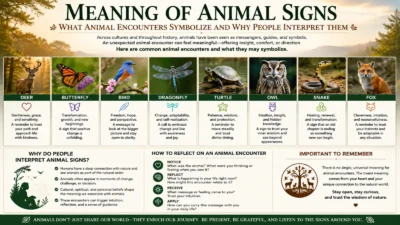
Animal symbolism patterns are one of the oldest ways humans have tried to understand the world. People observe animals in nature and connect their behavior to human ideas like strength, fear, wisdom, or freedom. Over time, these associations become repeated cultural patterns rather than literal truths.
In modern U.S. culture, animal symbols are everywhere. They appear in tattoos, sports teams, brand logos, and even personal identity choices. A wolf might represent independence, while an eagle often represents freedom. These meanings are widely understood, even if they are simplified versions of older cultural ideas.
What makes animal symbolism patterns interesting is not just what they mean, but how they change. The same animal can carry different meanings across cultures, religions, and time periods. Understanding this helps separate history, belief, and modern interpretation.
Quick Answer
Animal symbolism patterns are repeated cultural meanings assigned to animals based on their traits, stories, and human interpretation. In modern U.S. usage, they often represent qualities like strength, wisdom, freedom, or transformation. These meanings come from a mix of ancient mythology, religious storytelling, and human observation of nature.
TL;DR
- Animal meanings come from behavior, culture, and storytelling
- No animal has one fixed universal meaning
- U.S. usage often simplifies older symbolic traditions
- Religion and folklore shaped early interpretations
- Modern tattoos and branding reuse animal symbolism widely
Why Humans Create Animal Symbolism Patterns
Humans naturally look for meaning in patterns. Early communities lived close to nature, so animals were part of daily survival. Over time, people began linking animal behavior to human ideas.
A strong predator suggested power. A quiet nocturnal animal suggested mystery. A fast animal suggested speed and agility. These observations became mental shortcuts that helped people explain the world.
Animal symbolism patterns are not random. They come from repeated human experiences with nature and the need to turn complex observations into simple meaning.
How Animal Traits Turn Into Cultural Meaning
Most animal symbolism begins with visible traits. Humans observe behavior and turn it into metaphor.
Common associations include:
- Strength → lions, bears
- Speed → cheetahs, birds
- Intelligence → ravens, dolphins
- Danger → snakes, sharks
These associations are not scientific facts. They are symbolic interpretations shaped by storytelling.
Once these ideas appear in myths, stories, or sayings, they become cultural memory. Over generations, they turn into widely accepted symbolic patterns.
Ancient Civilizations and Animal Symbol Systems
Animal symbolism appears in many ancient societies, often tied to survival, environment, and storytelling.
In early cultures:
- Powerful animals were linked to leadership or protection
- Birds were often seen as messengers or guides
- Predators symbolized both fear and respect
These meanings were not universal. They developed independently in different regions based on local animals and cultural needs.
For example, a desert culture might view a falcon differently than a forest-based culture would view a bear. Geography shaped symbolism as much as imagination did.
Animal Symbolism in Religious and Spiritual Traditions
Many religious traditions use animals symbolically, but meanings are internal to each belief system. They are not interchangeable across cultures.
Animals may represent:
- Moral lessons or teachings
- Spiritual qualities or virtues
- Symbolic roles in stories or rituals
It is important to separate:
- Religious meaning (within tradition)
- Cultural interpretation (outside tradition)
- Modern decorative use (branding or art)
Confusion happens when these layers are blended without context. A symbol that is sacred in one system may become purely aesthetic in another.
Cross-Cultural Differences in Animal Symbolism
Animal meanings change dramatically across cultures. There is no single global definition for any animal symbol.
| Animal | Cultural Meaning Example A | Cultural Meaning Example B | Modern U.S. Interpretation |
|---|---|---|---|
| Snake | Healing, rebirth | Danger, deception | Transformation or fear |
| Owl | Wisdom | Omen or mystery | Knowledge, intelligence |
| Lion | Royal authority | Protection symbol | Strength, leadership |
| Raven | Messenger, trickster | Death symbolism | Mystery, intelligence |
These differences show that symbolism depends on cultural context, not fixed meaning.
Common Animal Symbol Patterns in Western and U.S. Culture
In modern U.S. culture, animal symbolism is often simplified into personality traits or values.
Common interpretations include:
- Lion → courage, leadership
- Wolf → independence, loyalty
- Eagle → freedom, vision
- Owl → wisdom, learning
These meanings are widely used in education, media, and storytelling. They are not strict definitions but shared cultural shortcuts.
This simplification makes animal symbolism easy to understand but can remove deeper historical complexity.
Animal Symbolism in Tattoos and Personal Identity
Animal tattoos are one of the most common modern uses of symbolism. People choose animals based on personal meaning rather than fixed cultural rules.
Common reasons include:
- Representing personality traits
- Marking life experiences or survival
- Expressing identity or values
- Connecting with nature or ancestry
Examples:
- Wolves often represent resilience or independence
- Birds may represent freedom or emotional release
- Snakes can represent transformation or renewal
In this context, meaning is personal and flexible, not standardized.
Animals in Branding, Sports, and Popular Media
Animals are widely used in branding and sports because they communicate ideas quickly and emotionally.
Companies and teams use animals to suggest:
- Power and dominance
- Speed and agility
- Intelligence or precision
- Loyalty and teamwork
Examples:
- Eagles often represent freedom or authority
- Sharks suggest competitiveness
- Bears suggest strength and endurance
These uses are symbolic tools, not cultural or spiritual systems. They are designed for recognition and emotional impact.
Spirit Animal Concept and Modern Misunderstandings
The phrase “spirit animal” is commonly used in modern conversation to describe a relatable personality match. However, this simplified use does not reflect the full cultural context of the term’s origin.
In modern usage:
- It often means “I relate to this animal”
- It is used humorously or casually
- It is detached from deeper cultural frameworks
Because of this, the phrase can sometimes oversimplify or misunderstand traditions where animal symbolism has deeper spiritual meaning. This is why context matters when using the term.
Psychological Reasons Animal Symbols Feel Natural
Animal symbolism also connects to how the human brain organizes information. People naturally assign traits to animals because it helps simplify complex ideas.
Psychological factors include:
- Pattern recognition
- Emotional projection
- Archetypal thinking (shared mental images)
For example, a strong animal becomes a mental shortcut for strength. A silent animal becomes a shortcut for mystery. These associations feel intuitive because they match human perception of nature.
How Animal Symbolism Changes Over Time
Animal symbolism is not fixed. It evolves as societies change.
- Ancient meanings often came from survival and mythology
- Religious meanings shaped moral and spiritual ideas
- Modern meanings focus on identity, branding, and media
Today, digital culture spreads animal symbolism faster than ever. This can create new meanings or simplify older ones, depending on how they are used.
FAQ
Why do humans assign meanings to animals?
Humans naturally connect animal behavior with human traits to simplify understanding. These patterns become symbolic over time through storytelling and culture.
Are animal symbolism meanings the same everywhere?
No. Different cultures interpret animals in different ways based on history, environment, and belief systems. There is no single universal meaning.
What does a wolf symbolize in modern U.S. culture?
A wolf often represents independence, loyalty, or resilience. However, the meaning can change depending on personal interpretation or context.
Is spirit animal a cultural or modern idea?
It has roots in cultural traditions, but modern usage is often simplified. Today it is commonly used to describe personal identification rather than traditional meaning.
Why are animals used in logos and branding?
Animals communicate strong ideas quickly, such as strength, speed, or intelligence. This makes them effective for visual identity and marketing.
Do animals have fixed symbolic meanings?
No. Symbolic meanings vary across cultures and time periods. They are shaped by human interpretation, not fixed definitions.
Conclusion
Animal symbolism patterns show how humans turn observations of nature into meaning. These meanings are shaped by history, culture, religion, and modern interpretation, rather than fixed truths.
In today’s U.S. culture, animal symbols are widely used in personal identity, branding, and storytelling. Understanding these patterns helps separate historical context from modern adaptation.
Animal symbolism patterns continue to evolve, reflecting how people reinterpret nature to express human ideas in changing times.