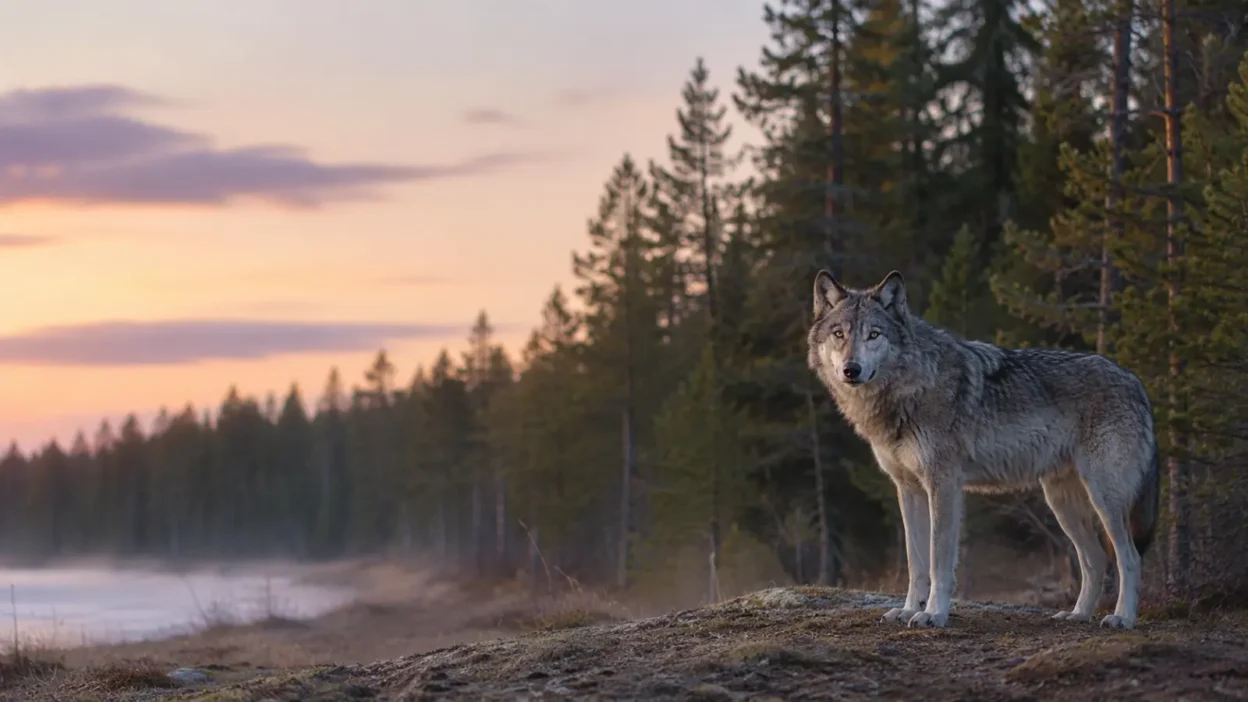
The wolf symbolism meaning most Americans meet today is a mix of loyalty, independence, instinct, protection, and wild freedom. It can also carry darker meanings, such as danger, deception, loneliness, or fear of what lives outside human control.
That double meaning is part of why wolves stay so memorable. A wolf can look like a devoted pack member in one setting and a threat in another. The symbol changes depending on whether it appears in a tattoo, a dream, a sports logo, a myth, a religious metaphor, or a conservation story.
In the United States, the wolf also carries a real history. Wolves were feared, hunted, nearly removed from much of their range, then later became symbols of wilderness restoration and ecological balance. That history makes the symbol more complicated than a simple “good” or “bad” meaning.
Quick Answer
In modern U.S. culture, wolf symbolism meaning most often points to loyalty, instinct, family bonds, protection, independence, and a strong connection to the wild. Historically, wolves have also symbolized danger, hunger, deception, and forces beyond human control, especially in European folklore and religious metaphor.
TL;DR
- Wolves often symbolize loyalty, instinct, and protection.
- The lone wolf means independence, not simple superiority.
- Wolf meanings can be positive or threatening.
- Indigenous wolf meanings vary by specific nation.
- The “alpha wolf” idea is often oversimplified.
- Modern wolf symbols appear in tattoos, logos, and fantasy.
What a Wolf Symbolizes Today
Today, the wolf most often symbolizes loyalty, instinct, protection, freedom, and strength. These meanings come from the way people observe wolves: they live in groups, defend territory, communicate through howls, and move through wild landscapes.
At the same time, wolves can symbolize fear, hunger, threat, and deception. This side comes from older stories where wolves were seen as dangerous predators near farms, flocks, villages, and dark woods.
The meaning depends on context.
| Wolf Image | Common Meaning | Best Reading |
|---|---|---|
| Wolf pack | Loyalty, family, teamwork | Connection and shared survival |
| Lone wolf | Independence, self-reliance | Strength, but also separation |
| Howling wolf | Voice, warning, longing | Communication across distance |
| Wolf eyes | Instinct, watchfulness | Awareness and inner alertness |
| Snarling wolf | Threat, defense, aggression | Boundary, fear, or conflict |
A wolf is rarely a flat symbol. It usually sits between two ideas: belonging and independence, care and danger, wisdom and wildness.
That is why the same wolf image can feel comforting to one person and unsettling to another.
Why Real Wolf Behavior Shaped the Symbol
Wolf symbolism did not appear from nowhere. It grew from what people noticed about real wolves.
Wolves hunt, travel, raise young, communicate, and defend territory in ways that are easy for humans to turn into meaning.
Still, symbolic meaning is not the same as animal science.
A wolf tattoo that means “loyalty” is not a biology lesson. A dream about a wolf is not proof that wolves carry a message. A mythic wolf is not the same thing as a living animal. Good symbolism respects the animal while also recognizing that humans add layers of meaning.
In simple terms, wolves became symbols because they are close enough to humans to feel familiar, but wild enough to feel mysterious.
Pack Loyalty, Family, and Community
The most common positive meaning of the wolf is loyalty. This comes from the wolf pack.
In popular language, “pack” often means any tight group. Friends call themselves a pack. Families use wolf imagery to show protection. Teams use wolves to suggest cooperation and endurance.
The appeal is easy to understand. A wolf pack suggests:
- staying close to your people
- protecting the vulnerable
- working together under pressure
- surviving through cooperation
- knowing where you belong
This is why wolf symbols are common in family tattoos, couple tattoos, team mascots, and group identities. The wolf becomes a shorthand for “I protect mine.”
But the symbol also has limits. Real wolf packs are not perfect human families in animal form. They do not exist to teach people moral lessons. The loyalty meaning is a human interpretation based on real social behavior, not a direct message from nature.
That distinction matters. It keeps the symbol grounded.
The Lone Wolf: Independence With a Catch
The lone wolf is one of the most popular wolf symbols in the United States. It usually means independence, self-reliance, privacy, survival, and the ability to walk your own path.
People use it when they feel different from the crowd. It can express a quiet kind of strength: “I can stand alone if I have to.”
But the lone wolf idea is often misunderstood.
In nature, a lone wolf is often a wolf away from its pack, sometimes searching for a mate, territory, or a new start. That makes the symbol more interesting. It is not only about rejecting others. It can also be about transition.
A lone wolf can mean:
- leaving an old group
- surviving a lonely season
- becoming self-reliant
- searching for a new home
- choosing distance for protection
Modern culture often turns the lone wolf into a fantasy of total independence. A better reading is more balanced. The lone wolf can be strong, but it can also be vulnerable. It may represent courage, but also isolation.
That tension is what gives the symbol depth.
Protection, Territory, and the Edge of Danger
Wolves can symbolize protection because they defend their young, their group, and their territory. This is why wolf imagery often feels watchful and guarded.
A wolf at the edge of a forest can look like a guardian. A wolf’s eyes can suggest awareness. A howling wolf can feel like a warning or a call to gather.
But protection can quickly turn into danger.
For farmers, shepherds, and people living near livestock, wolves were not only poetic animals. They were real predators. In stories from many parts of Europe and colonial America, the wolf became a figure of hunger outside the fence.
This is why wolves can mean both guardian and threat. The same traits create both meanings:
- sharp senses can mean wisdom or suspicion
- strong jaws can mean survival or violence
- pack loyalty can mean family or mob danger
- territory can mean home or exclusion
- wildness can mean freedom or fear
The wolf often marks a boundary. It asks who belongs, who is protected, and who is outside the circle.
Wolves in U.S. History: From Fear to Restoration
In the United States, wolf symbolism is tied to the history of settlement, livestock, wilderness, and conservation.
As European settlers expanded across North America, wolves were often treated as enemies of farms and ranches. They were seen as threats to livestock and as symbols of an untamed landscape that had to be controlled. This fear helped justify trapping, poisoning, bounties, and large-scale eradication campaigns.
By the twentieth century, wolves had been removed from much of the lower 48 states. That loss changed the animal’s meaning.
As conservation ideas grew, the wolf slowly became a symbol of wilderness, ecological balance, and the cost of trying to dominate nature. In places like Yellowstone, wolf restoration became more than a wildlife story. It became a national symbol of bringing back a missing predator and rethinking old fear.
This shift is important for U.S. readers. In American culture, the wolf is not only a mythic creature. It is also a real animal caught in debates over ranching, public land, endangered species, hunting laws, and the meaning of wild places.
That is why wolf symbolism can feel political without being tied to one party. It touches a larger question: how much wildness should modern life make room for?
Native American and Indigenous Wolf Meanings Need Specificity
Many Native American and Indigenous traditions include wolves in stories, clan systems, names, teachings, and art. In some communities, wolves may be connected with family, hunting, courage, guidance, protection, or kinship with the animal world.
But it is not accurate to say “the wolf means one thing in Native American culture.”
There are hundreds of Native nations, each with its own languages, histories, places, ceremonies, and stories. A wolf meaning in one community should not be treated as a universal Native meaning.
This is especially important because modern internet culture often borrows terms like “spirit animal” in a casual way. For many Native educators and communities, that can flatten living traditions into a personal aesthetic. Animal relationships in Indigenous contexts can involve clan identity, oral history, sacred responsibility, family stories, or community-specific teachings.
A respectful article should say this clearly: wolf imagery may be meaningful in many Indigenous traditions, but those meanings belong to specific peoples and contexts.
For a general U.S. reader, the safest approach is to avoid claiming Native authority unless you are referring to a specific nation, story, artist, or community source. Admiration is not the same as ownership.
European Stories: Rome’s She-Wolf, Fenrir, and Werewolves
European traditions give the wolf some of its most famous mixed meanings.
In Roman legend, a she-wolf nurses the abandoned twins Romulus and Remus, who are later connected with the founding of Rome. In that story, the wolf is not only dangerous. She is protective, maternal, and tied to origin.
In Norse mythology, the wolf Fenrir has a very different role. Fenrir is a monstrous wolf linked with fear, binding, and destruction during the end-time events of Ragnarök. Here, the wolf becomes a force too great for the gods to safely ignore.
European folklore also gives us the werewolf. Werewolf stories turn the wolf into a symbol of the human fear of losing control. The danger is not only outside in the forest. It is inside the person who transforms.
Christian language added another major layer. Phrases like “wolves in sheep’s clothing” use the wolf as a metaphor for false goodness, hidden danger, or spiritual deception.
These traditions shaped how many Americans inherited wolf imagery. The wolf became both mother and monster, protector and predator, outsider and mirror.
Spiritual, Dream, and Omen Readings
Modern spiritual readings often treat the wolf as a symbol of instinct, intuition, inner guidance, and personal truth. These meanings are popular in dream interpretation, meditation, oracle-style writing, tattoo culture, and social media.
They can be meaningful for individuals. But they should be framed as belief or interpretation, not proven fact.
Common modern readings include:
- A wolf in a dream may suggest fear, instinct, loneliness, or protection.
- A howling wolf may suggest the need to speak or be heard.
- A wolf pack may suggest support, pressure, or group identity.
- A black wolf may suggest shadow, danger, or hidden emotion.
- A white wolf may suggest guidance, rarity, or spiritual clarity.
These meanings are not fixed. A dream about being chased by a wolf does not mean the same thing as dreaming of walking beside one. The feeling of the dream matters. So does the person’s background, fear, memory, and culture.
In omen traditions, seeing or hearing a wolf may be read as a warning, guide, or sign of change. In a modern article, it is best to call that folklore or personal belief. It is not evidence that the animal is sending a universal message.
Wolf Tattoos, Jewelry, and Personal Identity
Wolf tattoos are popular because they can hold several meanings at once. A person may choose a wolf tattoo for loyalty, survival, family, grief, independence, protection, or connection to nature.
The design changes the meaning.
A wolf pack tattoo often points to family or chosen family. A lone wolf tattoo usually means independence or surviving alone. A howling wolf can suggest voice, longing, grief, or a call to one’s people. A wolf with a moon often adds mystery, night, cycles, or feminine-coded symbolism, though those meanings are modern and flexible.
Wolf jewelry and clothing work in a similar way. A small wolf pendant can feel protective. A wolf ring can suggest strength. A graphic wolf hoodie may simply signal wilderness, fantasy, gaming culture, or personal style.
The best tattoo meaning is personal but honest. A wolf design does not need an ancient origin to matter. It can mean, “I stayed loyal,” “I survived,” “I protect my family,” or “I trust my instincts.”
Where caution helps is cultural borrowing. If a design uses specific Indigenous patterns, sacred imagery, ceremonial objects, or tribal labels without connection or permission, the meaning becomes more complicated. A simple wolf is one thing. Copying living cultural symbols is another.
Wolves in Decor, Branding, Sports, and Pop Culture
In modern U.S. life, wolves appear everywhere: school mascots, sports teams, fantasy novels, outdoor brands, video games, tattoos, wall art, and social media usernames.
In branding, the wolf often suggests toughness, independence, wilderness, strategy, or group loyalty. Outdoor companies use wolves to signal rugged nature. Sports teams use wolves to suggest speed, teamwork, and controlled aggression. Fantasy stories use wolves as companions, monsters, shapeshifters, or signs of ancient power.
Home decor often softens the wolf. A wolf print in a bedroom or cabin may mean wilderness, solitude, protection, or a love of nature. A wolf-and-moon image often leans more mystical or gothic, especially online.
Pop culture keeps changing the symbol. A wolf can be a villain, a loyal companion, a werewolf love interest, a family crest, a warrior emblem, or an environmental icon. These uses are not ancient meanings. They are modern adaptations.
That does not make them fake. Symbols grow through reuse. The key is knowing the difference between older folklore and newer style.
Misuse, Oversimplification, and How to Read the Symbol Well
The wolf is easy to oversimplify.
One common problem is the “alpha wolf” idea. In modern culture, “alpha” is often used to mean aggressive dominance, emotional hardness, or control over others. That is a poor way to understand wolves and an even worse way to understand healthy human leadership.
Another problem is treating all wolf meanings as ancient, sacred, or universal. They should not be blended into one grand claim.
A third problem is cultural borrowing. Wolf imagery connected to a specific Indigenous community, clan, story, or ceremony should not be copied as a costume, tattoo trend, or vague spiritual badge.
There is also the fear-based misuse of wolves. Calling a person a wolf can suggest predation, deceit, or violence. Calling an isolated attacker a “lone wolf” can make real harm sound mythic or dramatic. In those cases, the phrase can distort both people and animals.
A better way to read wolf symbolism is to ask three questions:
- What setting is the wolf in?
- Who is using the symbol?
- Is the meaning historical, cultural, spiritual, personal, or decorative?
That keeps the wolf from becoming a blank shape for any meaning we want. It also makes the symbol more useful.
FAQs
What does a wolf symbolize most often?
A wolf most often symbolizes loyalty, instinct, protection, freedom, and strong family or group bonds. In some contexts, it can also symbolize danger, hunger, deception, or fear of the wild.
Is wolf symbolism positive or negative?
It can be either. A wolf may represent devotion and courage in a tattoo, but threat or deception in a religious metaphor or fairy tale.
What does a lone wolf symbolize?
A lone wolf usually symbolizes independence, self-reliance, privacy, or walking a difficult path alone. A balanced reading also includes isolation, transition, and the search for a new place to belong.
What does a wolf tattoo mean?
A wolf tattoo often means loyalty, survival, protection, instinct, or personal strength. The design matters: a pack suggests family, a lone wolf suggests independence, and a howling wolf can suggest voice or longing.
What does a wolf mean spiritually?
In modern spiritual interpretation, a wolf often represents intuition, guidance, instinct, courage, and trust in one’s inner voice. This is a belief-based reading, not a single proven meaning across all traditions.
What does the wolf mean in Native American culture?
There is no single Native American wolf meaning. Some Native nations have wolf stories, clans, or teachings, but meanings vary by community and should be described with specificity and respect.
Is the “alpha wolf” meaning accurate?
The popular “alpha wolf” meaning is often oversimplified. It is better to understand wolf leadership through family structure, cooperation, experience, and survival rather than pure aggression or domination.
Conclusion
The wolf is one of the clearest examples of a symbol with two sides. It can represent loyalty, family, protection, instinct, and freedom. It can also represent danger, hunger, deception, exile, or fear of the wild.