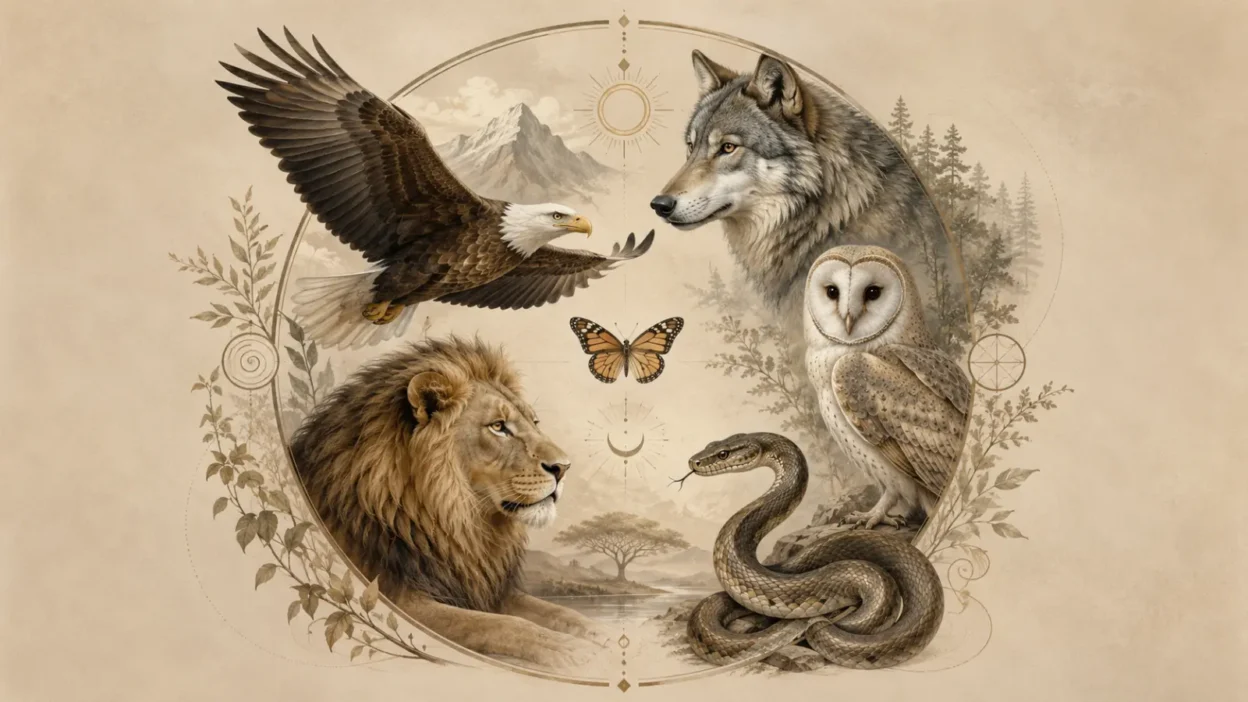
Animals are easy to recognize, but their meanings are not always simple. The meaning of animal symbols depends on the animal, the culture, the time period, and the way the image is used.
In the United States today, animal symbols often point to traits people admire or fear. A lion may suggest courage. An owl may suggest wisdom. A snake may suggest danger, healing, rebirth, or temptation, depending on the setting.
People care about animal symbolism because animals appear everywhere: tattoos, sports teams, school mascots, flags, jewelry, home decor, children’s books, religious art, brand logos, and social media. These images feel familiar, but they often carry older layers of meaning.
The safest way to read an animal symbol is to ask three questions: What animal is shown? Where is it shown? Who is using it?
Quick Answer
In modern U.S. culture, the meaning of animal symbols usually centers on human traits such as strength, freedom, wisdom, loyalty, transformation, protection, or danger. These meanings often grew from animal behavior people noticed, myths and religious stories, folklore, art, and later uses in tattoos, brands, mascots, and popular culture.
TL;DR
- Animal meanings depend on context.
- Most symbols come from observed traits.
- Religion and folklore shaped many meanings.
- Tattoos often make symbols personal.
- U.S. culture uses animals in mascots and logos.
- “Spirit animal” language needs cultural care.
What Animal Symbols Usually Mean Today
Animal symbols most often work as shorthand for human qualities. People use animals to express a value, mood, role, warning, memory, or identity.
A bear may stand for protection. A fox may suggest cleverness. A butterfly may point to change. A dove often represents peace. A wolf may suggest loyalty, wildness, danger, or belonging to a pack.
These meanings are not fixed laws. They are cultural habits. A single animal can carry very different meanings depending on whether it appears in a church window, a tattoo, a school mascot, a fantasy novel, a political cartoon, or a family crest.
In the United States, animal symbols often become personal. A person may choose a raven tattoo because they love mystery, grief imagery, intelligence, or a favorite story. Another person may choose it because ravens appear in a spiritual or family tradition. The image is the same, but the meaning changes with the person and context.
That is why animal symbolism should not be read as a code with one answer. It is closer to a language with patterns, accents, and local meanings.
Why Humans Turn Animals Into Symbols
People have lived beside animals for all of human history. Animals provided food, labor, clothing, warning, companionship, fear, wonder, and stories. It makes sense that people began using animals to explain human life.
Animal symbolism usually develops from a few sources:
- Visible traits: wings, claws, horns, scales, fur, eyes, speed, size, or color.
- Perceived behavior: hunting, nesting, migration, hibernation, guarding, or group life.
- Human emotion: fear of predators, affection for pets, awe toward large animals.
- Stories: myths, fables, religious images, legends, and folktales.
- Social use: flags, coats of arms, logos, team mascots, tattoos, and fashion.
A bird can become a symbol of freedom because it flies. A turtle can become a symbol of patience or endurance because it moves slowly and lives long. A snake can become a symbol of renewal because it sheds its skin.
But symbolism is not the same as biology. Symbolism tells us more about human interpretation than about the animal itself.
The Main Animal Meanings People Recognize Most Often
Many animal symbols have broad meanings that U.S. readers recognize quickly. These meanings are common, but they are not universal. They should be treated as starting points, not final answers.
| Animal | Common modern meaning | Why the meaning developed |
|---|---|---|
| Lion | Courage, leadership, pride | Size, strength, royal imagery, heroic stories |
| Owl | Wisdom, watchfulness, mystery | Night vision, quiet movement, ancient associations |
| Snake | Danger, healing, renewal, temptation | Venom, skin-shedding, religious and medical imagery |
| Butterfly | Transformation, beauty, fragile change | Metamorphosis from caterpillar to winged adult |
| Wolf | Loyalty, instinct, wildness, pack identity | Group hunting, social structure, wilderness stories |
| Eagle | Freedom, vision, national identity | Flight, high sight, U.S. national symbolism |
This table shows why animal symbols can feel clear at first. A visible trait becomes a human idea. Over time, art, stories, and public use repeat that idea until it feels natural.
Still, each meaning has limits. A lion can symbolize courage in one place and danger in another. A snake can be feared in one story and honored as a healing sign in another. A butterfly can mean joy, grief, hope, or short life, depending on the setting.
Ancient Roots: Survival, Myth, and Sacred Animals
Animal symbolism began long before modern books and websites tried to define it. Early people depended on animals and watched them closely. Hunting animals, herd animals, birds, reptiles, insects, and sea creatures all shaped how communities understood the world around them.
Some early animal images may have been tied to hunting, memory, ritual, teaching, or storytelling. It is tempting to give every ancient animal image a clear symbolic meaning, but that can go too far. Ancient art does not always come with an explanation. Sometimes scholars can make careful arguments. Sometimes the meaning remains uncertain.
Myths gave animals even more symbolic range. Animals could become messengers, helpers, monsters, tricksters, creators, guardians, or tests of courage. In many stories, an animal is not only an animal. It carries a lesson about power, desire, danger, wisdom, death, or the boundary between humans and the natural world.
Sacred animal meanings also vary widely. Some traditions honor animals as relatives, teachers, divine companions, or signs of a spiritual order. Others use animal images to explain moral ideas. These meanings belong to living traditions and should not be flattened into a simple “animal meaning chart.”
A respectful article can describe broad patterns. It should not pretend that one animal has the same sacred meaning everywhere.
Medieval and Religious Animal Symbolism
In medieval European art, animals often carried moral and religious meanings. Bestiaries, which were books about animals, mixed real creatures, imagined creatures, inherited lore, and religious lessons. They were not modern biology books. They were moral and spiritual reading.
A lamb could point to innocence or sacrifice. A lion could suggest royal strength or spiritual victory. A serpent could suggest danger, sin, healing, or wisdom, depending on the religious setting. Fantastic creatures such as dragons, unicorns, and basilisks also appeared as symbols, even when people disagreed about whether they were real.
Religious animal symbolism is not limited to Christianity. Across many traditions, animals appear in stories, rituals, art, and sacred teaching. They may represent divine qualities, moral lessons, cosmic forces, or relationships between humans and the living world.
The important point is context. A bird in a religious painting may not mean the same thing as a bird on a necklace. A snake in a medical sign, a Bible story, a Hindu image, a Greek myth, and a tattoo can carry different meanings.
Religious symbols should be handled with care because they are not only decorative. For many people, they remain part of worship, memory, ancestry, and identity.
Folklore, Omens, and Superstition
Animal symbolism also lives in folklore. These meanings often come from local stories, weather beliefs, luck beliefs, warnings, and sayings passed through families or regions.
Some examples are familiar in the United States:
- A black cat may be treated as unlucky in some settings, but loved as a pet or Halloween image in others.
- A cardinal may be interpreted by some people as a comforting sign after a death, though this is a belief rather than a proven fact.
- A crow or raven may suggest death, intelligence, prophecy, or mystery, depending on the story.
- A rabbit’s foot has been used as a luck charm, though the practice also raises animal welfare and cultural-history questions.
- A groundhog has become tied to seasonal prediction through a popular American tradition.
Folklore should be described as folklore. It can be meaningful to people without being factual proof that an animal is sending a message.
The same caution applies to dreams. If someone dreams of a wolf, snake, horse, or bird, the meaning depends on the dreamer’s emotions, memories, culture, and situation. Dream symbolism can be useful for reflection, but it should not be treated as a fixed prediction.
Animal Symbols in Modern U.S. Culture
In the United States, animal symbols are part of public life. The bald eagle is linked with national identity, freedom, strength, and high vision. The donkey and elephant are tied to political parties. School and sports mascots use animals to suggest speed, toughness, pride, teamwork, or local identity.
Brands also rely on animal meanings. A horse can suggest motion and status. A jaguar can suggest speed and sleek design. A dog can suggest loyalty and trust. A bird can suggest lightness, communication, or reach.
These uses work because animal symbols are fast. A logo has only a moment to communicate. A mascot has to create emotion in a crowd. An animal can do that quickly because people already carry associations with it.
Modern U.S. animal symbolism is often less about ancient belief and more about identity. It asks, “What do we want to be seen as?”
Animal Tattoos, Jewelry, and Personal Identity
Animal tattoos are one of the clearest ways people personalize symbolism today. A tattoo can draw from tradition, but it can also mark a private story.
A butterfly tattoo may honor survival after change. A wolf may represent family loyalty. A bear may stand for protection, motherhood, or endurance. A snake may mark healing, danger, rebirth, or a hard season of life. A pet portrait may symbolize grief, love, companionship, or memory.
Jewelry works in a similar way. A small bird pendant may mean freedom to one person and remembrance to another. A bee charm may suggest hard work, community, sweetness, or environmental concern. A dragon ring may suggest fantasy, protection, power, or cultural heritage.
The best animal tattoos and jewelry designs are specific. They do not rely only on a generic meaning list. They consider pose, style, expression, placement, cultural background, and personal reason.
A roaring wolf and a resting wolf do not say the same thing. A coiled snake and a healing snake around a staff do not say the same thing. A realistic eagle and a cartoon eagle carry different tones.
Animal symbolism becomes stronger when the design matches the meaning.
Home Decor, Fashion, Digital Culture, and Aesthetic Reuse
Animal symbols also appear in softer, more decorative forms. Owls show up in libraries, nurseries, and fall decor. Butterflies appear in fashion, phone cases, wall art, and memorial designs. Bees appear in kitchen decor, garden themes, jewelry, and environmental messaging.
In these settings, the meaning can become lighter. A leopard print shirt may suggest confidence or glamour rather than the animal itself. A ceramic fox on a shelf may feel playful more than mythic. A butterfly emoji may mean beauty, change, softness, or simply a pretty mood.
Digital culture speeds up this process. Animal emojis, memes, avatars, stickers, and usernames turn animals into quick identity signals. A person may use a frog, cat, wolf, rabbit, snake, or crow online for humor, personality, fandom, or aesthetic style.
This does not make the symbolism fake. It means the symbol has moved into a new setting. Modern symbols often carry several layers at once: old folklore, pop culture, personal taste, and visual mood.
That is why a design can be meaningful without being ancient. Not every meaningful animal symbol needs a sacred origin.
When Animal Symbolism Gets Oversimplified or Misused
Animal symbolism becomes weak when it turns complex traditions into simple personality labels. It becomes harmful when it borrows sacred images without understanding their meaning.
One common issue in U.S. culture is casual “spirit animal” language. Some people use the phrase to mean “something I relate to,” as in calling a celebrity, snack, or pet their spirit animal. But in many Indigenous contexts, relationships with animals can be sacred, specific, and tied to community, ceremony, family, clan, or story. Using the phrase casually can trivialize those traditions.
A better approach is to use plain language: “I relate to this animal,” “this animal inspires me,” or “this animal represents a quality I value.”
Oversimplification also happens when people claim an animal means one thing everywhere. That is rarely true. A snake is not only evil. A wolf is not only loyal. A crow is not only death. A lion is not only courage.
Other problems include:
- Treating endangered animals only as dramatic symbols while ignoring real conservation issues.
- Using animal mascots to promote aggression without care for animal reality.
- Copying sacred or clan-based imagery as decoration.
- Calling any animal symbol “ancient” without evidence.
- Mixing unrelated traditions into one vague spiritual meaning.
Responsible symbolism does not remove wonder. It makes the meaning more honest.
How to Interpret an Animal Symbol Responsibly
To understand an animal symbol, start with context. The animal alone is only part of the message.
Ask these questions:
- Where does the symbol appear?
- Is it religious, decorative, commercial, personal, political, or folkloric?
- Who made it?
- Who is using it now?
- Is the meaning documented, traditional, popular, or personal?
- Does the symbol come from a living culture that deserves special care?
- Is the animal shown as calm, fierce, wounded, flying, guarding, hunting, or transforming?
The same animal can shift meaning through posture, color, style, and setting. A white dove at a wedding feels different from a dark bird in a gothic illustration. A snake in a hospital symbol feels different from a snake in a warning sign. A bear in a child’s room feels different from a bear on a warning placard.
Good interpretation leaves room for nuance. It says, “In this context, this animal often suggests…” instead of “This animal always means…”
That small change keeps animal symbolism clear, respectful, and useful.
FAQs
What do animal symbols usually represent?
Animal symbols usually represent traits people connect with an animal, such as strength, freedom, wisdom, loyalty, protection, danger, or transformation. These meanings often come from observed traits, stories, religious images, folklore, and modern reuse.
Are animal meanings the same in every culture?
No. Animal meanings change across cultures, religions, regions, and time periods. A snake, owl, wolf, or crow may be honored in one context and feared in another.
What do animal tattoos mean?
Animal tattoos often represent personal identity, memory, survival, protection, grief, family, or a trait the wearer values. The meaning depends on the animal, design style, pose, placement, and the person’s reason for choosing it.
What animals symbolize strength?
Lions, bears, bulls, elephants, horses, eagles, and tigers are often used as strength symbols. The exact meaning can shift from physical power to courage, endurance, leadership, or protection.
Is animal symbolism spiritual?
It can be, but it is not always spiritual. Some animal symbols come from religion or sacred tradition, while others come from folklore, art, branding, sports, personal taste, or internet culture.
Is it okay to say “spirit animal”?
In casual U.S. speech, many people use the phrase loosely, but it can be disrespectful because animal relationships in some Indigenous traditions are sacred and specific. A safer choice is to say, “I relate to this animal,” or “this animal represents something important to me.”
Can an animal symbol have both positive and negative meanings?
Yes. Many animal symbols carry mixed meanings. A snake can suggest danger, healing, rebirth, or temptation; a wolf can suggest loyalty, wilderness, fear, or family; a crow can suggest death, intelligence, mystery, or warning.
Conclusion
Animal symbols remain useful because they connect human ideas to visible life. We see wings, claws, eyes, fur, scales, speed, patience, danger, and care, then turn those traits into stories about ourselves.