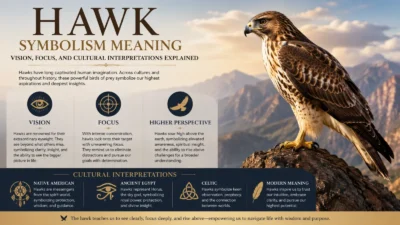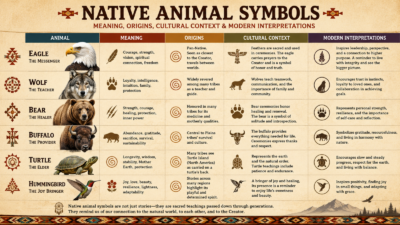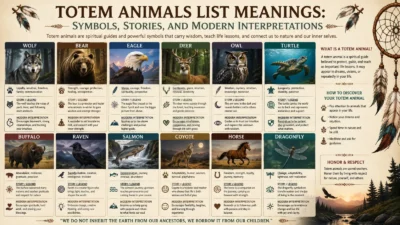
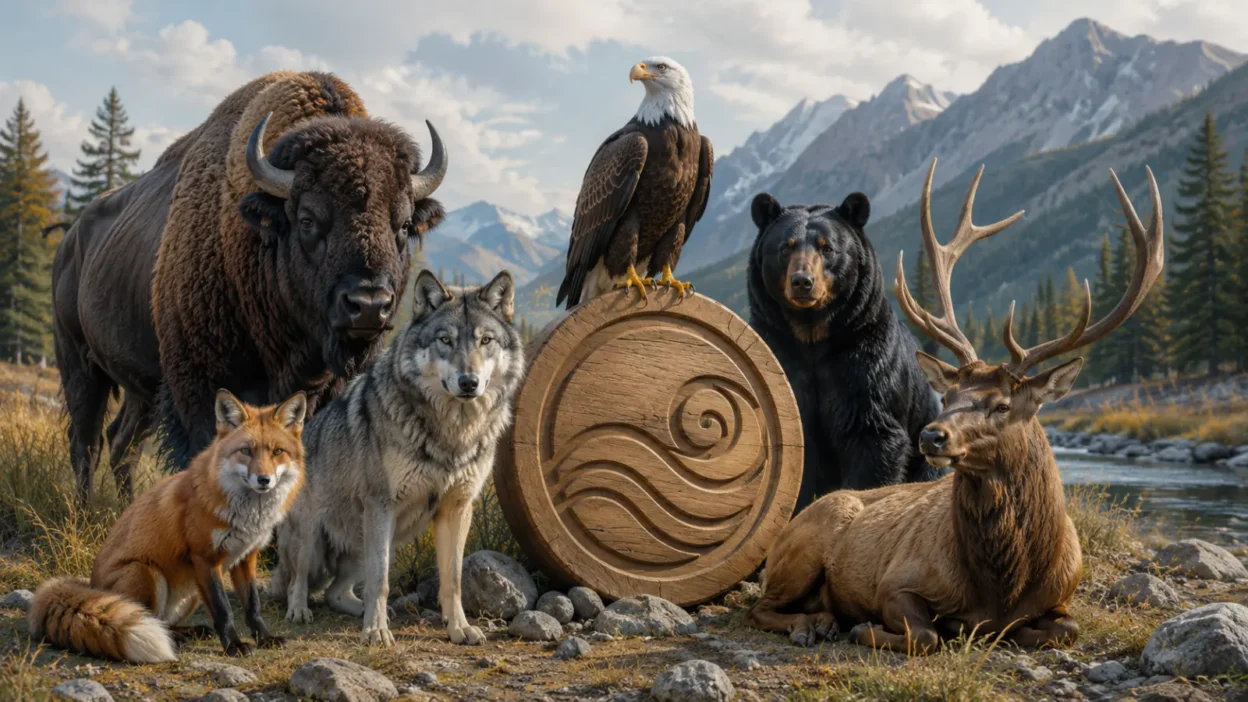
People search for animal totem meanings for many reasons. Some want to understand a repeated animal encounter. Others are choosing a tattoo, reading a dream, or trying to name a quality they admire in themselves.
An animal totem is usually understood today as an animal symbol that reflects traits, guidance, protection, identity, or a personal connection with nature. But the word “totem” also has deeper cultural and historical roots. It is not just a poetic name for a favorite animal.
Quick Answer
Animal totem meanings most commonly symbolize personal guidance, identity, protection, instinct, and traits people associate with a specific animal. Historically, totems have also been tied to kinship, clan identity, ancestry, and community relationships, so modern personal readings should be separated from culturally specific traditions.
TL;DR
- Animal totems often reflect admired animal traits.
- Historical totems are tied to kinship and identity.
- Meanings vary by culture, not by universal rule.
- Modern use is common in tattoos and decor.
- “Spirit animal” language can be culturally sensitive.
- Dreams and omens are belief-based interpretations.
What “Animal Totem” Means in Modern Symbolism
In modern U.S. symbolism, an animal totem usually means an animal that represents a person’s character, values, instincts, or life lessons. Someone may connect with the wolf because of loyalty and group bonds. Another person may choose the bear because it suggests protection and inner strength.
This modern use is often personal. It does not always come from a formal religious system or inherited community role. A person may choose an animal because it appears in dreams, shows up during a hard season, reminds them of a loved one, or reflects a quality they want to develop.
That does not make the meaning fake. Personal symbolism can be meaningful. But it should be named honestly as personal interpretation, not as proof that an animal has one fixed message for everyone.
A grounded way to define an animal totem is this: it is an animal used as a symbol of relationship, identity, guidance, memory, or character. The key word is symbol. The animal stands for something, but what it stands for depends on cultural context, personal experience, and the way the animal is being used.
Why Animals Become Symbols
Animals become symbols because people notice them. We watch how they move, hunt, protect, migrate, nest, hide, sing, shed skin, or survive winter. Over time, those visible traits turn into stories and meanings.
A bear may become linked with strength because it is large, physically powerful, and protective of its young. A fox may suggest cleverness because it is hard to catch and often appears in stories as quick-thinking. A butterfly may symbolize change because its life cycle visibly transforms from caterpillar to winged insect.
These links are not random, but they are also not scientific proof of human destiny. They are symbolic associations. People take something they observe in the natural world and use it to talk about human life.
Animal meanings usually develop from a few sources:
- Visible traits, such as wings, claws, shells, horns, or bright colors.
- Behavior, such as migration, hunting, nesting, hibernation, or cooperation.
- Human need, such as food, protection, companionship, warning, or awe.
- Storytelling, including folklore, myth, family stories, and moral lessons.
- Repeated cultural use, such as flags, mascots, tattoos, and logos.
This is why one animal can have several meanings. The snake can symbolize danger, healing, renewal, temptation, wisdom, or fear, depending on the setting. The owl can mean wisdom in one context and death or warning in another. Symbolism changes when the story changes.
Historical Roots: Totems, Kinship, and Clan Identity
The word “totem” is often used casually today, but historically it is connected to systems of kinship, relationship, and group identity. In many traditions, a totem is not simply a favorite animal. It can be tied to family, clan, ancestry, social rules, responsibilities, and stories passed through a community.
This is especially important when discussing Indigenous traditions. Different Native nations have different histories, languages, beliefs, and forms of animal relationship. There is no single “Native American animal totem system” that applies to all tribes.
Totem poles are a common source of confusion. Many Americans recognize tall carved poles with animals and human figures, but those poles belong especially to certain First Nations and Indigenous peoples of the Pacific Northwest Coast. They can commemorate ancestry, rights, events, histories, family crests, or community stories. They are not simple charts where each animal always means one thing.
This is where many modern articles go wrong. They take a culturally specific word and turn it into a universal personality test. A more responsible approach is to say that animal totems, in a broad modern sense, can be personal symbols, while historical totem systems often belong to specific communities and cannot be reduced to a list.
Animal Totems Are Not the Same as Generic “Spirit Animals”
Many people use “animal totem,” “spirit animal,” and “power animal” as if they mean the same thing. In popular writing, they often overlap. All three may refer to an animal that seems to guide, protect, teach, or mirror a person.
Still, the terms do not carry the same weight in every setting. “Spirit animal” has become a casual phrase in the United States, sometimes used jokingly for a celebrity, snack, mood, or favorite pet. That casual use can feel harmless to some people, but it can also trivialize Indigenous relationships with animals when it borrows sacred-sounding language without context.
A safer distinction is this:
An animal totem is often used as a symbolic animal connected with identity, ancestry, group relationship, or personal meaning.
A spirit animal is often used in modern popular culture to mean a personal spiritual guide, though the term can be culturally sensitive.
A power animal is often used in some modern spiritual and neo-shamanic settings to describe an animal helper or source of inner strength.
These terms are not interchangeable in all traditions. If you are speaking about your own personal symbolism, simple wording is often better. You can say, “I feel connected to wolves,” or “The owl is meaningful to me,” without claiming a sacred role you do not belong to.
Common Animal Totem Meanings and Why They Developed
Animal meanings are best read as patterns, not rules. The same animal can carry different meanings across cultures and personal experiences. Still, some modern associations appear often because they grow from visible traits, familiar stories, and repeated cultural use.
| Animal | Common symbolic reading | Why it developed | Caution |
|---|---|---|---|
| Bear | Strength, protection, rest | Size, power, hibernation, care for young | Not only a “warrior” symbol |
| Wolf | Loyalty, instinct, community | Pack life, hunting, vocal communication | Avoid reducing wolves to aggression |
| Eagle | Vision, freedom, authority | Flight, height, sharp sight | Sacred meanings vary by tradition |
| Owl | Wisdom, mystery, warning | Night vision, silence, nocturnal habits | Can mean death or omen in some folklore |
| Snake | Renewal, danger, healing | Shedding skin, venom, underground movement | Meanings are highly context-dependent |
| Butterfly | Change, hope, rebirth | Metamorphosis and delicate movement | Often modern and personal, not universal |
These meanings work best when you ask why the animal came to mean something. A wolf is not loyal because a chart says so. It became linked with loyalty because humans observed social bonds within packs and then turned that observation into a human lesson.
Context decides the meaning.
How U.S. Readers Encounter Animal Totems Today
Most Americans encounter animal totems through modern personal symbolism rather than formal clan systems. The animal appears as an image, not always as a living religious or social relationship.
Common places include tattoos, necklaces, wall art, oracle cards, meditation journals, sports teams, school mascots, military insignia, brand logos, video games, fantasy books, and social media posts. In each case, the animal carries a slightly different kind of meaning.
A tattoo tends to be intimate. A mascot is public and group-based. A logo is designed to be memorable. A dream symbol is private. A piece of home decor may be mostly aesthetic, even if the buyer also likes the animal’s meaning.
This is why interpretation should begin with use. Ask where the animal appears and who is using it. A lion on a family crest, a lion in a children’s book, and a lion tattoo after surviving an illness may all suggest courage, but they are not the same symbol in the same way.
Modern U.S. use also favors self-expression. People often choose animals that match the traits they want to claim: independence, calm, intelligence, courage, resilience, beauty, speed, or transformation. That is a valid symbolic practice when it is presented as personal meaning rather than inherited sacred knowledge.
Tattoo, Jewelry, and Decor Meanings
Animal totem tattoos are popular because they turn a private value into a visible mark. A person may choose a bear for protection, a raven for mystery, a deer for gentleness, or a snake for survival after change.
The best tattoo meanings are specific. “Wolf means loyalty” is a start, but it is thin. “A wolf reminds me of family, endurance, and learning to trust my instincts” is more meaningful and less generic.
Jewelry and decor work in a similar way. A small owl pendant may signal wisdom or memory. A butterfly print may mark a season of change. A turtle figure may suggest patience, steadiness, or connection to water and earth.
Before using animal imagery, especially designs that imitate Indigenous carving, ceremonial objects, or sacred patterns, it is worth asking:
- Is this a general animal image or a copied cultural design?
- Do I know where the style comes from?
- Am I treating a living tradition as decoration?
- Could I choose a more neutral design that still holds my meaning?
- Am I claiming identity, clan, or ceremony that is not mine?
A personal symbol does not need to borrow sacred imagery to feel strong. A simple, original animal design can carry deep meaning without pretending to be something it is not.
Religious, Folklore, and Mythic Layers
Animals appear in religious stories, folklore, and myths around the world. They may act as messengers, tricksters, guardians, sacrifices, companions, warnings, or signs of divine power. But those roles are not the same in every tradition.
A raven may be a trickster in some stories and a sign of death in others. A dove may suggest peace in many Christian-influenced U.S. settings, while a serpent may carry meanings of temptation, healing, wisdom, or renewal depending on the source. A horse can mean freedom, nobility, travel, war, wealth, or partnership.
The mistake is to merge all these meanings into one universal message. That creates a false sense of certainty. It also erases the people who hold those stories as part of living culture.
A better approach is to treat religious and folklore meanings as layered. One layer may be ancient or traditional. Another may come from literature. Another may come from movies, tattoos, or modern spirituality. They can overlap, but they should not be treated as identical.
For U.S. readers, this matters because American culture often blends symbols quickly. A wolf can move from wildlife documentary to fantasy novel to tattoo to team logo to online identity badge. Each reuse changes the meaning a little.
Dreams, Omens, and Repeated Animal Sightings
Many people wonder whether seeing the same animal again and again is a sign.
These experiences can feel meaningful. They may help a person notice emotions, fears, hopes, or decisions they have been avoiding. But they should be framed as personal or belief-based interpretation, not as proven messages.
A grounded reading starts with ordinary context. Is the animal common in your area? Is it migration season? Did you recently watch, read, or talk about that animal? Your mind may be linking the animal to something already present in your life.
After that, you can ask what the symbol brings up emotionally. A hawk might make you think about perspective. A deer might suggest gentleness or alertness. A snake might point to fear, change, or healing. The meaning comes from the meeting between the animal, the moment, and the person interpreting it.
Dreams work the same way. A dream animal may reflect memory, emotion, anxiety, desire, or cultural symbolism. It does not need to be supernatural to be useful.
Misuse, Oversimplification, and Cultural Respect
The biggest problem with animal totem symbolism is not that people find animals meaningful. Humans have always done that. The problem is when broad claims erase specific cultures.
Examples include saying “all Native Americans believe,” copying totem pole figures for decor, using “tribal” designs with no knowledge of origin, inventing fake ceremonies, or treating clan systems as personality categories anyone can adopt. These uses flatten living traditions into a mood board.
It is also misleading to claim that every animal has one ancient meaning. Many meanings found online are modern combinations of folklore, psychology, spiritual writing, and personal interpretation. Some may be thoughtful. Others are invented or overconfident.
Respectful use does not require fear. It requires accuracy and humility.
A respectful reader should avoid:
- claiming membership in a clan or tradition without belonging to it
- copying sacred or ceremonial designs
- presenting online lists as ancient fact
- using “spirit animal” as a joke
- treating all Indigenous nations as one culture
- turning living traditions into costume, decor, or branding
Respect keeps the symbol honest.
How to Interpret an Animal Totem in a Grounded Way
A grounded interpretation begins with context. Before asking, “What does this animal mean?” ask, “Where is this meaning coming from?”
Start with the animal itself. What traits are visible? Does it fly, burrow, hunt, migrate, sing, shed, hide, carry a shell, move in groups, or live alone? Symbolism often begins with observation.
Then look at cultural context. Is the animal part of a religious story, national emblem, family tradition, local folklore, or personal memory? A bald eagle in the United States does not carry the same public meaning as a butterfly on a memorial necklace.
Next, separate belief from fact. It is fine to say, “Some people interpret owls as warnings.” It is not accurate to say, “Owls always predict death.” Careful language makes the interpretation stronger, not weaker.
A simple method can help:
- Name the animal.
- Notice its real traits.
- Identify your personal connection.
- Check whether the symbol belongs to a specific culture.
- Avoid universal claims.
- Choose the meaning that fits the context best.
This approach gives the reader room for meaning without turning symbolism into certainty.
FAQs
What does an animal totem symbolize?
An animal totem often symbolizes identity, guidance, protection, instinct, or a trait associated with a specific animal. In historical and cultural settings, it may also relate to kinship, ancestry, clan identity, or community responsibility.
Is an animal totem the same as a spirit animal?
In modern popular use, the terms often overlap, but they are not always the same. “Spirit animal” can be culturally sensitive when used casually, while “animal totem” may refer to personal symbolism or to culturally specific kinship and identity systems.
How do I find my animal totem?
A grounded approach is to notice animals that carry lasting personal meaning, not just animals you briefly like. Consider repeated emotional connections, family stories, dreams, local wildlife encounters, and the traits you associate with the animal.
What does an animal totem tattoo mean?
An animal totem tattoo usually represents a personal quality, memory, life change, or protective symbol. Its meaning depends on the animal, the design style, and the wearer’s reason for choosing it.
Can animal totem meanings be negative?
Yes, some animals carry warning, fear, death, trickery, or danger meanings in certain traditions or stories. Negative meanings are not universal, and they often depend on folklore, religion, personal experience, or the setting where the animal appears.
Are animal totems Native American?
Some Native nations have animal-related clan, kinship, story, or ceremonial traditions, but there is no single Native American system that applies to all tribes. Modern “animal totem” lists often blend many sources and should not be treated as direct Native teaching.
Is it disrespectful to use animal totem symbolism?
It depends on how it is used. Personal animal symbolism can be respectful, but copying sacred designs, joking about “spirit animals,” or claiming cultural roles that are not yours can be harmful or misleading.
Conclusion
Animal symbols help people talk about courage, change, instinct, memory, grief, protection, and belonging. They work because animals are real beings we observe, fear, admire, depend on, and imagine through story.