
Most people run into symbolism long before they learn the word for it. A green light in a story can suggest hope. A cracked mirror in a movie can hint at a broken identity. A white outfit at a public event can signal purity, mourning, protest, or status depending on the setting.
That is why symbolism techniques matter. They help writers, artists, filmmakers, and even brands give ordinary things a second layer of meaning. They also help readers and viewers notice when a detail is doing more than just sitting there.
For a U.S. audience, this is not only a school topic. Symbolism shapes novels, political speeches, tattoos, advertising, memorials, sports culture, and online imagery. The challenge is knowing when a symbol is meaningful, when it is just decorative, and when people are reading too much into it.
Quick Answer
Symbolism techniques usually symbolize a way of giving concrete things deeper meaning, most often to express emotion, identity, conflict, memory, or values without saying everything directly. In modern U.S. use, the main idea is not “secret meaning” but layered meaning: a symbol works because an object, color, gesture, or setting picks up emotional and cultural weight over time.
TL;DR
- Symbols link concrete details to larger ideas.
- Context matters more than fixed meanings.
- Repetition makes symbolism easier to notice.
- Symbolism is not the same as allegory.
- U.S. culture uses symbols far beyond literature.
- Overreading is a common mistake.
What symbolism techniques actually are
A symbol is something visible or concrete that points beyond itself. It might be an object, color, place, gesture, character trait, weather pattern, or repeated action. On the surface, it is still what it is. But in context, it also suggests something larger.
So symbolism techniques are the methods people use to build or read that second layer. A novelist may repeat a river whenever a character is changing. A filmmaker may keep framing a character behind glass. A painter may use a flower, animal, or color scheme to suggest grief, desire, innocence, danger, or spiritual longing.
That does not mean every image is automatically symbolic. The point is not to “decode” everything like a puzzle. A symbol becomes persuasive when the work itself gives you reasons to notice it.
Why symbols work in the first place
Symbols work because people are pattern-making creatures. We connect images with feelings, objects with memories, and repeated details with ideas. Once enough people make the same association, that link can start to feel natural even though it was historically built.
Some symbolic meaning comes from everyday function. Keys suggest access because keys open things. Chains suggest restraint because chains restrict movement. Fire can suggest destruction, but also warmth, purification, danger, or passion because real fire does all of those things in life.
Some meaning comes from repetition in religion, folklore, art, and public culture. A dove can read as peace in one setting because generations of religious and political imagery helped make that connection familiar. But that does not make the meaning universal in every place or every story.
Emotion matters too. Symbols often work best when they compress a feeling into an image. A house can stand for safety, inheritance, burden, class, memory, or family tension because home is already emotionally loaded.
The main techniques creators use to build symbolism
Creators usually do not build symbolism with one random object. They build it through pattern.
Here are the most common techniques:
- Repetition: A detail appears again and again until the audience understands it matters.
- Placement: A symbol appears at turning points, beginnings, endings, or moments of crisis.
- Contrast: Two images are set against each other, such as light and shadow or bloom and decay.
- Transformation: The symbol changes as the character or story changes.
- Association with emotion: The image keeps showing up near grief, fear, desire, hope, or shame.
- Use of setting: Rooms, weather, roads, bridges, and thresholds often carry symbolic force.
- Color and texture: Color symbolism can be powerful, but only when the surrounding context supports it.
- Character habits or possessions: A recurring object can become a symbol because a character invests it with meaning.
A strong symbol usually feels both natural and deliberate. It belongs in the story as a real detail, but it also gathers meaning through repetition and use.
Subtle symbolism tends to be more durable than forced symbolism. If a writer keeps announcing what the symbol means, it usually loses strength. The best symbols let the audience notice the pattern for themselves.
Symbolism is not the same as metaphor, motif, or allegory
These terms overlap, which is why they get mixed up so often. But they are not identical.
| Term | What it does | How it usually works | Best way to spot it |
| Symbolism | Gives a concrete thing added meaning | An object, image, action, or setting points beyond itself | Ask what larger idea the detail keeps carrying |
| Metaphor | Compares one thing to another | A statement or image links unlike things | Look for comparison, direct or implied |
| Motif | Repeats a pattern | An image, phrase, sound, or idea recurs | Notice repeated elements across the work |
| Allegory | Builds a whole parallel meaning system | Many characters and events stand for larger ideas | The story works on two levels almost all the way through |
A symbol can become part of a motif if it repeats. A metaphor can feel symbolic if it grows larger than one line. An allegory often uses symbols everywhere. But a single red coat in a film is not the same thing as a full allegorical structure.
This distinction matters because it keeps interpretation honest. It helps you explain what kind of meaning is happening instead of using “symbolism” as a catch-all word for anything deep.
How to tell when something is probably symbolic
A useful question is simple: would the work lose something important if this detail disappeared?
If the answer is yes, you may be dealing with symbolism. Not always, but often.
Watch for these clues:
- The detail repeats in a noticeable way.
- The camera, narrator, or composition gives it extra attention.
- It appears near emotional turning points.
- Characters react to it strongly.
- Its meaning shifts over time.
- It connects to the work’s larger themes.
One good reading habit is to track the literal level first. What is this thing doing in the scene? Then move to the symbolic level. What idea or tension does it gather because of where it appears and how people respond to it?
That order matters. If you skip the literal level, you can start inventing meaning that the work never earned.
Why context matters more than dictionary-style meaning
People often ask what a symbol “always” means. Usually, that is the wrong question.
Take water. In one story, it may suggest cleansing or rebirth. In another, it may suggest danger, chaos, class division, or grief. The difference comes from context: who is experiencing it, what happens around it, what genre the work belongs to, and what traditions it draws on.
The same is true in modern U.S. life. White can suggest weddings, hospitals, blankness, surrender, luxury branding, or political staging. Black can suggest elegance, mourning, authority, fear, rebellion, or formal seriousness. None of those meanings exists in a vacuum.
Context also includes audience. A symbol can land differently for a churchgoer, a horror fan, a veteran, a teenager online, or someone reading through the lens of race, migration, gender, or regional memory. That does not mean “anything goes.” It means interpretation should stay tied to the actual setting and the actual audience likely to encounter it.
This is why fixed symbol dictionaries can be useful only at a very basic level. They may tell you common associations, but they cannot tell you what a symbol means in a specific work unless the work supports it.
A short history of symbolism as a movement and why that still matters
Today, people use “symbolism” to mean any symbolic method. But historically, Symbolism with a capital S also refers to a specific literary and artistic movement that took shape in late-19th-century France and spread into painting, theater, and broader European culture.
That movement reacted against strict realism and against the idea that art should only describe the visible world. Symbolist writers and artists leaned toward suggestion, mood, dream states, inner life, and emotional atmosphere. Instead of saying everything plainly, they wanted to evoke.
That history still matters because it helped shape how modern readers think about symbolism. It reinforced the idea that meaning can be indirect, that image can carry philosophy, and that art can aim for emotional truth rather than plain description.
Still, it is important not to confuse the movement with the general technique. A children’s novel, a sports logo, a memorial design, and a Symbolist painting may all use symbols, but they come from very different traditions and goals.
How symbolism techniques show up in U.S. life now
In the United States, symbolism is everywhere because public life runs on images as much as words.
In fiction and film, symbolism helps compress complex emotions. A house can stand for family pressure. A road can suggest freedom or drift. Rain can mark release, dread, or emotional exposure. American storytelling often uses symbolic places like bridges, front porches, highways, schools, diners, and borders because they already carry social meaning.
In politics, symbolism shapes staging and visual memory. Clothing colors, flag backdrops, monuments, bridges, candles, flowers, and public gestures all do symbolic work. They can communicate mourning, unity, authority, resistance, patriotism, or moral seriousness without a speech explaining it.
In branding, symbolism helps products feel like identities. A mountain may suggest endurance. Minimalist white space may suggest purity or luxury. A bold animal logo may suggest speed or toughness. These are not ancient truths. They are modern communication strategies that work because audiences have learned the codes.
In digital culture, symbolism moves fast. Emojis, color filters, memes, and repeated visual formats can create new symbolic shorthand in months. Some of that sticks. Some of it fades quickly. That is why internet symbolism should be handled with caution: trend meanings are often less stable than literary or religious ones.
Common mistakes: overreading, fake universals, and borrowed meanings
This is where many discussions of symbolism go wrong.
Overreading happens when people treat every detail as a symbol. Sometimes a blue curtain is just a blue curtain. Not every repeated object is profound. Good interpretation asks whether the work actually builds a pattern.
Fake universals happen when one culture’s association gets presented as human truth. A snake, owl, lotus, crow, or color may carry very different meanings across traditions. Even within the U.S., meanings shift by region, religion, generation, and community.
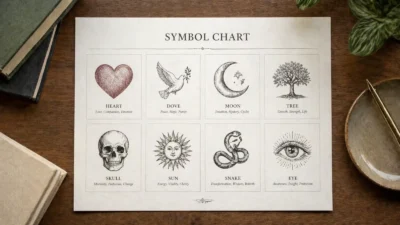
Borrowed meanings happen when people import symbolic claims from elsewhere without checking fit. A modern internet chart about “what flowers mean” or “what moon phases symbolize” may flatten history, ignore religious context, or blend unrelated traditions into one neat list.
Aesthetic stripping is another problem. Sacred or culturally rooted symbols can get turned into fashion, decor, or tattoo material with little attention to their living meaning. That does not mean symbols can never travel. It means reuse should be informed and respectful.
The safest approach is simple: make claims as narrow as the evidence allows. Say “often,” “in this context,” “in many U.S. readings,” or “within this tradition” when that is what the facts support.
How to use symbolism techniques well in your own writing or art
If you want to create symbolism, start small. Pick one or two details that genuinely fit the work instead of scattering symbolic objects everywhere.
A few practical rules help:
- Choose symbols with a real connection to the story or image.
- Let meaning build through repetition, not explanation.
- Keep the literal function intact.
- Allow some openness, but not total vagueness.
- Make the symbol evolve if the character or conflict evolves.
- Do not rely on clichés unless you are reworking them on purpose.
It also helps to ask what emotional pressure the symbol carries. Is it tied to guilt, longing, shame, hope, faith, class, memory, nation, or loss? A symbol becomes memorable when it is attached to a real tension.
And remember that restraint is part of the technique. The goal is not to hide a secret message in every object. The goal is to make the work feel deeper because its details keep opening outward.
FAQs
What do symbolism techniques mean in simple terms?
They are the methods people use to give an image, object, color, action, or place meaning beyond the literal one. In plain terms, they help a story or artwork say more than it says directly.
Are symbolism techniques only used in literature?
No. They are common in film, painting, advertising, politics, memorial design, religion, and online culture. Literature teaches the concept clearly, but everyday public life uses symbolic communication all the time.
Do symbols have one correct meaning?
Usually not. Some symbols have widely recognized associations, but context still matters. A symbol’s meaning depends on the work, the audience, and the tradition behind it.
What is the difference between symbolism and allegory?
Symbolism can appear in a single object, action, or image. Allegory is broader and usually builds a whole second layer across most of the story or artwork.
Can symbolism be spiritual or religious?
Yes, but that does not mean every symbol is sacred or that every interpretation is historically grounded. Religious symbols should be treated with extra care because living communities may understand them differently from decorative or commercial use.
Do symbolism techniques matter for tattoos?
They do, especially because tattoos make symbolic choices visible and lasting. But common tattoo meanings are often modern and personal, not universal or ancient, so it helps to research both cultural background and current use before choosing one.
Conclusion
Symbolism works best when it feels earned. An image, object, or setting gathers power because it keeps showing up in the right places, under the right emotional pressure, and within a clear context.