People often search for universal symbols and meanings because they want a simple answer. Which images stand for love, hope, life, danger, change, or protection? And do those meanings really hold across cultures?
The short answer is yes and no. Some symbols show up again and again because they connect to common human experiences like the sun’s warmth, a tree’s growth, or water’s role in survival. But that does not mean every culture reads them in exactly the same way.
That difference matters in the United States, where people meet symbols through religion, school, museums, tattoos, social media, branding, and pop culture all at once. A symbol may feel familiar, but its older meanings, sacred uses, and modern adaptations are not always the same thing.
Quick Answer
In modern U.S. use, universal symbols and meanings usually point to broad human themes like love, life, growth, hope, danger, change, and connection. Those meanings often grew from visible natural patterns, religious traditions, and long cultural reuse, but they are not perfectly universal, and context still matters.
TL;DR
- “Universal” usually means widely recurring, not identical everywhere.
- Nature symbols spread because people share basic experiences.
- The heart means love now, but not always.
- Animal symbols often carry mixed meanings.
- U.S. use blends history, religion, design, and media.
- Context matters more than any master list.
What people mean by “universal symbols”
When people call a symbol universal, they usually mean one of three things.
First, the symbol appears in many places. The sun, tree, water, and circle all show up across art, ritual, storytelling, and design. Second, the symbol is easy to recognize. Third, it tends to carry a broad theme that makes intuitive sense, even before someone studies its history.
That does not mean all people have always agreed on one fixed meaning. Museums and cultural institutions routinely show that symbols shift by region, medium, religion, and time period. The same motif can suggest blessing in one context, authority in another, and simple decoration somewhere else.
So it is better to think in layers. Some symbols are widely recurring. Some meanings are widely shared. Very few meanings are truly universal in a strict sense.
Why some symbols spread so widely
Symbols travel when they attach to things people notice over and over. Light helps people see. Water keeps people alive. Trees provide food, shade, and shelter. Paths suggest movement. Circles suggest cycles because people see them in the sun, moon, seasons, and wheels.
Humans also build symbols socially. Once a sign becomes useful in religion, storytelling, trade, state power, or art, it spreads farther. Later, print culture, schooling, global media, and digital design can make one version of a symbol feel normal even when it is only one version among many.
That is one reason modern Americans often treat a symbol’s most familiar pop-culture meaning as its original meaning. Sometimes that is true. Often it is not.
The symbols most often treated as universal today
The symbols below are not universal in a perfect sense, but they are among the most widely recognized in modern English-language culture.
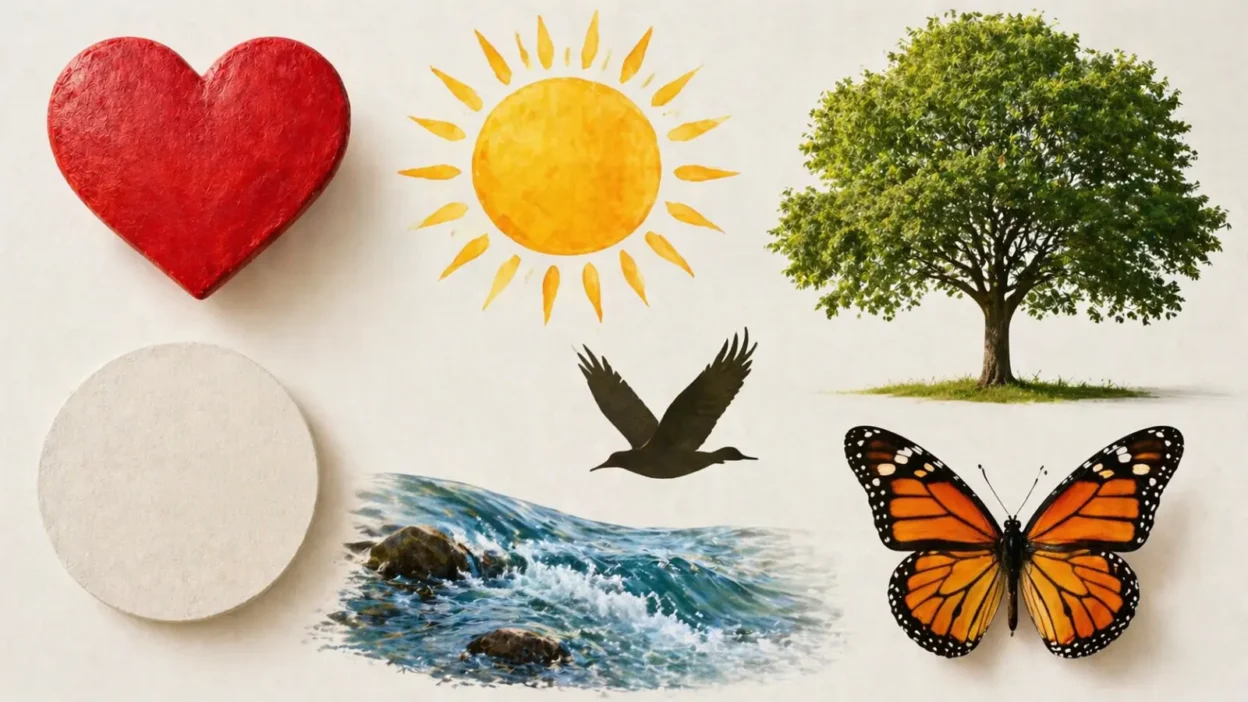
| Symbol | Most common U.S. meaning today | Why it spread |
|---|---|---|
| Heart | love, care, emotional attachment | simple visual shorthand in media, gifts, emojis |
| Sun / light | life, hope, clarity, renewal | basic human dependence on light and warmth |
| Tree | growth, stability, family, connection | visible roots, branching, long life |
| Water | life, cleansing, change, emotion | survival value and constant movement |
| Circle | wholeness, unity, cycles | strong visual link to repetition and completeness |
This table is useful as a starting point, not a final answer. Each symbol opens out into older meanings, religious uses, and modern reinterpretations that do not always line up neatly.
Heart: love, feeling, and the problem of oversimplification
In the United States today, the heart symbol most often means romantic love, affection, loyalty, or emotional warmth. That is the reading people bring to Valentine’s Day cards, emoji reactions, jewelry, tattoos, and nonprofit branding.
But the symbol’s history is messier than that. The physical heart has long been linked to inner life, courage, and feeling in many traditions, while Christian imagery gave the heart powerful devotional uses as well. The modern red heart as a clean graphic sign of love is a later simplification that became extremely strong through print, greeting cards, advertising, and digital communication.
That is why “heart = love” is both true and incomplete. It is the dominant modern meaning, especially in the U.S., but not the whole history.
Sun and light: life, clarity, power, and renewal
The sun is one of the easiest symbols to understand because its symbolic pull begins with ordinary experience. Light reveals. Warmth sustains. Dawn returns after darkness. From there, meanings like life, hope, vitality, truth, and renewal are easy to build.
Many cultures also connected the sun with rulership, divine order, or sacred power. That does not make every sun symbol religious. In modern American life, sun imagery appears just as often in wellness branding, summer design, optimism language, home decor, and tattoos that suggest energy or a fresh start.
Light symbolism works in a similar way. It often points to knowledge, guidance, exposure, or moral clarity. Still, even these common meanings can shift. Too much light can suggest surveillance or harsh exposure. A blazing sun can symbolize danger as much as comfort. Broad symbols stay broad because they can hold more than one emotional charge.
Tree and water: growth, connection, change, and survival
Tree symbolism travels well because people can see the metaphor right in front of them. Roots suggest origin. A trunk suggests strength. Branches suggest expansion. Seasonal change suggests endurance through loss and renewal. In American use, trees often stand for family, resilience, heritage, healing, or groundedness.
Water works differently. Its symbolic force comes from movement and necessity. Water nourishes, cleanses, floods, erodes, and carries things away. That is why it can represent life and renewal in one setting, but uncertainty, grief, or danger in another.
Together, these two symbols show how many so-called universal meanings are built from visible traits rather than hidden codes. People do not need the same religion to understand why a tree might suggest growth or why water might suggest change. But the details still depend on context. A family-tree tattoo is not the same as ritual washing, and ocean imagery in a grief poem is not the same as spa branding.
Circle and path symbols: wholeness, cycles, and life direction
The circle is one of the most reused symbolic shapes because it is visually simple and easy to map onto recurring patterns. It can suggest wholeness, continuity, inclusion, completion, or the cycle of life.
In the U.S., people read circles through wedding rings, logos, mandalas, seals, halos, and minimalist design. Some of those uses are sacred. Some are purely aesthetic. Some blend both. That is where caution matters.
Online writing often jumps from “circle” to sweeping sacred-geometry claims. A more careful reading is better. The circle does carry broad associations with unity and repetition, but its exact meaning depends on tradition and use. A halo in religious art, a ring in marriage, and a circle in brand design are not interchangeable, even if they share a visual grammar.
Path symbols work in a similar way. Roads, bridges, doors, and labyrinth-like forms often point to choice, transition, or life direction because movement through space is a basic human experience. Again, the broad theme travels well, while the precise meaning changes.
Birds, snakes, and butterflies: why animal symbols split in meaning
Animal symbolism often feels more dramatic because people project both fear and admiration onto living creatures.
- Birds commonly suggest freedom, spirit, messages, or transcendence because they move through the sky in ways humans cannot. But the type of bird matters. A dove, raven, eagle, and owl do not carry the same associations.
- Snakes are one of the clearest examples of mixed symbolism. They can signal danger, deceit, death, or fear, but also healing, renewal, fertility, or transformation because they shed their skin.
- Butterflies usually point to change, fragility, beauty, or rebirth in modern U.S. use, especially in memorial art and tattoos.
These examples show why universal-symbol lists can mislead readers. “Snake means evil” is too narrow. “Butterfly means transformation” is often true now, but it can become sentimental if stripped from context. Animal symbols are shaped by a mix of observable behavior, folklore, religion, and later media habits. They are some of the most recognizable symbols, but also some of the least stable.
Why “universal meaning” breaks down across cultures
This is the part many quick guides skip.
A symbol can recur widely without carrying the same meaning everywhere. A lotus in one context may be tied to specific religious and artistic traditions, while an American home store might use it as a generic sign of calm. A peacock may suggest beauty, status, spirituality, pride, or protection depending on setting. Even color and gesture meanings can shift sharply across cultures.
That matters for respectful use. When people treat sacred or culturally specific symbols as if they were free-floating “universal vibes,” they often flatten living traditions into decoration. The older meaning does not disappear, but neither does modern misuse.
A careful reader should ask: Is this a broad human motif, a specific religious sign, a piece of folklore, a design shorthand, or an internet trend? Sometimes it is more than one. The mistake is pretending those layers are the same.
How Americans use universal symbols now
In the United States, universal-looking symbols often work as shortcuts. They appear in tattoos, memorial jewelry, corporate logos, nonprofit campaigns, wedding decor, wellness products, sports branding, emoji use, and social posts.
That modern use tends to reward symbols that are:
- easy to recognize
- emotionally legible
- visually simple
- flexible across audiences
This is why the heart, sun, wings, tree, moon, butterfly, and wave remain so common. They let people signal identity or feeling quickly. A tattoo of a tree may suggest family roots. A butterfly may mark survival after change. A circle may imply unity. But those meanings are often personal, not ancient rules.
This is also where oversimplification shows up most clearly. A symbol used in a logo or tattoo may borrow the emotional mood of older traditions without carrying their full religious or historical meaning. That is not always wrong. It just needs honesty. Modern American symbolism is often remix culture: part inheritance, part design choice, part personal story.
How to read a symbol responsibly
A good interpretation usually starts with four questions:
- What is the setting? Art, religion, tattooing, branding, mourning, or internet humor?
- Whose meaning is this? A specific tradition, a modern American audience, or one person’s own use?
- What visible trait shaped the symbol? Light, growth, danger, flight, cycles, or change?
- What is documented, and what is later interpretation? Older history and modern reuse should not be blurred together.
This approach does not make symbols less interesting. It makes them more accurate. You can still say that the sun often symbolizes life or that the heart usually symbolizes love. You are just less likely to turn a broad pattern into a false universal.
FAQs
Are any symbols truly universal?
Very few symbols are universal in a strict sense. It is more accurate to say that some symbols recur widely and carry overlapping themes, while local meanings still vary.
What symbol most commonly represents love in the United States?
The heart is the clearest modern U.S. symbol of love. Its meaning is so familiar now that people use it in text messages, gifts, branding, and tattoos without needing explanation.
Why do so many cultures use the sun as a symbol?
Because the sun is tied to basic human experience. It provides light, warmth, daily rhythm, and seasonal change, which makes meanings like life, hope, and power easy to build.
Do universal symbols have the same meaning in tattoos?
Not always. Tattoo meanings are often more personal than historical, so a symbol may keep its broad public meaning while also carrying a private story for the person wearing it.
Are animal symbols always based on real animal behavior?
Only partly. Some meanings grow from what people observe, but many also come from folklore, religion, literature, and later pop culture. That is why the same animal can symbolize opposite things.
Is it disrespectful to use a symbol from another tradition?
It can be, especially if the symbol is sacred, ceremonial, or heavily simplified. The safest approach is to learn whether the symbol has a living religious or cultural use before treating it as generic decor.
Conclusion
The clearest way to understand symbols is to stop looking for one master key. Most of the images people call universal became widespread because they connect to visible, shared parts of life: light, love, danger, growth, change, and belonging.