Rainbow colors are easy to recognize, but their meanings are not as simple as a color chart. A rainbow can be a natural sight in the sky, a sign of hope after a storm, a religious image, a Pride symbol, a tattoo, a design choice, or a personal reminder of survival.
The meaning of rainbow colors is most often tied to hope, renewal, diversity, inclusion, and joy in modern U.S. culture. Those meanings come from several places at once: the way rainbows appear after rain, old religious stories, color symbolism, and the modern history of the rainbow Pride flag.
That mix is why the rainbow needs careful interpretation. Not every rainbow is a Pride symbol. Not every rainbow has a spiritual message. Not every color meaning is ancient or universal.
A better reading starts with context.
Quick Answer
In the United States today, the meaning of rainbow colors is most commonly hope, renewal, diversity, inclusion, and joy. Historically, rainbows also carry religious meanings of promise and protection in Jewish and Christian tradition, while modern Pride symbolism gives the rainbow a specific role in LGBTQ identity and visibility.
TL;DR
- Rainbow colors usually suggest hope and renewal.
- Pride symbolism is modern, specific, and important.
- Biblical meaning centers on covenant and promise.
- Color meanings shift by culture and context.
- Indigo is partly a naming tradition.
- Spiritual readings should be framed as belief.
What Rainbow Colors Usually Mean Today
Today, rainbow colors most often symbolize hope after difficulty. They also suggest variety, unity, joy, and openness. In the United States, many people also connect rainbow colors with LGBTQ Pride, especially when the colors appear on a flag, sticker, shirt, pin, or public display.
The shared idea behind many rainbow meanings is contrast. A rainbow appears when rain and sunlight meet. Because of that, people often read it as a sign that hard moments can pass, beauty can follow pain, and different things can exist together.
That does not mean every rainbow has the same message. A rainbow painted in a child’s bedroom may suggest cheerfulness. A rainbow flag outside a public building may suggest LGBTQ visibility. A rainbow in a church window may point to divine promise. A rainbow tattoo may mark grief, healing, identity, or survival.
The symbol depends on where it appears and who is using it.
What the Rainbow Actually Is Before It Becomes a Symbol
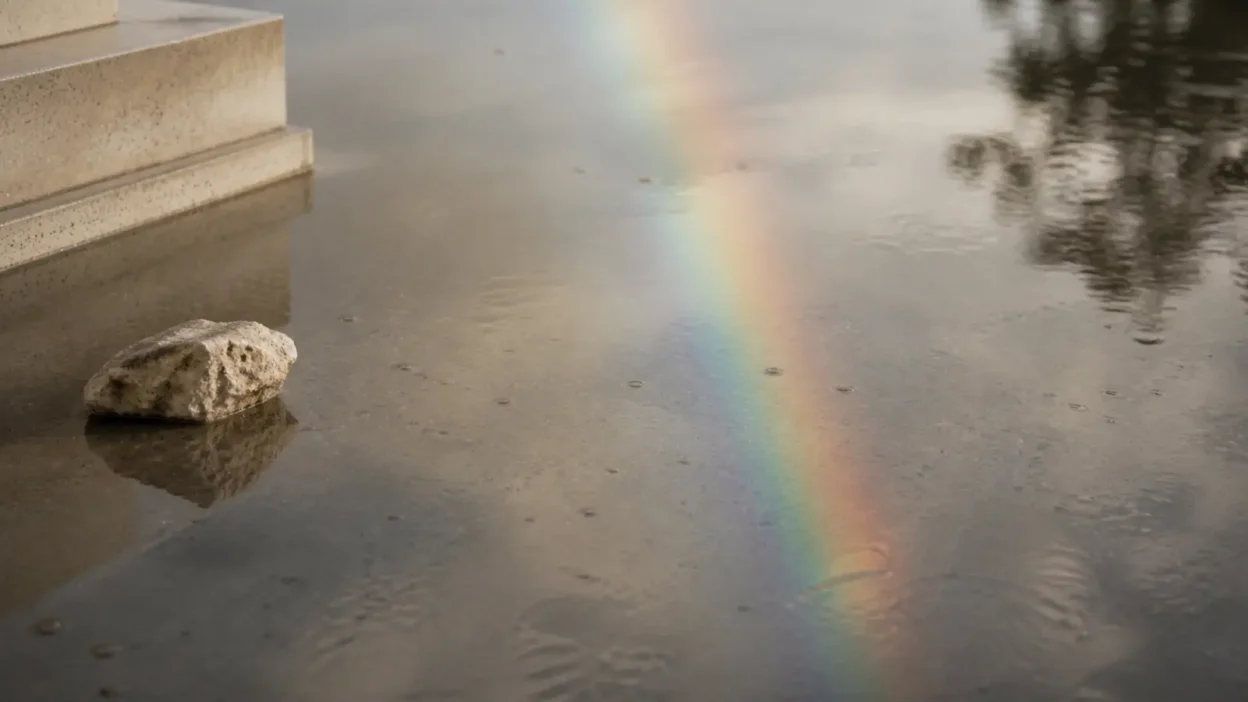
Before a rainbow is symbolic, it is physical. It is an arc of color formed when light passes through water droplets and separates into visible colors.
That matters because many symbolic meanings grow from what people can see. Rainbows seem brief. They appear between storm and sun. They are bright but unreachable. They cross the sky, yet they are not objects people can hold.
Those traits help explain the symbolism. The rainbow becomes a natural image for transition, wonder, hope, and the feeling that ordinary life has suddenly opened into something larger.
The colors are usually taught in the order red, orange, yellow, green, blue, indigo, and violet. In daily life, people remember that order as ROYGBIV. Still, a real rainbow is not made of seven separate blocks. It is a continuous spectrum, and the named colors are a human way of organizing what the eye sees.
That distinction helps prevent overclaiming. The symbolic meanings of the seven colors are cultural readings, not hidden facts inside the rainbow itself.
Why Rainbows Became Symbols of Hope After Hardship
The hope meaning is easy to understand. Rainbows often appear when a storm is ending or when rain and sunlight overlap. That timing makes them feel like a visible sign of relief.
People do not need a formal tradition to feel that. A gray sky breaks open. Light returns. Color appears where there was dullness. The moment itself teaches the metaphor.
This is why rainbows are common in sympathy art, children’s drawings, recovery messages, and social media posts after hard times. They offer comfort without needing many words.
In U.S. culture, this meaning became especially visible during public crises, memorials, health struggles, and community support campaigns. A rainbow in those settings often says, “There is still care here,” or “Something better may follow.”
That is a gentle meaning, but it should not be made too neat. A rainbow does not erase suffering. It works best as a symbol of endurance, not as a promise that pain disappears quickly.
The Seven Rainbow Colors and Their Common Symbolic Associations
Each rainbow color has its own common associations, but these meanings are flexible. They come from color symbolism, art, design, emotion, religion, politics, and popular culture. They are not fixed rules.
| Rainbow Color | Common Symbolic Associations | Context Caution |
|---|---|---|
| Red | life, passion, courage, urgency | Can also signal danger, anger, or sacrifice |
| Orange | warmth, creativity, energy, change | Less standardized than red or blue |
| Yellow | sunlight, optimism, clarity, joy | Can also suggest warning or caution |
| Green | growth, nature, healing, renewal | Can suggest envy or money in some settings |
| Blue | calm, trust, openness, sadness | Meaning shifts strongly by shade |
| Violet / Purple | imagination, spirit, dignity, mystery | Often shaped by religion, royalty, or fashion |
Red often feels like the most bodily color. It suggests blood, heat, life, passion, and courage. In a rainbow, it can feel like the beginning of vitality, but outside the rainbow it may also point to danger or anger.
Orange sits between red and yellow, so it often reads as energy with warmth. It can suggest creativity, movement, play, and change. Because orange has fewer long-standing symbolic rules than red or blue, its meaning depends heavily on context.
Yellow is tied to sunlight. In rainbow symbolism, it often suggests joy, clarity, and a brighter outlook. Yet yellow can also mean warning in traffic signs and hazard labels, so the setting matters.
Green is one of the easiest rainbow colors to read as renewal. It is tied to plants, spring, healing, and the living world. In American culture, it can also point to money, luck, or environmental concern.
Blue often suggests calm, trust, sky, water, and emotional depth. It can also mean sadness, as in “feeling blue.” This makes blue one of the most flexible rainbow colors.
Violet or purple is often linked to spirit, imagination, dignity, and mystery. In religious, royal, and artistic settings, purple can carry a more formal meaning. In a rainbow, it often feels like the edge of the visible spectrum, which adds to its reflective or spiritual tone.
Why Indigo Is the Most Complicated Rainbow Color
Indigo deserves its own caution. Many people learn that the rainbow has seven colors, including indigo. But in real sight, indigo is hard for many people to separate clearly from blue and violet.
The seven-color pattern is partly a naming tradition. It gives people a memorable order, but it should not be treated as if the sky contains seven clean stripes with firm borders.
That is why many modern design uses of the rainbow skip indigo or merge it with blue and violet. The common six-stripe Pride flag, for example, does not follow the schoolroom seven-color rainbow exactly.
Symbolically, indigo is often described as intuition, depth, wisdom, or inner vision. Those meanings are common in modern spiritual and color-symbolism writing, but they are less stable than the meanings of red, green, or blue. A careful article should present indigo as a later interpretive layer, not as a universal ancient truth.
Rainbow Colors in Biblical and Religious Symbolism
In Jewish and Christian tradition, the rainbow is strongly connected with the story of Noah. In that context, the rainbow is a sign of covenant, meaning a sacred promise between God and the earth after the flood.
This is one of the clearest religious meanings of the rainbow in U.S. culture. For many Christians, the rainbow can symbolize mercy, faithfulness, protection, and divine promise. For Jewish readers, the story belongs to the Hebrew Bible and carries its own covenantal meaning.
It is important to be precise here. The biblical story gives meaning to the rainbow as a whole. It does not assign modern personality-style meanings to each color.
Other religious and mythic traditions also include rainbow figures, bridges, messengers, or divine paths. These traditions should not be blended into one vague claim. A rainbow bridge in one culture, a covenant sign in another, and a Pride flag in modern America are not the same symbol, even if they share the same visual form.
Respectful interpretation keeps those meanings distinct.
Rainbow Colors, Pride, and Modern Identity in the United States
In the United States, the rainbow is deeply connected to LGBTQ Pride. This is one of its most visible modern meanings.
The Pride flag began in San Francisco in 1978. Its original design used eight stripes, and those colors were given specific meanings. Later, the widely known version became a six-stripe flag, mostly for practical production and display reasons.
The Pride flag matters because it changed the rainbow from a general sign of hope into a public symbol of identity, visibility, and rights. It says that LGBTQ people exist, belong, and should be able to live openly.
A few distinctions help:
- A natural rainbow is not automatically a Pride symbol.
- A rainbow flag usually is a Pride symbol.
- Rainbow colors in June often carry Pride meaning in the U.S.
- Rainbow colors in toys, weather art, or children’s decor may simply suggest joy.
- Some newer Pride flags add colors or shapes to represent communities not fully visible in the older six-stripe flag.
This is also where controversy can appear. Some people treat the rainbow only as religious. Others treat it only as Pride. In real U.S. culture, both meanings exist, along with many others. Context tells the reader which meaning is active.
How Rainbow Colors Appear in U.S. Life Today
Rainbow colors show up in many parts of daily life. Their meaning changes with the setting.
In children’s design, rainbows often suggest happiness, imagination, safety, and play. They are common in classrooms, nurseries, birthday parties, stickers, and toys because the colors feel bright and welcoming.
In branding, rainbow colors can suggest variety, creativity, openness, and a broad range of choices. A company may use rainbow colors to look inclusive, playful, artistic, or modern. But this can feel shallow if the message is not backed by real values.
In decor, rainbow colors may mean cheerfulness, hope, softness, or self-expression. A muted rainbow on a wall hanging feels different from a bright Pride flag in a parade.
In fashion, rainbow colors can signal joy, boldness, Pride, festival style, or nostalgic youth culture. A rainbow bracelet, pin, or shirt may be playful, political, personal, or all three.
In public life, rainbow colors often appear during Pride Month, at equality events, in memorial displays, and in community support campaigns. In those settings, they carry stronger social meaning than they do in ordinary decoration.
Tattoo and Personal Symbolism of Rainbow Colors
A rainbow tattoo can mean many things. The most common meanings are hope, survival, identity, remembrance, joy, and self-acceptance.
For some people, a rainbow tattoo marks LGBTQ pride. For others, it represents coming through grief, illness, trauma, or a painful life chapter. Some parents use rainbow imagery in connection with a child born after pregnancy loss, though that meaning should be handled with special care and never assumed.
The style matters too. A small fine-line rainbow may feel private and gentle. A bright rainbow flag tattoo may be a clear identity statement. A rainbow with clouds may suggest comfort after sadness. A rainbow with names, dates, or flowers may point to memory.
Because tattoos are personal, no outside reader should assume one fixed meaning. Rainbow tattoos are best interpreted as chosen symbols. The wearer’s own explanation matters most.
Folklore, Spiritual Meanings, and Omens: What to Treat Carefully
Rainbow folklore is wide and varied. Some stories connect rainbows with luck, treasure, divine messages, bridges, weather signs, or contact between earthly and heavenly realms.
These ideas can be meaningful, but they should be framed honestly. A belief that a rainbow is a sign from a loved one, a spiritual message, or a lucky omen is a personal or tradition-based interpretation. It is not something that can be proven from the rainbow itself.
Dream symbolism is even more personal. A rainbow in a dream may suggest hope, healing, relief, identity, or emotional transition. But dream meanings are not universal codes. They depend on the dreamer, the feeling of the dream, and the life situation around it.
A responsible reading might say: “Many people interpret rainbows as signs of hope or reassurance.” It should not say: “A rainbow always means a blessing is coming.”
That difference keeps the meaning useful without turning belief into false certainty.
Oversimplification, Misuse, and Context Problems
Rainbow colors are often simplified because they are easy to like. That is part of their appeal, but it can also cause problems.
One problem is commercial flattening. A brand may use rainbow colors to suggest inclusion without supporting the people or values linked to that message. This is especially sensitive around Pride imagery, where a rainbow can feel supportive in one context and performative in another.
Another problem is religious flattening. Some people describe the rainbow only as a biblical sign and ignore its modern LGBTQ meaning. Others do the reverse and ignore its religious meaning. In the United States, both readings are real for different communities.
A third problem is cultural overreach. It is tempting to say that rainbows mean the same thing in every culture. They do not. Many cultures value the rainbow, but the stories and meanings differ.
The safest interpretation is also the clearest one: rainbow colors often symbolize hope, renewal, diversity, and connection, but the specific meaning depends on use, place, and community.
FAQs
What do rainbow colors symbolize most often?
Rainbow colors most often symbolize hope, renewal, joy, diversity, and inclusion. In the U.S., they can also carry a strong connection to LGBTQ Pride when used in flag-like or public identity contexts.
What does each rainbow color mean spiritually?
Spiritual color meanings vary, but red is often read as life or energy, orange as creativity, yellow as joy, green as healing, blue as calm, and violet as spirit or reflection. These are interpretive associations, not fixed spiritual laws.
Do rainbow colors have a biblical meaning?
In Jewish and Christian scripture, the rainbow is a sign of covenant after the flood story. That meaning applies to the rainbow as a whole, not to a modern list of separate color meanings.
Is every rainbow a Pride symbol?
No. A natural rainbow, a child’s drawing, or a rainbow decoration may simply suggest color, joy, or hope. A rainbow flag or rainbow used during Pride events usually carries LGBTQ identity and visibility meaning.
What does a rainbow tattoo mean?
A rainbow tattoo may mean hope, survival, Pride, remembrance, healing, or self-acceptance. The design and the wearer’s story matter more than any single outside definition.
Are rainbow colors always positive?
Usually they are read positively, but not always. Some colors can carry mixed meanings, and rainbow imagery can become controversial when tied to politics, religion, identity, or commercial use.
Why do some rainbows have six colors instead of seven?
The natural rainbow is a continuous spectrum, while seven colors are a common naming tradition. Many modern rainbow designs use six colors because they are simpler, clearer, or based on the familiar Pride flag.
Conclusion
Rainbow colors endure because they bring several meanings together at once. They are natural, emotional, religious, cultural, and personal. That makes them flexible, but it also means they need context.