Color can change the whole feeling of a tattoo. A black rose, a red rose, and a blue rose may share the same shape, but most people will read them differently.
That is why color symbolism for tattoos matters. Tattoo color can suggest grief, passion, healing, loyalty, danger, renewal, softness, rebellion, or faith. It can also simply reflect what looks best on the skin and fits the design.
In the United States, tattoos are now a common form of self-expression. People use them to honor loved ones, mark survival, show identity, celebrate beauty, or carry a private reminder on the body.
Still, tattoo color meanings are not fixed laws. They depend on the design, the wearer, the style, the culture behind the image, and the viewer’s assumptions.
Quick Answer
In modern U.S. tattoo culture, color symbolism for tattoos most often points to personal identity, emotion, memory, and aesthetic choice. Red may suggest passion or danger, black may suggest strength or mourning, blue may suggest calm or loyalty, and green may suggest growth or healing, but these meanings change with the design and cultural context.
TL;DR
- Tattoo colors suggest emotion, not fixed personality.
- Black ink can mean tradition, grief, or strength.
- Red often reads as love, blood, danger, or courage.
- Design context matters more than color alone.
- Sacred and cultural colors need respectful handling.
- Modern meanings often mix history, fashion, and identity.
What Color Symbolism Means in Tattoo Art
Color symbolism in tattoo art is the meaning people attach to ink colors. It is not the same as the technical color theory an artist uses to build contrast, depth, and balance.
A tattoo color can work on several levels at once. It can make a design easier to read. It can carry a personal message. It can connect the wearer to a style, a memory, a culture, or a mood.
For example, black ink may be chosen because it ages clearly and gives a design structure. But it may also suggest grief, seriousness, protection, elegance, or commitment. Those meanings are not built into the pigment itself. They come from social use, visual association, and personal interpretation.
This is the key point: tattoo color is symbolic when people use it to communicate something beyond appearance. But no color has one meaning in every tattoo.
The Most Common U.S. Reading Today: Identity, Emotion, and Memory
In the United States today, tattoo colors are usually read through personal expression. Most people do not choose a color because of one ancient rule. They choose it because it feels connected to a story.
A red heart may mark love. A blue butterfly may suggest calm change. A green vine may feel like growth after a hard season. A black memorial tattoo may carry grief without needing many words.
Common modern reasons include:
- honoring someone who died
- marking recovery or survival
- showing personality or taste
- linking a tattoo to a favorite flower, animal, flag, team, or cause
- softening or intensifying the mood of a design
This makes modern tattoo color symbolism flexible. A color may have a public meaning, but the wearer’s meaning can be more important.
That does not mean every interpretation is equally supported by history. It means tattoos often work like personal symbols. They borrow from shared culture, then become private.
Why Tattoo Colors Took on Meaning in the First Place
Color meanings often begin with what people can see in daily life.
Red is linked with blood, heat, fire, roses, warning signs, and strong emotion. That is why it can suggest love, courage, danger, anger, sacrifice, or life force.
Green is tied to plants, spring, growth, medicine, money, envy, and nature. In tattoos, it often reads as renewal, healing, luck, earthiness, or transformation.
Black has long been linked in many Western settings with mourning, night, seriousness, authority, and mystery. In tattooing, it also has a practical role because black linework gives many designs their shape.
White can suggest purity, peace, ghosts, absence, light, or memorial softness. But white ink is also strongly tied to tattoo technique and skin tone, so its meaning is often mixed with its visual effect.
These meanings developed because people repeatedly used colors in ritual, clothing, art, warning systems, flags, religion, advertising, and fashion. Tattooing then absorbed those associations.
A Color-by-Color Guide to Common Tattoo Meanings
The table below gives common modern U.S. readings. It should not be treated as a rulebook. A color’s meaning changes when it is paired with a specific image.
| Tattoo Color | Common U.S. Reading | Important Caution |
|---|---|---|
| Black | Strength, grief, protection, tradition, seriousness | Also used because it ages well and defines form |
| Red | Love, passion, blood, courage, anger, danger | Can feel romantic, violent, sacred, or warning-like |
| Blue | Calm, loyalty, sadness, water, truth, distance | Shade matters; navy feels different from bright blue |
| Green | Growth, healing, nature, luck, money, renewal | Can also suggest envy, poison, or decay in some designs |
| Yellow/Gold | Joy, light, energy, wealth, hope | Yellow can also suggest caution or sickness |
| Purple/White | Spirituality, dignity, mystery, purity, peace, remembrance | These meanings vary strongly by religion and culture |
Black is the most stable tattoo color visually and symbolically. It can stand alone, outline other colors, or make a design feel older and more grounded.
Red is one of the most emotionally direct tattoo colors. It draws attention fast. It often feels alive, urgent, intimate, or dangerous.
Blue tends to cool a tattoo down. It can make a design feel peaceful, sad, loyal, oceanic, or dreamlike.
Green often adds a sense of life. In botanical tattoos, it can make growth and recovery feel more literal.
Yellow and gold bring light into a design. They can suggest optimism, divinity, warmth, wealth, or celebration, depending on the image.
Purple often carries a more inward feeling. It may suggest mystery, creativity, royalty, spirituality, or grief, but those readings are not universal.
White is subtle. It may be used for highlights, pale designs, sacred imagery, or memorial work, but it can be hard to see on some skin and may change as it heals.
Shade Matters: Bright, Dark, Muted, Pastel, and Neon Ink
A color’s shade can change the message as much as the color family itself.
Bright red may feel bold, romantic, or urgent. Deep burgundy may feel older, more serious, or more sensual. Pale pink may soften a tattoo and suggest tenderness rather than intensity.
Dark green can feel forest-like, protective, or traditional. Light green may suggest new growth, freshness, or youth. Acid green can feel strange, toxic, digital, or rebellious.
Pastels often make tattoos feel gentle, playful, nostalgic, or dreamy. This is common in floral tattoos, cute designs, anime-inspired pieces, and soft memorial work.
Muted colors can make a tattoo feel vintage or worn-in. They often appear in American traditional and neo-traditional work, where the palette is meant to stay readable over time.
Neon colors feel modern, artificial, nightlife-oriented, or futuristic. Their symbolic meaning often comes from pop culture, cyberpunk design, rave culture, gaming, or digital aesthetics more than old folklore.
Design Changes the Meaning More Than Color Alone
A color does not speak by itself. It speaks through the tattoo.
A red rose usually points toward love, beauty, romance, devotion, or loss. A red dagger may feel like betrayal, violence, bravery, or sacrifice. A red dragon may suggest force, protection, luck, danger, or myth, depending on the style.
The same is true for black. A black cross, black snake, black butterfly, black sun, and black armband do not carry the same message. They share a serious visual tone, but their meanings come from the image.
Placement also matters. A tiny blue star behind the ear feels different from a blue full-sleeve ocean scene. A white memorial script on the wrist feels different from white ink used only as a highlight.
Tattoo style matters too. A red rose in American traditional style may read as classic and bold. A red watercolor rose may feel softer and more emotional. A red geometric rose may feel modern and designed.
Color adds emotional direction. The design gives that emotion a subject.
Historical Roots: From Body Marking to American Tattoo Styles
Tattooing is much older than modern tattoo shops. People have used body marking for identity, status, healing, beauty, protection, mourning, religion, and memory in many parts of the world.
That history does not mean all tattoos share one origin or one meaning. Different societies used tattooing in different ways. Some markings were sacred. Some were social. Some were decorative. Some were connected to endurance, adulthood, rank, or family.
In what is now the United States, tattoo history includes Indigenous traditions, maritime tattooing, military tattooing, sideshow performers, professional city shops, flash sheets, biker and punk subcultures, fine-art tattooing, and today’s highly varied tattoo scene.
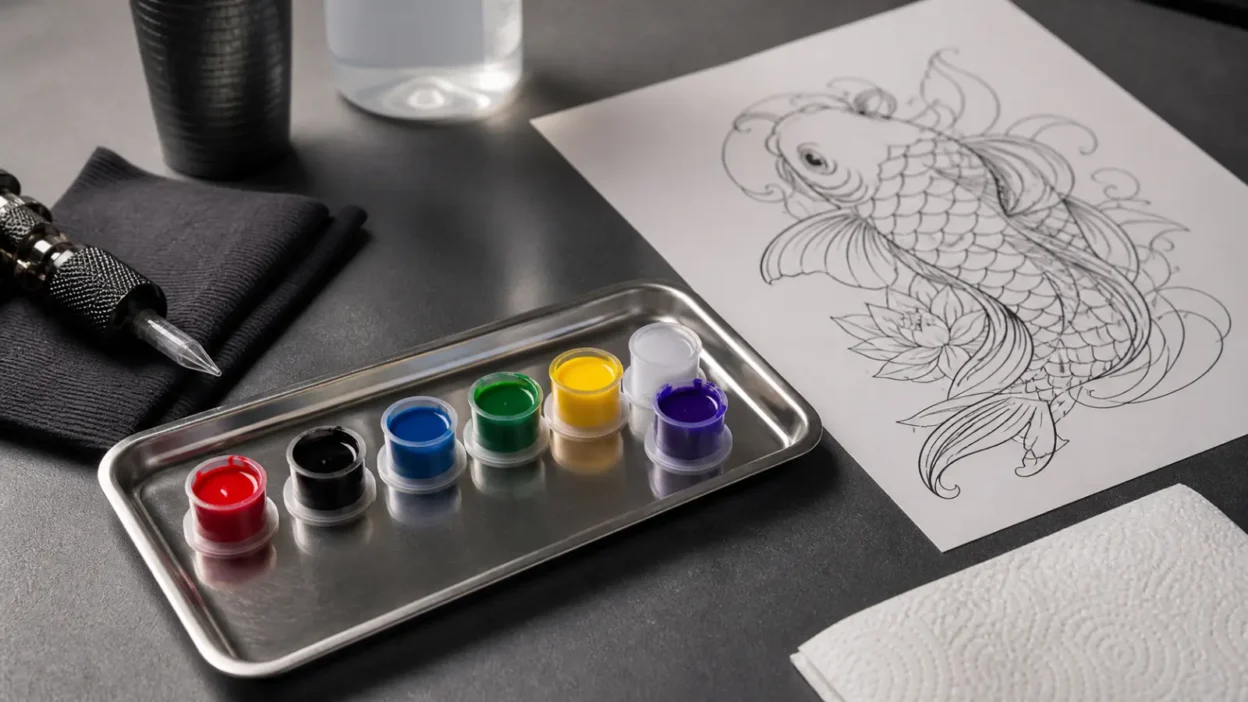
Color became especially important in recognizable tattoo styles. American traditional tattooing often uses bold black lines and a limited palette, including red, green, yellow, and blue. This makes the tattoo readable from a distance and helps it age with clarity.
Over time, color tattoos moved from flash walls and sailor imagery into many styles: realism, watercolor, illustrative work, Japanese-inspired pieces, neo-traditional designs, pop culture tattoos, and delicate fine-line work with small color accents.
The meaning changed with the audience. A colorful tattoo once might have marked someone as outside polite society. Today, in many U.S. settings, it may be seen as art, identity, memory, or fashion.
Sacred, Cultural, and Cross-Cultural Meanings Need Care
Color meanings are not the same everywhere. A color used for weddings in one culture may be linked with mourning in another. A color used in a religious image may have a meaning that should not be reduced to “aesthetic.”
This matters in tattooing because tattoos live on the body. A sacred symbol in a certain color can carry meaning for a living community, not just for the person who likes the look.
Indigenous tattoo traditions in North America deserve special care. They are not simply design inspiration. In many communities, tattooing has been tied to identity, kinship, spirituality, life stages, memory, and cultural survival. The meaning may belong to a specific nation, family, ceremony, or revitalized practice.
Religious color meanings also need care. Blue in a Christian-inspired image, saffron or orange in a South Asian religious context, white in a mourning setting, or green in Islamic visual culture cannot be explained responsibly with one quick sentence. These colors may carry layers of practice, theology, region, and history.
A respectful approach is simple: do not borrow sacred color-symbol combinations casually. Learn the context. Ask whether the symbol is open, restricted, devotional, memorial, or community-specific.
Color Symbolism in American Traditional, Neo-Traditional, and Modern Tattoos
Tattoo style shapes how color is read.
American traditional tattoos often use strong outlines and a clear palette. Red, green, yellow, and black are common because they hold visual impact. In that style, color may feel classic, durable, bold, and connected to older tattoo flash.
Neo-traditional tattoos often expand the palette. They may use deeper shadows, jewel tones, and more color blending. Purple, teal, burgundy, and gold can make old symbols feel more dramatic or personal.
Blackwork uses little or no color. Its symbolism often comes from contrast, permanence, pattern, and density. A blackwork tattoo may feel protective, severe, elegant, spiritual, or abstract depending on the design.
Watercolor tattoos use soft edges and color washes. They often feel emotional, artistic, spontaneous, or dreamlike. The color may suggest memory or movement more than a fixed symbol.
Fine-line tattoos often use color sparingly. A single red thread, blue tear, green leaf, or gold star can carry more weight because the rest of the tattoo is quiet.
In modern tattooing, color is both symbolic and stylistic. It tells the viewer how to feel before they even understand the image.
Modern U.S. Uses: Awareness, Grief, Pride, Fashion, and Digital Culture
Modern U.S. tattoo color symbolism often comes from public life as much as old tradition.
Awareness colors are a clear example. Pink can suggest breast cancer awareness. Teal may point to ovarian cancer awareness or sexual assault awareness, depending on context. Purple is used for several causes, including domestic violence awareness and Alzheimer’s awareness. These meanings depend on the full design, not color alone.
Memorial tattoos also use color carefully. Black and gray may feel solemn. A loved one’s favorite color may make the tattoo more intimate. White highlights, blue flowers, or a small yellow star can soften grief without making it less serious.
Pride tattoos often use color as identity. Rainbow palettes, trans pride colors, bisexual pride colors, and other flag-based palettes are usually read through community symbols. In these cases, color order and combination matter.
Fashion and internet culture also shape meaning. Pastel tattoos may feel soft and nostalgic. Red ink tattoos can feel minimal, edgy, or intimate. Chrome-like silver and digital blues can suggest futuristic style. Neon colors can point toward nightlife, gaming, cyber aesthetics, or pop art.
Sports and regional identity matter too. A tattoo in team colors may be more about loyalty than general color symbolism. Red and black on one person may mean grief; on another, it may mean a favorite team.
Misuse, Oversimplification, and Practical Limits
The biggest mistake is treating tattoo colors like a personality test. A black tattoo does not prove someone is dark or guarded. A red tattoo does not prove passion. A blue tattoo does not prove calmness.
Those readings may fit in some cases. They are not evidence about a person’s character.
Another mistake is flattening cultures. Saying “white means purity” ignores many contexts where white can be linked with mourning, death, ancestors, or ritual. Saying “red means love” ignores warning signs, blood, anger, political symbols, and sacred uses.
Tattoo color can also be distorted by online trends. A color may become popular because of celebrities, social media, or a visual trend, not because of deep historical meaning. That does not make the tattoo shallow. It just means the source of the meaning is modern.
There are practical limits too. Some colors heal, fade, or show differently depending on skin tone, placement, sun exposure, technique, and ink formulation. White and yellow can be subtle. Red may be bold but can also be associated with irritation for some people. A good tattoo artist can explain what is realistic for the design.
Symbolism should not replace practical advice. The best tattoo color is one that fits the design, respects the culture behind the image, works with the skin, and still feels meaningful after the trend passes.
How to Choose a Tattoo Color With Meaning
Start with the design, not the color chart.
Ask what the tattoo is really about. Is it love, grief, survival, beauty, faith, humor, family, rebellion, or change? Once the core idea is clear, color can support it.
A few useful questions help:
- Does this color match the emotion of the design?
- Is the color tied to a culture, religion, or community I should understand first?
- Will this color still make sense to me in ten years?
- Does the color work with the tattoo style?
- Has the artist explained how it may heal on my skin?
It is also fine to choose a color because it is beautiful. Not every tattoo needs a heavy symbolic burden. Aesthetic pleasure is a real reason.
But if a tattoo uses sacred imagery, memorial colors, identity flags, or culture-specific designs, slow down. Meaning is not only personal in those cases. It can also be shared, inherited, or protected.
FAQs
What does a black tattoo symbolize?
A black tattoo often symbolizes strength, grief, protection, seriousness, or tradition. It is also the most common tattoo color because black ink gives structure, contrast, and long-term readability.
What does a red tattoo mean?
A red tattoo often suggests love, passion, courage, blood, danger, or intensity. The design decides the direction: a red heart, red snake, red rose, and red flame all create different meanings.
What tattoo color symbolizes healing?
Green is often used for healing because it connects with plants, growth, renewal, and nature. Blue can also suggest emotional healing, peace, and calm, especially in water, sky, or butterfly designs.
Are tattoo color meanings spiritual?
They can be, but not automatically. Some colors have religious or spiritual associations in certain traditions, while other meanings are personal, modern, or decorative.
Do tattoo colors mean the same thing in every culture?
No. Color meanings shift across cultures, religions, regions, and historical periods. A responsible tattoo interpretation should avoid claiming that one color has the same meaning everywhere.
Is white ink symbolic?
White ink can symbolize purity, light, peace, memory, ghosts, softness, or subtlety. It is also a technical choice, so its meaning is often tied to how visible or delicate the tattoo appears.
Can I choose a tattoo color just because I like it?
Yes. Personal taste is a valid reason to choose a tattoo color. Symbolism can add meaning, but it does not need to control every design choice.
Conclusion
Tattoo color works because people already read color emotionally. Red feels different from blue. Black feels different from yellow. Green changes the mood of a leaf, and purple changes the tone of a flower or moon.