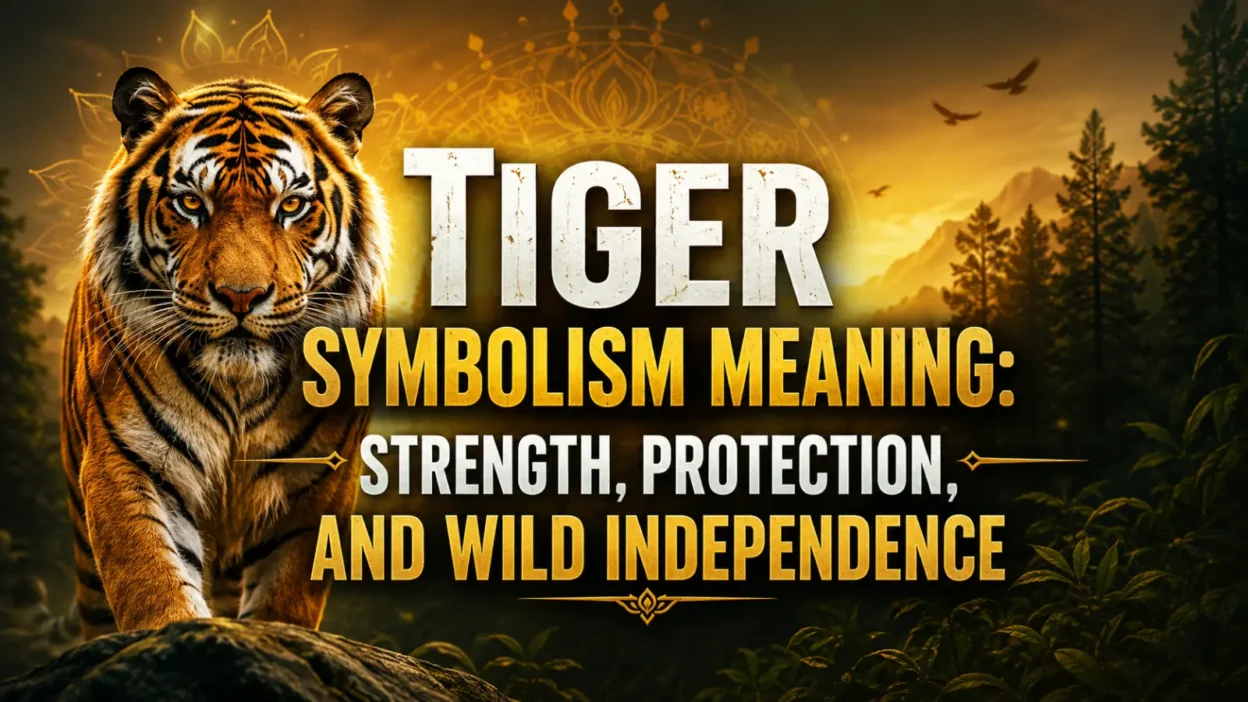
A tiger is more than a large striped cat in symbolic language. It is an image of force, focus, danger, beauty, and survival. Because tigers are visually striking and physically impressive, people have used them for centuries to express power and protection.
In the United States today, tiger symbolism meaning is usually tied to courage, personal strength, independence, confidence, and fierce protection. You can see this in tattoos, school mascots, sports logos, fashion, home decor, and social media imagery.
But tiger symbolism is not one single global meaning. Much of its deeper history comes from Asia, where real tigers lived near human communities and entered art, religion, folklore, zodiac systems, and political imagery. Modern U.S. use often borrows from those older meanings, sometimes carefully and sometimes too loosely.
A responsible reading keeps those layers separate. A tiger in a tattoo, a Korean folk painting, a Chinese zodiac image, a goddess image, a college mascot, and a dream all work differently.
Quick Answer
In modern U.S. culture, a tiger most often symbolizes courage, strength, confidence, independence, and protective power. Historically, tiger meanings also developed from Asian art, folklore, religion, and zodiac traditions, where the animal could represent guardianship, authority, danger, spiritual force, or royal power depending on context.
TL;DR
- Tigers most often symbolize strength and courage.
- They can also mean protection and independence.
- Asian traditions give tiger imagery deep roots.
- U.S. use is often modern and secular.
- Dream meanings are interpretive, not factual.
- Context changes the meaning sharply.
What the Tiger Symbol Refers To
Tiger symbolism usually refers to the image of the tiger rather than the animal alone. People interpret the striped body, alert eyes, silent movement, claws, teeth, and solitary presence. The symbol can appear as a realistic tiger, a white tiger, a roaring tiger head, a tiger tattoo, a zodiac animal, a mascot, or a stylized pattern.
The tiger’s appearance matters. Its stripes make it instantly recognizable. Its face can look calm, watchful, threatening, noble, or protective depending on the design. A sleeping tiger may suggest controlled strength. A roaring tiger may suggest warning, aggression, or fearless self-defense.
The meaning also changes by setting. A tiger on a college sweatshirt does not carry the same meaning as a tiger in a temple painting. A tiger in a dream does not mean the same thing as a tiger in Chinese cosmology. The same animal can become a symbol of personal courage, military authority, sacred protection, danger, beauty, or commercial confidence.
That is why the first rule of interpretation is simple: ask where the tiger appears and who is using it.
The Core Meaning: Strength Under Control
The most common modern meaning of the tiger is strength. Not just physical strength, but strength that feels focused, alert, and self-contained.
In the United States, people often read the tiger as a symbol of:
- courage in the face of fear
- independence and self-reliance
- personal confidence
- fierce protection of loved ones
- ambition and competitive drive
- beauty mixed with danger
A tiger does not usually symbolize gentle comfort. It carries tension. It suggests power that can defend, lead, or strike. That is why the tiger is so popular in sports, tattoos, martial imagery, and bold fashion.
The phrase “strength under control” is useful because tiger symbolism is not only about force. A tiger often appears calm before it acts. This gives the symbol a sense of discipline. It can suggest a person who does not need to prove power loudly, but can use it when needed.
This is also why tiger imagery works well for people who want a symbol of resilience. The tiger can represent surviving pressure without losing focus.
Why the Tiger Became a Symbol of Power
Tiger symbolism developed from real animal traits, but symbolic meaning should not be confused with biology. People saw tigers as powerful because they are large predators, move with stealth, defend territory, and can inspire fear.
Their solitary nature also shaped interpretation. Unlike lions, which are often imagined through pride, kingship, and group leadership, tigers are often read as private power. In modern symbolism, that becomes independence. A tiger does not need a crowd to appear strong.
The stripes add another layer. They make the tiger beautiful and hard to forget. In nature, stripes help the animal blend into its surroundings. In art and design, those same stripes become a visual shorthand for wildness, intensity, and individuality.
Still, symbolism can exaggerate. A tiger is not a moral teacher, a human personality type, or a guaranteed sign from the universe. It is an animal whose traits people have turned into metaphor. Good interpretation respects both sides: the real creature and the meanings humans project onto it.
A Quick Guide to Tiger Meanings by Context
Tiger symbolism works best when read by context. A tattoo, mascot, religious image, and dream may share the same animal but not the same message.
| Context | Common Meaning | Important Caution |
|---|---|---|
| Tattoo | Strength, independence, courage, survival | Personal meaning matters more than a fixed rule |
| Chinese symbolism | Authority, protection, bravery, zodiac force | Meanings vary by period, object, and tradition |
| Korean folk imagery | Guardian, mountain presence, humor, protection | Not every tiger image has one sacred meaning |
| U.S. mascots | School pride, toughness, competitive spirit | Live animal mascots raise welfare concerns |
| Dreams or omens | Fear, instinct, pressure, inner power | Interpretive belief, not proven fact |
This table shows the main pattern. Tigers usually point toward power, but the kind of power changes.
Protection and Guardianship in East Asian Traditions
In several East Asian traditions, the tiger is not only a fierce animal. It can also be a guardian. This meaning likely developed because an animal feared for its strength could also be imagined as strong enough to drive away harmful forces.
Protective tiger imagery appears in household, tomb, architectural, and seasonal settings.
This is different from simply saying “the tiger means protection everywhere.” It does not. Protection is one major strand, especially in specific Asian visual traditions, but the details matter.
A guardian tiger can feel fierce because it is meant to warn danger away. Its threatening look is part of its protective function. In that sense, the tiger symbol holds two ideas at once: fear and safety. It is frightening to enemies, but reassuring to the people or place it protects.
Chinese Tiger Symbolism: Zodiac, Direction, and Authority
Chinese tiger symbolism is one of the strongest historical roots behind modern tiger meaning. In Chinese tradition, the tiger has been linked with bravery, authority, protection, military force, and the power to repel harmful spirits.
The tiger is also one of the twelve Chinese zodiac animals. In zodiac use, the tiger is often associated with courage, boldness, drive, and strong temperament. These personality readings are traditional and popular, but they should be understood as cultural interpretation rather than scientific fact.
The White Tiger has a more specific role. In Chinese cosmological imagery, it is associated with the west among the four directional animals. This is not the same as a modern white tiger in a zoo or tattoo design, though modern designs often borrow the phrase. The historical White Tiger belongs to a larger symbolic system involving directions, colors, seasons, and cosmic order.
Tigers also appeared in political and military contexts. Their image could suggest command, speed, and force. A tiger was not only admired as a wild creature; it became a sign of organized power.
This helps explain why Chinese tiger symbolism feels broader than modern “be brave” messaging. It includes personal courage, but also protection, rank, cosmic direction, military authority, and ritual meaning.
Korean Tiger Meaning: Guardian, Folk Figure, and Mountain Presence
Korean tiger symbolism has its own rich character. The tiger often appears as a guardian, a mountain-associated being, and a familiar figure in folk painting. It can look dignified, comical, stern, or even slightly foolish depending on the artwork.
One of the best-known Korean motifs pairs a tiger with magpies. In some New Year and household contexts, this image was used protectively. The tiger could relate to mountain power or authority, while the magpie could carry messages of good fortune or community protection.
Korean tiger imagery is especially interesting because it is not limited to fear. A tiger may be strong, but it may also be approachable, humorous, or satirical. In folk art, the tiger’s expression can look exaggerated or almost human. This gives the symbol a range that many simple symbolism lists miss.
The tiger can also appear with mountain spirit imagery. In that setting, it may serve as a companion, messenger, or sign of sacred mountain presence. But again, context matters. A folk tiger, a Buddhist-influenced mountain image, and a modern pop-culture tiger should not be treated as the same thing.
South Asian Religious and Cultural Meanings
In South Asian religious art, tiger meaning often overlaps with warrior power, divine force, sovereignty, and protection. But this area needs careful wording because the tiger is not used in one fixed way.
The goddess Durga is often shown as a fierce warrior figure defeating the buffalo demon Mahisha. In many images, her mount is a lion. In some regional and artistic contexts, she may appear with a tiger or a lion-tiger-like mount. For that reason, it is more accurate to say that tiger imagery can be part of Durga-related visual culture, not that the tiger is always her universal symbol.
When the tiger appears in this kind of religious imagery, it is not merely decorative. It can help express controlled divine force, courage, and the ability to confront chaos. The animal’s ferocity supports the image of a power that protects cosmic or moral order.
Tigers also became political and national symbols in parts of South Asia. They could suggest resistance, royal power, regional identity, or fierce independence. These meanings are historically layered. Some are religious, some are political, and some are later nationalist or commercial reuses.
For a U.S. reader, the key point is respect. A tiger on a hoodie or tattoo may feel like a personal symbol, but similar imagery may have sacred or historical weight in living traditions.
The Tiger in U.S. Culture: Mascots, Brands, Decor, and Pop Culture
In the United States, tiger symbolism is usually modern, secular, and highly visual. Most Americans encounter tiger imagery through sports, schools, cartoons, cereal boxes, tattoos, fashion, home decor, nature documentaries, and social media.
Sports and school mascots are especially important. A tiger mascot usually means toughness, pride, speed, and competitive energy. The message is simple: our team is fierce. This use does not require deep knowledge of Asian symbolism. It works because the tiger is widely understood as strong and intimidating.
Brands also use tigers to suggest boldness, appetite, confidence, or exotic style. In fashion and decor, tiger prints can signal glamour, risk, and wild energy. In children’s media, tiger characters may become friendly, bouncy, comic, or loyal, softening the animal’s dangerous side.
There is also a modern ethical issue. Some U.S. schools and entertainment settings have used live tigers as mascots or attractions. That practice is increasingly debated because tigers are endangered wild animals with complex welfare needs. A symbolic tiger can build identity without requiring a real animal to perform that symbol.
So, in U.S. culture, the tiger often means strength and school spirit. But modern readers may also connect it with conservation, animal welfare, and the difference between admiring wildlife and using it as spectacle.
Tiger Tattoos: Personal Strength, Independence, and Respectful Design
A tiger tattoo usually represents personal power. Many people choose it to mark courage, survival, independence, protection, or a life stage where they had to become stronger.
A calm tiger tattoo may suggest quiet confidence. A roaring tiger may suggest defiance or self-defense. A tiger with flowers may soften the image and show balance between beauty and ferocity. A tiger with a dagger, snake, dragon, moon, or flames changes the meaning again depending on the design tradition.
Common tiger tattoo meanings include:
- “I can protect myself.”
- “I survived something hard.”
- “I value independence.”
- “I move with focus.”
- “I am not easily intimidated.”
Cultural style matters. Japanese, Chinese, Korean, South Asian, and American traditional tiger designs may draw from different art histories. A design can be inspired by those traditions, but it should not pretend to carry sacred meaning if the wearer does not understand the source.
It is also wise to avoid using “tribal tiger,” “totem tiger,” or “spirit animal tiger” language carelessly. Tigers are not native to North America, and many online claims about “Native American tiger meaning” are modern inventions or vague borrowing. A respectful tattoo can still be bold without attaching false cultural authority to it.
Dreams, Omens, and Spiritual Readings: Belief, Not Proof
Many people search for tiger meaning after seeing one in a dream. Dream interpretation is personal, not factual. A tiger dream does not have one proven meaning.
A tiger in a dream may reflect fear, pressure, anger, confidence, attraction to danger, or a need to protect yourself. A chasing tiger may suggest a problem you are avoiding. A calm tiger may suggest strength you are learning to live with. A caged tiger may suggest power that feels blocked or controlled.
Omen meanings should also be treated as belief. In some folklore and spiritual writing, seeing a tiger may be read as a sign of courage, warning, protection, or transformation. These readings can be meaningful to people, but they are not evidence-based claims.
The phrase “tiger spirit animal” is common online, but it needs care. Some people use it casually to mean a personal inspiration animal. Others connect similar language to Indigenous traditions, where “spirit animal” can be culturally specific and not just a personality label. For a general U.S. audience, it is better to say “personal symbol,” “guiding image,” or “animal inspiration” unless speaking within a specific tradition with knowledge and permission.
The safest spiritual reading is this: a tiger can symbolize a need to face fear with focus. Beyond that, meaning depends on the person, culture, and setting.
Misuse, Oversimplification, and Better Interpretation
Tiger symbolism is often oversimplified. Many articles reduce it to “power, courage, and passion,” then repeat the same idea under different headings. That misses the real depth of the symbol.
The tiger can mean courage, but it can also mean danger.
Misuse happens when people make broad claims without evidence. Examples include saying tigers had the same meaning in every culture, treating all Asian tiger imagery as one tradition, or inventing ancient meanings for modern tattoo designs.
A better way to interpret tiger symbolism is to ask four questions:
- Is this historical, religious, folkloric, or modern?
- Is the meaning personal or cultural?
- Is the claim documented or just popular online?
- Does the image come from a living tradition that deserves respect?
This approach keeps the symbol strong without turning it into fantasy. It also lets the tiger remain complex: beautiful, dangerous, protective, independent, and culturally layered.
FAQs
What does a tiger symbolize most commonly?
A tiger most commonly symbolizes strength, courage, independence, confidence, and protective power. In modern U.S. use, it often appears as a bold image of personal force or competitive spirit.
Is tiger symbolism positive or negative?
It can be both. Tigers can symbolize bravery, protection, beauty, and resilience, but they can also suggest danger, aggression, fear, or uncontrolled anger depending on the image and context.
What does a tiger tattoo mean?
A tiger tattoo often means personal strength, survival, independence, and courage. The exact meaning depends on the pose, style, added symbols, and the wearer’s own reason for choosing it.
What does a tiger mean spiritually?
Spiritually, a tiger is often interpreted as a symbol of inner strength, instinct, courage, and protection. These meanings are belief-based and personal, not facts that apply to everyone.
What does a tiger symbolize in Chinese culture?
In Chinese symbolism, the tiger can represent bravery, protection, authority, military force, and the power to ward off harmful spirits. The White Tiger also has a specific role as a directional symbol connected with the west.
What does dreaming about a tiger mean?
A tiger dream may suggest fear, pressure, anger, confidence, or a need to face something directly. Dream meanings are personal interpretations, so the details of the dream matter more than a fixed definition.
Why are tigers popular as mascots in the United States?
Tigers are popular mascots because they suggest toughness, speed, pride, and competitive energy. In modern U.S. sports culture, the tiger is easy to recognize and quickly communicates strength.
Conclusion
The clearest modern meaning of the tiger is focused strength. It represents courage, independence, confidence, and the ability to protect what matters. That is why it remains popular in tattoos, mascots, branding, decor, and personal symbolism.
At the same time, tiger symbolism meaning is deeper than a simple list of traits. Its roots include Asian art, folklore, religion, zodiac systems, political imagery, and modern U.S. reuse. Some meanings are historical, some are sacred, some are personal, and some are purely commercial.
The best interpretation respects context. A tiger symbol is strongest when we let it be what it has long been: a sign of power that deserves both admiration and caution.